
Ressources
Explorez une large gamme de ressources sur le GCED afin d’approfondir votre compréhension et de renforcer vos activités de recherche, de plaidoyer, d’enseignement et d’apprentissage.
3,229 résultats trouvés
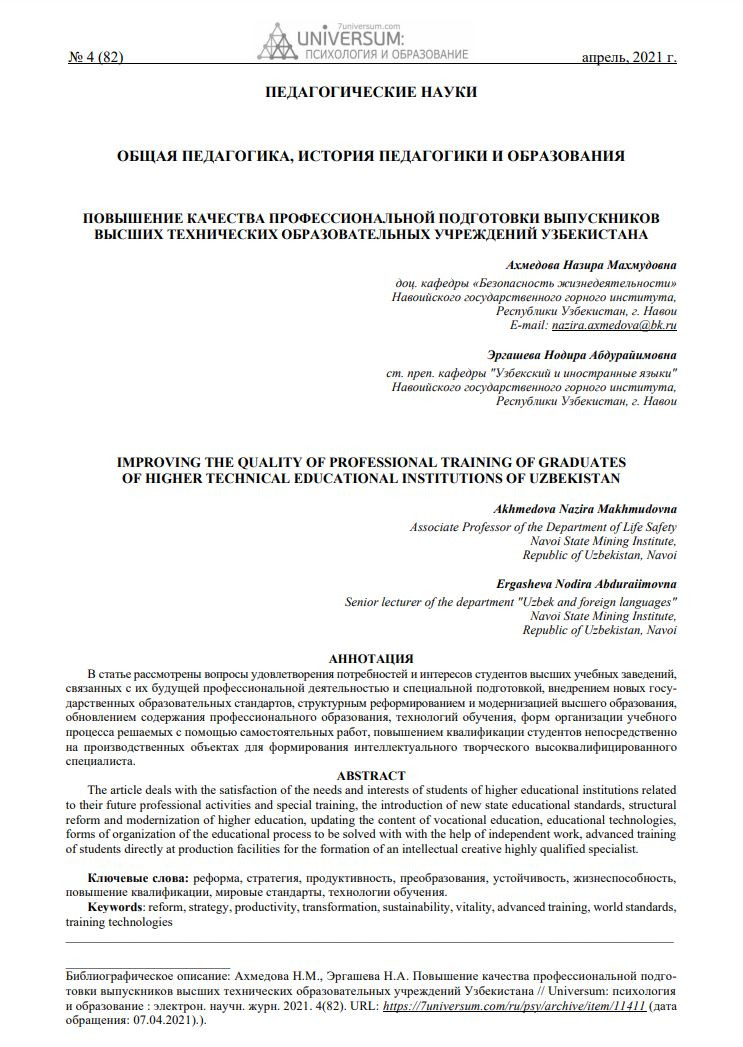 Improving the Quality of Professional Training of Graduates of Higher Technical Educational Institutions of Uzbekistan Année de publication: 2021 Auteur: Nazira Akhmedova | Nodira Ergasheva The article deals with the satisfaction of the needs and interests of students of higher educational institutions related to their future professional activities and special training, the introduction of new state educational standards, structural reform and modernization of higher education, updating the content of vocational education, educational technologies, forms of organization of the educational process to be solved with with the help of independent work, and advanced training of students. Повышение качества профессиональной подготовки выпускников высших технических образовательных учреждений Узбекистана Année de publication: 2021 Auteur: Nazira Akhmedova | Nodira Ergasheva В статье рассмотрены вопросы удовлетворения потребностей и интересов студентов высших учебных заведений, связанных с их будущей профессиональной деятельностью и специальной подготовкой, внедрением новых государственных образовательных стандартов, структурным реформированием и модернизацией высшего образования, обновлением содержания профессионального образования, технологий обучения, форм организации учебного процесса решаемых с помощью самостоятельных работ, повышением квалификации студентов непосредственно на производственных объектах для формирования интеллектуального творческого высоквалифицированного специалиста.
 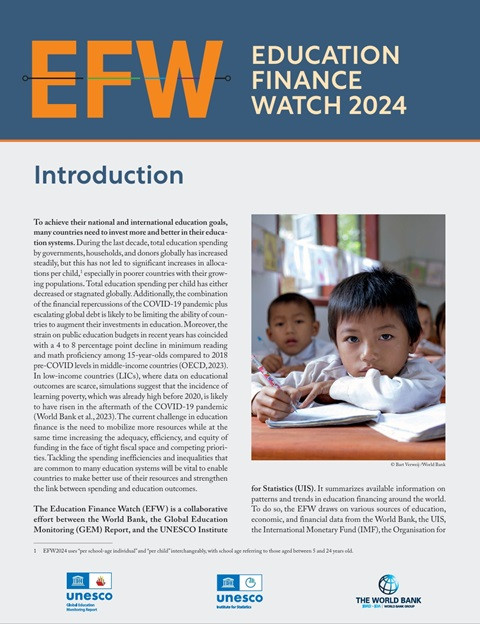 Education Finance Watch 2024 Année de publication: 2024 Auteur institutionnel: Global Education Monitoring Report Team | UNESCO Institute for Statistics (UIS) | World Bank The Education Finance Watch (EFW) is a collaborative effort between the World Bank, the GEM Report, and the UNESCO Institute for Statistics (UIS). The EFW aims to provide an analysis of trends, patterns, and issues in education financing around the world. The EFW uses various sources of education, economic, and financial data from the World Bank, UIS, the International Monetary Fund, and the Organization of Economic Co-operation and Development (OECD).
 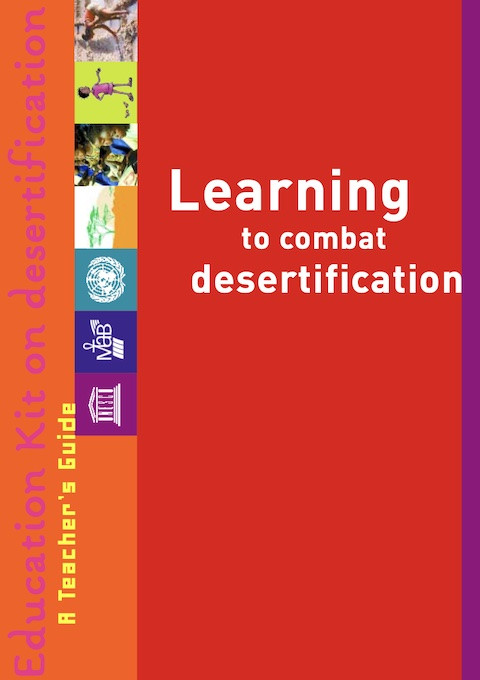 Education Kit on Combating Desertification: Learning to Combat Desertification; A Teacher’s Guide Année de publication: 2003 Auteur institutionnel: UNESCO The educational guide contained in this kit is addressed to teachers around the world living in areas affected by or under threat from desertification. For this reason, the guide should be seen as a general presentation to be adapted to the specific realities and preoccupations of each region or country. The guide begins with the different problems of desertification, which the teachers could integrate into lessons (fauna, flora, crop varieties or rearing, methods of land exploitation, socio-economic problems etc.). It presents the major objectives of the Convention and proposes several solutions to combat desertification. Kit pedagógico sobre la lucha contra la desertificación: Aprendiendo a luchar contra la desertificación; Guía educativa para el maestro Année de publication: 2003 Auteur institutionnel: Organización de las Naciones Unidas para la Educación, la Ciencia y la Cultura (UNESCO) La guía educativa contenida en este kit va dirigida a los maestros de todo el mundo que viven en zonas afectadas o amenazadas por la desertificación. Por tanto, ha de ser considerada como una presentación general que debe ser adaptada a las realidades y preocupaciones específicas de cada país o región. La guía comienza con la presentación de los diferentes problemas en torno a la desertificación (fauna, flora, tipos de cultivo, cría de animales, formas de explotación de la tierra, problemas socioeconómicos, etc.), los cuales pueden ser integrados en el transcurso de las clases. La guía presenta los principales objetivos de la Convención y propone una serie de soluciones para combatir la desertificación. Kit pédagogique sur la lutte contre la désertification: Apprendre à lutter contre la désertification; Guide éducatif pour l’enseignant Année de publication: 2003 Auteur institutionnel: Organisation des Nations Unies pour l'éducation, la science et la culture (UNESCO) Le guide éducatif contenu dans le kit s’adresse aux enseignants du monde entier vivant dans les zones affectées ou menacées par la désertification. Pour cette raison, le guide doit être perçu comme une présentation générale, à adapter aux réalités et aux préoccupations spécifiques de chaque pays ou région. L’ouvrage s’ouvre sur les différentes problématiques de la désertification, que les enseignants doivent intégrer (faune, flore, types de culture ou d’élevage, mode d’exploitation de la terre, problèmes socio-économiques, etc.) ; il présente ensuite les grands objectifs de la Convention et propose quelques solutions pour lutter contre la désertification.
 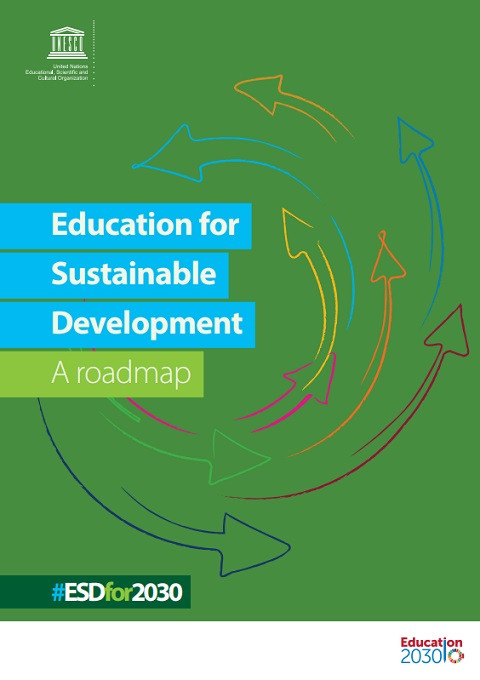 可持续发展教育: 路线图 Année de publication: 2022 Auteur institutionnel: 联合国教科文组织 (UNESCO) 本文是联合国教科文组织实施可持续发展教育所制定的路线图,旨在阐明地球面临的紧迫挑战,探讨教科文组 织通过教育应对这些挑战的下一步工作,并详细梳理新的侧重点和行动。
 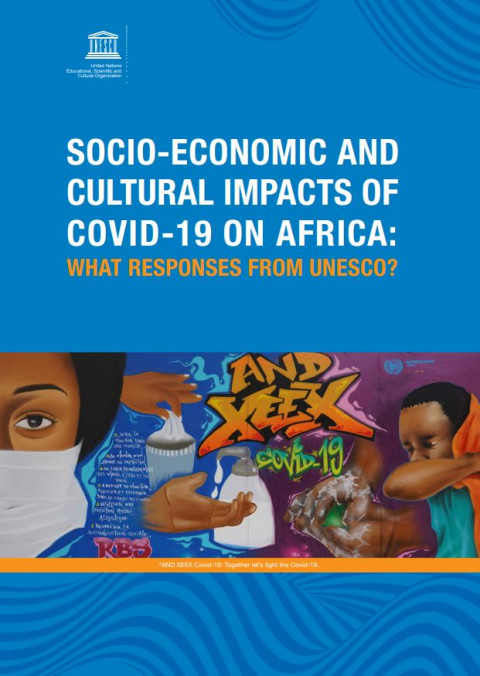 Socio-Economic and Cultural Impacts of COVID-19 on Africa: What Responses from UNESCO? Année de publication: 2020 Auteur institutionnel: UNESCO This policy paper analyses the socio-economic and cultural impacts of the disease on Africa as a whole, caused by both the immediate effects and the present and future consequences of the pandemic, including on the African societal fabric, which is likely to lead to a fracture in the trust between States and their citizens and within communities themselves. As such, it highlights the main measures that were adopted by African countries to contain the crisis and its socio-economic and cultural effects. While committing to acting and reflecting on the present and future consequences of the pandemic, UNESCO aims to contribute substantially to the ongoing debates in Africa through the development of a strategic response to help the collective global and regional efforts against the pandemic. Incidences socio-économiques et culturelles de la COVID-19 sur l'Afrique: quelles réponses de l'UNESCO?? Année de publication: 2020 Auteur institutionnel: Organisation des Nations Unies pour l'éducation, la science et la culture (UNESCO) Ce document de politique analyse les incidences socioéconomiques et culturelles de la maladie sur l’Afrique dans son ensemble, aussi bien par les effets immédiats que les conséquences présentes et futures de la pandémie, y compris sur le tissu sociétal africain, susceptible d’entraîner une fracture de la relation de confiance entre les États et leurs citoyens, et au sein des communautés elles-mêmes. Ce faisant, elle met en lumière les principales mesures adoptées par les pays africains pour juguler la crise et ses effets socio-économiques et culturelles. Tout en s’engageant dans l’action et dans la réflexion sur les conséquences présentes et futures de la pandémie, l’UNESCO entend ainsi contribuer de manière substantielle aux débats en cours en Afrique à travers en l’articulation d’une réponse stratégique pour apporter sa contribution aux efforts collectifs mondiaux et régionaux de lutte contre la pandémie.
  Culture | 2030 Indicators: Thematic Indicators for Culture in the 2030 Agenda Année de publication: 2019 Auteur institutionnel: UNESCO The Culture|2030 Indicators is a framework of thematic indicators whose purpose is to measure and monitor the progress of culture’s enabling contribution to the national and local implementation of the Goals and Targets of the 2030 Agenda for Sustainable Development (SDGs). The methodology is developed to assist countries and cities with very different capacities regarding the collection of data and cultural statistics. The evidence gathered will inform policies and decisions as well as operational actions enabling greater investments in culture as a sector of activity and a greater recognition of its transversal role across other sectors.