
Ressources
Explorez une large gamme de ressources sur le GCED afin d’approfondir votre compréhension et de renforcer vos activités de recherche, de plaidoyer, d’enseignement et d’apprentissage.
3,229 résultats trouvés
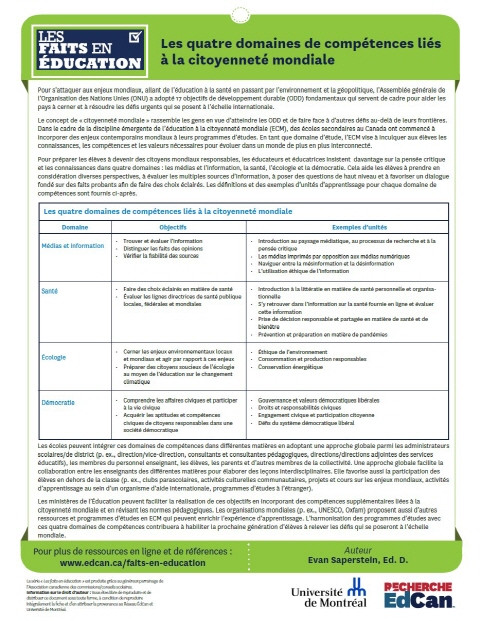 The Four Areas of Competence Linked to Global Citizenship Année de publication: 2023 Auteur: Evan Saperstein Auteur institutionnel: Université de Montréal | Association Canadienne d'Education Ce document présente les quatre domaines de compétences liées à la citoyenneté, et comment les intégrer à l'éducation des élèves. Pour préparer les élèves à devenir des citoyens mondiaux responsables, les éducateurs et éducatrices insistent davantage sur la pensée critique et les connaissances dans quatre domaines : les médias et l’information, la santé, l’écologie et la démocratie. This document presents the four areas of competency linked to citizenship, and how to integrate them into pupils' education. To prepare students to become responsible global citizens, educators are placing greater emphasis on critical thinking and knowledge in four areas: media and information, health, ecology and democracy. Les quatre domaines de compétences liés à la citoyenneté mondiale Année de publication: 2023 Auteur: Evan Saperstein Auteur institutionnel: Université de Montréal | Association Canadienne d'Education Ce document présente les quatre domaines de compétences liées à la citoyenneté, et comment les intégrer à l'éducation des élèves. Pour préparer les élèves à devenir des citoyens mondiaux responsables, les éducateurs et éducatrices insistent davantage sur la pensée critique et les connaissances dans quatre domaines : les médias et l’information, la santé, l’écologie et la démocratie. This document presents the four areas of competency linked to citizenship, and how to integrate them into pupils' education. To prepare students to become responsible global citizens, educators are placing greater emphasis on critical thinking and knowledge in four areas: media and information, health, ecology and democracy.
 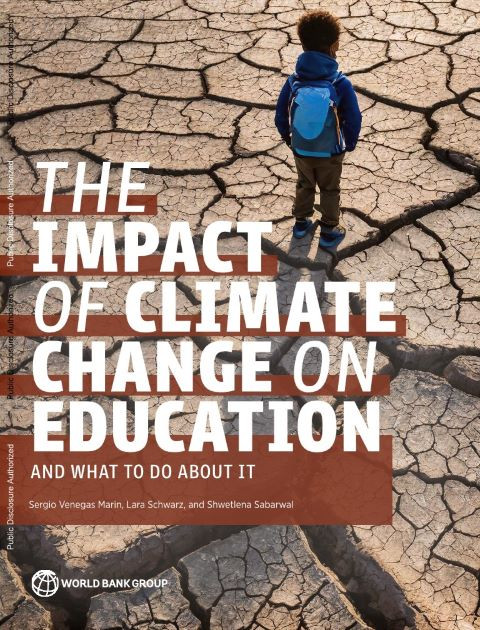 The Impact of Climate Change on Education and What to Do about It Année de publication: 2024 Auteur: Sergio Venegas Marin | Lara Schwarz | Shwetlena Sabarwal Auteur institutionnel: International Bank for Reconstruction and Development | World Bank Education can be the key to ending poverty in a livable planet, but governments must act now to protect it. Climate change is increasing the frequency and intensity of extreme weather events such as cyclones, floods, droughts, heatwaves and wildfires. These extreme weather events are in turn disrupting schooling; precipitating learning losses, dropouts, and long-term impacts. Even if the most drastic climate mitigation strategies were implemented, extreme weather events will continue to have detrimental impacts on education outcomes.
  Confronting Inequality through GCED: Toward Justice, Inclusion, and Transformation (SangSaeng; No.65, 2025) Année de publication: 2025 Auteur institutionnel: APCEIU The 62nd issue of SangSaeng has been published with the theme of “Ethical AI and GCED: Exploring the Expanding Domain of Artificial Intelligence.”AI has never been as pervasive and influential as it is in today’s rapidly changing world. Despite the convenience and cutting-edge technology AI has offered us, it has the potential to pose a threat to humanity. This is where ethics for AI should come forward. In this regard, this issue will lead readers to the alarming side of AI as well as its future developments, focusing on the importance of GCED and AI ethics in tackling any potential problems.Contents03 Editor's Note 04 Special ColumnEmbracing Change to Cultivate Success — Integrating Global Citizenship Education into Tertiary Education / Dendev Badarch08 FOCUS Ethical AI and GCED: Exploring the Expanding Domain of Artificial IntelligenceRole of Ethics in the Era of AI — Protecting and Guiding AI Processes for Humanity to Flourish / Emma Ruttkamp-BloemPayingAttention to AI Ethics — An Avenue for a New Competitive Edge in Business / Myoungshin KimDriving Innovative Education — Balancing Future Possibilities and Ethical Concerns: How GCED Can be Used to Address AI Issues / Angelique Southern 20 Special ReportEmpowering a Climate Generation — From Classrooms to Climate Frontlines : The Transformative Role of Education highlighted at COP28 / Djian Sadadou 22 Best PracticesNavigating an AI Future — Ethical AI and the Importance of Critical Thought / Hannah GrantGLACE Brings the World to a City — Empowering Youth as Global Citizens: Lessons from Navotas City’s Project GLAC / Marco D. MedurandaLowering Eco-Anxiety — Teaching Climate Change Through Media and Information Literacy / Laetitia Legrand 33 GCED YOUTH NETWORKNew Wave of Youth Advocacy — Role of AI in Youth Advocacy and its Ethical Implications to Global Citizenship / Oshan M. Gunathilake and Diego Manrique36 Understanding the Asia Pacific RegionDiscovering Auroville — Where Boundaries Fade, Nature Thrives, and Global Minds Unite / Akanksha Arya 39 Peace in My MemoryHappiness without Violence — Mindanao Peace Forum Celebrates Building a Culture of Peace / Ludivina Borja-DekitPeace Scholar Passes Away Amidst Turbulent Times / Kwang-Hyun KIM 45 Story TimeThe Right Footing — My Life Has Purpose Thanks to Football / Hajar Abulfazl 48 LetterShared Challenges of Global Citizens / Natsuki Nagata 50 APCEIU in Action
  Making the Case For Inclusive Quality Physical Education Policy Development: A Policy Brief Année de publication: 2021 Auteur: Nancy McLennan Auteur institutionnel: UNESCO This evidence-based policy brief presents the benefits of investing in inclusive quality physical education (QPE) policy development. Content draws directly on findings from in-country interventions which demonstrate the value of inter-sectoral partnerships in QPE policy development and the delivery of low cost/high impact QPE programming which stands to accelerate post-COVID recovery efforts. A series of practical recommendations are included for public and private stakeholders in the sport-education ecosystem, alongside resources to support the implementation of recommendations. S’engager en faveur de l’élaboration inclusive de politiques d’éducation physique de qualité: Note de politique Année de publication: 2021 Auteur: Nancy McLennan Auteur institutionnel: Organisation des Nations Unies pour l'éducation, la science et la culture (UNESCO) Cette note de politique, fondée sur des faits, présente les avantages à investir dans l’élaboration inclusive de politiques d’Éducation Physique de Qualité (EPQ). Le contenu s’inspire directement des résultats issus d’interventions menées dans quatre pays, qui démontrent l’intérêt des partenariats intersectoriels dans le développement des politiques d’EPQ et de la mise en œuvre de programmes d’EPQ à faible coût/à fort impact qui devraient accélérer les efforts de rétablissement post-COVID. Cette note contient une sélection de recommandations pratiques à destination des acteurs publics et privés de l’écosystème sport-éducation, ainsi que des ressources pour soutenir la mise en œuvre de ces recommandations. En defensa de un desarrollo inclusivo de políticas de educación física de calidad: Informe de políticas Année de publication: 2021 Auteur: Nancy McLennan Auteur institutionnel: Organización de las Naciones Unidas para la Educación, la Ciencia y la Cultura (UNESCO) Este informe presenta los beneficios de la inversión en el desarrollo de políticas inclusivas de educación física de calidad (EFC). Su contenido se funda directamente en evidencias observadas durante intervenciones en países que demuestran la importancia de las asociaciones intersectoriales en el desarrollo de políticas de EFC y en la ejecución de programas de EFC de bajo costo y alto impacto que ayudarán a agilizar los esfuerzos de recuperación tras la COVID. Se incluye una serie de recomendaciones para socios de los sectores público y privado en el ecosistema deportivo – educativo, así como también recursos para apoyar la aplicación de las recomendaciones.
  Political Leadership for Sustainable Development: Why Do the Global Goals Matter to Local Councillors, and Why Do Local Councillors Matter for the Global Goals?; Training Manual Année de publication: 2021 Auteur: Maeve Bateman | Jihyun Kim Auteur institutionnel: Irish Development Education Association (IDEA) | Bridge 47 Our Bridge 47 Consortium Member, IDEA, partnered with Women for Election, a not-for-profit, non-partisan organisation which trains and supports women in Ireland to run for politics.In 2019 and 2020 this partnership developed and delivered training programmes for women Councillors on ‘Political Leadership for Sustainable Development: Why Do the Global Goals Matter to Local Councillors, and Why Do Local Councillors Matter for the Global Goals?’This training manual is to provide guidelines for any civil society organisations that would like to engage with local politicians on how to inspire, support and equip them as leaders for sustainable development who are ready to participate in and implement the localisation of the Sustainable Development Goals.
 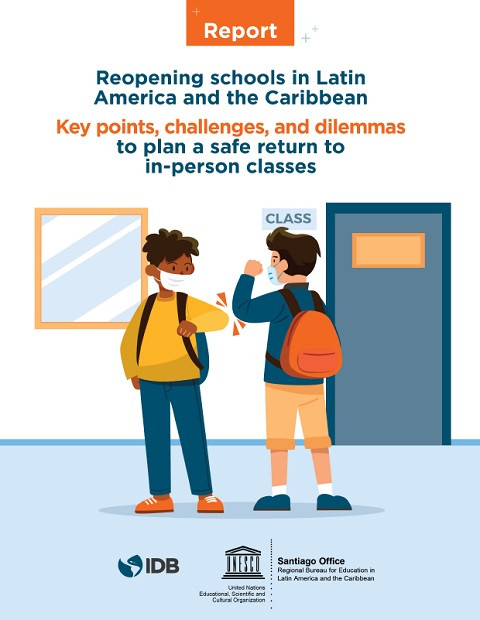 Reopening Schools in Latin America and the Caribbean: Keys, Challenges, and Dilemmas to Plan for a Safe Return to in-Person Classes Année de publication: 2021 Auteur: Alejandro Vera | Martín Scasso | Alejandro Morduchowicz | Cecilia Berlanga Alessio Robles Auteur institutionnel: UNESCO Santiago | Inter-American Development Bank The suspension of in-person classes as a consequence of the COVID-19 pandemic profoundly affected the education systems in Latin America and the Caribbean (LAC) and compromised the achievements reached around the goals established in the SDG4-Education 2030 Agenda. The most vulnerable people have been the most affected by this situation, which widened the preexisting gaps. The countries of the region have carried out great efforts to guarantee the continuity of learning. However, these have been limited by the challenges that this unprecedented crisis brought, aggravated by unequal conditions in access to infrastructure and other resources that affect broad sectors of the population.This report analyzes the possibilities, restrictions and needs that the countries of the region will face during the process of returning to in-person classes, considering five dimensions: (i) safe schools (school infrastructure, access to water and sanitation); (ii) human resources (principals and teachers); (iii) access to ITC and connectivity; (iv) education financing and (v) information and planning. Reabrir las escuelas en América Latina y el Caribe: Claves, desafíos y dilemas para planificar el retorono seguro a las clases presenciales; Reporte Année de publication: 2021 Auteur: Alejandro Vera | Martín Scasso | Alejandro Morduchowicz | Cecilia Berlanga Alessio Robles Auteur institutionnel: Organización de las Naciones Unidas para la Educación, la Ciencia y la Cultura (UNESCO) La suspensión de clases presenciales como consecuencia de la pandemia de COVID-19 afectó profundamente los sistemas educativos de América Latina y el Caribe, y puso en riesgo los avances alcanzados en torno al cumplimiento de las metas establecidas en la Agenda ODS 4-Educación 2030. Las poblaciones más vulnerables se han visto más afectadas por esta situación, lo cual acrecentó las brechas preexistentes. Los países de la región llevaron a cabo enormes esfuerzos para garantizar la continuidad de los aprendizajes. Sin embargo, se ven limitados por los desafíos que presenta este contexto inédito de crisis y agravados por las desiguales condiciones de acceso a infraestructura y otros recursos que afectan a vastos sectores de la población.El reporte analiza las posibilidades, restricciones y necesidades que enfrentarán los países de la región durante el proceso del regreso a las clases presenciales, considerando cinco dimensiones: (i) escuelas seguras (infraestructura escolar, acceso al agua y saneamiento); (ii) recursos humanos (directores y docentes); (iii) acceso a TIC y conectividad, (iv) financiamiento de la educación y (v) información y planificación.