
Ressources
Explorez une large gamme de ressources sur le GCED afin d’approfondir votre compréhension et de renforcer vos activités de recherche, de plaidoyer, d’enseignement et d’apprentissage.
3,380 résultats trouvés
 Un nuevo contrato social para la educación: promover un paradigma de interconexión relacional y los conocimientos Année de publication: 2023 Auteur: Elena Toukan Auteur institutionnel: UNESCO En el presente artículo se examinan los recientes llamamientos a “un nuevo contrato social para la educación” a través de la lente de una ontología relacional para la humanidad y un planeta vivo. Mediante una visión crítica de la teoría del contrato social, el artículo examina cómo este llamamiento puede ser un punto de partida hacia un cambio paradigmático más profundo a la hora de enmarcar cuestiones de justicia, organización social y la propia educación. Propone pasar de un modelo transaccional basado en normas a un modelo basado en relaciones y fundamentado en la comprensión y la apreciación de la interdependencia y la interconexión. Con miras a forjar futuros más justos y sostenibles para la humanidad y el planeta, el nuevo contrato social para la educación deberá trascender las dinámicas sociales atomistas, transaccionales y de confrontación y organizarse en torno a la interconexión relacional. Un nouveau contrat social pour l’éducation : promouvoir un paradigme d’interconnexion relationnelle Année de publication: 2023 Auteur: Elena Toukan Auteur institutionnel: UNESCO Le présent article examine les récents appels en faveur d’un « nouveau contrat social pour l’éducation » à travers le prisme d’une ontologie relationnelle au service de l’humanité et d’une planète vivante. Il se penche, en portant un regard critique sur la théorie du contrat social, sur la façon dont ces appels peuvent amorcer un changement de paradigme plus profond en ce qui concerne la façon d’aborder les questions de justice, d’organisation sociale et d’éducation. Il propose de passer d’un modèle transactionnel fondé sur les règles à un modèle relationnel qui repose sur la compréhension et la valorisation de l’interdépendance et de l’interconnexion. Afin de façonner des futurs plus justes et plus durables pour l’humanité et la planète, le nouveau contrat social pour l’éducation devra dépasser les dynamiques sociales atomistes, transactionnelles et antagonistes et se structurer autour de l’interconnexion relationnelle.
 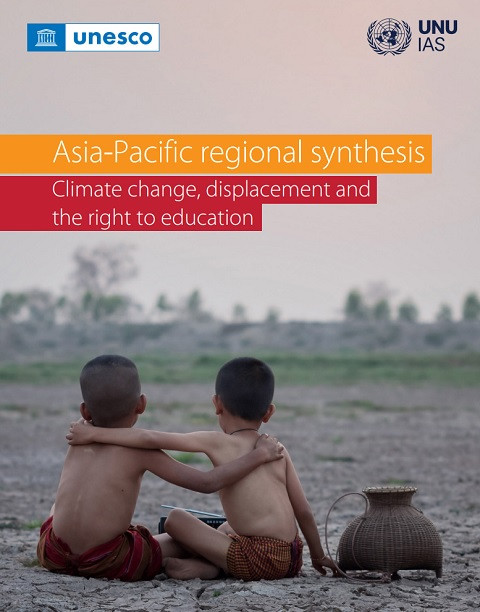 Asia-Pacific Regional Synthesis: Climate Change, Displacement and the Right to Education Année de publication: 2023 Auteur institutionnel: UNESCO | United Nations University Institute for the Advanced Study of Sustainability (UNU-IAS) | UNESCO Bangkok In 2020, 30.7 million people were displaced by natural disasters – disasters which the scientific community acknowledges are more frequent and more intense as a result of climate change. In Asia and the Pacific alone, 21.3 million people were displaced, making it the region the most impacted by national disasters and climate change in the world. Therefore, country case studies were carried out in Bangladesh, India, Indonesia, Tuvalu, and Viet Nam to examine not only specific vulnerabilities to climate change and related mobility, but also the impacts of climate change on the right to education in Asia and the Pacific. These case studies show that climate change directly threatens education – through the destruction of schools and property – but also indirectly puts education in peril by forcing people to cross borders, ensuring neither legal residency nor the right to education. This regional synthesis report aims to guide policy-makers through providing operational policy recommendations on how to ensure education is protected in Asia and the Pacific in the face of climate change and displacement from a human rights-based approach. The report is one of four being developed and will contribute to the global initiative on climate change and displacement and the right to education – launched by UNESCO in 2020 – by informing the development of a Global Report with global policyrecommendations.How climate change impacts the right to education in Asia and the Pacific21.3million displacementstook place in Asia and the Pacific
  Good Practices in South-South and Triangular Cooperation: Transforming Education and Delivering on SDG 4 Année de publication: 2023 Auteur institutionnel: UNESCO | United Nations Children's Fund (UNICEF) | UN. Office for South-South Cooperation (UNOSSC) Quality Education: South-South cooperation as a lever for action. This publication showcases 40 innovative solutions on how South-South and Triangular Cooperation can transform education.South-South and triangular cooperation is at the heart of SDG4 implementation on Quality Education. As demonstrated in the last few years, this kind of cooperation can mobilize action, ambition, solidarity and solutions to transform education in a rapidly changing world. From the inclusive approach to digital learning in Lao People’s Democratic Republic to distance learning and teacher training strategies in Caribbean SIDS, South-South cooperation is a key modality of cooperation for transforming education and supporting internationally agreed development goals, including the 2030 Agenda. This publication showcases 40 innovative solutions on how South-South and Triangular Cooperation can transform education.This publication presents forty innovative solutions from around the world which showcase how South-South and triangular cooperation can support the development of more efficient, equitable and resilient education systems that are adapted to the challenges of the 21st century. Countries of the South, with the support of partners, must enhance South-South and triangular cooperation to exchange resources, technology, skills and knowledge to realize the promise of making inclusive, quality education available to all.
  Manuel de formation mondial: l'IA et l'état de droit pour le pouvoir judiciaire Année de publication: 2023 Auteur: Miriam Stankovich | Ivana Feldfeber | Yasmín Quiroga | Marianela Ciolfi Felice | Vukosi Marivate Auteur institutionnel: UNESCO Qu'est-ce que l'intelligence artificielle (IA) ? Comment ça marche ? Et plus important encore, comment trouve-t-elle sa place dans un contexte judiciaire ? Des technologies telles que l'IA existent depuis des décennies, mais elles n’ont commencé à être utilisées dans divers cadres judiciaires et exécutifs que très récemment. Bien que l'IA ait un immense potentiel pour le système judiciaire, pour aider les juges à prendre de meilleures décisions, améliorer leur efficacité, l'accessiblité, et pour aider à détecter et à prévenir la criminalité, elle soulève également des questions importantes parmi les acteurs judiciaires, alors qu'ils se préparent à un avenir où l'IA sera de plus en plus utilisée dans les systèmes judiciaires. En 2022, l'UNESCO a lancé deux évaluations des besoins. Tout d'abord, dans le cadre de l'enquête de l'UNESCO sur l'évaluation des besoins en matière d'intelligence artificielle en Afrique, 90 % des 32 pays interrogés ont demandé un soutien au renforcement des capacités du pouvoir judiciaire en matière d'IA. Dans le même temps, une deuxième enquête mondiale sur les acteurs judiciaires dans 100 pays a mis en avant la nécessité de mieux comprendre l'utilisation de l'IA dans l'administration de la justice et ses implications juridiques plus larges sur les sociétés. Cet ouvrage, « Manuel de formation mondial : l'IA et l'état de droit pour le pouvoir judiciaire », répond à ces besoins et fournit aux acteurs judiciaires (juges, procureurs, avocats, juristes, facultés de droit et établissements de formation judiciaire) les connaissances et les outils nécessaires pour comprendre les avantages et les risques de l'IA dans leur travail. Ce manuel de formation aidera les acteurs judiciaires à atténuer les risques potentiels de l'IA pour les droits humains en fournissant des conseils sur les lois, principes, règles et jurisprudences internationales pertinents en matière de droits humains qui sous-tendent l'utilisation éthique de l'IA.
 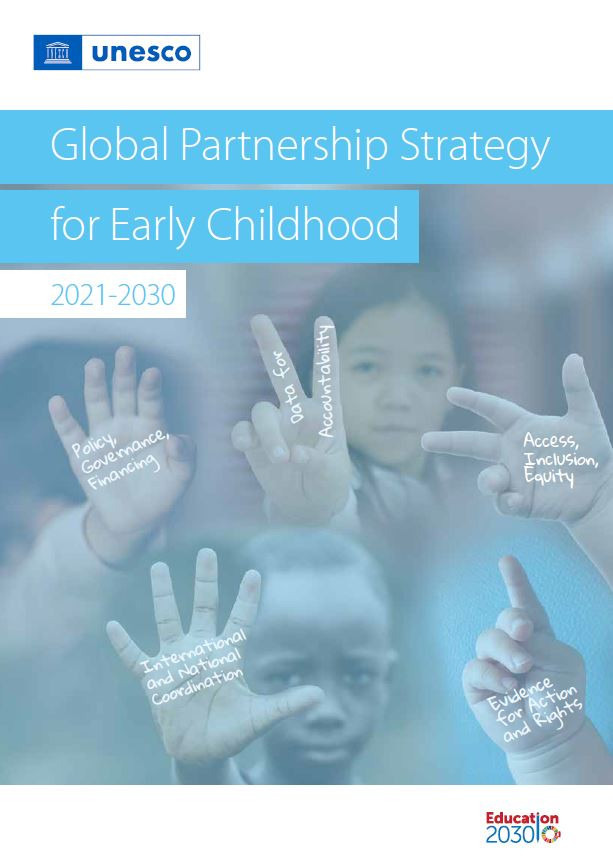 Global Partnership Strategy for Early Childhood, 2021-2030 Année de publication: 2022 Auteur institutionnel: UNESCO The Global Partnership Strategy for early childhood is the result of inter-agency efforts to counter the negative trend in education and to overcome the reduction and closure of services for health, nutrition, sanitation, and child protection in all regions of the world during the COVID-19 pandemic. Well-designed and implemented policies and services for early childhood care, education and development enable all countries to protect and guarantee child rights, achieve high rates of return on their investments in child and family development and widen avenues for transforming societies and lives. Stratégie de partenariat mondial pour la petite enfance, 2021-2030 Année de publication: 2022 Auteur institutionnel: Organisation des Nations Unies pour l'éducation, la science et la culture (UNESCO) La Stratégie de Partenariat mondial pour la petite enfance est le résultat des efforts interagences pour contrer la tendance négative dans l’éducation et pour surmonter la réduction et la fermeture des services de santé, de nutrition, d’assainissement et de protection de l’enfance dans toutes les régions du monde pendant la pandémie de COVID-19. Des politiques et des services bien conçus et mis en oeuvre pour la protection, l’éducation et le développement de la petite enfance permettent à tous les pays de protéger et de garantir les droits de l’enfant, d’obtenir des taux de rendement élevés sur leurs investissements dans le développement de l’enfant et de la famille et d’élargir les possibilités de transformation des sociétés et des vies.
  اﻟﺘﺼﺪي ﻟﺨﻄﺎب اﻟﻜﺮاﻫﻴﺔ: ﻫﻞ اﻟﺘﻌﻠﻴﻢ ﻫﻮ اﻟﺤﻞ؟ Année de publication: 2022 Auteur: Nicole Fournier-Sylvester Auteur institutionnel: UNESCO | UN. Office on Genocide Prevention and the Responsibility to Protect هذه الورقة جزء من مجموعة أوراق المناقشة ، التي تمّ إعدادها بتكليف من اليونسكو ومكتب الأمم المتحدة للمستشار الخاص وتعتبر الأوراق مساهمة ، )OSAPG( المعني بمنع الإبادة الجماعية مباشرة في استراتيجية وخطة عمل الأمم المتحدة. في سياق منتدى أصحاب المصلحة المتعددين والمؤتمر الوزاري المعني بمعالجة خطابالكراهية من خلال التعليم في سبتمبر وأكتوبر 2021.وقد سلط تفشي جائحة كوفيد- 19 الضوء على أهمية استراتيجية وخطة عمل الأمم المتحدة ، مما أدى إلى ظهور موجة من خطاب الكراهية في جميع أنحاء العالم - مما يؤدي إلى تفاقم التعصب والتمييز تجاه مجموعات معينة وزعزعة استقرار المجتمعات والأنظمة السياسية. تسعى أوراق المناقشة إلى تفريغ القضايا الرئيسية المتعلقةبهذا التحدي العالمي واقتراح الاستجابات والتوصيات الممكنة. Addressing Hate Speech: Educational Responses Année de publication: 2022 Auteur: Nicole Fournier-Sylvester Auteur institutionnel: UNESCO | UN. Office on Genocide Prevention and the Responsibility to Protect This paper is part of a collection of discussion papers, commissioned and produced by UNESCO and the United Nations Office of the Special Adviser on the Prevention of Genocide (OSAPG).The papers are a direct contribution to the United Nations Strategy and Plan of Action and are published in the context of the Multistakeholder Forum and Ministerial Conference on Addressing Hate Speech through Education in September and October 2021.The outbreak of the COVID-19 pandemic has highlighted the pertinence of the United Nations Strategy and Plan of Action, generating a wave of hate speech across the world –further exacerbating intolerance and discrimination towards particular groups and destabilizing societies and political systems. The discussion papers seek to unpack key issues related to this global challenge and propose possible responses and recommendations. Afrontar el discurso de odio: respuestas educativas Année de publication: 2022 Auteur: Nicole Fournier-Sylvester Auteur institutionnel: UNESCO | UN. Office on Genocide Prevention and the Responsibility to Protect Este documento forma parte de una colección de documentos de discusión, encargados y producidos por la UNESCO y la Oficina del Asesor Especial para la Prevención del Genocidio de las Naciones Unidas (OSAPG). Los documentos son una contribución directa a la Estrategia y el Plan de Acción de las Naciones Unidas y se publican en el contexto del Foro Multilateral y la Conferencia Ministerial sobre Combatir los discursos de odio a través de la educación en septiembre y octubre de 2021.El estallido de la pandemia del COVID-19 ha puesto de manifiesto la pertinencia de la Estrategia y el Plan de Acción de las Naciones Unidas, generando una ola de discursos de odio en todo el mundo, exacerbando aún más la intolerancia y la discriminación hacia determinados grupos y desestabilizando las sociedades y los sistemas políticos. Los documentos de discusión tratan de desentrañar las cuestiones clave relacionadas con este reto mundial y proponer posibles respuestas y recomendaciones.