
Ressources
Explorez une large gamme de ressources sur le GCED afin d’approfondir votre compréhension et de renforcer vos activités de recherche, de plaidoyer, d’enseignement et d’apprentissage.
3,229 résultats trouvés
 أصداء، التنوع الثقافي: طريق نحو تحقيق التنمية؛ الذكرى السنوية العاشرة لإعتماد الإعلان العالمي لليونسكو بشأن التنوع الثقافي Année de publication: 2011 Auteur institutionnel: منظمة الأمم المتحدة للتربية والعلم والثقافة (UNESCO) This founding text was the first to acknowledge cultural diversity as “the common heritage of humanity”. It is with great pride that UNESCO is commemorating the 10th anniversary of the Declaration. Commemorate – from the Latin cum memorare – means quite literally “to remember together” or “to remember with”. This collection is compiled the voices of all those who have contributed to the heightening of human awareness by throwing into relief the inestimable value of cultural diversity. These excerpts from books, articles and statements by global intellectual and political leaders, artists and Nobel Prize-winners all call for the safeguarding of cultural diversity, which is inseparable from respect for human dignity. Their voices resound in bearing witness to the strength of cultural diversity and to its capacity to enlighten the minds of women and men. We are duty-bound to ensure that it is central to public policies and a resource for development and dialogue among nations. The United Nations was born of the determination of men and women “to save succeeding generations from the scourge of war...”. In accordance with that principle, UNESCO was established on a key idea, expressed at the very beginning of its Constitution: “... since wars begin in the minds of men, it is in the minds of men that the defences of peace must be constructed”. In the world today, globalized, connected and interdependent as never before, this mission is more vital than ever. The rapprochement of peoples and cultures requires a commensurately global awareness. Cultural diversity has always been at the heart of international relations. It is also, increasingly, a feature of the contemporary mixed and plural societies in which we live. In view of this reality, we must formulate appropriate public policies and rethink the mechanisms of social cohesion and civic participation. How can we build common ground on the basis of such diversity? How can we construct genuine moral and intellectual solidarity of humanity? Any new vision of humanism must be grounded itself in the dynamism and diversity of cultural heritage. It is a source of inspiration and knowledge to be shared and a means of broadening our horizons. The goal of the UNESCO Universal Declaration on Cultural Diversity is to provide keys and benchmarks for capitalizing on this wealth. There can be no sustainable governance if cultural diversity is not acknowledged. There can be no economic and social development if specific features of every culture are belittled and ignored. Envisioning education beyond 2015: Asia-Pacific regional perspectives; final report Année de publication: 2014 Auteur institutionnel: UNESCO Bangkok This report provides a thorough account of the discussions and deliberations that led to the construction of the Asia-Pacific Statement on Education Beyond 2015 (Bangkok Statement), the outcome document of this historic event. Participants reviewed in fine detail EFA progress across the Asia-Pacific region and debated key thematic areas of basic education, skills and competencies, global citizenship education, education for sustainable development, teachers, governance and finance. Participants also looked into implementation strategies, and education ministers from across the region shared their views on remaining challenges, future priorities and strategies for education beyond 2015. Envisager l'éducation au-delà de 2015: Perspectives Régionales Asie-Pacifique; rapport final Année de publication: 2014 Auteur institutionnel: UNESCO Bangkok Ce rapport fournit un compte rendu détaillé des discussions et délibérations qui ont conduit à la construction de la Déclaration de l'Asie-Pacifique sur l'éducation Au-delà de 2015 (Déclaration de Bangkok), le document final de cet événement historique. Les participants ont examiné en cours détail EPT bien dans toute la région Asie-Pacifique et ont débattu des domaines thématiques clés de l'éducation de base, les compétences et les compétences, l'éducation à la citoyenneté mondiale, l'éducation pour le développement durable, les enseignants, la gouvernance et les finances. Les participants ont également examiné les stratégies de mise en œuvre, et les ministres de l'éducation de toute la région ont partagé leurs points de vue sur les défis restant à relever, des priorités et des stratégies futures pour l'éducation au-delà de 2015. Inclusión, educación para el desarrollo sostenible, aprendizaje de adultos, educación superior e investigación: cuatro conferencias internacionales para promover la equidad, la calidad, la pertinencia y la responsabilidad social en materia de educación Année de publication: 2008 Auteur institutionnel: Organización de las Naciones Unidas para la Educación, la Ciencia y la Cultura (UNESCO) This cycle of conferences brings together a wide array of influential stakeholders in the common interest of creating education systems that serve the needs of all learners, address the challenges of today's world and make learning a springboard of development. Inclusion, éducation pour le développement durable, éducation des adultes, enseignement supérieur et recherche: quatre conférences internationales pour promouvoir l'équité, la qualité, la pertinence et la responsabilité sociale en matière d'éducation Année de publication: 2008 Auteur institutionnel: Organisation des Nations Unies pour l'éducation, la science et la culture (UNESCO) This cycle of conferences brings together a wide array of influential stakeholders in the common interest of creating education systems that serve the needs of all learners, address the challenges of today's world and make learning a springboard of development. Inclusion, education for sustainable development, adult learning, higher education and research: four international conferences to promote equity, quality, relevance and social responsibility in education Année de publication: 2008 Auteur institutionnel: UNESCO This cycle of conferences brings together a wide array of influential stakeholders in the common interest of creating education systems that serve the needs of all learners, address the challenges of today's world and make learning a springboard of development.
 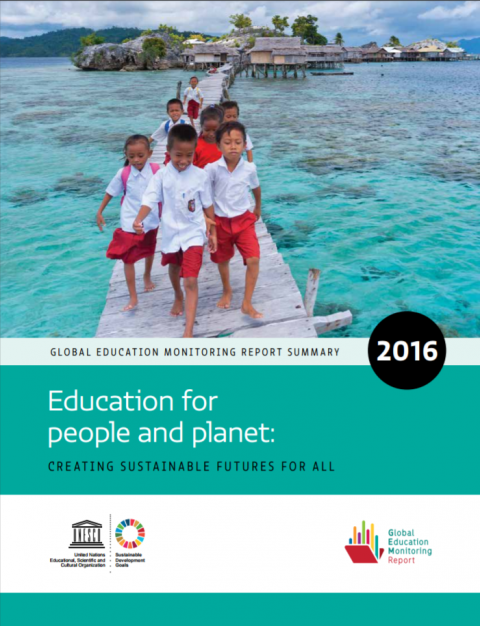 L'Education pour les peuples et la planète: créer des avenirs durables pour tous, résumé du rapport mondial de suivi sur l'éducation, 2016 Année de publication: 2016 Auteur institutionnel: Organisation des Nations Unies pour l'éducation, la science et la culture (UNESCO) The GEM Report provides an authoritative account of how education is the most vital input for every dimension of sustainable development. Better education leads to greater prosperity, improved agriculture, better health outcomes, less violence, more gender equality, higher social capital and an improved natural environment. Education is key to helping people around the world understand why sustainable development is such a vital concept for our common future. Education gives us the key tools – economic, social, technological, even ethical – to take on the SDGs and to achieve them. These facts are spelled out in exquisite and unusual detail throughout the report. Yet the report also emphasizes the remarkable gaps between where the world stands today on education and where it has promised to arrive as of 2030. [Summary] Education for People and Planet: Creating sustainable Futures for All, Global Education Monitoring Report, 2016; Summary Année de publication: 2016 Auteur institutionnel: UNESCO Education for People and Planet: Creating Sustainable Futures for All explores the complex relationship between education and the new 2030 Agenda for Sustainable Development, covering six fundamental pillars – Planet, Prosperity, People, Peace, Place and Partnerships. This report shows that education will not deliver its full potential unless participation rates increase dramatically and sustainable development guides education system reform. It also warns of the destructive impact that climate change, conflict, unsustainable consumption and the increasing gap between rich and poor have on education. A huge transformation is needed if we are to create sustainable futures for all.
 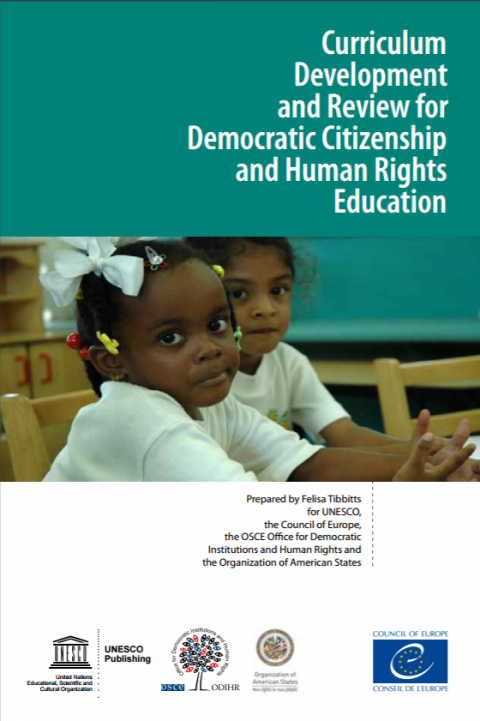 Curriculum Development and Review for Democratic Citizenship and Human Rights Education Année de publication: 2016 Auteur institutionnel: UNESCO | Council of Europe | Organization of American States (OAS) | OSCE. Office for Democratic Institutions and Human Rights (ODIHR) Education for democratic citizenship and human rights education are vital for peaceful, sustainable and inclusive societies based on respect for the human rights of every person. Effective teaching and learning processes require well-trained teachers, positive learning environments and high-quality learning materials. This is underpinned by education policy, including curriculum development and review, which is the main focus of this book. The strengthening of education policies in the fields of education for democratic citizenship and human rights lies at the very heart of the efforts of the Council of Europe, the United Nations Educational, Scientific and Cultural Organization, the Office for Democratic Institutions and Human Rights of the Organization for Security and Co-operation in Europe, and the Organization of American States. These organisations have jointly produced this publication in order to support states’ commitment to fostering citizenship and human rights education and improving access to quality education for all. Élaboration et révision des programmes d'enseignement pour l'éducation à la citoyenneté démocratique et aux droits de l'homme Année de publication: 2016 Auteur institutionnel: Organisation des Nations Unies pour l'éducation, la science et la culture (UNESCO) | Conseil de l'Europe | Organization of American States (OAS) | OSCE. Office for Democratic Institutions and Human Rights (ODIHR) Education for democratic citizenship and human rights education are vital for peaceful, sustainable and inclusive societies based on respect for the human rights of every person. Effective teaching and learning processes require well-trained teachers, positive learning environments and high-quality learning materials. This is underpinned by education policy, including curriculum development and review, which is the main focus of this book. The strengthening of education policies in the fields of education for democratic citizenship and human rights lies at the very heart of the efforts of the Council of Europe, the United Nations Educational, Scientific and Cultural Organization, the Office for Democratic Institutions and Human Rights of the Organization for Security and Co-operation in Europe, and the Organization of American States. These organisations have jointly produced this publication in order to support states’ commitment to fostering citizenship and human rights education and improving access to quality education for all.