
Ressources
Explorez une large gamme de ressources sur le GCED afin d’approfondir votre compréhension et de renforcer vos activités de recherche, de plaidoyer, d’enseignement et d’apprentissage.
3,224 résultats trouvés
 Global Education Monitoring Report 2024: Gender Report; Technology on Her Terms Année de publication: 2024 Auteur institutionnel: UNESCO | Global Education Monitoring Report Team The 2024 Gender Report tells the increasingly positive story of girls’ education access, attainment and achievement, which is helping reverse decades of discrimination. But there is much more to say on gender equality in and through education. A companion to the 2023 GEM Report, this report looks at the interaction between education and technology with a gender lens. First, it looks at the impact of technology on girls’ education opportunities and outcomes. Although many instances are seen of radio, television and mobile phones providing a learning lifeline for girls, particularly in crisis contexts, gender divides exist globally in both access to technology and in digital skills, although the latter are smaller among youth compared to among adults. Biased social and cultural norms inhibit equitable access to and engagement with technology in and outside of school, with girls always left on the wrong side of the divide. While technology offers many girls opportunities to access important education content in safe environments, for instance on comprehensive sexuality education, technology in practice often exacerbates negative gender norms or stereotypes. Social media usage impacts learners’ and particularly girls’ well-being and self-esteem. The ease with which cyberbullying can be magnified through the use of online devices in the school environment is a cause of concern, as is the biased design of artificial intelligence algorithms. Second, the report looks into the role of education on the shape of future technological development. It shows that women struggle to pursue STEM careers, which manifests from an early age in the form of anxiety in mathematics and develops into a reluctance to study STEM subjects, ultimately resulting in a lack of women in the technology workforce. Women make up only 35% STEM graduates, and hold only a quarter of science, engineering and ICT jobs. Ensuring women participate on equal terms in shaping the world’s ongoing digital transformation will ensure that technology works for everyone and takes into consideration the needs of all humanity.
  Can African Countries Afford Their National SDG 4 Benchmarks? Année de publication: 2024 Auteur institutionnel: UNESCO | Global Education Monitoring Report Team This brief paper follows the broad methodological approach of the two previous SDG 4 costing exercises and their main assumptions (UNESCO, 2015a; UNESCO, 2020). It introduces the SDG 4 benchmarking process and how to estimate the cost of achieving these targets set by countries, largely based on their sector plans. Finally, it presents the revised assumptions of the model and the key findings. Despite lowering ambition, there is still an average national financing gap of USD 78 billion per year in the 44 low- and lower-middle-income countries in Africa.
  Global Education Meeting: Fortaleza Declaration; Unlocking the Transformative Power of Education for Peaceful, Equitable and Sustainable Futures Année de publication: 2024 Auteur institutionnel: UNESCO | Brazil. Ministry of Education The 2024 Global Education Meeting (GEM), held in Fortaleza, Brazil, marked a significant milestone in the global pursuit of education equity and financing, with the adoption of the powerful Fortaleza Declaration by over 650 participants including over 50 Ministers from across the globe. Reunión mundial sobre la educación: Declaración de Fortaleza; Aprovechar el poder transformador de la educación para forjar futuros pacíficos, equitativos y sostenibles Année de publication: 2024 Auteur institutionnel: UNESCO | Brazil. Ministry of Education Este documento recoge la declaración de los ministros, los jefes y los miembros de las delegaciones nacionales, los representantes de los organismos de las Naciones Unidas, los asociados humanitarios y para el desarrollo, las organizaciones internacionales y regionales, las organizaciones de la sociedad civil, la profesión docente, los jóvenes y los estudiantes, el sector privado y las fundaciones, a partir de su participación en la Reunión Global sobre Educación (GEM) 2024, llevada a cabo los días 31 de octubre y 1° de noviembre. Esta reunión, organizada por la UNESCO y con sede en Brasil, tuvo el propósito de trazar la ruta para que la educación sea la prioridad de las naciones, las regiones y el mundo como un elemento clave para alcanzar todos los ODS, adoptando un enfoque integrado y de aprendizaje permanente, centrado en el fortalecimiento y la transformación de la educación.
  Youth Report 2024: Technology in Education; A Tool on Our Terms! Année de publication: 2024 Auteur institutionnel: UNESCO | Global Education Monitoring Report Team | Restless Development The 2024 Youth Report on technology in education is the result of an extensive consultation process in partnership with Restless Development involving +1500 youth and students across 8 regions. The consultations invited participants to reflect on the key challenges and opportunities for the use of technology in education in their regions through the lenses of the recommendations in the global 2023 Global Education Monitoring Report on technology in education: Technology on our terms. The discussions centred on the need for the use of technology in education to be appropriate for national and local contexts and to be equitable and leave no one behind. The report calls for decisions about technology in education to keep learners at the centre when deciding whether the use of technology in education would be appropriate, equitable, evidence-based, and sustainable. Through this report, young people have described what technology on their terms would look like. It concludes with a call to action calling which highlights concrete recommendations that governments can follow to ensure that technology in education is on youth terms.
 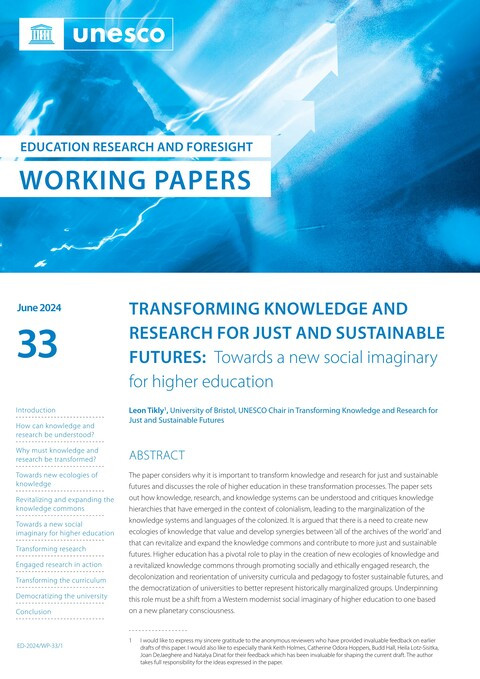 Transforming Knowledge and Research for Just and Sustainable Futures: Towards a New Social Imaginary for Higher Education (Education, Research and Foresight: Working Papers; No.33, 2024) Année de publication: 2024 Auteur: Leon Tikly Auteur institutionnel: UNESCO The paper considers why it is important to transform knowledge and research for just and sustainable futures and discusses the role of higher education in these transformation processes. The paper sets out how knowledge, research, and knowledge systems can be understood and critiques knowledge hierarchies that have emerged in the context of colonialism, leading to the marginalization of the knowledge systems and languages of the colonized. It is argued that there is a need to create new ecologies of knowledge that value and develop synergies between ‘all of the archives of the world’ and that can revitalize and expand the knowledge commons and contribute to more just and sustainable futures. Higher education has a pivotal role to play in the creation of new ecologies of knowledge and a revitalized knowledge commons through promoting socially and ethically engaged research, the decolonization and reorientation of university curricula and pedagogy to foster sustainable futures, and the democratization of universities to better represent historically marginalized groups. Underpinning this role must be a shift from a Western modernist social imaginary of higher education to one based on a new planetary consciousness.
  Mapping Cultural Policies in Small Island Developing States: Amplifying SIDS Voices in the Global Policy Dialogue on Culture and Sustainable Development Année de publication: 2025 Auteur institutionnel: UNESCO Mapping Cultural Policies in Small Island Developing StatesSpanning three sub-regions – the Atlantic, Indian Ocean and South China Sea (AIS), the Caribbean, and the Pacific – the Small Island Developing States (SIDS) represent 39 UNESCO Member States and 9 Associate Members. Countries and regional organizations have increasingly demonstrated their commitment in the context of fast-evolving policy landscape and cultural ecosystems, encompassing the different dimensions of culture through its diversity and a wide spectrum of concerned stakeholders. Today, a SIDS-specific, culture-led development vision is on the rise.Culture has a multifaceted impact on sustainable development pathways of the SIDS, from climate action, biodiversity protection and food security to economic diversification, social inclusion, gender equality or urban sustainability. The voices and aspirations of SIDS must be heard in the global policy dialogue, in acknowledgement of their priorities, opportunities and insights. International cooperation efforts by UNESCO and other organizations are also essential in identifying areas for future policy investment and adaptation at the national and regional levels.Following the UNESCO World Conference on Cultural Policies and Sustainable Development – MONDIACULT 2022, SIDS are championing culture for sustainable development towards the adoption of a new Programme of Action, the Antigua and Barbuda Agenda for SIDS 2024-2034. Cartografía de las políticas culturales en los Pequeños Estados Insulares en desarrollo: amplificando las voces de los PEID en el diálogo mundial en materia de políticas sobre cultura y desarrollo sostenible Année de publication: 2025 Auteur institutionnel: Organización de las Naciones Unidas para la Educación, la Ciencia y la Cultura (UNESCO) Cartografía de las políticas culturales en los Pequeños Estados Insulares en Desarrollo Abarcando tres subregiones – el Atlántico, el océano Índico y el mar de China meridional, el Caribe y el Pacífico – los Pequeños Estados Insulares en Desarrollo (PEID) representan 39 Estados miembros de la UNESCO y 9 Miembros Asociados. Los países y las organizaciones regionales han demostrado cada vez más su compromiso en el contexto de un panorama de políticas y unos ecosistemas culturales en rápida evolución, que abarcan las distintas dimensiones de la cultura a través de su diversidad y de un amplio espectro de partes interesadas. Actualmente, está en auge la visión del desarrollo específica para los PEID, basada en la cultura. La cultura tiene un impacto multidimensional en las vías de desarrollo sostenible de los PEID, desde la acción por el clima, la protección de la diversidad biológica y la seguridad alimentaria hasta la diversificación económica, la inclusión social, la igualdad de género o la sostenibilidad urbana. En el diálogo mundial en materia de políticas deben escucharse las voces y aspiraciones de los PEID, en reconocimiento de sus prioridades, oportunidades y puntos de vista. Las iniciativas de cooperación internacional de la UNESCO y otras organizaciones también son esenciales para determinar los ámbitos de inversión y adaptación de las políticas futuras a escala nacional y regional. Tras la Conferencia Mundial de la UNESCO sobre Políticas Culturales y el Desarrollo Sostenible – MONDIACULT 2022, los PEID defienden la cultura para el desarrollo sostenible con vistas a la adopción de un nuevo Programa de Acción, la Agenda de Antigua y Barbuda para los PEID 2024-2034 Cartographie des politiques culturelles dans les Petits États Insulaires en développement : faire émerger la voix des PEID dans le dialogue politique mondial sur la culture et le développement durable Année de publication: 2025 Auteur institutionnel: UNESCO Cartographie des politiques culturelles dans les Petits États insulaires en développement Répartis dans trois sous-régions - l’Atlantique, l’océan Indien et la mer de Chine méridionale (AIS), les Caraïbes et le Pacifique - les petits États insulaires en développement (PEID) représentent 39 États membres de et 9 membres associés de l’UNESCO. Les pays et les organisations régionales ont progressivement démontré leur engagement dans un paysage politique et des écosystèmes culturels en évolution rapide, englobant les différentes dimensions de la culture, à travers sa diversité et son large éventail de parties prenantes. Aujourd’hui, une vision du développement spécifique aux PEID et axée sur la culture est en plein essor. La culture a un impact multiforme sur les voies du développement durable des PEID - qu’il s’agisse de la lutte contre le changement climatique, de la protection de la biodiversité, de la sécurité alimentaire, de la diversification économique, de l’inclusion sociale, de l’égalité entre les genres ou de la durabilité urbaine. Leurs voix et leurs aspirations doivent être entendues dans le dialogue politique mondial, en reconnaissance de leurs priorités, de leurs opportunités et de leurs idées innovantes. Les efforts de coopération internationale portés par l’UNESCO et d’autres organisations sont également essentiels pour identifier les domaines d’investissement et d’adaptation des politiques futures aux niveaux national et régional. Dans la continuité de la Conférence mondiale de l’UNESCO sur les politiques culturelles et le développement durable - MONDIACULT 2022, les PEID œuvrent en faveur de la culture pour le développement durable en vue de l’adoption d’un nouveau programme d’action, l’Agenda d’Antigua-et-Barbuda pour les PEID 2024-2034.
 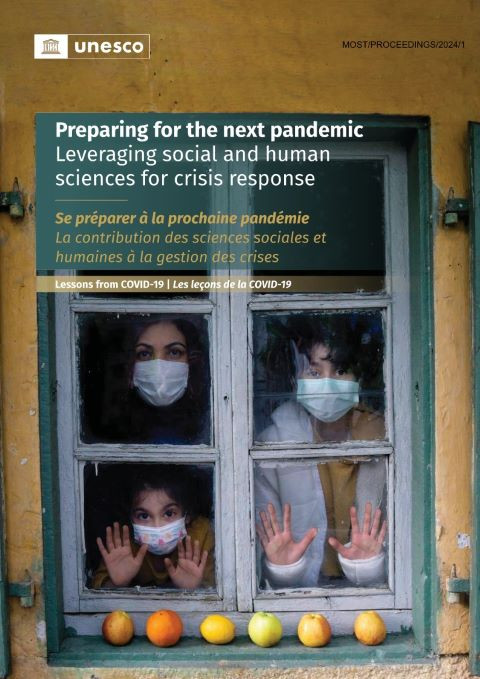 Preparing for the Next Pandemic Leveraging Social and Human Sciences for Crisis: Lessons from COVID-19 Année de publication: 2024 Auteur: Erwan Dianteill | N'Dri Thérèse Assié-Lumumba Auteur institutionnel: UNESCO The Social Sciences Response to COVID-19 Understanding the social impact of the COVID-19 pandemic is crucial for crafting effective and inclusive recovery policies. Prior to the pandemic, growing gaps in well-being were already undermining environmental sustainability, the social fabric, and progress worldwide. Fragile and unequal systems proved to be a pre-existing aggravating condition that fuelled the pandemic on a global scale. COVID-19 widened the gap between developed countries—which already had the financial means to respond to the crisis and had easy access to the vaccine—and the rest of humanity, resulting in devastating effects in the Global South, with more than 130 million people crossing the poverty line. Addressed to policymakers and scholars, this publication presents a comprehensive state of knowledge of the social science perspectives on the COVID-19 pandemic, covering a wide range of topics from its impact on mental health, education, climate change, economy, governance, migration, demography, digitalization, and more. The authors analyse the challenges faced by society during the pandemic and present actionable proposals for policymakers and practitioners. This publication is a reminder of the importance of Social Sciences and Humanities in addressing global challenges and provides a roadmap for future research and policy action to build more resilient societies.