
Ressources
Explorez une large gamme de ressources sur le GCED afin d’approfondir votre compréhension et de renforcer vos activités de recherche, de plaidoyer, d’enseignement et d’apprentissage.
2,781 résultats trouvés
 Cultural aspects in Christian and Islamic religions Année de publication: 2011 Auteur institutionnel: UNESCO Beirut | Université Saint Joseph de Beyrouth This book allows the readers the opportunity to know about the cultural aspects related to religions, mainly in Lebanon and the Near East, their meaning and their aim. This knowledge will help the reader, firstly, to grasp the meaning of these various aspects, whether they concern him directly or the people who live in the same country, with whom he shares common space and living. Secondly, the book contributes to the Lebanese understanding one another’s behaviors and their own behavior concerning these aspects. Therefore, the book also contributes to the Lebanese looking at one another with more trust before starting to criticize. This book includes chapters that cover most of the different cultural aspects in Christian and Islamic religions. The first chapter deals with time, passing through each month of the year and its days, in a chronological manner. The second chapter delves into religious occasions in the Christian then Islamic religions. It explains the meaning of Holidays and remembrances of God and their particular aspects as well as the religious reasons of each. This chapter includes a part about al-‘awliya’ and Saints who are mentioned in some of the Lebanese daily rituals. Chapter three delves into the individual’s life stages from birth to religious vows, to marriage and death. The aspects that go with these stages constitute an important part in the life of the Lebanese. This chapter details the aspects and traditions of all these stages in which people take part, thus creating a common ground in a multi-religious society. Chapter four deals with religious practices, acts of worship, and legal prescriptions. It describes them and deals with their spiritual meaning to individuals who express their faith when practicing them. Prayer, Mass, and Pilgrimage, among others, are religious practices that are detailed in a way to make the reader understand what they mean to those who perform them. Chapter five leads us into religious places and their meaning, from churches to mosques and monasteries, khalwat and husayniyyat, all of which have different and divergent meanings to visitors. Yet, they all show the importance given by man to the place when expressing his faith and his relation with the Creator. Chapter six takes us to religious habits and customs, such as the clothes worn by religious dignitaries, their symbolism and meaning. It also deals with some general habits and customs. The reader may find that some chapters overlap. In fact, we have tried to make each part related to the others yet independent from them. This method facilitates the reading and understanding of any subject on its own without the need to refer to prior or subsequent parts. Finally, those who had any – minor or major – contribution in this book – despite the lacks that some readers might see – hope that they have offered a useful work in the process of discovering others who are different and who hold rich traditions as well human and spiritual values.
  World Migration Report 2024 Année de publication: 2024 Auteur institutionnel: Organisation Internationale pour les Migrations (OIM) The World Migration Report 2024 provided by the IOM aims at providing a better understanding of the migration phenomenon through a series of key questions: What is the proportion of migrants in the world? Are most migrants men or women? Which are the main host countries? The interactive edition presents only some of the key information contained in the full report. État de la migration dans le monde en 2024 Année de publication: 2024 Auteur institutionnel: Organisation Internationale pour les Migrations (OIM) Le Rapport État de la migration dans le monde 2024 publié par l'OIM a vocation à faire mieux comprendre le phénomène migratoire à travers de grandes questions: Quelle est la proportionde migrants dans le monde? Les migrants sont-ils majoritairement des hommes ou des femmes? Quels sont les principaux pays d'accueil ? L'édition interactive présente uniquement une partie des informations clés contenues dans le rapport complet rédigé en Anglais.
 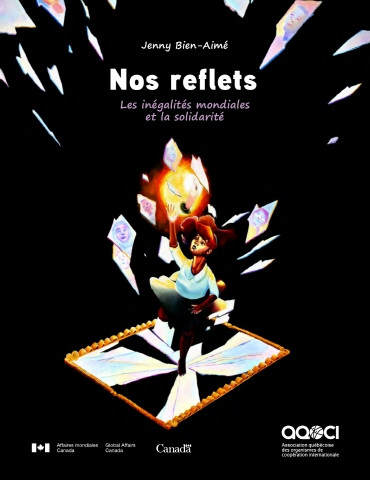 Our Reflections: Global Inequality and Solidarity Année de publication: 2022 Auteur: Jenny Bien-Aimé Auteur institutionnel: Quebec Association of International Cooperation Organizations (AQOCI) In 2022, the SDI took place from February 6 to 12, and the member organizations of AQOCI chose the theme "In the context of the COVID-19 pandemic: calling for the co-construction of a just and united world."With this theme, the public was invited to discuss the persistent global inequalities and injustices and to explore solutions for making our world more just, united, and equitable.For the occasion, the comic book Nos Reflets was created by the artist Jenny Bien-Aimée. Nos reflets: Les inégalités mondiales et la solidarité Année de publication: 2022 Auteur: Jenny Bien-Aimé Auteur institutionnel: Association québécoise des organismes de coopération internationale (AQOCI) En 2022, la SDI s'est déroulée du 6 au 12 février et les organismes membres de l’AQOCI ont choisi comme thématique « Dans le contexte de pandémie de COVID-19 : appeler à la coconstruction d’un monde juste et solidaire ».Avec cette thématique, le public a été convié à échanger sur les inégalités et les injustices persistantes à l’échelle mondiale et à discuter des solutions pour rendre notre monde plus juste, solidaire et équitable.Pour l'occasion, la bande dessinée Nos Reflets a été produite par l'artiste Jenny Bien-Aimée.
 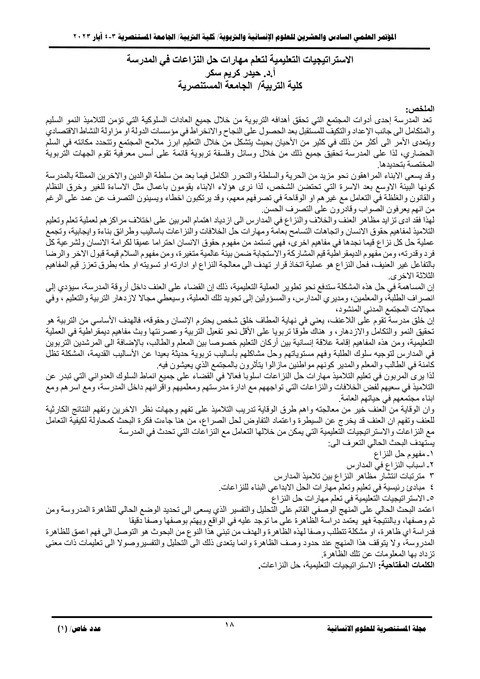 Instructional Strategies for Learning Conflict Resolution Skills in School (Mustansiriyah Journal of Humanities; Vol. 1-1, Special Issue) Année de publication: 2023 Auteur: Haider Kareem Sukar Auteur institutionnel: Mustansiriyah University The school is a community tool that achieves its educational goals through all behavioral habits that provide students with sound and integrated growth, as well as preparation and adaptation for the future after obtaining success and involvement in government institutions and the economy. In the civilizational scale, so the school must achieve all means of education and an educational philosophy based on foundations with educational entertainment Adolescent children may seek more freedom, power, and complete liberation later on from the authority of parents and others represented by the school, as it is the broader environment after the family that embraces the person, so we see these children doing actions such as abuse of others, violation of order and law, harshness in dealing with others, or rudeness in their behavior with them They may make mistakes and misbehave on purpose even though they know what is right and are able to act well. Therefore, the increasing manifestations of violence, disagreement and conflict in schools have led to an increase in the interest of educators of all positions in the process of learning and teaching students the concepts of human rights and the attitudes of tolerance in general and the skills of resolving differences and conflicts in constructive and positive ways and means. الاستراتيجيات التعليمية لتعلم مهارات حل النزاعات في المدرسة (مجلة المستنصرية للعلوم الإنسانية؛ Vol. 1-1، العدد الخاص) Année de publication: 2023 Auteur: Haider Kareem Sukar Auteur institutionnel: Mustansiriyah University تعد المدرسة إحدى أدوات المجتمع التي تحقق أهدافه التربوية من خلال جميع العادات السلوكية التي تؤمن للتلاميذ النمو السليم والمتكامل الى جانب الإعداد والتكيف للمستقبل بعد الحصول على النجاح والانخراط في مؤسسات الدولة او مزاولة النشاط الاقتصادي ويتعدى الأمر الى أكثر من ذلك في كثير من الأحيان بحيث يتشكل من خلال التعليم ابرز ملامح المجتمع وتتحدد مكانته في السلم الحضاري، لذا على المدرسة تحقيق جميع ذلك من خلال وسائل وفلسفة تربوية قائمة على أسس معرفية تقوم الجهات التربوية المختصة بتحديدها. وقد يسعى الابناء المراهقون نحو مزيد من الحرية والسلطة والتحرر الكامل فيما بعد من سلطة الوالدين والاخرين الممثلة بالمدرسة كونها البيئة الاوسع بعد الاسرة التي تحتضن الشخص، لذا نرى هؤلاء الابناء يقومون باعمال مثل الاساءة للغير وخرق النظام والقانون والغلظة في التعامل مع غيرهم او الوقاحة في تصرفهم معهم، وقد يرتكبون اخطاء ويسيئون التصرف عن عمد على الرغم من انهم يعرفون الصواب وقادرون على التصرف الحسن. لهذا فقد ادى تزايد مظاهر العنف والخلاف والنزاع في المدارس الى ازدياد اهتمام المربين على اختلاف مراكزهم لعملية تعلم وتعليم التلاميذ لمفاهيم حقوق الانسان واتجاهات التسامح بعامة ومهارات حل الخلافات والنزاعات باساليب وطرائق بناءة وايجابية.
 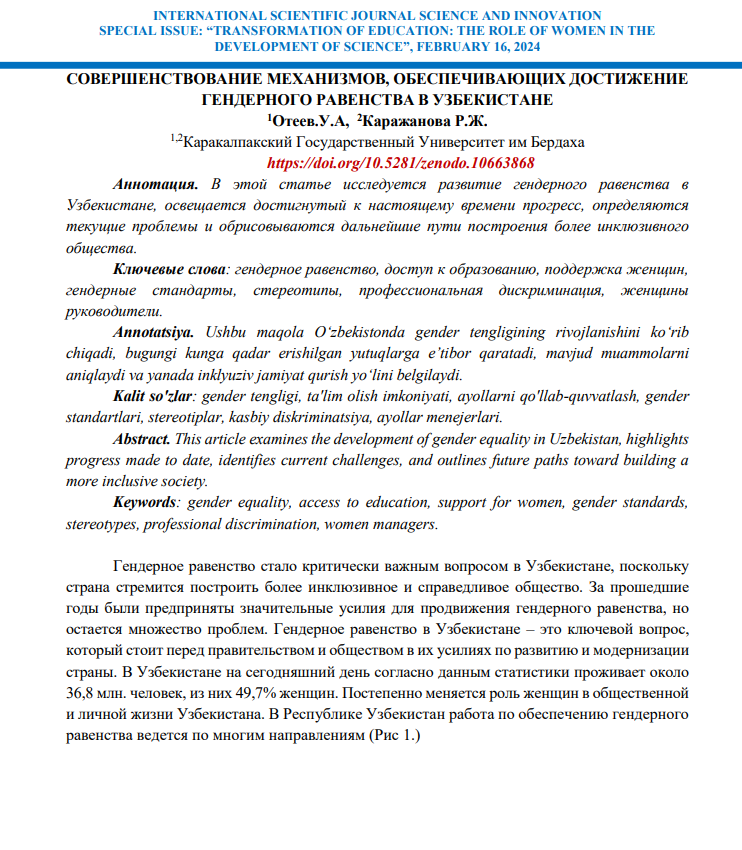 Improving Mechanisms to Ensure the Achievement of Gender Equality in Uzbekistan Année de publication: 2024 Auteur: Отеев Уразбай | Каражанова Роза Auteur institutionnel: Наука и инновации This article examines the development of gender equality in Uzbekistan, highlights progress made to date, identifies current challenges, and outlines future paths toward building a more inclusive society. Совершенствование механизмов, обеспечивающих достижение гендерного равенства в Узбекистане Année de publication: 2024 Auteur: Отеев Уразбай | Каражанова Роза Auteur institutionnel: Наука и инновации В этой статье исследуется развитие гендерного равенства в Узбекистане, освещается достигнутый к настоящему времени прогресс, определяются текущие проблемы и обрисовываются дальнейшие пути построения более инклюзивного общества.
 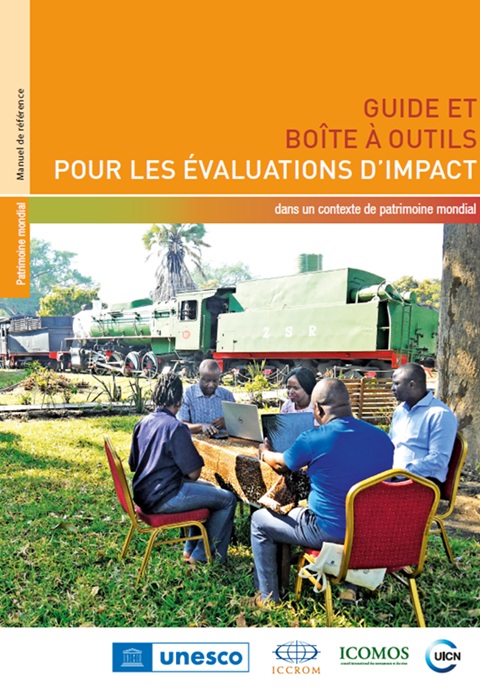 Guide et boîte à outils pour les évaluations d’impact dans un contexte de patrimoine mondial Année de publication: 2023 Auteur: Sarah Court | Eugene Jo | Richard Mackay | Mizuki Murai | Riki Therivel Auteur institutionnel: Organisation des Nations Unies pour l'éducation, la science et la culture (UNESCO) | International Centre for the Study of the Preservation and Restoration of Cultural Property (ICCROM) | International Council on Monuments and Sites (ICOMOS) | International Union for Conservation of Nature (IUCN) Notre patrimoine mondial menacé : les évaluations d’impact offrent des solutionsLors du 50e anniversaire de la Convention du patrimoine mondial, en 2022, on dénombrait plus de 1 100 sites du patrimoine mondial de l’UNESCO. Ces sites sont si précieux pour l’humanité que leur conservation nous incombe à tous. Pourtant, nombre de ces lieux exceptionnels sont confrontés à la pression croissante qu’exercent les divers types de développement et des projets dans et autour des sites. L’évaluation des impacts de ces projets – avant toute décision de mise en œuvre – est essentielle pour éviter tout dommage causé au patrimoine mondial et identifier des choix durables.Le Guide et boîte à outils pour les évaluations d’impact dans un contexte de patrimoine mondial est la référence incontournable qui explique la démarche à suivre pour atteindre cet objectif. Grâce à des conseils et outils (dont des listes de contrôle et glossaire), il fournit un cadre permettant de réaliser des évaluations d’impact pour les sites du patrimoine culturel et naturel.Élaboré par l’UNESCO et les Organisations consultatives du Comité du patrimoine mondial – l’ICCROM, l’ICOMOS et l’UICN –, ce manuel constitue une base de collaboration intersectorielle et multidisciplinaire en vue de trouver des réponses permettant de protéger les sites du patrimoine mondial et de soutenir un développement qualitatif et approprié. Les États parties, les gestionnaires du patrimoine, les décideurs, les planificateurs et les aménageurs de la Convention du patrimoine mondial sont invités à l’utiliser pour contribuer à la réalisation de notre engagement collectif : la transmission de notre patrimoine inestimable aux générations futures.