
Ressources
Explorez une large gamme de ressources sur le GCED afin d’approfondir votre compréhension et de renforcer vos activités de recherche, de plaidoyer, d’enseignement et d’apprentissage.
3,799 résultats trouvés
 Education 2030: Incheon declaration and framework for action towards inclusive and equitable quality education and lifelong learning for all Année de publication: 2015 Auteur institutionnel: UNESCO | United Nations Development Programme (UNDP) | United Nations Population Fund (UNFPA) | UN. Office of the United Nations High Commissioner for Refugees (UNHCR) | United Nations Children's Fund (UNICEF) | United Nations Entity for Gender Equality and the Empowerment of Women (UN Women) | World Bank This framework — painstakingly drafted over many months with input from governments, international agencies, civil society and experts — provides guidance for implementing the education commitments made in the 2030 Agenda for Sustainable Development at a national, regional and global level. In particular: it aims at mobilizing all countries and partners around Sustainable Education Goal 4 and its targets;it proposes ways of implementing, coordinating, financing and monitoring the new commitments; andit proposes indicative strategies which countries may wish to draw upon in developing their plans, taking into account different national realities, capacities and levels of development and respecting national policies and priorities. 교육 2030 인천선언과 실행계획: 포용적이고 공평한 양질의 교육과 모두를 위한 평생학습을 향해 Année de publication: 2015 Auteur institutionnel: 유네스코 | United Nations Development Programme (UNDP) | United Nations Population Fund (UNFPA) | UN. Office of the United Nations High Commissioner for Refugees (UNHCR) | United Nations Children's Fund (UNICEF) | United Nations Entity for Gender Equality and the Empowerment of Women (UN Women) | World Bank 정부, 국제기구, 시민사회와 전문가의 조언을 받아 몇 달 동안 많은 노력을 기울여 초안이 작성된 이 실행계획은 지속가능한 발전을 위한 2030 아젠다의 국가적, 지역적, 세계적 단계에서의 실현을 위한 교육의 역할에 대한 실천 가이드를 제공한다. 이는 모든 국가와 지속가능목표 4와 그 대상을 둘러싼 파트너들을 움직이도록 하는 데에 그 목적을 둔다.이 실행계획은 새로운 역할에 대한 실천, 협력, 자금조달과 관찰 방안을 제안한다.이 실행계획은 각 국가들이 서로 다른 국가적 상황과 역량, 발전 단계 및 각국의 정책과 우선순위를 존중한 계획을 세울 수 있도록 전략을 보여준다.
  [Video] Central Asian Kids Share Their Views on Gender Inequality Année de publication: 2020 Auteur institutionnel: World Bank In Central Asia, and around the world, women earn 30% less than men. In anticipation of March 8, we asked the children what they think about it. [Видео] Что говорят дети в Центральной Азии о гендерном неравенстве в оплате труда Année de publication: 2020 Auteur institutionnel: World Bank В Центральной Азии, и по всему миру, женщины зарабатывают на 30% меньше, чем мужчины. В преддверии 8 марта мы спросили детей, что они думают об этом.
  Step by Step: Social and Emotional Learning Program; Teacher’s Guide (Grade 1 - 11) Année de publication: 2016 Auteur: José Fernando Mejía | Gloria Inés Rodríguez | Nancy Guerra | Andrea Bustamante | María Paula Chaparro | Melisa Castellanos Auteur institutionnel: World Bank This Program offers a series of practical lessons designed to be implemented in the classroom by the teacher. These lessons are based on a carefully chosen developmental perspective of middle childhood and adolescence, to fit the characteristics and needs of each age group or grade, from ages 6 through 17. The lessons are organized into three modules, six general skills and 18 specific skills. Step by Step focuses on six core life skills: self-awareness, self-regulation, social awareness, positive communication, determination, and responsible decision-making. Paso a Paso: Programa de Educación Socioemocional; Guía del docente (Grados 1 - 11) Année de publication: 2016 Auteur: José Fernando Mejía | Gloria Inés Rodríguez | Nancy Guerra | Andrea Bustamante | María Paula Chaparro | Melisa Castellanos Auteur institutionnel: World Bank Este programa ofrece una serie de sesiones prácticas diseñadas para ser implementadas por un decente en el aula. Estas sesiones tienen como base una perspectiva del desarrollo de la niñez y la adolescencia cuidadosamente elegida, para responder a las características y necesidades de cada grado o grupo de edad, desde los 6 hasta los 17 años. Las sesiones están organizadas en tres módulos, seis habilidades generales y 18 habilidades específicas. Paso a Paso se enfoca en seis habilidades centrales para la vida: autoconciencia, autoregulación, conciencia social, comunicación positiva, determinación y toma responsable de decisiones.
  Step by Step: Social and Emotional Learning Program; Student Workbook (Grade 1 - 11) Année de publication: 2016 Auteur: José Fernando Mejía | Gloria Inés Rodríguez | Nancy Guerra | Andrea Bustamante | María Paula Chaparro | Melisa Castellanos Auteur institutionnel: World Bank This Program offers a series of practical lessons designed to be implemented in the classroom by the teacher. These lessons are based on a carefully chosen developmental perspective of middle childhood and adolescence, to fit the characteristics and needs of each age group or grade, from ages 6 through 17. The lessons are organized into three modules, six general skills and 18 specific skills. Step by Step focuses on six core life skills: self-awareness, self-regulation, social awareness, positive communication, determination, and responsible decision-making. Paso a Paso: Programa de Educación Socioemocional; Cuaderno para estudiante (Grados 1 - 11) Année de publication: 2016 Auteur: José Fernando Mejía | Gloria Inés Rodríguez | Nancy Guerra | Andrea Bustamante | María Paula Chaparro | Melisa Castellanos Auteur institutionnel: World Bank Cuaderno de trabajo para el estudiante del Programa Paso a Paso para el grado undécimo. Este programa ofrece una serie de sesiones prácticas diseñadas para ser implementadas por un decente en el aula. Estas sesiones tienen como base una perspectiva del desarrollo de la niñez y la adolescencia cuidadosamente elegida, para responder a las características y necesidades de cada grado o grupo de edad, desde los 6 hasta los 17 años. Las sesiones están organizadas en tres módulos, seis habilidades generales y 18 habilidades específicas. Paso a Paso se enfoca en seis habilidades centrales para la vida: autoconciencia, autoregulación, conciencia social, comunicación positiva, determinación y toma responsable de decisiones.
  Gender Bias, Citizen Participation, and AI (Policy Research Working Papers; Planet; RRR; 11046) Année de publication: 2025 Auteur: Jose Antonio Cuesta Leiva | Natalia Gisel Pecorari Auteur institutionnel: World Bank This paper investigates the role of gender bias in artificial intelligence–driven analyses of citizen participation, using data from the 2023 Latinobarómetro Survey. The paper proposes that gender bias—whether societal, data driven, or algorithmic—significantly affects civic engagement. Using machine learning, particularly decision trees, the analysis explores how self-reported societal bias (machismo norms) interacts with personal characteristics and circumstances to shape civic participation. The findings show that individuals with reportedly low levels of gender bias, who express political interest, have high levels of education, and align with left-wing views, are more likely to participate. The paper also explores different strategies to mitigate gender bias in both the data and the algorithms, demonstrating that gender bias remains a persistent factor even after applying corrective measures. Notably, lower machismo thresholds are required for participation in more egalitarian societies, with men needing to exhibit especially low machismo levels. Ultimately, the findings emphasize the importance of integrated strategies to tackle gender bias and increase participation, offering a framework for future studies to expand on nonlinear and complex social dynamics.
 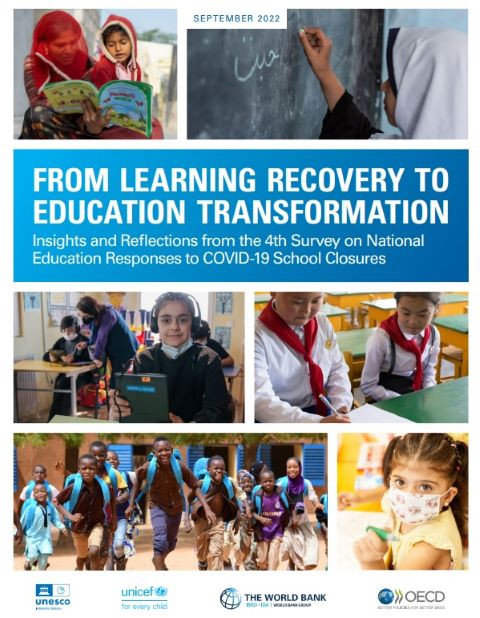 From Learning Recovery to Education Transformation: Insights and Reflections from the 4th Survey on National Education Responses to COVID-19 School Closures Année de publication: 2022 Auteur institutionnel: UNESCO | UNESCO Institute for Statistics (UIS) | United Nations Children's Fund (UNICEF) | World Bank | Organisation for Economic Co-operation and Development (OECD) From Learning Recovery to Education Transformation, a new joint report by UNESCO, UNESCO Institute for Statistics (UIS), UNICEF, The World Bank and The OECD, presents findings from the fourth round of the Survey on National Education Responses to COVID-19 School Closures, administered between April–July 2022 with responses from Ministries of Education in 93 countries. It explores how countries are progressing in the RAPID actions to recover learning: Reach every child and keep them in school; Assess learning levels regularly; Prioritize teaching the fundamentals; Increase the efficiency of instruction; and Develop psychosocial health and wellbeing.