
Ressources
Explorez une large gamme de ressources sur le GCED afin d’approfondir votre compréhension et de renforcer vos activités de recherche, de plaidoyer, d’enseignement et d’apprentissage.
3,790 résultats trouvés
 Education 2030: Déclaration d'Incheon et Cadre d'action: vers une éducation inclusive et équitable de qualité et un apprentissage tout au long de la vie pour tous Année de publication: 2016 Auteur institutionnel: Organisation des Nations Unies pour l'éducation, la science et la culture (UNESCO) | United Nations Development Programme (UNDP) | United Nations Children's Fund (UNICEF) | United Nations Entity for Gender Equality and the Empowerment of Women (UN Women) | World Bank | United Nations Population Fund (UNFPA) | UN. Office of the United Nations High Commissioner for Refugees (UNHCR) This framework — painstakingly drafted over many months with input from governments, international agencies, civil society and experts — provides guidance for implementing the education commitments made in the 2030 Agenda for Sustainable Development at a national, regional and global level. In particular: it aims at mobilizing all countries and partners around Sustainable Education Goal 4 and its targets; it proposes ways of implementing, coordinating, financing and monitoring the new commitments; and it proposes indicative strategies which countries may wish to draw upon in developing their plans, taking into account different national realities, capacities and levels of development and respecting national policies and priorities.
 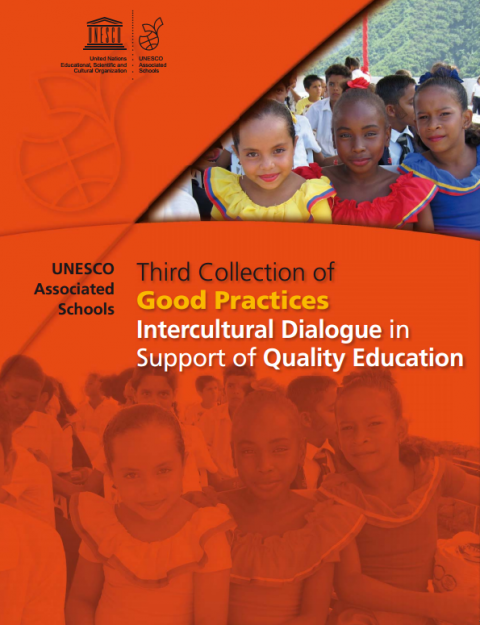 Third collection of good practices: intercultural dialogue in support of quality education Année de publication: 2013 Auteur institutionnel: UNESCO Associated Schools Project Network (ASPnet) The UNESCO Associated Schools Project Network (ASPnet) conducts pilot projects aimed at reinforcing the humanistic and ethical principles of UNESCO in school curricula and throughout the learning process, often within the framework of UN and UNESCO International Day, Years and Decades, Promoting intercultural dialogue is thus an ASPnet priority. The initiatives presented in this Third Collection of ASPnet Good Practices were carried out by ASPnet schools and their partner institutions in the context of the International Year for the Rapprochement of Cultures (2010). The selected projects illustrate both multicultural education and intercultural education in action. Troisième recueil de bonnes pratiques: le dialogue interculturel à l'appui de l'éducation de qualité Année de publication: 2013 Auteur institutionnel: UNESCO Associated Schools Project Network (ASPnet) Les écoles associées de l'UNESCO (réSEAU) mènent des projets pilotes visant à renforcer les principes humanistes et éthiques de l'UNESCO dans les programmes scolaires et tout au long du processus d'apprentissage, souvent dans le cadre de l'ONU et de la Journée internationale de l'UNESCO, années et décennies, la promotion du dialogue interculturel est donc une priorité Reseau. Les initiatives présentées dans ce troisième Collection de Reseau bonnes pratiques ont été réalisées par les écoles Reseau et leurs institutions partenaires dans le cadre de l'Année internationale du rapprochement des cultures (2010). Les projets sélectionnés illustrent à la fois l'éducation multiculturelle et l'éducation interculturelle dans l'action.
  World Education Statistics 2024 Année de publication: 2024 Auteur institutionnel: UNESCO Institute for Statistics (UIS) The report summarizes the education data published by UIS and serves as a fundamental resource and essential guide for policy-makers, researchers and analysts, as well as anyone interested in education data and statistics. Statistics are presented in 11 thematic chapters, covering primary and secondary education; early childhood; technical, vocational and tertiary education; skills for work; parity; literacy and numeracy; sustainable development and global citizenship; learning environment; scholarships; teachers; and financing education.
 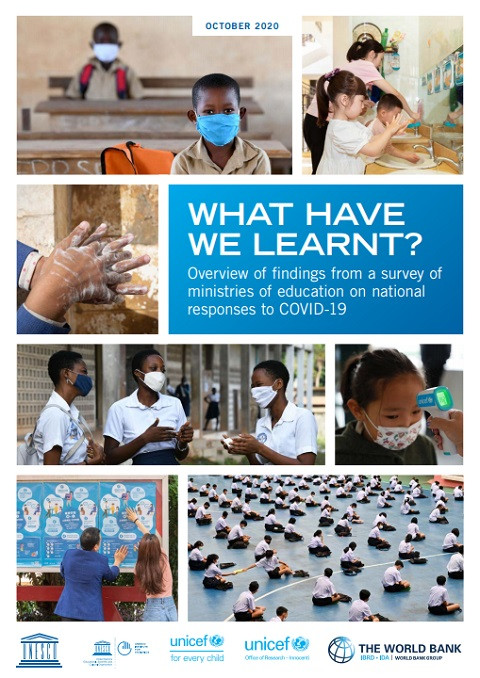 What Have We Learnt?: Overview of Findings From a Survey of Ministries of Education on National Responses to COVID-19 Année de publication: 2020 Auteur institutionnel: UNESCO | United Nations Children's Fund (UNICEF) | World Bank As part of the coordinated global education response to the COVID-19 pandemic, UNESCO, UNICEF and the World Bank conducted a Survey on National Education Responses to COVID-19 School Closures. In this joint report, the results of the first two rounds of data collection administered by the UNESCO Institute for Statistics (UIS) were analysed. They cover government responses to school closures from pre-primary to secondary education.
  Internationalization of Tertiary Education in the Middle East and North Africa Année de publication: 2020 Auteur: Giulia Marchesini Auteur institutionnel: World Bank Conceived in order to provide a crucial baseline in research on internationalization in MENA, this report draws on available data to respond to both a real need for regional analysis and a direct demand from stakeholders, including tertiary education institutions in the region. Encouraging internationalization to be mainstreamed throughout MENA is the objective that this report seeks to achieve by way of stimulating regional policy dialogue on the subject. The report presents some global trends in internationalization and details its main benefits, before providing an overview of the current status of internationalization in the MENA region, including an in-depth analysis of student mobility. In its reflections on the way forward for the region, the report situates its recommendations in the context of COVID-19, within which, despite serious challenges due to a lack of attractiveness of the region, MENA may find a key opportunity. It suggests that adapting to the “new normal” through the deeper implementation of internationalization “at home” – a dimension that does not require physical mobility and, being implemented within domestic environments, has a much wider reach – may help enable the region to make strides towards catching up on the internationalization agenda. Internationalisation de l’enseignement supérieur dans la région Moyen-Orient Afrique du Nord Année de publication: 2020 Auteur: Giulia Marchesini | Lise Barbotte | Paul Cahu | Aurelia Hoffmann | Holly Johnstone | Mirna Mehrez | Marco Pasqualini | Francisco Marmolejo Auteur institutionnel: World Bank Ce rapport s'appuie sur les données disponibles pour répondre à la fois à un réel besoin d'analyse régionale et à une demande directe des parties prenantes, y compris des établissements d'enseignement supérieur de la région MENA. Encourager le développement de l’internationalisation à travers la région MENA est l'objectif que ce rapport cherche à atteindre, en stimulant un dialogue régional sur les politiques publiques autour de ce sujet. Le rapport présente quelques tendances mondiales de l'internationalisation et détaille ses principaux avantages, avant de donner un aperçu de l'état actuel de l'internationalisation dans la région MENA, y compris une analyse approfondie de la mobilité étudiante. Parmi les recommandations proposées pour le développement de l’internationalisation, le contexte de la COVID-19 est vu, pour la région MENA, comme une fenêtre d’opportunité pour pallier au manque d'attractivité de la région dans ce domaine. Mettre l’accent sur l'internationalisation « à domicile » - une dimension qui ne nécessite pas de mobilité physique et qui se développe dans le cadre domestique, et a donc une portée plus large - pour s’adapter à la « nouvelle normalité » peut aider la région à rattraper son retard sur le plan de l’internationalisation.
  Achieving SDG4 Through a Human Rights Based Approach to Education: World Development Report 2018 Background Paper Année de publication: 2018 Auteur: Kate Moriarty Auteur institutionnel: World Bank Quality education is a critical dimension for the achievement of sustainable development. The renewed political commitment set out in sustainable development goal 4 (SDG4) is an opportunity to ensure strong coherence between education policy and the right to education first articulated more than 70 years ago. This paper presents the results of a desk-based study on a human rights-based approach to education (HRBAE) in the context of SDG4. It explores the ways in which such an approach can guide policy, planning, and the delivery of education in observance with agreed international frameworks providing for the right to education. The paper argues that the human rights conventions on the right to education are not passive instruments designed to remain only at the level of discourse but, as legal obligations, require action from the state and should be central in the development of education services, including in the context of large scale displacement and crisis. This paper outlines the legally binding commitments of the right to education. It considers how these can be applied practically through a HRBA-E to address the continuing barriers to access and completion of quality education and learning.
  International Understanding and Cooperation in Education in the Post-Corona World Année de publication: 2020 Auteur: Dongjoon Jo | Edward Vickers | Dina Kiwan | Fei Yan | Kyujoo Seol | Kyoko Nakayama Auteur institutionnel: APCEIU Research Report of International Understanding and Cooperation in Education in the Post-Corona World APCEIU has published a report, including research studies from 6 experts in order to figure out the role of education in promoting international understanding and cooperation in the education sector in the post-pandemic world. Through this research project, APCEIU mainly sought to answer the following questions; ▲What will be the implications of COVID-19 for international exchange and cooperation especially in education?▲What should we as educators, researchers, and practitioners do to counter the rise of populist nationalism?▲What should be the focus and direction of international cooperation in education during and after the pandemic in order to promote international understanding and GCED? This research project is expected to provide insightful views on the desirable direction for international understanding and cooperation in the education sector. Table of Contents 1. The development of UNESCO’s exchange programmes and their possible rearrangements in the post-pandemic years (Dong-Joon Jo, Professor at Department of Political Science and International Relations, Seoul National University, Korea) 2. ‘Rethinking Schooling’ once again: Post-corona challenges for education for peace and sustainability in Asia (Edward Vickers, Professor of Comparative Education at Kyushu University, Japan) 3. Race, gender, disability, and their intersections under the impact of COVID-19 (Dina Kiwan, Professor in Comparative Education, University of Birmingham, United Kingdom) 4. Competition or cooperation: Configuring ‘International’ in Chinese school textbooks (Fei Yan, Post-Doctoral Research Fellow, South China University, China) 5. The implications of democratic citizenship education and global citizenship education in South Korea for the post-corona era (Kyujoo Seol, Professor of Social Studies Education, Kyeongin National University of Education, Korea) 6. What can we learn from the pandemic of COVID-19?: An attempt to develop teaching materials for international understanding and cooperation based on Japanese educational issues (Kyoko Nakayama, Professor of Social Studies Education and Multicultural Education, Teikyo University, Japan)
  Disinfodemic: Deciphering COVID-19 Disinformation (Policy Brief; 1) Année de publication: 2020 Auteur: Julie Posetti | Kalina Bontcheva Auteur institutionnel: UNESCO The purpose of this brief is to provide a structure for understanding the COVID-19 disinfodemic and the responses to it, highlighting practices which have a bearing on the UN Sustainable Development Goals (SDGs), the right to health and the right to freedom of expression. SDG 16.10 calls for “public access to information and fundamental freedoms”.