
Ressources
Explorez une large gamme de ressources sur le GCED afin d’approfondir votre compréhension et de renforcer vos activités de recherche, de plaidoyer, d’enseignement et d’apprentissage.
1,322 résultats trouvés
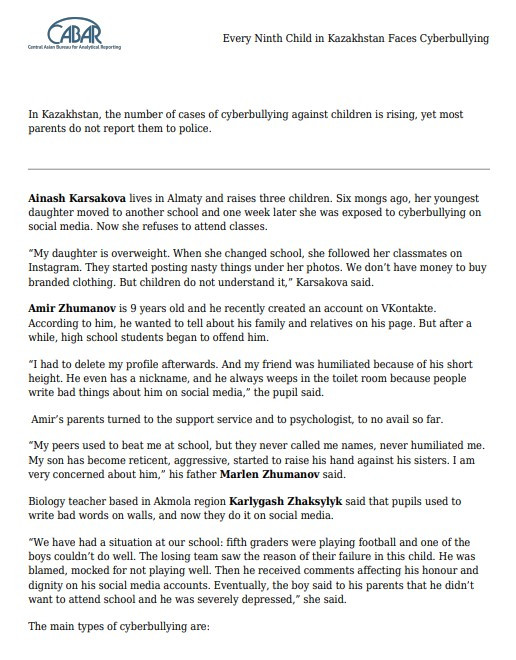 В Казахстане каждый девятый ребенок сталкивается с кибербуллингом Année de publication: 2022 Auteur institutionnel: Central Asian Bureau for Analytical Reporting (CABAR) В Казахстане растет количество случаев кибербуллинга в отношении детей, но большинство родителей не обращаются в правоохранительные органы.
  A Practical Guide: Women's Council for Promoting Peace and Stability Année de publication: 2019 Auteur: Sultanova R.Sh. | Kachikeeva B. | Mamatkulova A. | Dosalieva B.A. This guide focuses on promoting women's councils to influence peacebuilding and conflict prevention, as well as the involvement of women's councils in the prevention of domestic violence, early marriage and abduction of girls and women, and other factors that affect security. Практическое руководство: Женские советы в укреплении мира и стабильности Année de publication: 2019 Auteur: Sultanova R.Sh. | Kachikeeva B. | Mamatkulova A. | Dosalieva B.A. В этом руководстве сосредоточено внимание на продвижение женских советов в целях влияния на процесс миростроительства и предотвращения конфликтов, а также участия женских советов в профилактике насилия в семье, ранних браках и похищения девушек и женщин и других факторов влияющих на безопасность.
 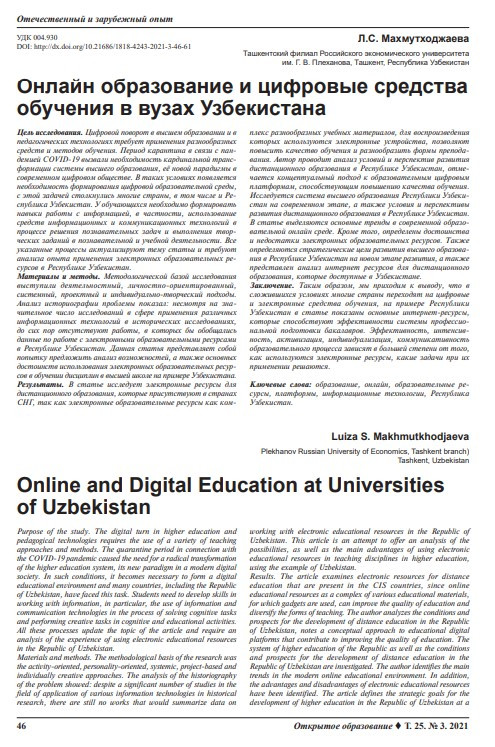 Online and Digital Education at Universities of Uzbekistan (Open Education; vol. 25, no. 3) Année de publication: 2021 Auteur: Makhmutkhodjaeva L.S. The quarantine period in connection with the COVID-19 pandemic caused the need for a radical transformation of the higher education system, its new paradigm in modern digital society. In such conditions, it becomes necessary to form a digital educational environment, and many countries, including the Republic of Uzbekistan, have faced this task. Students need to develop skills in working with information, in particular, the use of information and communication technologies in the process of solving cognitive tasks and performing creative tasks in cognitive and educational activities. Онлайн образование и цифровые средства обучения в вузах Узбекистана (Открытое образование; vol. 25, no.3) Année de publication: 2021 Auteur: Makhmutkhodjaeva L.S. Период карантина в связи с пандемией COVID-19 вызвали необходимость кардинальной трансформации системы высшего образования, её новой парадигмы в современном цифровом обществе. В таких условиях появляется необходимость формирования цифровой образовательной среды, с этой задачей столкнулись многие страны, в том числе и Республика Узбекистан. У обучающихся необходимо формировать навыки работы с информацией, в частности, использование средств информационных и коммуникационных технологий в процессе решения познавательных задач и выполнения творческих заданий в познавательной и учебной деятельности.
 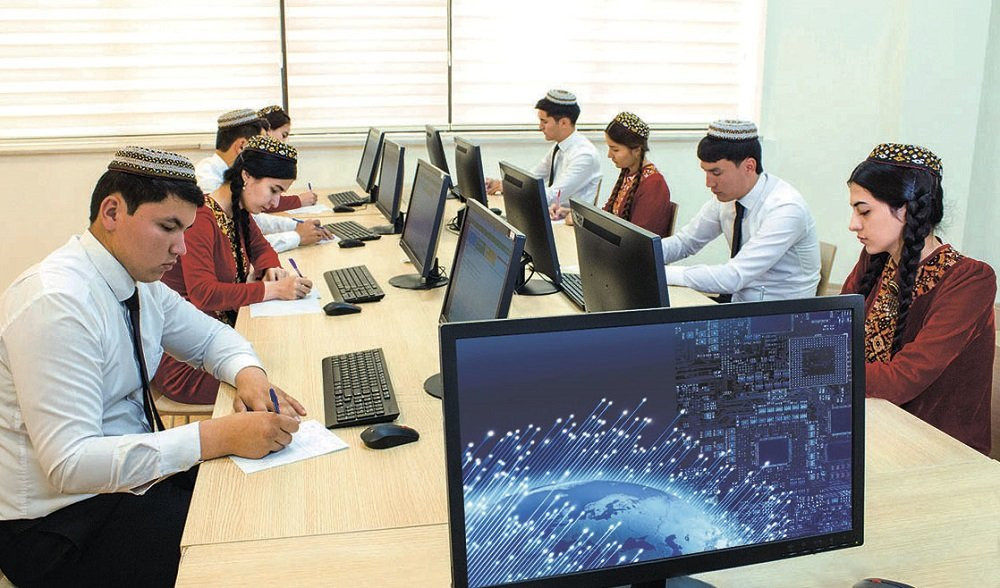 Turkmenistan’s Digital Education System and COVID-19: Still Waiting for Change Année de publication: 2020 Auteur: Rustam Muhamedov The coronavirus pandemic has forced the country’s government to embrace the immediate introduction of digital technology into education. In Turkmenistan, where the authorities still do not officially recognize cases of COVID-19, the digitalization of education is slow. On that is independent researcher Rustam Mukhamedov. Цифровое образование в Туркменистане: В ожидании изменений на фоне COVID-19 Année de publication: 2020 Auteur: Rustam Muhamedov Пандемия коронавируса заставила правительства развивающихся стран принять немедленные меры по внедрению цифровых технологий в сферу образования. В Туркменистане, где власти все еще не признают случаи заболевания COVID-19 на официально уровне, цифровизация образования идёт медленно. Об этом пишет независимый исследователь Рустам Мухамедов.
 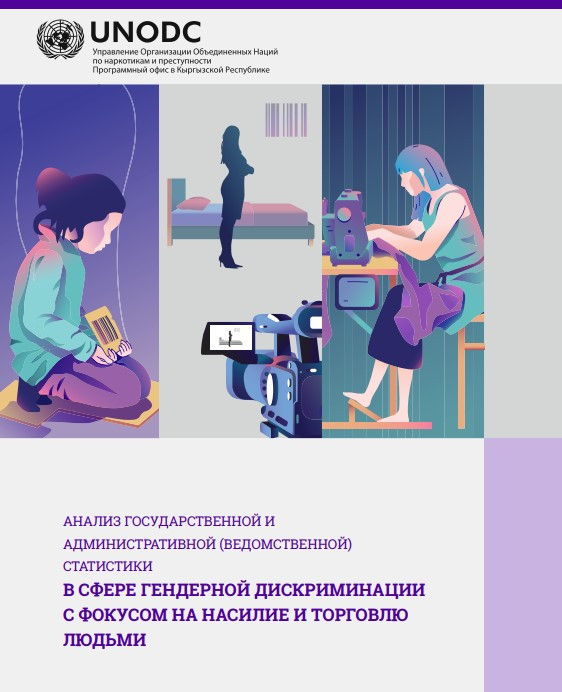 Analysis of State and Administrative (departmental) Statistics in the Field of Gender Discrimination with a Focus on Violence and Human Trafficking Année de publication: 2018 Auteur institutionnel: UN. Office on Drugs and Crime (UNODC) The analytical review includes brief information on the legislative bases of statistics in the field of gender discrimination, violence, and human trafficking, as well as departmental regulations regulating the collection of statistics on this issue in state statistics bodies, the judicial system, internal affairs bodies, health authorities, prosecutors, the penitentiary service, crisis centers and courts of elders. The analysis makes it possible to understand what information flows in the field of gender discrimination, violence, and human trafficking exist in the authorized bodies state bodies, what indicators are collected in them, and how statistics are generated at the national level. For each authorized state body, the structure of the information system, the movement of information flows, and a list of indicators on gender-based crimes, family violence, and human trafficking are given. Анализ государственной и административной (ведомственной) статистики в сфере гендерной дискриминации с фокусом на насилие и торговлю людьми Année de publication: 2018 Auteur institutionnel: UN. Office on Drugs and Crime (UNODC) Аналитический обзор включает краткую информацию о законодательных основах статистики в сфере гендерной дискриминации, насилия и торговли людьми, а также ведомственные нормативные акты, регулирующие сбор статистки по данному вопросу в органах госстатистики, судебной системе, органах внутренних дел, органах здравоохранения, прокуратуры, службе исполнения наказаний, кризисных центрах и судах аксакалов. Проведенный анализ дает возможность понять, какие информационные потоки в сфере гендерной дискриминации, насилия и торговли людьми существуют в уполномоченных государственных органах, какие показатели в них собираются, и как формируется статистика на национальном уровне. По каждому уполномоченному государственному органу приводится структура информационной системы, движение информационных потоков, перечень показателей по гендерно-обусловленным преступлениям, семейному насилию и торговле людьми.
  Human Rights Education in the School System Europe, Central Asia, and North America: A Compendium of Good Practices Année de publication: 2010 Auteur institutionnel: OSCE. Office for Democratic Institutions and Human Rights (ODIHR) The Compendium of Good Practices: Human Rights Education in the School System in Europe, Central Asia, and North America includes 101 good practices in human rights education in primary, secondary, and teacher training institutions in the OSCE region, also covered by the UNESCO, OHCHR mandate.