
Ressources
Explorez une large gamme de ressources sur le GCED afin d’approfondir votre compréhension et de renforcer vos activités de recherche, de plaidoyer, d’enseignement et d’apprentissage.
1,443 résultats trouvés
 التربية على التسامح وتجسيد ثقافة العيش المشترك من التسامح إلى التعايش Année de publication: 2022 Auteur institutionnel: Democratic Arab Center حظى مفهوم التسامح باهتمام كبير في ضوء المتغيرات المجتمعية المعاصرة من أجل ضمان استقرار المجتمع، وتعايش أفراده في وئام وسلام بالإضافة إلى أهميته على مستوى العلاقات بين الدول وبعضها. التسامح قيمة إنسانية ذات طابع عالمي، ولقد ظهر مفهوم التسامح من حاجة المجتمعات الغارقة في الحروب والاقتتال الأهلي، وهو أعطى تقدما باهرا للمجتمعات والمؤسسات في الغرب، وحرّر الإنسـان من قيود الخوف، لقد أرسى مفهوم التسامح قوانين أكثر إنسانية، وفرض على الـدول أنماطا جديدة مـن التفكير وإعمال العقل لاستنباط مخارج تجنب البشرية العنف والتعصب، وقـد التزمت الأمـم المتحدة بتدعيم التسامح من خلال تعزيز التفاهم المتبادل بين الثقافات والشعوب . وقد تنبهت منظمة اليونسكو للتربية والثقافة والعلـوم التابعة للأمم المتحدة، إلى موضوع ثقافة التسامح فأصدرت في السادس عشر من تشرين الثاني لعام 1995، إعلاناً يتضمـن الـمبـادئ الأساسية للتسامح كثقافة تربوية ونفسية و اجتماعية. وقـد أصبح هذا اليوم ومنذ المؤتمر العام لليونسكو في دورته الثامنة والعشرين، يوماً عالمياً للتسامح Tolerance Education and the Embodiment of Coexistence Culture: From Tolerance to Coexistence Année de publication: 2022 Auteur institutionnel: Democratic Arab Center The concept of tolerance has received great attention in light of contemporary societal changes in order to ensure the stability of society and the coexistence of its members in harmony and peace, in addition to its importance at the level of relations between countries.Tolerance is a human value of a universal nature. The concept of tolerance emerged from the need of societies mired in war and civil strife. It gave remarkable progress to societies and institutions in the West, and liberated people from the shackles of fear. The concept of tolerance established more humane laws and imposed on countries new patterns of thinking. And using reason to devise ways to avoid violence and intolerance for humanity. The United Nations has committed to strengthening tolerance by promoting mutual understanding between cultures and peoples.The United Nations Educational, Scientific and Cultural Organization, UNESCO, became aware of the issue of the culture of tolerance and issued, on November 16, 1995, a declaration containing the basic principles of tolerance as an educational, psychological and social culture. Since the twenty-eighth session of the UNESCO General Conference, this day has become an international day for tolerance.
  Strengthening Social and Emotional Learning in Hybrid Modes of Education: Building Support for Students, Teachers, Schools and Families; A UNESCO-IBE Discussion Paper Année de publication: 2024 Auteur institutionnel: UNESCO International Bureau of Education (IBE) The COVID-19 pandemic intensified existing educational disparities globally, prompting a reevaluation of school curricula to include Social and Emotional Learning (SEL). This shift recognized the holistic needs of learners, teachers, and families, emphasizing competencies beyond traditional knowledge acquisition. Despite SEL's increasing global recognition, it is often absent from formal curricula, prompting the UNESCO-IBE to address this gap. This Discussion Paper explores the crucial role of SEL in the broader transformation of global education, particularly in the post-COVID-19 era. It highlights six key topics, presenting diverse experiences in integrating SEL into education. Experts from various fields contribute insights, focusing on socio-emotional and hybrid learning advancements worldwide. The report aims to inspire global change-makers, advocating for robust policies aligned with UNESCO's Futures of Education framework. This call to action aligns with the UNESCO-IBE's HELA initiative, promoting flexible hybrid learning models for crisis response and sustainable educational strategies in line with the UN Transforming Education Summit's vision.
  Toward a More Inclusive Post-COVID Recovery: A Tool to Further the Caribbean Policy Agenda Année de publication: 2022 Auteur: Anna Kasafi Perkins | Stacy Richards-Kennedy | Don Marshall | R. Clive Landis Auteur institutionnel: UNESCO Kingston | University of the West Indies The Caribbean is a grouping of islands and low-lying coastal countries of sovereign nations and dependent territories that share a history of colonialism and coloniality,1 which has shaped and continues to shape their “complex mix of political and administrative structures”. Indeed, Caribbean nations experience a “paradoxical, type of political sovereignty and experience of development”. All Caribbean nations have been classified by the United Nations as Small Island Developing States (SIDS), taking account of “the peculiar social, economic and environmental vulnerabilities” they experience. Caribbean SIDS are highly indebted and vulnerable to climate change, hurricanes and other natural hazards. At the same time, theirs is a paradoxical existence as their vulnerabilities place them alongside least developed countries, in spite of some being designated by the World Bank as high or middle-income countries. Such classification limits access to the international financing needed towards achieving the Sustainable Development Goals.
  New Challenges and Approaches to Regional and Global Security in Central Asia Année de publication: 2020 Auteur institutionnel: Organization for Security and Co-operation in Europe (OSCE) On 26 October 2018 in Nur-Sultan, the OSCE Programme Office in Nur-Sultan jointly with the Friedrich Ebert Foundation and the Kazakhstan Council on International Relations, with support from the Institute of Diplomacy under the Academy of Public Administration and the Public Opinion Research Institute co-organized an international conference entitled “New Challenges and Approaches to Regional and Global Security in Central Asia”. This compendium, which includes presentations given at the conference by both Kazakhstan’s and foreign participants, explores main regional security threats in Central Asia and ways to address these problems, as well as regional co-operation issues in responding to contemporary challenges. The edition will be of interest to political scientists, international relations experts, civil servants, scholars, educators, university-level students, and broad sections of the public interested in the contemporary development of the region. The edition is published in Russian and English. The paper of Mr. Pal Dunay is written in the English language in the original, the rest of the reports are in Russian. All reports have been translated and edited with the support of the OSCE Program Office in Nur Sultan. Any opinions and recommendations expressed in the materials arising from the conference are those of the authors and do not necessarily reflect the views of the conference organizers. Новые вызовы и подходы по регионально и глобальной безопасности в Центральной Азии Année de publication: 2020 Auteur institutionnel: Organization for Security and Co-operation in Europe (OSCE) 26 октября 2018 г. Офисом программ ОБСЕ в Нур-Султане совместно с Фондом им. Фридриха Эберта и Казахстанским советом по международным отношениям при поддержке Института дипломатии Академии государственного управления и Исследовательского института «Общественное мнение» была организована международная конференция «Новые вызовы и подходы по регионально и глобальной безопасности в Центральной Азии». В данный сборник материалов включены доклады казахстанских и зарубежных участников конференции, раскрывающие основные угрозы безопасности в регионе Центральной Азии и пути решения возникающих проблем, а также актуальные вопросы регионального сотрудничества в реагировании на современные вызовы. Издание предназначено для политологов, экспертов-международников, государственных служащих, научных работников, преподавателей и студентов высших учебных заведений, а также для широкого круга читателей, интересующихся современным развитием региона. Издание публикуется на русском и английском языках. Доклад господина Пал Дунай написан на английском языке в оригинале, остальные доклады на русском языке. Все доклады переведены и отредактированы при содействии Офиса программ ОБСЕ в Нур-Султане. Мнения и рекомендации авторов докладов в рамках конференции принадлежат авторам и не обязательно отражают точку зрения организаторов конференции.
 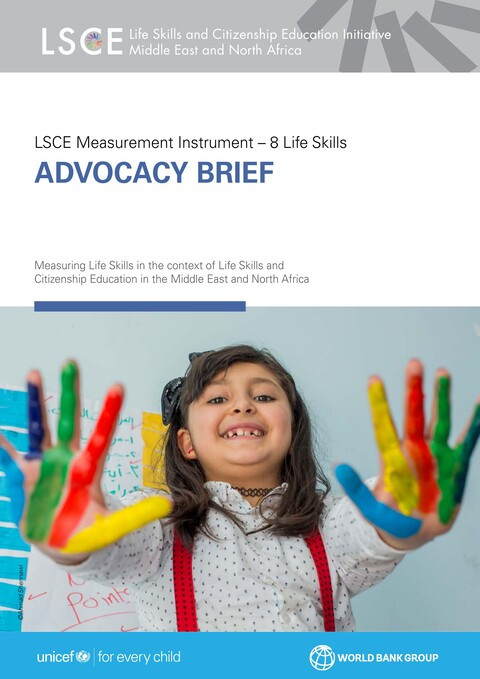 أدوات التقييم الخاصة بتطبيق أداة تعليم المهارات الحياتية والمواطنة: قياس المهارات الحياتية بناءً على إطار العمل الإقليمي لتعليم المهارات الحياتية والمواطنة في منطقة الشرق الأوسط وشمال أفريقيا; امللخص التنفيذي Année de publication: 2021 Auteur institutionnel: UNICEF Middle East and North Africa "إن تعليم المهارات الحياتية مُهم للغاية لتمكين الأطفال والشباب من تحقيق النجاح في التعليم والعمل والأهداف الشخصية. ومع ذلك، قد أدرجت القليل من الأنظمة التعليمية المهارات الحياتية في نظامها التعليمي. ومن أسباب ذلك هو التحديات المتعلقة بنقص المعرفة الخاصة بكيفية قياس المهارات الحياتية وتقييمها. وبناءً على إطار العمل الإقليمي لتعليم المهارات الحياتية والمواطنة في الشرق الأوسط وشمال أفريقيا، فإن منظمة اليونيسف والبنك الدولي قد طورا أداة تعليم المهارات الحياتية والمواطنة لقياس المستوى الوطني لنتائج طلبة الصف السابع في ثماني مهارات حياتية بوصفه تقييم وطني واسع النطاق. يرجى أيضًا الاطلاع على منشور قياس المهارات الحياتية." LSCE Measurement Instrument: Measuring Life Skills in the Context of Life Skills and Citizenship Education in the Middle East and North Africal; Advocacy Brief Année de publication: 2021 Auteur institutionnel: UNICEF Middle East and North Africa Teaching and learning life skills is incredibly important for empowering children and young people to achieve success in education, employment, and personal goals. Nevertheless, few education systems have integrated life skills into their education systems. One of the reasons for this is challenges concerning the lack of knowledge as to how life skills can be measured, assessed, and evaluated. Building on the regional Life Skills and Citizenship Education (LSCE) framework in the Middle East and North Africa (MENA), UNICEF and The World Bank have developed this LSCE Measurement Instrument, to measure the national level of grade 7 students’ scores in eight life skills as national large-scale assessment.
 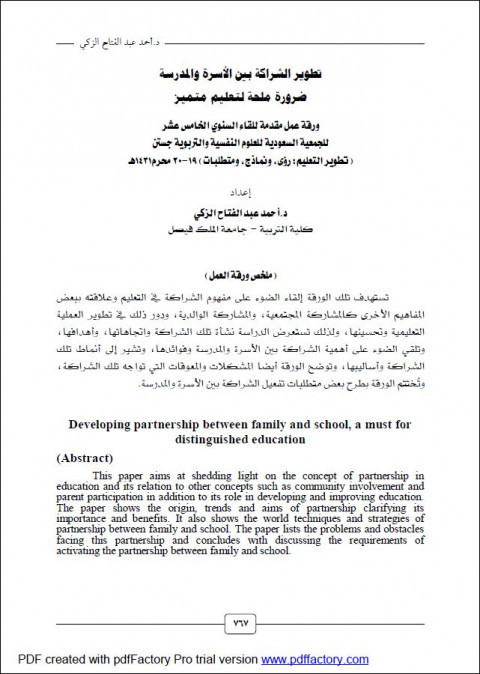 تطوير الشراكة بين الأسرة والمدرسة ضرورة ملحة لتعليم متميز Année de publication: 2010 Auteur: الزكي، أحمد عبد الفتاح Auteur institutionnel: King Saud University تستهدف الورقة إلقاء الضوء على مفهوم الشراكة في التعليم وعلاقته ببعض المفاهيم الأخرى كالمشاركة المجتمعية، والمشاركة الوالدية، ودور ذلك في تطوير العملية التعليمية وتحسينها، ولذلك تستعرض الدراسة نشأة تلك الشراكة واتجاهاتها، وأهدافها، وتلقي الضوء على أهمية الشراكة بين الأسرة والمدرسة وفوائدها، وتشير إلى أنماط تلك الشراكة وأساليبها، وتوضح الورقة أيضا المشكلات والمعوقات التي تواجه تلك الشراكة. وتختتم الورقة بطرح بعض متطلبات تفعيل الشراكة بين الأسرة والمدرسة. Developing Partnership between Family and School, a Must for Distinguished Education Année de publication: 2010 Auteur: الزكي، أحمد عبد الفتاح Auteur institutionnel: King Saud University This paper aims at shedding light on the concept of partnership in education and its relation to other concepts such as The paper shows the origin, trends and aims of partnership clarifying its importance and benefits. It also shows the techniques and strategies of partnership between family and school from around the world . The paper lists the problems and obstacles facing this partnership and concludes with discussing the requirements of activating the partnership between family and school.