
Ressources
Explorez une large gamme de ressources sur le GCED afin d’approfondir votre compréhension et de renforcer vos activités de recherche, de plaidoyer, d’enseignement et d’apprentissage.
1,322 résultats trouvés
 Образование в области прав человека в школьной системе Европы, Центральной Азии и Северной Америки: Сборник примеров успешных практик Année de publication: 2010 Auteur institutionnel: OSCE. Office for Democratic Institutions and Human Rights (ODIHR) Сборник примеров успешных практик «Образование в области прав человека в школьной системе Европы, Центральной Азии и Северной Америки» включает 101 пример успешных практик в сфере образования в области прав человека в начальной, средней школе и в педагогических учебных заведениях в регионе ОБСЕ, на который также распространяются полномочия ЮНЕСКО, УВКПЧ ООН.
  Teaching Russian Language to Students from Turkmenistan (Philological Class; vol.26, no.4) Année de publication: 2021 Auteur: Armine A. Grigoryan | Evgeniya B. Popkova In the last few years, there has been great interest on the part of the younger generation of the former Soviet republics in obtaining higher education in Russia. In this regard, the problem of Russian language training for foreign applicants entering bachelor’s or master’s degree programs at universities of the Russian Federation is becoming rather urgent. The purpose of the article is to consider the main factors – linguistic and extralinguistic, which hinder the successful teaching of Russian as a foreign language, and to develop methods guides aimed at the formation of the Russian language communicative competence among Turkmen students. Обучение русскому языку студентов из Туркменистана (Филологический класс; vol.26, no.4) Année de publication: 2021 Auteur: Armine A. Grigoryan | Evgeniya B. Popkova В последние несколько лет наблюдается большой интерес со стороны молодого поколения бывших союзных республик к получению высшего образования в России. В связи с этим актуализируется проблема подготовки по русскому языку иностранных абитуриентов, поступающих в бакалавриат или магистратуру в вузы РФ. Целью статьи являются рассмотрение основных факторов – лингвистических и экстралингвистических, препятствующих успешному обучению русскому языку как иностранному, и выработка методических рекомендаций по формированию коммуникативной компетенции у туркменских студентов.
  Journalism Education - Improvement of the Quality of Education and New Technologies Année de publication: 2010 Auteur institutionnel: OOSCE. Office of the Representative on Freedom of the Media Publication of materials from the 11th Central Asian Media Conference. Media professionals and officials from all five Central Asian states - Kazakhstan, Kyrgyzstan, Tajikistan, Turkmenistan, and Uzbekistan - attended the conference. Representatives of academia, professors from various universities, national and international experts, and representatives of national and international organizations also attended the conference, during which the latest media developments in Central Asia were discussed. The main theme of the conference was journalism education. Журналистское образование повышение качества образования и новые технологии Année de publication: 2010 Auteur institutionnel: OOSCE. Office of the Representative on Freedom of the Media Публикация материалов 11 центральноазиатской конференции СМИ. Работники СМИ и официальные лица из всех пяти центральноазиатских государств – Казахстана, Кыргызстана, Таджикистана, Туркменистана и Узбекистана – приняли участие в конференции. Представители научных кругов, преподавательского состава различных университетов, национальные и международные эксперты, представители национальных и международных организаций также участвовали в работе конференции, в ходе которой были обсуждены последние события в сфере СМИ в Центральной Азии. Основной темой конференции стало журналистское образование.
  Central Asia - In Defence of the Future: Media in Multi-Cultural and Multi-Lingual Societies Année de publication: 2003 Auteur institutionnel: OOSCE. Office of the Representative on Freedom of the Media Collection of speeches at the 5th Central Asian Media Conference held in Bishkek, Kyrgyzstan, September 17-18, 2003. Центральная Азия - В защиту будущего: СМИ в многокультурных и многоязычных обществах Année de publication: 2003 Auteur institutionnel: OOSCE. Office of the Representative on Freedom of the Media Сборник выступлений на 5-й Центральноазиатской конференции СМИ, проходившей в Бишкеке, Кыргызстан, 17-18 сентября 2003 г.
 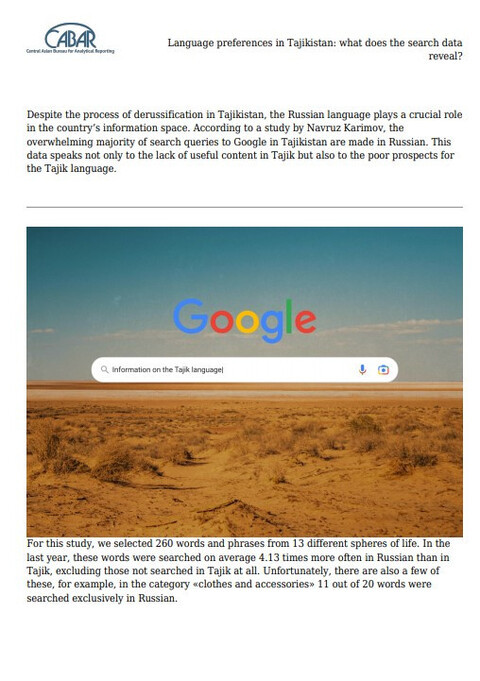 Language Preferences in Tajikistan: What Does the Search Data Reveal? Année de publication: 2023 Auteur: Navruz Karimov Auteur institutionnel: Central Asian Bureau for Analytical Reporting (CABAR) Despite the process of derussification in Tajikistan, the Russian language plays a crucial role in the country’s information space. According to a study by Navruz Karimov, the overwhelming majority of search queries to Google in Tajikistan are made in Russian. This data speaks not only to the lack of useful content in Tajik but also to the poor prospects for the Tajik language. Языковые предпочтения в Таджикистане: что говорят данные поисковых запросов? Année de publication: 2023 Auteur: Navruz Karimov Auteur institutionnel: Central Asian Bureau for Analytical Reporting (CABAR) Несмотря на процесс дерусификации в Таджикистане, русский язык продолжает играть ключевую роль в информационном пространстве страны. Согласно исследованию Навруза Каримова, подавляющее большинство поисковых запросов к Google в Таджикистане делается на русском языке. Эти данные говорят не только об отсутствии полезного контента на таджикском языке, но и о плохих перспективах таджикского языка.
 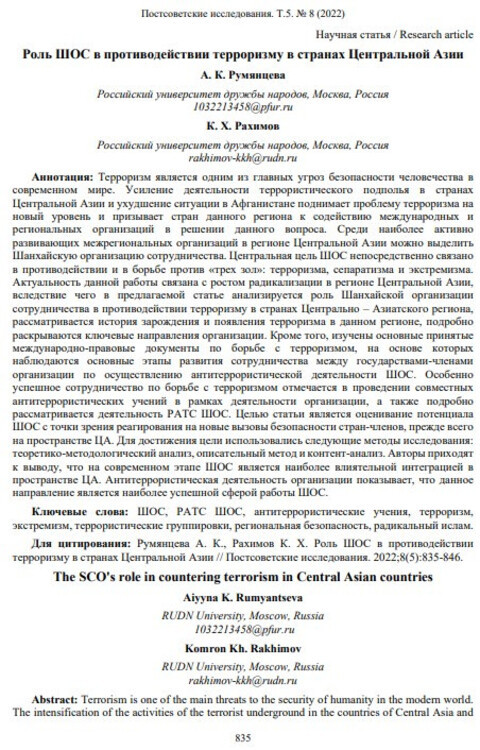 The SCO’s Role in Countering Terrorism in Central Asian Countries (Post-Soviet Studies; Vol.5, No.8) Année de publication: 2022 Auteur: А. К. Румянцева | К. Х. Рахимов Terrorism is one of the main threats to the security of humanity in the modern world. The intensification of the activities of the terrorist underground in the countries of Central Asia and the deterioration of the situation in Afghanistan raises the problem of terrorism to a new level and calls on the countries of this region to assist international and regional organizations in resolving this issue. Among the most actively developing interregional organizations in the Central Asian region is the Shanghai Cooperation Organization. The central goals of the SCO are directly related to countering and combating the "three evils": terrorism, separatism and extremism. The relevance of this paper relates to the growth of radicalization in the Central Asian region, as a result of which the proposed article analyzes the role of the Shanghai Cooperation Organization in countering terrorism in the countries of the Central Asian region, examines the history of the origin and emergence of terrorism in this region, reveals in detail the key areas of the organization. In addition, the main adopted international legal documents on combating terrorism have been studied, on the basis of which the main stages of the development of cooperation between the member states of the organization for the implementation of anti-terrorist activities of the SCO are observed. Particularly successful cooperation in the fight against terrorism is noted in the conduct of joint anti-terrorist exercises within the framework of the organization's activities, and the activities of the SCO RATS are also considered in detail. The purpose of the article is to assess the potential of the SCO in terms of responding to new security challenges of the member states, primarily in the Central Asian region. To achieve the goal, the following research methods were used: theoretical and methodological analysis, descriptive method, and content analysis. The authors come to the conclusion that at the present stage the SCO is the most influential integration in the space of Central Asia. The organization's anti-terrorist activities show that this field is one of the most successful within the organization's work.