
Ressources
Explorez une large gamme de ressources sur le GCED afin d’approfondir votre compréhension et de renforcer vos activités de recherche, de plaidoyer, d’enseignement et d’apprentissage.
2,657 résultats trouvés
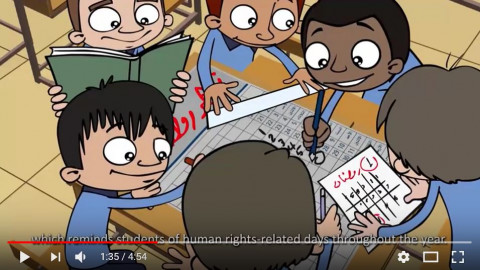 [Video] Equal rights between girls and boys Année de publication: 2015 Auteur institutionnel: United Nations Relief and Works Agency for Palestine Refugees in the Near East (UNRWA) Palestine refugee students of all ages learn about human rights in their everyday lives through the Human Rights, Conflict Resolution and Tolerance Education Programme, funded by the United States. In this short animation, young boys and girls learn to respect each other’s rights regardless of gender.
  Educación para la ciudadanía y la convivencia: manual de ciudadanía y convivencia desde la construcción colectiva de sentidos y redes; derechos humanos y paz Année de publication: 2015 Auteur institutionnel: Centro de Investigación y Educación Popular (CINEP) | Secretaría de Educación del Distrito (SED) Human rights and peace is one of the main themes related with education for citizenship and coexistence. Therefore, identifies three areas of reflection: 1) Human rights as an ongoing and unfinished process, 2) Recognizing the diversities, 3) The generations of peace. Each one of these areas is accompanied by didactic tools that allow to deepen into the contents that are based on fundamental theoretical and practical elements, which could be useful in the pedagogical process leaded by the participants of the project. National meeting on peace education: working papers; report Année de publication: 2015 Auteur institutionnel: Encuentro de Educacion para la Paz y los Derechos Humanos This document presents the most relevant reflections and commitments made up from the First National Encounter of Education for Peace and Human Rights, which took place on July 29th of 2014, with the participation of the Mayors, Secretaries of Education from the different territories of Colombia, governmental organizations, NGO's and multilateral agencies. Réunion nationale de l'éducation pour la paix: document de travail; mémoires Année de publication: 2015 Auteur institutionnel: Encuentro de Educacion para la Paz y los Derechos Humanos Ce document présente les réflexions les plus pertinentes et les engagements pris à partir de la première rencontre nationale de l'éducation pour la paix et les droits de l'homme, qui a eu lieu le 29 Juillet 2014, avec la participation des maires, secrétaires d'éducation des différents territoires de la Colombie, gouvernementales organisations, les ONG et les agences multilatérales. Encuentro nacional de educación para la paz: documento de trabajo; memorias Année de publication: 2015 Auteur institutionnel: Encuentro de Educacion para la Paz y los Derechos Humanos This document presents the most relevant reflections and commitments made up from the First National Encounter of Education for Peace and Human Rights, which took place on July 29th of 2014, with the participation of the Mayors, Secretaries of Education from the different territories of Colombia, governmental organizations, NGO's and multilateral agencies. Memorias del Segundo encuentro nacional sobre educación para la paz y los derechos humanos en los territorios Année de publication: 2015 Auteur institutionnel: Encuentro de Educacion para la Paz y los Derechos Humanos The discussions and reflections of the Second National Encounter of Education for Peace and Human Rights were focused on the reality of schools, their dynamics and the territorial problems, taking into account those territories were the armed Colombian conflict has been deeply developed and the politic and administrative relations between the local-national dynamics present important challenges. These memories gather those discussions that lead to actions, new challenges and commitments, specially focused on the construction of public policy for education for peace and human rights. Education for a culture of peace, human rights, citizenship, democracy and regional integration: ECOWAS reference manual, for use by trainer of trainers Année de publication: 2013 Auteur institutionnel: UNESCO Dakar | Economic Community of West African States (ECOWAS) The manual comprises seven modules dealing with the Culture of Peace and Conflict Management; Human Rights; Civism and Citizenship; Democracy and Good Governance; Gender and Development; Public Health, Environment and Sustainable Development; and Regional Integration. Each module has sub-themes with introductions, reference materials, general objectives to guide the trainer and generic pedagogical tables that are flexible enough to be adapted to available teaching resources in the different ECOWAS countries. It is also suitable and adaptable to the training of teachers involved in both formal and non-formal education delivery at different levels of teaching and learning. The ultimate goal of the Manual is to build a critical mass of ECOWAS citizens equipped with competent skills, not only for cognitive and psycho-motor domains of education, but also affective skills for positive values, attitudes and behaviors that promote peace, tolerance and peaceful co-existence of community citizens. L'éducation pour une culture de la paix, les droits de l'homme, la citoyenneté, la démocratie et l'intégration régionale: manuel de référence de la CEDEAO, pour une utilisation par le formateur de formateurs Année de publication: 2013 Auteur institutionnel: UNESCO Dakar | Economic Community of West African States (ECOWAS) Le manuel comprend sept modules traitant de la culture de la paix et gestion des conflits; Droits de l'homme; Civisme et citoyenneté; Démocratie et bonne gouvernance; Genre et développement; La santé publique, l'environnement et le développement durable; et l'intégration régionale. Chaque module comporte des sous-thèmes avec des introductions, des documents de référence, des objectifs généraux pour guider le formateur et tables pédagogiques génériques qui sont suffisamment souples pour être adaptés aux ressources pédagogiques disponibles dans les différents pays de la CEDEAO. Il est également adapté et adaptable à la formation des enseignants impliqués à la fois dans la prestation de l'éducation formelle et non formelle à différents niveaux d'enseignement et d'apprentissage. Le but ultime du Manuel est de construire une masse critique de citoyens de la CEDEAO dotés de compétences compétentes, non seulement pour les domaines cognitif et psycho-moteur de l'éducation, mais aussi des habiletés affectives pour les valeurs positives, les attitudes et les comportements qui favorisent la paix, la tolérance et pacifique co-existence des citoyens communautaires. Programa Mundial para Educação em Direitos Humanos: segunda fase, plano de ação Année de publication: 2012 Auteur institutionnel: UN Office of the High Commissioner for Human Rights According to Human Rights Council resolution 12/4, the second phase of the World Programme (2010–2014) will focus “on human rights education for higher education and on human rights training programmes for teachers and educators, civil servants, law enforcement officials and military personnel at all levels” and “Member States should also continue the implementation of human rights education in primary and secondary school systems”. The plan of action focuses on human rights education in two broadly defined sectors, i.e. higher education and training for civil servants, law enforcement officials and the military. Programme mondial en faveur de l'Éducation aux droits de l'Homme: deuxième phase, plan d'action Année de publication: 2012 Auteur institutionnel: UN Office of the High Commissioner for Human Rights According to Human Rights Council resolution 12/4, the second phase of the World Programme (2010–2014) will focus “on human rights education for higher education and on human rights training programmes for teachers and educators, civil servants, law enforcement officials and military personnel at all levels” and “Member States should also continue the implementation of human rights education in primary and secondary school systems”. The plan of action focuses on human rights education in two broadly defined sectors, i.e. higher education and training for civil servants, law enforcement officials and the military.