
Ressources
Explorez une large gamme de ressources sur le GCED afin d’approfondir votre compréhension et de renforcer vos activités de recherche, de plaidoyer, d’enseignement et d’apprentissage.
518 résultats trouvés
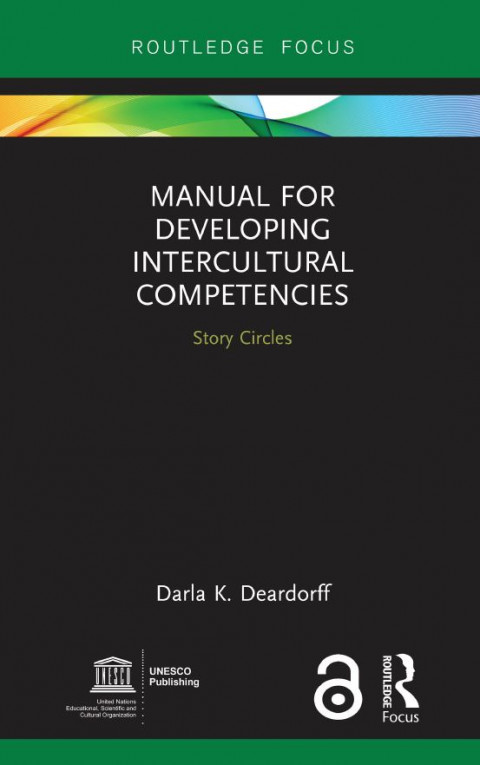 培养跨文化能力手册 : 故事圈 Année de publication: 2020 Auteur: Darla K. Deardorff Auteur institutionnel: UNESCO 该文件详细介绍了用以培养跨文化能力的“故事圈”的方法,包括其使用的工具,操作方法等,同时包括了大量培训资源、案例素材与辅助材料。
 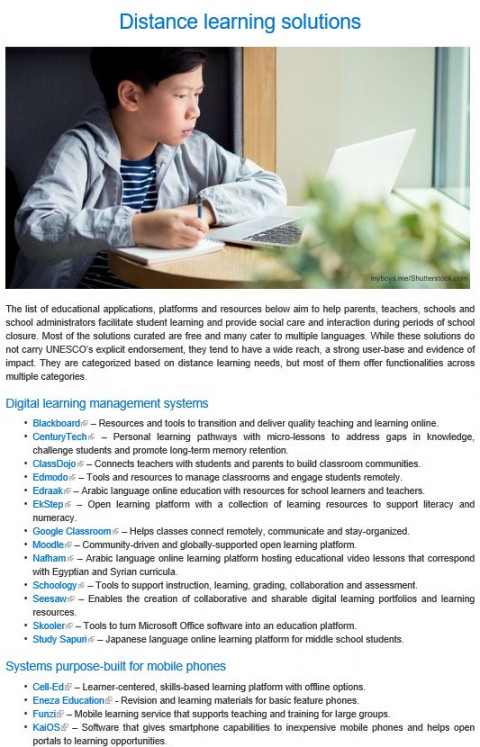 Distance Learning Solutions Année de publication: 2020 Auteur institutionnel: UNESCO The list of educational applications, platforms and resources below aim to help parents, teachers, schools and school administrators facilitate student learning and provide social care and interaction during periods of school closure. Most of the solutions curated are free and many cater to multiple languages. While these solutions do not carry UNESCO’s explicit endorsement, they tend to have a wide reach, a strong user-base and evidence of impact. They are categorized based on distance learning needs, but most of them offer functionalities across multiple categories. Solutions d’apprentissage à distance Année de publication: 2020 Auteur institutionnel: UNESCO La liste d’applications et de plates-formes éducatives ci-dessous vise à aider parents, enseignants, établissements et responsables pédagogiques à faciliter l’apprentissage des élèves et à assurer des interactions et des services sociaux pendant la fermeture des écoles. La plupart des solutions sont gratuites et plusieurs sont multilingues. Bien qu’elles ne soient pas explicitement soutenues par l’UNESCO, ces solutions ont généralement une large portée, de nombreux utilisateurs et une efficacité avérée. Elles sont classées par type de besoin pédagogique mais la plupart présente des fonctionnalités relevant de plusieurs catégories.
  Access to Information: A New Promise for Sustainable Development Année de publication: 2019 Auteur institutionnel: UNESCO The central aim of this study is to unpack the major trends in the field of ATI laws and their implementation. In order to understand the trends, the report examines the activities of trendsetters. It focuses on awareness-raising by UNESCO, Member State recommendations in the Universal Periodic Review, the commitments of the Open Government Partnership, actions of civil society organizations, and the standard-setting activities of such regional intergovernmental organizations as the Council of Europe, the African Union and the Organization of American States.
 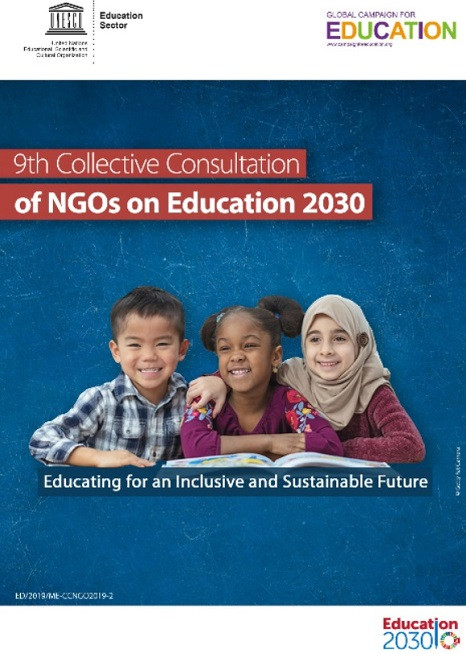 9th Collective Consultation of NGOs on Education 2030: Educating for an Inclusive and Sustainable Future Année de publication: 2020 Auteur institutionnel: UNESCO | Global Campaign for Education (GCE) This includes proceedings and key messages of the 9th Global meeting of the Collective Consultation of NGOs on Education 2030 (CCNGO 2019) organized by UNESCO from 2-5 December 2019 in Hammamet, Tunisia and generously hosted by the Global Campaign for Education (GCE), alongside the Arab Campaign for Education for All (ACEA) and the National Association of the Right to Education (ANDET). The CCNGO 2019 aimed to build on CSOs(Civil Society Organisations) experiences and strong commitments to strengthen collective initiatives towards the realisation of the SDGs and education related targets. The focus and major theme of the Meeting was the role and engagement of civil society organizations in supporting equity and inclusion in the implementation of SDG4-Education 2030 at national, regional and global level. 9e Consultation collective des ONG sur l’Éducation 2030: Éduquer pour un avenir inclusif et durable Année de publication: 2020 Auteur institutionnel: Organisation des Nations Unies pour l'éducation, la science et la culture (UNESCO) | Global Campaign for Education (GCE) Cela comprend les actes et les messages clés de la 9eRéunion mondialede la Consultation collective des ONG sur l’Éducation 2030(CCONG2019) a été organisée par l’UNESCO du 2 au 5 décembre2019 à Hammamet, Tunisie,où elle a été généreusement accueillie par la Campagne mondiale pour l’éducation(CME), la Campagne arabe pour l’éducation pour tous(ACEA) et l’Association nationale du droit à l’éducation(ANDET). La Réunion mondialede la CCONG2019 avait pour but derenforcer les initiatives collectives visant à la mise en œuvre des ODD et des cibles relatives à l’éducation ens’appuyantsur l’expérience des OSC et leur forte mobilisation. La réunion avait pour thèmecentral l’action et l’engagement des organisations de la société civile en faveur de l’équité et de l’inclusion dans le cadre dela mise en œuvre de l’ODD 4 –Éducation 2030aux niveaux national, régional et mondial.
  Country Commitments to Gender Equality in Education Année de publication: 2018 Auteur: Erica Murphy Auteur institutionnel: UNESCO The international community has committed through legal and political frameworks to achieving gender equality in all spheres, including education. These frameworks include obligations to protect and secure women and girls' right to education through the elimination of discriminatory barriers, whether they exist in law or in everyday life, and to undertake positive measures to bring about equality, including in access of, within, and through education.This paper firstly sets out the legal and political frameworks on gender equality in education to which states have committed and then describes how they have committed.In the second section, the content of states’ commitments to achieve gender equality in education is explained, including the normative content of relevant provisions found in international and regional human rights treaties and the 2030 Agenda for Sustainable Development. This section also includes a classification of states according to what legal commitments to women and girls’ right to education they have made.The final section details how states can be held accountable for failure to meet their legal commitments to gender equality in education, including what mechanisms are available and examples of how these mechanisms have been used to hold states accountable.This paper is also background paper prepared for the 2018 Global education monitoring report gender review: Meeting our commitments to gender equality in education.
 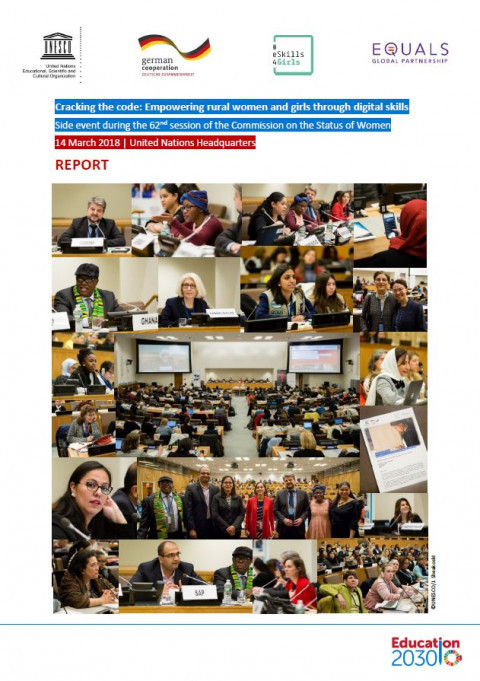 Cracking the Code: Empowering Rural Women and Girls through Digital Skills; Side Event during the 62nd Session of the Commission on the Status of Women, 14 March 2018, United Nations Headquarters: Report Année de publication: 2018 Auteur institutionnel: UNESCO | Germany. Federal Ministry for Economic Cooperation and Development (BMZ) UNESCO and the German Federal Ministry of Economic Cooperation and Development (BMZ) co-organised the side event ‘Cracking the code: Empowering rural women and girls through digital skills’ on 14 March 2018, United Nations Headquarters in New York, on the margins of the 62nd session of the CSW. More than 500 participants participated in the event while a broad global audience followed the discussions through live webcast.This report provides an overview of the discussions and examples of government, civil society organizations, and private sector initiatives to close the gender digital gap and empower rural girls and women to be ICT users, creators and innovators through gender-responsive digital skills training as well as science, technology, engineering and mathematics (STEM) education more broadly.
  UNESCO Regional consultation in sub-saharan Africa: Why teach about genocide? The example of the Holocaust, 10-11 Septembre 2012, Cape Town, South Africa: report Année de publication: 2013 Auteur institutionnel: UNESCO The rst UNESCO consultation on « Why Teach about Genocide? The Example of the Holocaust » was organized following the UNESCO General Conference resolution 34C/61 on Holocaust Remembrance. The consultation of Member States is part of a series of initiatives launched by UNESCO to promote education about the Holocaust and other genocides, in particular with a view to contributing to the prevention of genocide and mass atrocities and promoting education for peace.The consultation took place in Cape Town, South Africa, on 10-11 September 2012 in the presence of senior representatives from the Ministries of Education of 14 countries in Sub-Saharan Africa. The following countries were represented: BENIN, BURUNDI, DEMOCRATIC REPUBLIC OF THE CONGO, CÔTE D’IVOIRE, ETHIOPIA, REPUBLIC OF MAURITIUS, NAMIBIA, KENYA, RWANDA, SENEGAL, SOUTH AFRICA, TANZANIA, TOGO and ZAMBIA. Experts in Holocaust and genocide studies from various countries and institutions were invited to present key issues throughout the consultation and participate in the discussions. The consultation was supervised by the Education Sector of UNESCO/Division of Education for Peace and Sustainable Development/Section of Education for Peace and Human Rights and UNESCO Regional Bureau for Education in Africa (BREDA, Dakar, Senegal)The main purpose of the meeting was to discuss how the history of the Holocaust, and more generally the history of genocide, could be included in the curricula of participating countries. The meeting also clari ed various conceptual and pedagogical issues, and paved the way for further cooperation between UNESCO and participating Ministries of Education on how to launch new educational programmes in interested countries.
  Guidebook on Education for Sustainable Development for Educators: Effective Teaching and Learning in Teacher Education Institutions in Africa Année de publication: 2018 Auteur institutionnel: UNESCO The guidebook on Education for Sustainable Development for Educators: Effective teaching and learning in teacher education institutions in Africa has been conceived as a tool to mainstream sustainability into all aspects of teacher education and training with useful information concerning teaching, learning and assessment approaches to help achieve the ESD goals and learning outcomes.