
Ressources
Explorez une large gamme de ressources sur le GCED afin d’approfondir votre compréhension et de renforcer vos activités de recherche, de plaidoyer, d’enseignement et d’apprentissage.
328 résultats trouvés
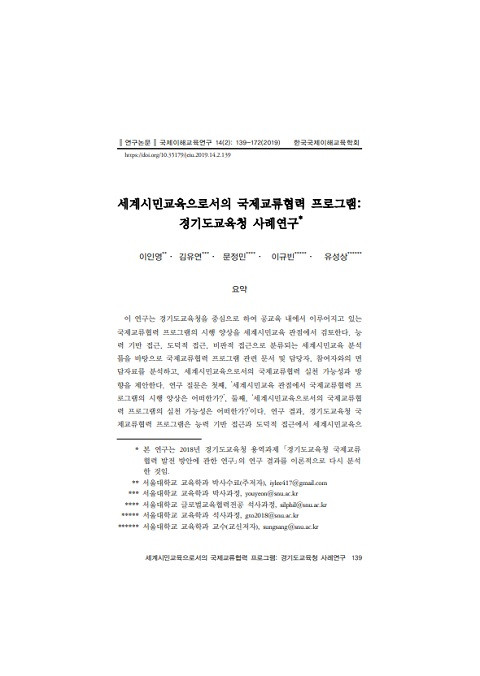 International Exchange and Cooperation Programs as Global Citizenship Education: A Case Study of the Gyeonggi Provincial Office of Education (Journal of Education for International Understanding; Vol. 14, No. 2) Année de publication: 2019 Auteur: Inyoung Lee | Youyeon Kim | Jeongmin Moon | Kyubin Lee | Sungsang Yoo Auteur institutionnel: Korean Society of Education for International Understanding (KOSEIU) This study examines the implementation of international exchange programs conducted within public education, focusing on the Gyeonggi Provincial Office of Education from the standpoint of global citizenship education. It also proposes the feasibility and direction of international exchange programs based on the analytical framework that analyses the global citizenship education as the competency-based approach, moral approach, and critical approach. The research questions are: first, 'what is the aspects of the implementation of international exchange programs in terms of global citizenship education?' and second, 'what is the possibility of implementing international exchange programs as global citizenship education?' To find the answer to the questions, documents related to the international exchange program and data from interviews with the person in charge and the participants of programs were analyzed. This paper found that there is a feasibility for implementing the competency-based approach and moral approach in the international exchange programs. However, in order to invigorate international exchange as the practice of global citizenship education, it is recommended that: first, international exchange from the viewpoint of critical approach should be developed. Second, every student should have the opportunity to participate in the programs regardless of their economic status. Lastly, target nations for international exchange should be chosen not only from the competency-based approach but from the various perspective of global citizenship education. 세계시민교육으로서의 국제교류협력 프로그램: 경기도교육청 사례연구 (국제이해교육연구; Vol. 14, No. 2) Année de publication: 2019 Auteur: 이인영 | 김유연 | 문정민 | 이규빈 | 유성상 Auteur institutionnel: 한국국제이해교육학회 이 연구는 경기도교육청을 중심으로 하여 공교육 내에서 이루어지고 있는 국제교류협력 프로그램의 시행 양상을 세계시민교육 관점에서 검토한다. 능력 기반 접근, 도덕적 접근, 비판적 접근으로 분류되는 세계시민교육 분석틀을 바탕으로 국제교류협력 프로그램 관련 문서 및 담당자, 참여자와의 면담자료를 분석하고, 세계시민교육으로서의 국제교류협력 실천 가능성과 방향을 제안한다. 연구 질문은 첫째, ‘세계시민교육 관점에서 국제교류협력 프로그램의 시행 양상은 어떠한가?’, 둘째, ‘세계시민교육으로서의 국제교류협력 프로그램의 실천 가능성은 어떠한가?’이다. 연구 결과, 경기도교육청 국제교류협력 프로그램은 능력 기반 접근과 도덕적 접근에서 세계시민교육으로서의 실천 가능성을 보였다. 그러나 향후 세계시민교육의 실천으로서 국제교류협력을 활성화하기 위해서는 다음과 같은 개선방안을 제안한다. 첫째, 비판적 접근에서의 세계시민교육에 기반한 국제교류협력을 강화해야 한다. 둘째, 국제교류협력에 가정의 경제적 배경과 관심에 상관없이 모든 학생이 참여할 수 있도록 운영되어야 한다. 셋째, 능력 기반 접근에 한정되지 않고 다양한 관점에서 세계시민교육에 접근하여 교류 대상 국가를 선정할 필요가 있다.
 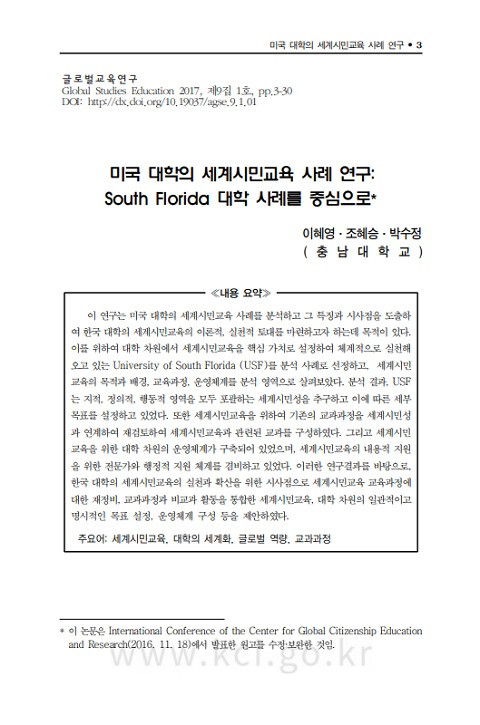 A Case Study on Global Citizenship Education of University of South Florida (Global Studies Education; Vol. 9, No. 1) Année de publication: 2017 Auteur: Hyeyoung Lee | Hyeseung Cho | Soojung Park Auteur institutionnel: Global Studeis Education Association This study investigates the issues for the practice of global citizenship education in universities and analyses a case study of the university in US. The University of South Florida (USF), which defines global citizen education as one of the core strategic plans of the university, is selected. Global citizenship education at USF is aimed at strengthening students' global competencies; global awareness, responsibility and participation. The goals of the practice are globalization of the undergraduate general education curriculum, extra-curricular activities in connection with the curriculum, globalized curriculum leading to graduate courses, and enhancing global competencies of all university members. It is reported that USF dedicated special organizations and systematic operation to support these goals. Based on our investigation and analysis, a reform of the global citizen education curriculum, a global citizenship education that integrates the curriculum and the extra-curricular activities, a coherent and explicit goal setting at the university level, and an operating system structure are required for universities in Korea to promote global citizenship education. 미국 대학의 세계시민교육 사례 연구: South Florida 대학 사례를 중심으로 (글로벌교육연구; Vol. 9. No. 1) Année de publication: 2017 Auteur: 이혜영 | 조혜승 | 박수정 Auteur institutionnel: Global Studeis Education Association 이 연구는 미국 대학의 세계시민교육 사례를 분석하고 그 특징과 시사점을 도출하여 한국 대학의 세계시민교육의 이론적, 실천적 토대를 마련하고자 하는데 목적이 있다. 이를 위하여 대학 차원에서 세계시민교육을 핵심 가치로 설정하여 체계적으로 실천해오고 있는 University of South Florida (USF)를 분석 사례로 선정하고, 세계시민교육의 목적과 배경, 교육과정, 운영체계를 분석 영역으로 살펴보았다. 분석 결과, USF는 지적, 정의적, 행동적 영역을 모두 포괄하는 세계시민성을 추구하고 이에 따른 세부 목표를 설정하고 있었다. 또한 세계시민교육을 위하여 기존의 교과과정을 세계시민성과 연계하여 재검토하여 세계시민교육과 관련된 교과를 구성하였다. 그리고 세계시민교육을 위한 대학 차원의 운영체계가 구축되어 있었으며, 세계시민교육의 내용적 지원을 위한 전문가와 행정적 지원 체계를 겸비하고 있었다. 이러한 연구결과를 바탕으로, 한국 대학의 세계시민교육의 실천과 확산을 위한 시사점으로 세계시민교육 교육과정에 대한 재정비, 교과과정과 비교과 활동을 통합한 세계시민교육, 대학 차원의 일관적이고 명시적인 목표 설정, 운영체계 구성 등을 제안하였다.
  Global Citizenship Education in the Primary Geography Curriculum of the Republic of Korea: Content Analysis Focusing on the Semantic Structure of 2009 Revised School Curriculum (Journal of the Korean Geographical Society; Vol. 49, No. 6) Année de publication: 2014 Auteur: Dongmin Lee Auteur institutionnel: Korean Geographical Society The purpose of this study is to analyze the share of global citizenship education in the 2009 Revised Social Studies (geography area) School Curriculum of the Republic of Korea. I selected the achievement standards of the geography domain in the fifth and sixth grades as the subjects of analysis. The chosen subjects were examined using content analysis: I used KrKwic, a Korean language content analysis tool, to analyze the content and drew a semantic network of the analysis results using UciNet/NetDraw. I found that the geography domain of the 2009 Revised Primary School Curriculum included the concepts of and factors of global citizenship education. However, global citizenship education did not account for a major portion of the curriculum, and the curriculum achievement standards were noticeably nation-state centered. Global citizenship education factors were not closely associated with to other related factors in fact, they even revealed a isolated pattern. These findings suggest that the inclusion of global citizenship education in primary geography education is limited, because the connections between global citizenship education and related contents, such as the environment, sustainable development, conflict, and cooperation, are probably impeded. Globalization accompanies the transformation of territories, identities, and the relations between nation-states and the world, although nation-states continue to play a significant role in the globalized worlds. Therefore global citizenship education, a educational trend focusing on the global community, is particularly important and is required in the geography curriculum of the global era. I expect that the examination undertaken in this study to contribute to future curriculum revisions regarding globalizatin and global citizenship. 초등지리 교육과정에 반영된 세계시민교육 관련 요소의 구조적 특성에 관한 연구: 2009 개정 교육과정 성취기준에 대한 내용분석을 중심으로 (대한지리학회지; Vol. 49, No. 6) Année de publication: 2014 Auteur: 이동민 Auteur institutionnel: 대한지리학회 본 연구의 목적은 현행 2009 개정 초등사회과 지리영역 교육과정에 반영된 세계시민교육 관련 요소의 구조적 특성을 분석하는데 있다. 분석대상으로는 세계에 관한 부분을 다룬 5~6학년군 지리영역 교육과정의 성취기준을 선정하였으며, 한글 텍스트의 내용분석을 위한 소프트웨어인 KrKwic 및 의미연결망 분석도구인 UciNet/NetDraw를 활용하여 관련 개념의 출현빈도 및 의미연결망, 연결중심성을 분석하였다. 분석 결과 2009 개정 초등사회과 지리영역 교육과정은 세계시민성 함양 등 세계시민교육의 이상과 요소를 반영하고는 있지만, 교육과정상의 세계에 대한 단원들은 세계나 세계공동체 등 세계시민교육 관련 요소보다는 주로 국가를 중심으로 구성되는 특성을 보이고 있었다. 세계시민교육 관련 요소는 교육과정 성취기준상에서의 출현빈도가 낮았을 뿐만 아니라, 세계와 관련된 주요 개념들과 밀접한 관계를 맺지 못한채 사실상 고립되다시피한 특성을 나타내었다. 이로 인해 환경 및 지속가능개발, 갈등, 협력 등 세계시민교육적으로 접근할 필요성이 높은 개념들 역시 세계시민교육적인 관점과 연결될 수 있는 가능성이 제한될 수 있다는 문제점도 지적된다. 세계화 시대에는 국가도 중요한 역할을 하지만, 기존의 국가 경계가 투과적인 형태로 변화하고 국경을 넘어선 세계공동체적 관점이 중요시되는만큼 지리교육 역시 이러한 현실을 감안하여 세계시민교육적 요소를 보다 적극적으로 반영할 필요성이 제기된다. 이러한 논의를 향후 교육과정 개정에 반영함으로써, 국가뿐만 아니라 세계공동체 또한 중요시되는 세계화 시대에 보다 높은 적합성을 갖는 교육과정을 구성할 수 있으리라고 기대된다.
  Global Citizenship Education in the Social Studies Curriculum: from the 6th curriculum to the 2015 revised curriculum (Educational Research; Vol. 58) Année de publication: 2017 Auteur: Jungwoo Lee Auteur institutionnel: Sungshin Women's University Educational Research Institute This study is an comparative analysis study about global citizenship education(GCED) in the socials studies curriculum from the 6th curriculum to the 2015 revised curriculum. The main findings of this study are as follows: First, from the 6th curriculum, the themes related with GCED has been appeared in 5th-6th grades and 7th-9th grades. From 2007 revised curriculum, 3rd-4th grades also have dealt with GCED in the standards related with 'culture' or 'minority'. Second, cognitive domain was the most predominant goal of GCED among cognitive, emotional and behavioral domains. Third, overall predominant perception is 'national' but 'world justice and governance', ‘neoliberalism’ are also reflected in the curriculum. 사회과 교육과정에 반영된 세계시민교육: 제6차 교육과정에서 2015 개정 교육과정의 변화를 중심으로 (교육연구; Vol. 68) Année de publication: 2017 Auteur: Jungwoo Lee Auteur institutionnel: Sungshin Women's University Educational Research Institute 이 연구는 제6차 교육과정에서 2015 개정 교육과정까지의 초등학교와 중학교 사회과 교육과정의 성격과 목표, 성취기준에 반영되어 있는 세계시민교육 관련 내용을 분석한 것이다. 분석 결과는 세 가지로 요약된다. 첫째, 세계시민교육 관련 주제는 초등학교 5-6학년과 중학교 급에서는 제6차 교육과정부터 꾸준히 등장하였다. 초등학교 3-4학년의 경우 2007 개정 교육과정부터 다양성 및 소수자와 관련된 내용으로 세계화 관련 내용이 제시되기 시작하였다. 둘째, 인지, 정서, 행동 영역 중에서는 전반적으로 인지적 영역에 대한 강조가 상대적으로 강하게 나타났다. 하지만 초등학교 5-6학년 군에서는 교육과정 개정이 거듭될수록 인지, 정서, 행동 영역에 대한 강조가 고르게 나타나고 있는 반면, 3-4학년군은 상대적으로 정서 영역이, 중학교 급은 인지 영역에 대한 강조가 강하게 나타나는 등 학교 급별 차이가 있었다. 셋째, 관점 면에서는 국가주의적 관점이 지배적인 가운데 세계정의와 거버넌스, 신자유주의 관점이 혼재되어 있었다. 이러한 분석 결과가 교육과정 및 교수학습에 시사하는 바를 논의하였다.
  Study on Youth participated on the Development of Global Citizenship: Focused on A case of Community Link Extra Curricular School Activities (Forum for Youth Culture; Vol. 36) Année de publication: 2013 Auteur: Oksoon Kim | Insoon Shin Auteur institutionnel: Research Center for Korean Youth Culture The purpose of this study is to investigate the effects of global citizenship program that had been provided as a CLECSA for creativity to middle school students. Global citizenship program had been administered by the specialists of Hanbart welfare center at Dae Jeon city during the 2nd semester of 2012. Achieving the purpose of study, researchers compare 216 students who had the global citizenship program with 71 student who did not have in terms of ① universal value of human being, ②respect for diversity, ③ interests in global issues, ④ intension of participating in problem solving, ⑤ inclination for globalization. From the analysis of the questionnaires, three important result has been came out. First, female students showed high scores in the area of interests in global issues but low in the area of intension of participating in problem solving. Second, experience of going abroad did not affect the global citizenship, however, the experience of staying foreign countries over one year affected the global citizenship, especially in the area of universal value of human being, respect for diversity, and inclination for globalization. Third, a group of students who had the global citizenship program showed high scores in the area of interests in global issues and intention of participating in problem solving. Based upon the research findings, researchers suggested that CLECSA for creativity should reinforce in terms of quantity and quality and develop the diverse programs for multicultural education on the basis of global education. 세계시민교육 참여 청소년에 관한 연구: 지역사회 연계형 창의적 체험활동의 일례를 중심으로 (청소년문화포럼; Vol. 36) Année de publication: 2013 Auteur: 김옥순 | 신인순 Auteur institutionnel: 한국청소년문화연구소 본 연구는 세계시민교육 프로그램의 효과를 고찰하고자, 2012년 2학기 중 대전의 한밭복지관이 주관한 창의적 체험활동에 참여했던 중학생 216명과 일반 중학생 71명 등 총 287명을 대상으로 인간의 보편적 가치, 다양성에 대한 가치존중, 세계문제에 대한 흥미와 관심, 문제해결에 대한 참여의지, 세계지향성 등 5개 영역의 세계시민의식을 비교하는 설문조사를 실시하여 분석한 것이다. 이를 통해 밝혀진 연구 결과는 다음과 같다. 첫째, 여자 청소년은 다양성에 대한 가치존중이 남자 청소년 보다 높지만, 세계문제에 대한 흥미와 관심, 그리고 문제해결에 대한 참여의지는 낮았다. 둘째, 외국에 가본 경험 유무는 세계시민의식에 유의미한 차이를 보이지 않았고, 외국에서 1년 이상 살아본 경험이 있는 청소년은 인간의 보편적 가치, 다양성에 대한 가치존중, 세계지향성 등 3개 영역의 점수가 높은 것으로 나타났다. 셋째, 세계시민교육 프로그램에 참여한 청소년은 일반 청소년보다 세계문제에 대한 흥미와 관심이 많았고, 문제해결에 대한 참여의지도 높았다. 본 연구는 이러한 연구 결과를 통해, 창의적 체험활동 시간을 이용한 세계시민교육의 양적, 질적인 보완과 지역사회와의 다양한 연계 방안, 다문화에 대해 높아지는 관심과의 연계 등을 제안하였다.