
Ressources
Explorez une large gamme de ressources sur le GCED afin d’approfondir votre compréhension et de renforcer vos activités de recherche, de plaidoyer, d’enseignement et d’apprentissage.
45 résultats trouvés
 Introducing quality assurance of education for democratic citizenship in schools - comparative study of 10 countries Année de publication: 2009 Auteur institutionnel: Council of Europe For over a decade the Council of Europe has been working on policies in the field of education for democratic citizenship (EDC). One result has been that the Committee of Ministers of the Council of Europe agreed on a recommendation stating that EDC is central to educational politics, and that it is a “factor for innovation in terms of organising and managing overall education systems, as well as curricula and teaching methods” (Recommendation Rec(2002)12). According to this recommendation, European governments acknowledged their responsibility for ensuring the cultural basis of democracy through education. However, politics is not so simple that supranational recommendations are immediately translated into policy in national states. This gap between agreed and realised policies has been termed a “compliance gap”. One of the most logical reasons for noncompliance comes from a lack of awareness or competences. Therefore the Council of Europe concentrated on producing materials that could help raise awareness and develop competences. Key products resulting from this effort have been collected as an “EDC/HRE Pack” since 2005.This collection covers the areas of policy making, democratic governance of educational institutions, teacher training and quality assurance. The “Tool for Quality Assurance of Education for Democratic Citizenship in Schools” (Bîrzea et al., 2005), which is one of these materials, forms the reference document for this study.This study analyses relevant conditions and possible activities with regard to implementing the tool in 10 national educational systems. As relevant conditions, the study considers the existing attempts to deliver educational quality within countries, together with the teacher training programmes that accompany these attempts. As possible activities, national adaptations of the tool, and various ways of working with different target groups, are also taken into account.The following sections provide background information concerning the project. This will help the reader understand why the tool needs to be adapted in different circumstances. Section 2 presents points of reference that open theoretical perspectives on the work presented. Section 3 provides a rationale for the selection of participating countries and gives and describes the methodology used when conducting this study. Finally, Section 4 provides an overview of the remaining contents of this book.
 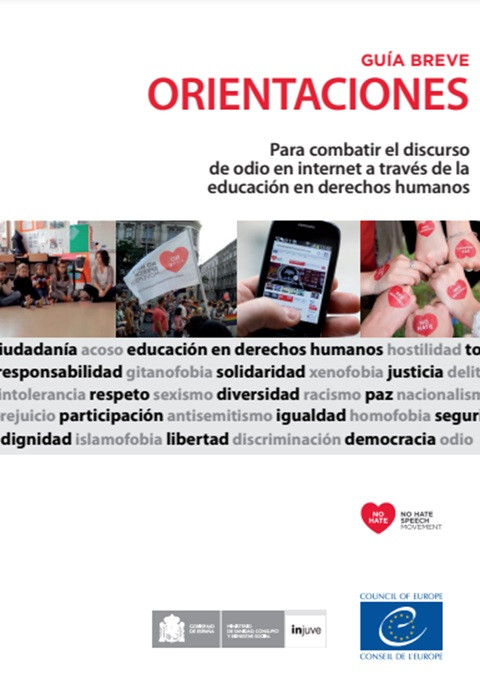 Brief Guidance Guide: To Combat Hate Speech on the Internet Through Human Rights Education Année de publication: 2016 Auteur: Ellie Keen | Mara Georgescu Auteur institutionnel: Youth Institute | Council of Europe The Youth Institute has published “Bookmarks”, a guide to combat hate speech on the Internet, which aims to be a brief and useful manual for the dissemination of concepts related to human rights and freedom of expression, as well as to raise and face the challenge of defending these rights on the Internet from a young perspective. It also aims to become a practical tool for action, training and awareness-raising work, aimed at both young people themselves and trainers, to establish in a simple way the essential concepts related to online hate speech and provide mechanisms to combat it. Guía breve orientaciones: Para combatir el discurso de odio en internet a través de la educación en derechos humanos Année de publication: 2016 Auteur: Ellie Keen | Mara Georgescu Auteur institutionnel: Youth Institute | Council of Europe El Instituto de la Juventud ha editado “Orientaciones”, una guía para luchar contra el odio en internet que pretende ser un breve manual útil para la difusión de los conceptos relacionados con los derechos humanos y la libertad de expresión, así como plantear y afrontar el reto de defender estos derechos en internet desde una perspectiva joven. También nace con el objetivo de convertirse en una herramienta práctica para la acción, el trabajo formativo y de sensibilización, dirigida tanto a los propios jóvenes como a los formadores, para fijar de manera sencilla los conceptos esenciales relacionados con el discurso de odio online y aportar mecanismos para combatirlo.
  Higher Education and Democratic Culture: Citizenship, Human Rights and Civic Responsibility (Council of Europe Higher Education Series No.8) Année de publication: 2008 Auteur: Josef Huber | Ira Harkavy Auteur institutionnel: Council of Europe This book on the responsibility of higher education for a democratic culture is the 8th volume in the Council of Europe's Higher Education series. It is the direct result of a Higher Education Forum held in June 2006 on the responsibility of higher education for citizenship, human rights and sustainability. This forum was a part of the Council of Europe's long-standing commitment to work in the area of education for democratic citizenship and human rights. It complements earlier work on the public responsibility for higher education and research which led to a recommendation of the Committee of Minister to the member states of the Council of Europe in 2007. If our aim is to work for sustainable democratic societies, the responsibility of public authorities for a high-quality higher education system must go hand in hand with the responsibility of higher education institutions towards the advancement of society.
  Mapping of Media Literacy Practices and Actions in EU-28 Année de publication: 2016 Auteur institutionnel: European Audiovisual Observatory | Council of Europe A project conducted by the European Audiovisual Observatory and financed by the European Commission This study aims at analysing the various media literacy initiatives on a national or regional level in order to provide an overview of what is currently being undertaken. This is the first major mapping exercise to survey the field in Europe. Although this study does not aim at covering the entire media literacy initiatives, it provides a detailed overview of the main trends, coming out of a selection of 547 featured projects involving 939 stakeholders across the European Union, which were identified through a questionnaire addressed at national experts from the different EU-28 member states. So what is Europe doing to encourage our media literacy? What measures are being taken at national and European levels to foster our critical appreciation and understanding of the mass media? The results of this study can be found in a general report accompanied by 4 annexes: Annex 1 provides national summaries showing the findings of the responses concerning each of the 28 EU member states; Annex 2 contains the list of the 547 featured projects; Annex 3 summarises the 145 case-study projects; Annex 4 contains the original responses from the 29 national experts, which are accessible in separate files available on the website of the European Commission.
  Regulatory Authorities for Electronic Media and Media Literacy: Comparative Analysis of the Best European Practices Année de publication: 2018 Auteur: Robert Tomljenović Auteur institutionnel: Council of Europe Information event for stakeholders of the media community in Serbia on presentation of the Study “Regulatory Authorities for Electronic Media and Media Literacy - Comparative analysis of the best European practices” was organized by the Council of Europe Office in Belgrade, JUFREX Programme and the Embassy of Finland in Serbia, on 20 December 2018, in order to jointly point out the importance of the development of media literacy in Serbia and the Western Balkans region.The study analyzes and indicates challenges and issues that come with living in a digitalized, hypertechnological mediated world, in which we are faced with countless information, issues of disinformation and fake news, algorithmic separation in ideological echo chambers, hate speech, clickbait journalism, and decreased trust in both mainstream media and the level of journalistic professionalism. With such a media ecosystem, it is vital to define the position of a regulatory authority for electronic media as well as its responsibilities and obligations, and stress the regulator's role in promoting and developing media literacy, one of the key skills for living in the 21st century and the answer to many questions and challenges that come with the modern era."The Council of Europe considers media literacy one of the main tools for strengthening media pluralism and the quality of media content. All media actors in Serbia have the responsibility to promote media literacy to enable understanding and critical analysis of content offered by traditional and digital media. Especially children have the right to a safe and stimulating media environment" said Head of the Council of Europe Office in Belgrade, Tobias Flesenkemper.The study emphasizes that a prerequisite for every democratic process is a well-informed citizen. The Study presents several examples of best European practices and how to engage regulatory bodies and all other relevant actors to increase media literacy, with a particular focus on the Finnish model in this area. Media education is implemented in Finland wherever there are children and youth, not only in kindergartens and schools, but also in libraries, playrooms, youth centers, even in virtual communities and digital games.As pointed out by the Ambassador of Finland in Belgrade, Perti Ikonen, the high level of media literacy of citizens is what the media in Finland forces to adhere to high professional standards, and basically the work of the institutions responsible for the promotion of media literacy. Finland took over the chairmanship of the Committee of Ministers of the Council of Europe in November this year, and during its term of office, until May 2019, the priorities of the Finnish Presidency will be to strengthen the human rights and rule of law system in Europe, support equality as well as inclusiveness with a particular focus on youth and the prevention of radicalization.The study was developed within the framework of the Joint European Union and the Council of Europe Programme "Strengthening the Judicial Expertise on Freedom of Expression and Media in South-East Europe (JUFREX)".
 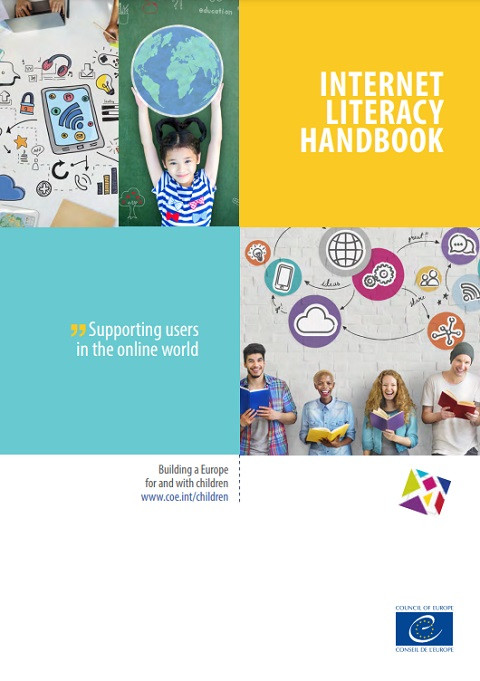 Internet Literacy Handbook: Supporting Users in the Online World Année de publication: 2017 Auteur: Janice Richardson | Elizabeth Milovidov | Martin Schmalzried Auteur institutionnel: Council of Europe Since the first edition of the Internet Literacy Handbook was issued in 2003 the world of the Internet has changed tremendously. The number of Internet users has risen; users are increasingly younger, trends in how people use the Internet and what they are looking for evolve, and new pitfalls in, for example, personal security arise seemingly overnight.This new edition takes into account the myriad changes, although the object of the Handbook still remains, namely to offer families, educators and policy-makers sufficient technical know-how to allow them to navigate, with young people, through communication technology. The new edition also expands the scope of the Fact sheets anchoring previously “new” concepts of digital citizenship and digital parenting. This edition includes 26 Fact sheets arranged under 6 thematic headings including a heading specifically dedicated to “Looking Forward” towards the future of the Internet. The Handbook is designed to be easy to use and helpful, as illustrated by the Fact sheet entitled “Finding quality information on the Web”. It is also available online, where it can be downloaded either in its full format or per individual factsheet. Manuel de maîtrise de l'internet: Accompagner les utilisateurs dans le monde en ligne Année de publication: 2017 Auteur: Janice Richardson | Elizabeth Milovidov | Martin Schmalzried Auteur institutionnel: Conseil de l'Europe Depuis la publication de la première édition du Manuel de maîtrise d’Internet en 2003, le monde en ligne a beaucoup changé. Les Internautes sont de plus en plus jeunes, leur nombre a augmenté, leurs usages d’Internet et l’objet de leurs recherches évoluent et de nouveaux dangers, par exemple en matière de sécurité individuelle, apparaissent chaque jour. Cette nouvelle édition tient compte de ces nombreux changements mais conserve son objectif, qui est de donner aux familles, aux enseignants et aux décideurs politiques des connaissances techniques suffisantes pour pouvoir naviguer, avec les jeunes, dans le monde des technologies de la communication. La nouvelle édition étend également le contenu des Fiches d’information aux concepts qui étaient alors «nouveaux» de citoyenneté numérique et de parentalité numérique, ce qui porte le nombre de fiches à 26, organisées en six thématiques dont l’une est spécialement consacrée à l’avenir d’Internet. Le manuel se veut convivial et pratique, comme l’illustre la fiche intitulée « Trouver de l’information de qualité sur le web ». Il est également accessible en ligne où il peut être téléchargé dans son intégralité ou fiche par fiche. COMPASS: a manual on human rights education with young people Année de publication: 2012 Auteur: Patricia Brander Auteur institutionnel: Council of Europe Compass was first published in 2002 within the framework of the Human Rights Education Youth Programme of the Directorate of Youth and Sport of the Council of Europe. The programme was created because human rights education – meaning educational programmes and activities that focus on promoting equality in human dignity – was and remains of incalculable value in shaping a dimension of democratic citizenship for all young people and in promoting a culture of universal human rights.Compass has become a reference manual for many young people involved in value-based youth work and non-formal education. It is currently available in more than 30 languages, ranging from Arabic and Japanese to Icelandic and Basque. In some countries it has become part of the resources for human rights education in schools and in some others it is not possible to use it in schools. The adventures of Compass across Europe often mirror the contrasted reality of human rights education: promoted here and combated there, praised by some and despised by others.The success of Compass has been followed by its younger sibling, Compasito – a manual for human rights education with children is already available in several languages and on the way to becoming another bestseller for human rights education. More importantly, Compass and its publication in various language versions has been the medium through which human rights education has been brought onto the agenda of youth work and into the programme of many schools. National networks for human rights education have been created in several countries, where they reinforce the work done by human rights organisations and educational professionals in making the right to human rights education a reality to more children and young people across Europe. The forum on human rights education with young people, Living, Learning, Acting for Human Rights, held in Budapest in 2009, stressed the importance of human rights education today. COMPASS: un manuel sur l'éducation aux droits de l'homme avec les jeunes Année de publication: 2012 Auteur: Patricia Brander Auteur institutionnel: Conseil de l'Europe Compass a été publiée en 2002 dans le cadre du Programme Jeunesse d'Éducation aux Droits de l'Homme de la Direction de la Jeunesse et du Sport du Conseil de l'Europe. Le programme a été créé parce que l'éducation aux droits de l'homme - à savoir les programmes et les activités qui mettent l'accent sur la promotion de l'égalité dans la dignité humaine éducation - a été et reste d'une valeur inestimable dans l'élaboration d'une dimension de la citoyenneté démocratique pour tous les jeunes et à promouvoir une culture des droits humains universels. Compass est devenu un manuel de référence pour de nombreux jeunes impliqués dans le travail de la jeunesse fondée sur des valeurs et de l'éducation non formelle. Il est actuellement disponible dans plus de 30 langues, allant de l'arabe et le japonais à l'islandais et le basque. Dans certains pays, il est devenu une partie des ressources pour l'éducation aux droits de l'homme dans les écoles et dans certains autres, il est impossible de l'utiliser dans les écoles. Les aventures de Compass en Europe reflètent souvent la réalité contrastée de l'éducation aux droits de l'homme: promotion ici et là combattu, loué par les uns et méprisé par les autres. Le succès de Compass a été suivi par son frère cadet, Compasito - un manuel pour l'éducation aux droits de l'homme avec les enfants est déjà disponible en plusieurs langues et sur la façon de devenir un autre best-seller pour l'éducation aux droits de l'homme. Plus important encore, Compass et sa publication dans différentes versions linguistiques a été le moyen par lequel l'éducation aux droits de l'homme a été mis sur l'ordre du jour du travail de jeunesse et dans le programme de nombreuses écoles. Les réseaux nationaux pour l'éducation aux droits de l'homme ont été créés dans plusieurs pays, où ils renforcent le travail accompli par les organisations des droits humains et professionnels de l'éducation à faire du droit à l'éducation des droits de l'homme une réalité à plus d'enfants et de jeunes à travers l'Europe. Le forum sur l'éducation aux droits de l'homme avec les jeunes, la vie, l'apprentissage, agir pour les droits de l'homme, tenue à Budapest en 2009, a souligné l'importance de l'éducation aux droits de l'homme aujourd'hui.