
Ressources
Explorez une large gamme de ressources sur le GCED afin d’approfondir votre compréhension et de renforcer vos activités de recherche, de plaidoyer, d’enseignement et d’apprentissage.
884 résultats trouvés
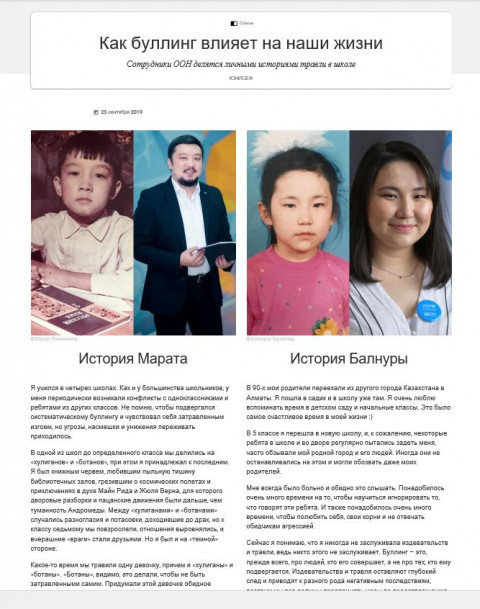 Как буллинг влияет на наши жизни Année de publication: 2019 Auteur institutionnel: UNICEF Kazakhstan В данной статье сотрудники ООН делятся личными историями травли в школе.
 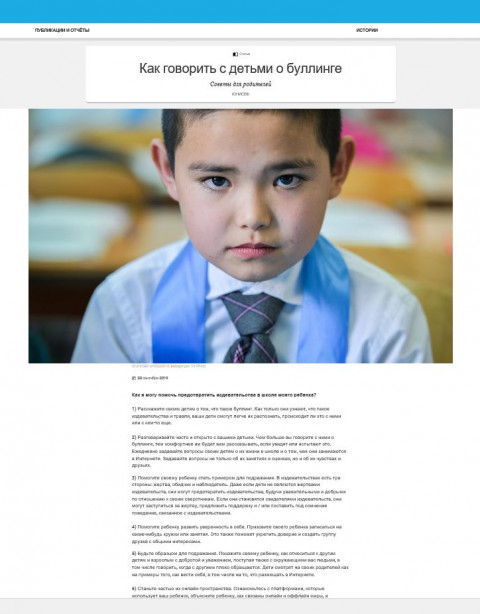 How to Talk with Children About Bullying: Tips for Parents Année de publication: 2019 Auteur institutionnel: UNICEF Kazakhstan In this article, parents are offered practical advice on how to talk with children about bullying in order to prevent its occurrence and teach children how to effectively counteract it. Как говорить с детьми о буллинге: Советы для родителей Année de publication: 2019 Auteur institutionnel: UNICEF Kazakhstan В данной статье вниманию родителей предлагаются практические советы о том, как говорить с детьми о буллинге, чтобы предотвратить его проявления и научить детей эффективно ему противодействовать.
  Противодействие насильственному экстремизму: Вводное руководство по концепциям, разработке программ и передовой практике Année de publication: 2019 Auteur institutionnel: Search for Common Ground Данная учебная программа направлена актуализацию передовых методов и опыта, накопленного в процессе противодействия насильственному экстремизму. Программа по противодействию насильственному экстремизму, адаптированная для Центральной Азии, предназначена для подготовки государственных служащих и работников из организаций гражданского общества. Это контекстуально грамотная и удобная для восприятия учебная программа по противодействию насильственному экстремизму и повышению осведомленности, учитывающая вашу специфику. В ней освещаются преимущества подходов к сотрудничеству, выходящих за рамки применения военных или секьюритизированных мер реагирования на насильственный экстремизм и подкрепленных передовой практикой, а также предлагаются инструменты и рекомендации для простойадаптации к вашим локальным условиям и культуре. Наконец, программа способствует раннему выявлению и смягчению рисков посредством разработки программ, а также использования подхода «Не навреди» (Do No Harm).Данная программа предлагает руководство по разработке, реализации и мониторингу конструктивных мер противодействия насильственному экстремизму, при этом также давая общее представление об управлении проектами. Таким образом, данная учебная программа не направлена на развитие общих навыков управления проектами, мониторинга и оценки или на привлечение средств. Поскольку проблема насильственного экстремизма сложна и в значительной степени зависит от локального контекста, программа также не является руководством по движущим силам радикализации в вашем местном контексте и не предлагает программы и политику, которые могли бы быть наиболее эффективными. Вместо этого программа познакомит вас с наводящими вопросами и инструментами, необходимыми для принятия обоснованных и эффективных решений в вашей работе по противодействию насильственному экстремизму.
  Security, Extremism and Education: Safeguarding or Surveillance? Année de publication: 2015 Auteur: Lynn Davies This article analyses how education is positioned in the current concerns about security and extremism. Initially, a central dilemma is acknowledged: that schooling appears to be simultaneously irrelevant to the huge global questions of security and yet central to the learning of alternative ways to conduct human relations. With regard to extremism, two aspects of importance in ideological compliance or challenge are firstly the attempted securitization of education, and secondly the role of education in young people joining or supporting extremist movements. Educational approaches within transitional justice underline the importance of tackling violence in schools and promoting a human rights culture that promotes both human security and ultimately national security. Security, Extremism and Education: Safeguarding or Surveillance? Année de publication: 2015 Auteur: Lynn Davies Cet article analyse le rôle de l'éducation dans les préoccupations actuelles concernant la sécurité et l'extrémisme. Dans un premier temps, on reconnait le problème fondamental suivant : à priori, il n’y a aucun rapport entre l'école et la question pressante de la sécurité dans le monde, et pourtant l’école est clé dans l'apprentissage des différents moyens de gestion des relations interpersonnelles. En ce qui concerne l'extrémisme, deux aspects de l’adhésion à une idéologie ou de la défiance sont importants : d'une part les efforts pour sécuriser l'éducation, et d'autre part le rôle de l'éducation vis-à-vis des jeunes rejoignent ou soutiennent des mouvements extrémistes. Les approches éducatives au sein de la justice transitionnelle soulignent l'importance de lutter contre la violence dans les écoles et de promouvoir une culture des droits de l'homme favorisant à la fois la sécurité humaine et la sécurité nationale.
  UNITED NATIONS HUMAN RIGHTS MECHANISMS and the Right to Education in Insecurity and Armed Conflict Auteur: Takhmina Karimova | Gilles Giacca | Stuart Casey-Maslen Auteur institutionnel: Geneva Academy of International Humanitarian Law and Human Rights This publication, United Nations Human Rights Mechanisms and the Right to Education in Insecurity and Armed Conflict, seeks to respond to the acute need to identify trends in the practice, and contribution, of United Nations human rights mechanisms to the protection of education in times of insecurity and conflict. It is the result of a one-year research project carried out by researchers at the Geneva Academy of International Humanitarian Law and Human Rights (Geneva Academy). The research was overseen by a Legal Advisory Committee and subject to multi-disciplinary peer review. Accompanying the publication is a summary policy document intended to guide future work in this area. An electronic version of each publication is available at http://www.geneva-academy.ch and at http://www.educationandconflict.org.United Nations Human Rights Mechanisms and the Right to Education in Insecurity and Armed Conflict is the second in a series of legal research documents commissioned by Protect Education in Insecurity and Conflict (PEIC) on the protection of education during insecurity and armed conflict. PEIC is a programme of the Education Above All Foundation, an independent organization chaired by Her Highness Sheikha Moza Bint Nasser of Qatar, UNESCO Special Envoy for Basic and Higher Education. A policy, research, and advocacy organization, PEIC is concerned with the protection of education during insecurity and armed conflict. PEIC’s Legal Programme contributes to such protection through the strategic use of international and national law. Its legal research papers are authored by academics and/or practicing lawyers. They are aimed at a varied audience, including international and national lawyers; non-legally trained education experts and policy-makers within governments; political, social, and cultural bodies; and civil society. The Geneva Academy aims to provide instruction of a high academic standard, conduct and promote scientific research, organize training courses and expert meetings, and provide legal expertise in the branches of international law relating to situations of armed conflict. Founded in 2007, the Academy replaces the University Centre for International Humanitarian Law created in 2002 by the Faculty of Law of the University of Geneva and the Graduate Institute of International Studies, now the Graduate Institute of International and Development Studies(IHEID).
 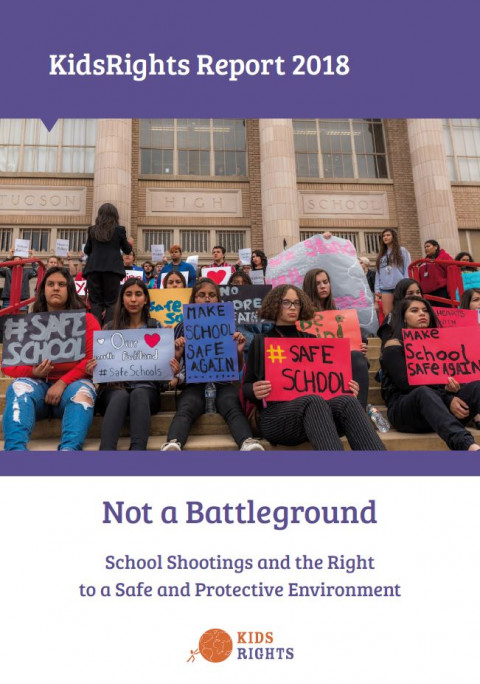 Not a Battleground: School Shootings and the Right to a Safe and Protective Environment Année de publication: 2018 Auteur: Kim Brouwers | Chrissie van Heijningen Auteur institutionnel: KidsRights Foundation Violence is a daily reality for many children, at home, at play and at school. More than 100,000 children die from violence every year, and others suffer the effects well into adulthood. This is a violation of Article 19 of the UNCRC, which stipulates that every child has the right to a safe environment to grow up in, protected from all kinds of violence.School should be a safe place where young people can grow and develop without fear. School shootings are a very real threat to many children, devastating families, creating a lifetime of trauma for survivors, and affecting millions more children by putting them in a permanent state of alert in their learning environment.To prevent school shootings, we need a better understanding of the causes, and therefore more academic research, and better data, therefore detailed registration of incidents by national governments.
 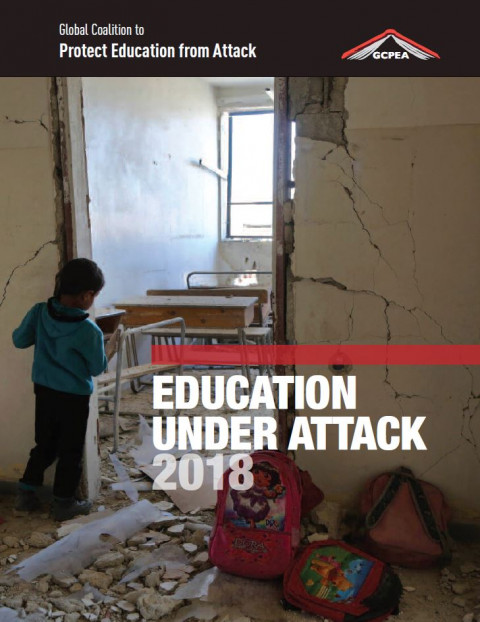 Education Under Attack 2018 Année de publication: 2018 Auteur institutionnel: Global Coalition to Protect Education from Attack (GCPEA) This report is the fourth edition of Education under Attack. It builds on the 2014 study published by the Global Coalition to Protect Education from Attack and the 2007 and 2010 publications by the United Nations Educational, Scientific and Cultural Organization (UNESCO). The present edition covers the five-year period from January 2013 to December 2017. The previous edition included profiles of 30 countries that had experienced at least five incidents of attacks on education in which students or education personnel were harmed, including at least one direct attack or one person killed, between 2009 and mid-2013. The current study includes profiles of 28 countries that experienced at least 20 attacks on education during the 2013-2017 reporting period, regardless of the severity of the incidents. Although significant data gaps remain and data quality varies, reporting of attacks on education has become more comprehensive and systematic over the last five years.Each country profile includes information on six categories of attacks on education, as relevant: Physical attacks or threats of attacks on schools Physical attacks or threats directed at students, teachers, and other education personnel Military use of schools and universities Child recruitment at, or en route to or from, school or university Sexual violence by armed parties at, or en route to or from, school or university Attacks on higher education
 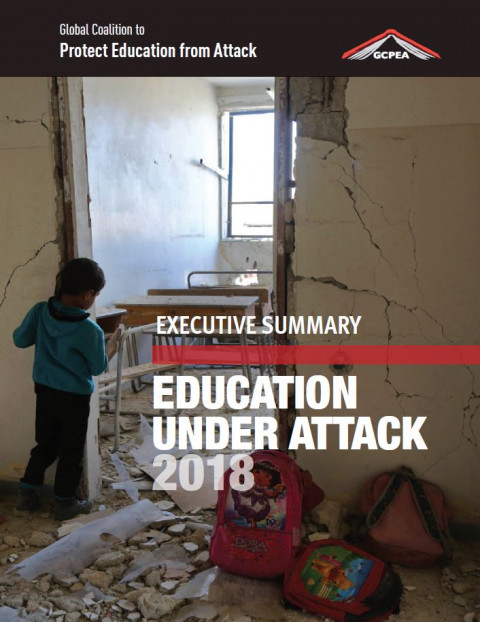 [Summary] Education Under Attack 2018; Executive Summary Année de publication: 2018 Auteur institutionnel: Global Coalition to Protect Education from Attack (GCPEA) A global study of threats or use of force, either deliberate or indiscriminate, against students, teachers, academics, education support and transport staff or education officials, and against schools, universities and other education institutions carried out for political military, ideological, sectarian, ethnic or religious reasons from 2013 to 2017.