
Ressources
Explorez une large gamme de ressources sur le GCED afin d’approfondir votre compréhension et de renforcer vos activités de recherche, de plaidoyer, d’enseignement et d’apprentissage.
1,725 résultats trouvés
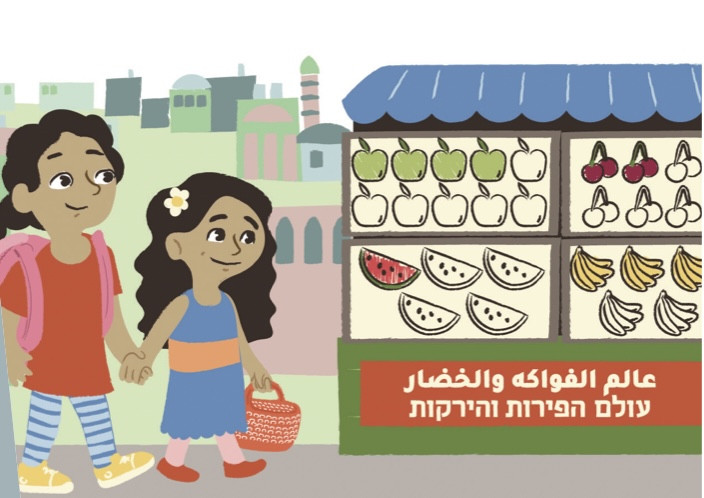 Representation and Presence of the Arab Community in Education Materials Année de publication: 2019 Auteur: Yael Maayan Auteur institutionnel: Sikkuy-Aufoq This paper seeks to examine the representation and presence of the Arab community in education subjects in Israel. It aims to deepen and reflect on the current situation in the field of education materials and the existing policy, and to suggest the required changes. It is a policy that attempts to offer Jewish school students a variety of forms of consideration and interaction with the Arab citizens of Israel.
 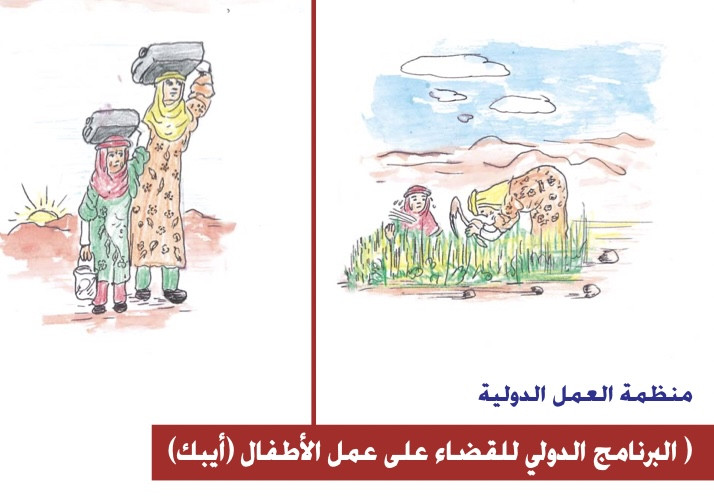 المساواة بين الجنسين وعمل الأطفال: أداة تربوية للمدربين والمدربات Année de publication: 2006 Auteur: Anita Amorim | UnaMurray | Ségolène Samouiller | Sandhya Badrinath Auteur institutionnel: International Labour Organization (ILO) إن القضاء على عمل الأطفال وترويج المساواة بين الفتيان والفتيات، الرجال والنساء، مساران متلازمان. وقد صُممت الأداة التربوية هذه لإظهار ضرورة تبنّي مفهوم النوع الاجتماعي من أجل فهم تعقيد ظاهرة عمل الفتيات والفتيان وإبراز تأثير النوع الاجتماعي على خيارات الأطفال، سواء فيما يتعلق بفرص العمل أو بالموارد المالية المتوفرة والمختلفة بالنسبة للفتيان والفتيات.وتهدف الأداة التربوية هذه إلى مساعدة المدربين والمدربات في اليمن على تحفيز الوعي لدى الصغار، وبخاصة المراهقين منهم، وعلى إفهامهم عمل الأطفال والمساواة بين الجنسين. فهي تستند إلى مبدأ أساسي قائلا إن للمراهقين دورا مهما يلعبونه من خلال تقوية وعيهم بقضايا العدالة الاجتماعية وعبر تأثيرهم في الوقت عينه على مجتمعهم بغية إحداث تغيير إيجابي فيه. فبواسطة تحميل الفتيات والفتيان المسؤوليات والاعتراف بقيمة مساهماتهم، نأمل أن نسخّر الثراء الإبداعي والالتزام الموجودين لدى المراهقين لمكافحة عمل الأطفال وترويج المساواة بين الجنسين. Gender Equality and Child Labour: A Participatory Tool for Facilitators Année de publication: 2006 Auteur: Anita Amorim | UnaMurray | Ségolène Samouiller | Sandhya Badrinath Auteur institutionnel: International Labour Organization (ILO) Ending child labor and promoting equality between boys and girls, men and women, go hand in hand. This educational tool is designed to demonstrate the necessity of adopting the concept of gender in order to understand the complexity of the phenomenon of girls and boys work and to highlight the impact of gender on children's choices, both with regard to job opportunities and the financial resources available and different for boys and girls.This educational tool aims to help male and female trainers in Yemen to raise awareness among young people, especially adolescents, and to understand child labor and gender equality. It is based on the basic principle that adolescents have an important role to play by strengthening their awareness of social justice issues and at the same time influencing their society in order to bring about positive change in it. By holding girls and boys accountable and recognizing the value of their contributions, we hope to harness the creative richness and commitment of adolescents to combat child labor and promote gender equality.
  ميثاق الشراكة بين المدرسة والأسرة الحقوق والواجبات Année de publication: 2016 Auteur institutionnel: Saudi Arabia. Ministry of Education الملف عبارة عن ميثاق الشراكة بين المدرسة والأسرة. ويناقش الحقوق والواجبات في هذه الشراكة في المملكة العربية السعودية. ويهدف الميثاق الى تمكيــن الأسرة والمدرســة مــن غــرس المبــادئ السامية وتعزيزهــا لــدى أبنائهــم. وكذلك يهدف الميثاق لتعزيز مفهوم المواطنة الصالحة في المجتمع المدرسي وخارجه. يحتوي الميثاق على عدة بنود من أهمها: حقوق الطالب والأسرة والمدرسة وواجبات الطالب والأسرة والمدرسة. Charter of Partnership between the School and the Family: Rights and Duties Année de publication: 2016 Auteur institutionnel: Saudi Arabia. Ministry of Education The file is a charter of partnership between the school and the family. It discusses the rights and duties of this partnership in the Kingdom of Saudi Arabia. The charter aims to enable the family and the school to inculcate and promote lofty principles in their children. The charter also aims to promote the concept of good citizenship in and outside the school community. The charter contains several articles, the most important of which are: the rights of the student, the family, and the school, and the duties of the student, the family, and the school.
 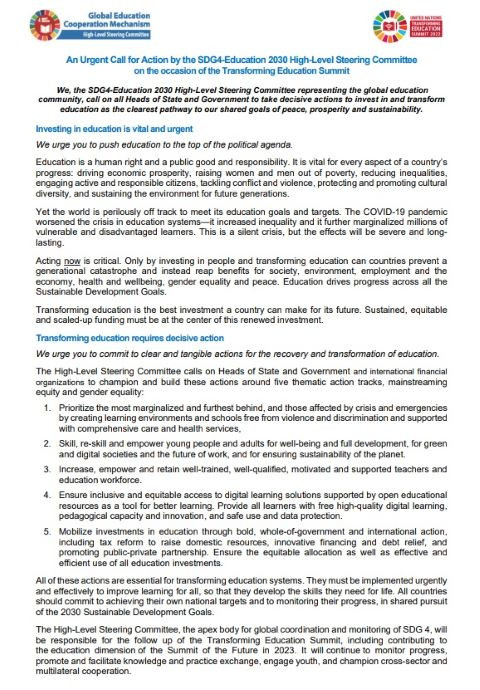 Срочный призыв к действиям Руководящего комитета высокого уровня по ЦУР 4 – «Образование-2030» по случаю Саммита по трансформации образования Année de publication: 2022 Auteur institutionnel: United Nations (UN) Мы, Руководящий комитет высокого уровня ЦУР 4-Образование-2030, представляющий мировое образовательное сообщество, призываем всех глав государств и правительств предпринять решительные действия по инвестированию и преобразованию образования как наиболее четкого пути к нашим общим целям мира, процветания и устойчивости. 可持续发展目标 4—2030 年教育高级别指导委员会 在教育变革峰会之际的紧急行动呼吁 Année de publication: 2022 Auteur institutionnel: United Nations (UN) 我们,代表全球教育界的 SDG4-Education 2030 高级别指导委员会,呼吁所有国家元首和政府首脑采取果断行动,对教育进行投资和改造,作为实现和平、繁荣和可持续发展这一共同目标的最清晰途径 .
  Following Up on the Transformative Commitments Made at the Summit: A Call to Action by the SDG4 High-level Steering Committee Année de publication: 2022 Auteur institutionnel: United Nations (UN) The Transforming Education Summit aims to mobilize solutions to accelerate national and global efforts to achieve Sustainable Development Goal 4: Ensure inclusive and equitable quality education and promote lifelong learning opportunities for all. Seven new Global Initiatives launched at the Summit will focus on such solutions to transform education.
  Transforming Education Systems: Why, What, and How Année de publication: 2022 Auteur: Rebecca Winthrop | David Sengeh Auteur institutionnel: Brookings Institution This brief is for any education leader or stakeholder who is interested in charting a transformation journey in their country or education jurisdiction such as a state or district. It is also for civil society organisations, funders, researchers, and anyone interested in the topic of national development through education. In it, the authors answer the following three questions and argue for a participatory approach to transformation: Why is education system transformation urgent now? The world is at an inflection point. Climate change, the changing nature of work, increasing conflict and authoritarianism together with the urgency of COVID recovery has made the transformation agenda more critical than ever. What is education system transformation? Education system transformation must entail a fresh review of the goals of your system – are they meeting the moment that we are in, are they tackling inequality and building resilience for a changing world, are they fully context aware, are they owned broadly across society – and then fundamentally positioning all components of your education system to coherently contribute to this shared purpose. How can education system transformation advance in your country or jurisdiction? Three steps are crucial: Purpose (developing a broadly shared vision and purpose), Pedagogy (redesigning the pedagogical core), and Position (positioning and aligning all components of the system to support the pedagogical core and purpose). Deep engagement of educators, families, communities, students, ministry staff, and partners is essential across each of these 3P steps.
  Transforming Education: An Urgent Political Imperative for Our Collective Future; Vision Statement of the Secretary-General on Transforming Education Année de publication: 2022 Auteur institutionnel: United Nations (UN) Education is a fundamental human right. It has long held a special place in the hearts and minds of people across the world, and for good reason. Throughout history, it has been a source of personal dignity and empowerment and a driving force for the advancement of social, economic, political, and cultural development.Yet today, beset by inequalities and struggling to adjust to the needs of the 21st century, education is in crisis. The impacts of this crisis play out over time and often go unseen. But they are profound and will be felt for decades to come. If we are to transform our world by 2030 as envisaged by the Sustainable Development Goals, then the international community must give this crisis the attention it deserves. We must respond decisively, with conviction, imagination, and in solidarity to transform education. Informed by an extensive and inclusive preparatory process, we offer this Vision Statement to Member States and the global public to support our joint efforts towards that transformation, to contribute to the upcoming Summit of the Future, and as a manifesto for collective action.