
Ressources
Explorez une large gamme de ressources sur le GCED afin d’approfondir votre compréhension et de renforcer vos activités de recherche, de plaidoyer, d’enseignement et d’apprentissage.
1,726 résultats trouvés
 Transformative Education: Bridging Education for Change Année de publication: 2021 Auteur: Jana Arbeiter | Maja Bučar Auteur institutionnel: Bridge 47 This publication suggests that improvements in the areas of coordination, cooperation, awareness raising and capability development are needed, as outlined in the recommendations below. Policies and strategies at national, regional and global level should adopt overarching visions for transformative education in the form of overarching strategies for SDG Target 4.7. Mechanisms for coordination and collaboration between the different components of SDG Target 4.7 should be established at national, regional and global levels. Awareness of the role of transformative education and SDG Target 4.7 in contributing to more just and sustainable futures should be raised jointly between the different components of SDG Target 4.7. Opportunities for capacity building and upskilling of practitioners and learners linked to transformative education should be enabled and created at national, regional and global levels.
  Unlocking the Transformative Potential of Education: The Alliance Between Lifelong Learning and SDG Target 4.7 Année de publication: 2021 Auteur: Chris Millora Auteur institutionnel: Bridge 47 This paper has found that Lifelong learning as a spectrum of formal, informal and non-formal learning, offers a framework to embrace different forms of learning people gain in various spaces across their lifespan. While several lifelong learning policies emphasise economic benefits, evidence shows that lifelong learning also facilitates active citizenship, tolerance to diversity, empathy, learning to live together, leadership, intergenerational learning, and awareness of social injustices. This paper demonstrated the impact of ALE provisions that bring to centre stage the needs of adults – particularly women – in resource-poor contexts. These programmes recognise the ‘funds of knowledge’ and ‘banks of skills’ already existing in these communities – challenging the deficit discourse that is dominant particularly in development circles even today.Based on these findings, this paper puts forward seven interrelated policy recommendations: (1) acknowledgement, within SDG 4.7 policies, that learning occurs in all life stages, forms and spaces; (2) prioritisation of lifelong learning and transformative approaches to education into local, national, regional and global level policies, including provisions of funding; (3) a focus on the transformative competencies and outcomes of lifelong learning; (4) positioning lifelong learning as a cross- cutting (rather than separate) approach to achieving the SDGs; (5) increased attention to recognising, validating and accrediting (RVA) non-formal and informal learning; (6) involving marginalised groups as stakeholders that can shape policy and not only recipients; (7) increased government support and financing to adult educators and literacy facilitators.
  Transformative Competencies: How to Define and Implement Competencies for SDG Target 4.7 Année de publication: 2021 Auteur: Johanna Helin Auteur institutionnel: Bridge 47 This paper was commissioned to support advocacy for SDG Target 4.7 in European and global policies by exploring the concept of ‘Competencies for SDG Target 4.7’. This advocacy paper draws from a desk review of existing global and regional competency frameworks at national, regional and global levels. The aim is to get a clearer understanding of these transformative competencies and how they help the implementation and assessment of Target 4.7.This paper is divided in three sections. The first section provides background to the different world views that frame the discussion on competencies, before turning to presenting some of the competency frameworks for Target 4.7. The second section gives some examples of how these competencies are being introduced into national education policies, professional skills training and lifelong learning. The paper finishes with conclusions and policy recommendations.
  Indicators: The Need and Challenges of Tracking Implementation of Target 4.7 Année de publication: 2021 Auteur: Johanna Helin Auteur institutionnel: Bridge 47 This paper investigates the existing and proposed indicators and monitoring frame- works for 4.7. Examining efforts at national, regional, and global levels will identify the main challenges in measurement initiatives. The paper will start by looking at the context of SDGs and the special character of Target 4.7. Thereafter, it will discuss the process and limitations of defining the indicators at the global level. It will also review regional developments, tools, and ideas for national and local level assessment frameworks in Asia-Pacific and Europe. The paper ends with conclusions and policy recommendations.
  Resources: For SDG Target 4.7 Année de publication: 2021 Auteur: Sandra Oliveira Auteur institutionnel: Bridge 47 This paper is part of a series of publications commissioned to support advocacy for more space for SDG Target 4.7 of Agenda 2030 in European and global policies. In November 2019, Bridge 47 organised an event called Envision 4.7, which brought together civil society organisations, national governments, MEPs, European and global organisations, and together wrote a Roadmap for SDG Target 4.7 for Europe.Focusing on the key themes of this Envision 4.7 Roadmap and drawing on the Envision 4.7. policy papers as key references, this paper focuses on providing a global overview and identification of the types of resources re- quired to achieve this target.\
  Dialogue on Quebec Food Autonomy Année de publication: 2020 Auteur institutionnel: Institut du Nouveau Monde (INM) Food autonomy is more than ever a crucial subject for Quebec society. The COVID-19 pandemic has revealed the fragility of our food system and has created a new opportunity to talk about this strategic issue. Several players are saying it: it It is time to bring agricultural producers closer to citizens, and to create new forms of solidarity between them.To do this, the Union des producteurs agricoles (UPA) wishes to set up a real opportunity for dialogue between the two ends of the production chain food, that is to say producers and citizens.The Dialogue on food autonomy is an opportunity for citizens to participate in the development of a social contract on issues related to food autonomy and to facilitate a dialogue between them and producers, who are an essential link. of this strategic issue. It provides opportunities for open and constructive exchanges between agricultural producers and citizens, first separately and then in a common group. It will then be offered to all of Quebec. Dialogue sur l’autonomie alimentaire du Québec Année de publication: 2020 Auteur institutionnel: Institut du Nouveau Monde (INM) L’autonomie alimentaire est plus que jamais un sujet crucial pour la société québécoise. La pandémie de COVID-19 a révélé la fragilité de notre système alimentaire et a créé une nouvelle occasion de parler de cet enjeu stratégique. Plusieurs acteurs le disent : il est temps de rapprocher les producteurs agricoles des citoyens, et de créer de nouvelles solidarités entre eux. Pour ce faire, l’Union des producteurs agricoles (UPA) souhaite mettre en place une occasion réelle de dialogue entre les deux extrémités de la chaîne de production alimentaire, soit les producteurs et les citoyens.Le Dialogue sur l’autonomie alimentaire est l’occasion pour les citoyens de participer à l’élaboration d’un contrat social sur les enjeux liés à l’autonomie alimentaire et de faciliter un dialogue entre eux et les producteurs, qui sont un maillon essentiel de cet enjeu stratégique. Il prévoit des occasions d’échanges ouverts et constructifs entre les producteurs agricoles et les citoyens, d’abord séparément puis dans un groupe commun. Il sera par la suite proposé à l’ensemble du Québec.
  Encyclopedia on Democracy and Citizen Participation Auteur: Malorie Flon | Émilie Béorofei Auteur institutionnel: Institut du Nouveau Monde (INM) As part of its Strategic Meeting on Democracy and Citizen Participation, the INM has set up an online information pack, the first contents of which you will find on this site.A vast deliberative process, the Strategic Rendezvous aims to enlighten the people of Quebec on the current transformations of our democracy: a representative system that no longer responds, on its own, to the democratic requirement; a growing demand from certain citizens to participate in decisions that affect them; increasingly complex social issues and collective challenges, which public and private authorities must tackle; institutions forced to adapt quickly and continuously to a constantly changing world.The Briefing Kit tackles these questions by providing basic notions of the concepts involved: democracy, participation, citizenship, etc. To questions frequently asked during public debates, the dossier offers some possible answers. It outlines, for the reader who wants to dive into it, definitions of the different types of citizen participation: public, electoral, social. In order to better understand what is practiced in Quebec in each of these categories, the reader will turn to The authorities of public participation in Quebec.Are you a practitioner or would you like to deepen your knowledge of the practice of citizen participation? The Toolbox is here for you! It contains references, guides, methods and examples of experiences that will equip you to implement, in turn, participatory practices. Encyclopédie sur la démocratie et la participation citoyenne Auteur: Malorie Flon | Émilie Béorofei Auteur institutionnel: Institut du Nouveau Monde (INM) Dans le cadre de son Rendez-vous stratégique Démocratie et participation citoyenne, l’INM a mis sur pied un dossier d’information en ligne, dont vous trouverez les premiers contenus dans ce site.Vaste démarche délibérative, le Rendez-vous stratégique vise à éclairer la population québécoise sur les transformations actuelles de notre démocratie: un système représentatif qui ne répond plus, seul, à l’exigence démocratique; une demande croissante de certains citoyens à participer aux décisions qui les touchent; des enjeux sociaux et des défis collectifs de plus en plus complexes, auxquels les pouvoirs publics et privés doivent s’attaquer; des institutions obligées de s’adapter rapidement et continuellement à un monde en constante transformation. Le dossier d’information s’attaque à ces questions en fournissant des notions de base sur les concepts en jeu: démocratie, participation, citoyenneté, etc. Aux questions fréquemment posées lors des débats publics, le dossier offre des pistes de réponses. Il esquisse, pour le lecteur qui voudra s’y plonger, des définitions des différents types de participation citoyenne: publique, électorale, sociale. Afin de mieux comprendre ce qui se pratique au Québec dans chacune de ces catégories, le lecteur se tournera vers Les instances de participation publique au Québec. Vous êtes praticien ou souhaitez approfondir votre connaissance de la pratique de la participation citoyenne? La Boîte à outils est là pour vous! Elle contient des références, guides, méthodes et exemples d’expériences qui vous outilleront pour mettre en œuvre, à votre tour, des pratiques participatives.
 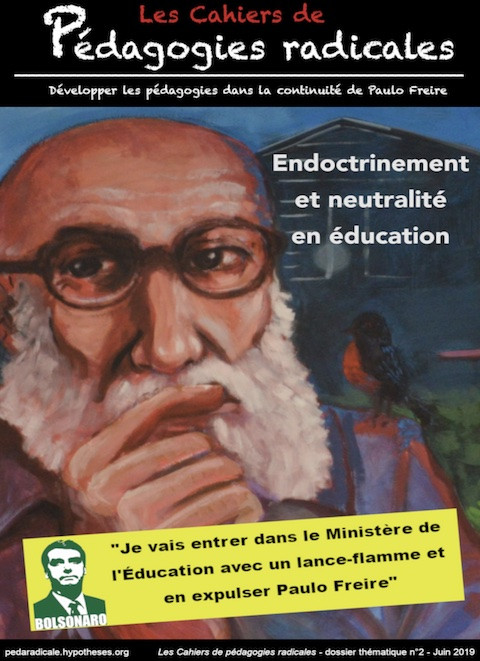 Les Cahiers de pédagogies radicales : Développer les pédagogies inspirées par l'œuvre de Paulo Freire; Endoctrinement et neutralité en éducation Année de publication: 2019 Auteur: Irène Pereira | Gauthier Tolini Auteur institutionnel: École supérieure du professorat et de l'éducation (ESPE) de Livry Garga Ce deuxième numéro des Cahiers de pédagogies radicales part dans unpremier temps de la volonté de faire connaître la situation au Brésil et lesdébats concernant le « Mouvement de l’école sans parti » qui s’attaque à laliberté pédagogique des enseignants en essayant de leur interdire d’aborderles questions de genre et et les questions économiques et sociales en classe.Pour cela, ce mouvement veut faire passer une loi sur la neutralité desenseignants qui n’existe pas au Brésil : ceux-ci étant tenu actuellementuniquement à une obligation de favoriser le pluralisme des idées. JairBolsonaro, qui est président du Brésil depuis janvier 2019, soutient cemouvement réactionnaire. Il accuse en particulier l’oeuvre de Paulo Freired’endoctrinement marxiste et veut éradiquer sa pensée de l’éducationbrésilienne.Cette situation au Brésil pose des problèmes qui sont centraux pour tous lespédagogues critiques. Quelle est la différence entre pédagogie critique etendoctrinement ? Pour Paulo Freire, c’est parce que la pédagogie critiquefavorise le pluralisme des idées et le dialogue critique qu’il n’y a pasendoctrinement. C’est d’ailleurs sans doute pourquoi l’approche de PauloFreire ne se trouve pas en contradiction avec le projet démocratique, mais aucontraire est insupportable aux régimes dictatoriaux. Mais ce qui est le plusinquiétant au Brésil, c’est qu’il semble tout simplement qu’un enseignant quidéfend dans sa classe les droits de l’homme et la lutte contre lesdiscriminations pourrait être considéré comme portant atteinte à la neutralité.