
Ressources
Explorez une large gamme de ressources sur le GCED afin d’approfondir votre compréhension et de renforcer vos activités de recherche, de plaidoyer, d’enseignement et d’apprentissage.
884 résultats trouvés
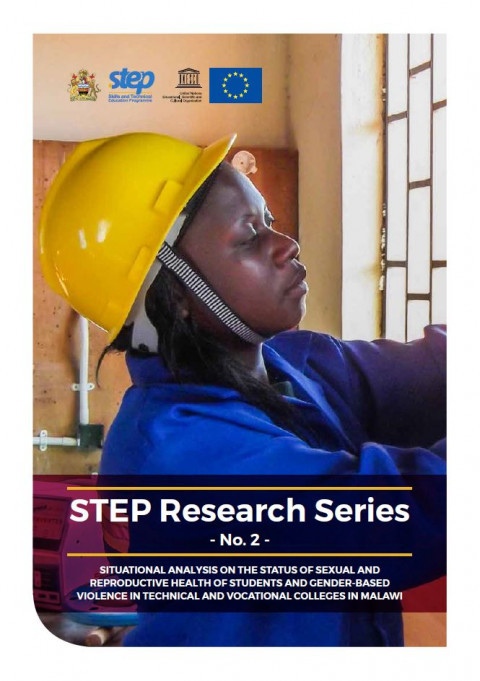 Situational Analysis on the Status of Sexual and Reproductive Health of Students and Gender-based Violence in Technical and Vocational Colleges in Malawi (STEP Research Series No. 2) Année de publication: 2017 Auteur institutionnel: Skills and Technical Education Programme (STEP) Funded by the EU and implemented by UNESCO in collaboration with the Government of Malawi, the Skills and Technical Education Programme (STEP) is dedicated to reinforcing Technical, Entrepreneurial and Vocational Education and Training (TEVET) in Malawi.The programme will run from 2016-2020 and aims to improve TEVET at post-secondary level with a focus on equal access to enrolment, with particular emphasis on female learners; improving quality in the sector; and the establishment of clear governance structures. The STEP Research Series presents the highlights of the research undertaken by the programme.The situational analysis on the status of sexual and reproductive health of students and gender-based violence in technical and vocational colleges in Malawi is the second report in the STEP Research Series.
  The Critical Thinking Workbook: Games and Activities for Developing Critical Thinking Skills Auteur institutionnel: Global Digital Citizen Foundation Critical thinking is clear, rational, logical, and independent thinking. It’s about improving thinking by analyzing, assessing, and reconstructing how we think. It also means thinking in a self-regulated and self-corrective manner. It’s thinking on purpose!The Critical Thinking Workbook helps you and your students develop mindful communication and problem-solving skills with exciting games and activities. It has activities that are adaptable to any grade level you want.The activity pages in the Critical Thinking Workbook are meant to be shared and explored. Use it as an electronic document or as worksheets.You can either print off the pages and use them as activity sheets, or you can edit them directly right in the document on your computer.There are also Answer Keys for the activities that need them provided at the back of the book.
  Beyond Access: Toolkit for Integrating Gender-based Violent Prevention and Response into Education Projects Année de publication: 2015 Auteur institutionnel: United States Agency for International Development (USAID) This toolkit was developed to support implementation of the U.S. Strategy to Prevent and Respond to Gender-based Violence Globally. It provides guidance and resources for USAID technical and program officers working on education to increase understanding of GBV in the education context and strengthen integration of a gender-based violence (GBV) response into projects and activities. Because reducing school-related GBV is a high priority for USAID in all school systems globally, this toolkit includes school-related GBV, but the overall focus is GBV in the education context broadly.The Toolkit provides:The United States government definition of GBV and USAID’s definition of school-related GBVExplanation for why integrating GBV prevention and response improves education outcomes, and the evidence on the prevalence of GBV in the education sectorGuiding principles to ensure the well-being of those at risk for, and survivors of, GBVIllustrative GBV prevention and response activities by the USAID Education Strategy GoalsGuidance on how to integrate GBV prevention and response throughout theUSAID Program Cycle to be able to monitor, evaluate, learn, and adapt education projects and activities accordingly, and it includes illustrative indicators for measuringGBV prevention and response for each of the USAID Education Strategy goals.
  Journée de la mémoire des génocides et de la prévention des crimes contre l'humanité Année de publication: 2017 Auteur institutionnel: éduscol Le travail de mémoire passe prioritairement par l'éducation des enfants et des adolescents. Depuis 2003, la journée du 27 janvier est l'occasion pour la communauté éducative d'engager une réflexion sur les génocides et de rappeler les valeurs humanistes qui fondent notre démocratie. Une démarche à destination des jeunes générations qui, près de soixante-dix ans après la découverte des crimes commis par les nazis reste toujours aussi importante en termes d'éducation à la citoyenneté.
 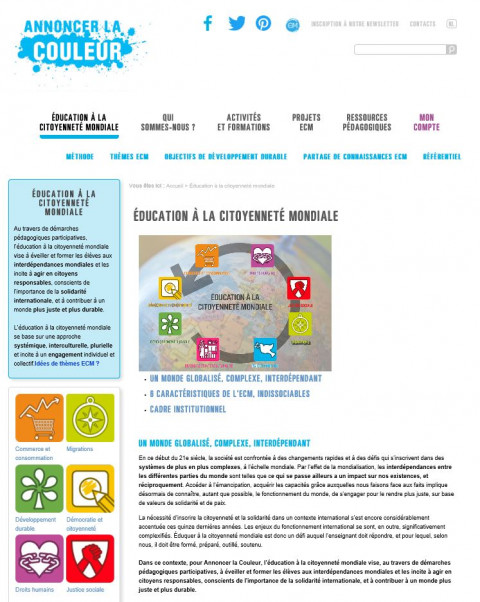 Éducation à la citoyenneté mondiale Auteur institutionnel: Annoncer la Couleur (ALC) En ce début du 21e siècle, la société est confrontée à des changements rapides et à des défis qui s'inscrivent dans des systèmes de plus en plus complexes, à l'échelle mondiale. Par l’effet de la mondialisation, les interdépendances entre les différentes parties du monde sont telles que ce qui se passe ailleurs a un impact sur nos existences, et réciproquement. Accéder à l’émancipation, acquérir les capacités grâce auxquelles nous faisons face aux faits implique désormais de connaître, autant que possible, le fonctionnement du monde, de s'engager pour le rendre plus juste, sur base de valeurs de solidarité et de paix.La nécessité d’inscrire la citoyenneté et la solidarité dans un contexte international s’est encore considérablement accentuée ces quinze dernières années. Les enjeux du fonctionnement international se sont, en outre, significativement complexifiés. Éduquer à la citoyenneté mondiale est donc un défi auquel l’enseignant doit répondre, et pour lequel, selon nous, il doit être formé, préparé, outillé, soutenu.Dans ce contexte, pour Annoncer la Couleur, l’éducation à la citoyenneté mondiale vise, au travers de démarches pédagogiques participatives, à éveiller et former les élèves aux interdépendances mondiales et les incite à agir en citoyens responsables, conscients de l'importance de la solidarité internationale, et à contribuer à un monde plus juste et plus durable.
  ABC de l’éducation à la citoyenneté et à la participation politique Année de publication: 2018 Auteur institutionnel: Campus pour la démocratie Les thèmes éducation à la citoyenneté et participation politique sont discutés de manière controversée. Pour des raisons de lisibilité, nous ne présentons ici que quelques définitions et modèles abrégés et renonçons à la prétention d’exhaustivité.
  Éducation à la citoyenneté Auteur institutionnel: Vedura La citoyenneté est le lien social qui réunit une personne et l'Etat, et qui permet à cette personne d'accomplir ses droits civiques et politiques. Être citoyen, c'est accomplir ses droits et devoirs civiques, mais également être responsable, individuellement et collectivement. Le citoyen contribue à donner un sens à la société dans laquelle il vit. L'éducation à la citoyenneté s'inscrit pleinement dans l'éducation au développement durable : c'est l'apprentissage de connaissances, de comportements, et de gestes citoyens à accomplir au quotidien qui vont dans le sens des valeurs du développement durable. De nombreuses thématiques intègrent l'éducation à la citoyenneté : la démocratie la paix les droits de l'homme les devoirs citoyens l'éco-citoyenneté l'éducation à la santé la prévention des conduites à risque l'égalité homme-femme la lutte contre les discriminations le développement durable l'éco-citoyenneté ... L'éducation à la citoyenneté concerne tous les publics, et fait l'objet d'une attention particulière de l'Education Nationale : "les compétences sociales et civiques inscrites dans le socle commun de connaissances et de compétences, défini par le décret n°2006-830 du 11 juillet 2006 doivent pouvoir s’appuyer sur le développement d’un "parcours civique" qui permet à l’élève de prendre conscience de son statut de citoyen, de ses droits et devoirs et du lien indissociable entre la liberté et la responsabilité. Ce parcours se fonde, entre autres, sur les événements et activités qui permettent de mettre en œuvre dans les écoles et les établissements scolaires un ensemble d'itinéraires de citoyenneté."
  INSPIRE: семь стратегий по ликвидации насилия в отношении детей Année de publication: 2016 Auteur institutionnel: World Health Organization (WHO) Cборник информационных материалов, основанных на фактических данных и предназначенных для всех, кто заинтересован в профилактике насилия в отношении детей и подростков и принятии ответных мер — от государственных деятелей до обычных граждан и от организаций гражданского общества до представителей частного сектора. В этом документе представлен комплекс избранных стратегий, основанных на самых убедительных из имеющихся на сегодняшний день фактических данных и призванных помочь странам и сообществам сосредоточить усилия на профилактических программах и услугах, обладающих наибольшим потенциалом для снижения уровня насилия в отношении детей. В комплекс входят семь следующих стратегий: Implementation and enforcement of laws (Принятие и обеспечение соблюдения нормативных актов); Norms and values (Нормы и ценности); Safe environments (Создание безопасной среды); Parent and caregiver support (Поддержка родителей и воспитателей); Income and economic strengthening (Повышение доходов и улучшение экономического положения); Response and support services (Ответные меры и оказание поддержки); Education and life skills (Обучение и формирование жизненных навыков). Кроме того, в комплекс INSPIRE входят два типа сквозных мероприятий, сочетание которых позволяет связывать между собой и усиливать эти семь стратегий и одновременно оценивать ход их реализации.
  Securitisation, Counterterrorism and the Silencing of Dissent: The Educational Implications of Prevent Année de publication: 2016 Auteur: Aislinn O'Donnell Auteur institutionnel: Society for Educational Studies | Taylor & Francis This paper outlines some of the implications of counterterrorist legislation, including Prevent, for the pedagogical relationship and for educational institutions. The concept of ‘radicalization’, central to the Prevent Strategy, is one that is contested in the field of counterterrorism, yet educators are now expected to identify and refer students ‘at risk of radicalization’. Based on the experience of teaching IRA and INLA prisoners in the Republic of Ireland, the author outlines a set of philosophical and ethical principles that ought to underpin education. It is argued that education must not be subordinated to security and intelligence agendas on pragmatic, educational and ethical grounds. Securitisation, Counterterrorism and the Silencing of Dissent: The Educational Implications of Prevent Année de publication: 2016 Auteur: Aislinn O'Donnell Auteur institutionnel: Society for Educational Studies | Taylor & Francis Le présent document décrit quelques impacts de la législation antiterroriste, y compris la prévention, sur l’approche pédagogique et les établissements d'enseignement. Le concept de « radicalisation » qui figure au cœur de la stratégie « Prévenir » est contesté dans le domaine de la lutte contre le terrorisme. Toutefois, les éducateurs sont maintenant en mesure d'identifier et d’orienter les élèves « en voie de radicalisation ». Sur la base de l'expérience de l'enseignement dispensé aux prisonniers de l'IRA et de l'INLA dans la République d'Irlande, l'auteur décrit un ensemble de principes philosophiques et éthiques qui devraient soutenir l'éducation. On fait valoir l’idée que l'éducation ne doit pas être subordonnée aux questions de sécurité et de renseignement pour des raisons pragmatiques, éducatives et éthiques.