
Ressources
Explorez une large gamme de ressources sur le GCED afin d’approfondir votre compréhension et de renforcer vos activités de recherche, de plaidoyer, d’enseignement et d’apprentissage.
875 résultats trouvés
 Training for Citizenship, Yes it Is Possible !: What We Need to Know and Know How to Do; Standards Basic Citizenship Skills Année de publication: 2004 Auteur institutionnel: Colombia. Ministerio de Educación Nacional This document presents the national standards of education for citizenship in Colombia, from a competency development approach. It includes the learning standards to be promoted in all grades, from basic to secondary education. Which are organized into three groups: Peaceful coexistence, identity and respect of differences, and democratic participation and responsibility. Formar para la Ciudadanía, ¡ Sí es posible !: Lo que necesitamos saber y saber hacer ; Estándares básicos de competencias ciudadanas Année de publication: 2004 Auteur institutionnel: Colombia. Ministerio de Educación Nacional Este documento presenta los estándares nacionales de educación para la ciudadanía en Colombia, desde un enfoque de desarrollo de competencias. Incluye los aprendizajes que se quieren promover en todos los grados de la educación básica y media, organizados en tres grupos: Convivencia pacífica, identidad y respeto por las diferencias y participación y responsabilidad democrática.
  Education in the Time of COVID-19 (COVID-19 Report; ECLAC-UNESCO) Année de publication: 2020 Auteur institutionnel: Economic Commission for Latin America and the Caribbean (ECLAC) | UNESCO Santiago The coronavirus disease (COVID-19) pandemic has caused an unprecedented crisis in all areas. In the field of education, this emergency has led to the massive closure of face-to-face activities of educational institutions in more than 190 countries in order to prevent the spread of the virus and mitigate its impact. The Economic Commission for Latin America and the Caribbean (ECLAC) has argued that even before the pandemic hit, the social situation in the region was deteriorating, owing to rising rates of poverty and extreme poverty, the persistence of inequalities and growing social discontent. In this context, the crisis will have a profoundly negative impact on the various social sectors, particularly health and education, as well as on employment and poverty. Meanwhile, UNESCO has identified major gaps in educational outcomes, which are related to the unequal distribution of teachers in general, and of the best qualified teachers in particular, to the detriment of lower-income countries and regions and of rural areas, where indigenous and migrant populations tend to be concentrated.In the sphere of education, many of the measures that the region’s countries have adopted in response to the crisis are related to the suspension of face-to-face classes at all levels, which has given rise to three main areas of action: the deployment of distance learning modalities through a variety of formats and platforms (with or without the use of technology); the support and mobilization of education personnel and communities; and concern for the health and overall well-being of students.The aim of this document is to shed light on various consequences that these measures will have on educational communities in the short and medium term, and to offer key recommendations on how to manage those consequences in the best possible manner, drawing attention to opportunities for learning and innovation in the post-pandemic education system. La educación en tiempos de la pandemia de COVID-19 (Inform COVID-19; CEPAL-UNESCO) Année de publication: 2020 Auteur institutionnel: Economic Commission for Latin America and the Caribbean (ECLAC) | UNESCO Santiago La pandemia de enfermedad por coronavirus (COVID-19) ha provocado una crisis sin precedentes en todos los ámbitos. En la esfera de la educación, esta emergencia ha dado lugar al cierre masivo de las actividades presenciales de instituciones educativas en más de 190 países con el fin de evitar la propagación del virus y mitigar su impacto.La Comisión Económica para América Latina y el Caribe (CEPAL) ha planteado que, incluso antes de enfrentar la pandemia, la situación social en la región se estaba deteriorando, debido al aumento de los índices de pobreza y de pobreza extrema, la persistencia de las desigualdades y un creciente descontento social. En este contexto, la crisis tendrá importantes efectos negativos en los distintos sectores sociales, incluidos particularmente la salud y la educación, así como en el empleo y la evolución de la pobreza. Por su parte, la UNESCO ha identificado grandes brechas en los resultados educativos, que se relacionan con una desigual distribución de los docentes, en general, y de los docentes mejor calificados, en particular, en desmedro de países y regiones con menores ingresos y de zonas rurales, las que suelen concentrar además a población indígena y migrante.En el ámbito educativo, gran parte de las medidas que los países de la región han adoptado ante la crisis se relacionan con la suspensión de las clases presenciales en todos los niveles, lo que ha dado origen a tres campos de acción principales: el despliegue de modalidades de aprendizaje a distancia, mediante la utilización de una diversidad de formatos y plataformas (con o sin uso de tecnología); el apoyo y la movilización del personal y las comunidades educativas, y la atención a la salud y el bienestar integral de las y los estudiantes.El objetivo de este documento es visibilizar la diversidad de consecuencias que estas medidas tendrán sobre las comunidades educativas a corto y mediano plazo, así como plantear las principales recomendaciones para sobrellevar el impacto de la mejor manera posible, proyectando oportunidades para el aprendizaje y la innovación en la educación posterior a la pandemia.
  Education for Develpment (EdD) in a Diverse World: Comparative Study of Education for Global Citizenship (EdGC) in Paraguay and Spain Année de publication: 2017 Auteur: Ángela Alcaide Capilla | María Jesús Martínez Usarralde Auteur institutionnel: University of Valencia According to the summary of the author: "This article aims to collect a comparative analysis regarding Global Citizenship Education in two different contexts: Spain and Paraguay. The objective is to discover the main characteristics of this education, in meaning and practice, focusing on the diversity of views and constraints of reality, which enrich existing theory speeches, opening this field of knowledge to the experience of its application. In fact, this is the objective and the conclusion. The research justifies the value of this information in the field of study, based on interviews with experts from which relevant information that eludes the rhetorical speeches can be extracted." La Educación para el Desarrollo (EpD) en un mundo diverso: estudio comparativo de la Educación para la Ciudadanía Global (EpCG) en Paraguay y España Année de publication: 2017 Auteur: Ángela Alcaide Capilla | María Jesús Martínez Usarralde Auteur institutionnel: University of Valencia Según el resumen de los autores: "El presente artículo pretende acometer un análisis comparado en relación a la Educación para a la Ciudadanía Global en dos contextos diferentes: España y Paraguay. Se pretende con ello reconocer los rasgos principales de esta educación, en significado y práctica, bajo la premisa de destacar la diversidad de visiones y condicionantes de la realidad, que conceden a los discursos ya existentes en la teoría una gran riqueza, abriendo su campo de conocimiento a la experiencia que de su aplicación se extrae. En sí, este es objetivo y conclusión. Con la investigación se justifica el valor que esta información tiene para el campo de estudio, a partir de entrevistas a personas expertas de las que se extrae información relevante que escapa a la retórica."
  The Paraguayan Educational System Facing the Social Challenges of the 21st Century: A Historical Evolution Towards the Educational Goals Program 2021 Année de publication: 2018 Auteur: Carlos Novella García Auteur institutionnel: Autonomous University of Madrid In the summary the author sustains: "In 2011 the Iberoamerican States Organization for Education and Culture assumed the responsibility of coordinatin the actions and follow a challenging educative programa called "Educative Goals 2021: the education that we want for the generations of the bicentenary". This article pretends to learn the full details of this program and analyze the progresses and achievements made by Paraguay, one of the countries that signed this project. Different national and international reports were analysed in order to know, in detail and in a reliable way, the results of the application and development of the eleven goals of the program regarding education in the Paraguayan context. Nevertheless, due to the extension of this article, the authors focused on three of the eleven goals and obtained very relevant results concerning the absences and achievements of the objectives of these goals. The data evidences considerable progress in the education policies since 2011 although education, selection and professional development of teachers is still lacking development." I would add that the author highlights the importance of an international and Iberoamerican citizenship. El sistema educativo paraguayo ante los desafíos sociales del siglo XXI: una evolución histórica hacia el programa metas educativas 2021 Année de publication: 2018 Auteur: Carlos Novella García Auteur institutionnel: Autonomous University of Madrid En el resumen el autor sostiene: "En el año 2011 la Organización de Estados Iberoamericanos para la Educación y la Cultura asumió la responsabilidad de coordinar las acciones y realizar el seguimiento de un programa educativo muy ambicioso llamado “Metas Educativas 2021: la educación que queremos para la generación de los bicentenarios”. Este artículo pretende conocer con más detalle los fines de este programa y analizar los avances y logros alcanzados por Paraguay uno de los países firmantes de este proyecto. Para dicho análisis nos servimos de informes nacionales e internacionales que nos permitieran conocer con detalle y fiabilidad los resultados de la aplicación y desarrollo de las once metas del programa en materia educativa en el contexto educativo paraguayo. No obstante, por extensión de este artículo nos centramos en tres de estas once metas consiguiendo resultados muy relevantes respecto a los logros y a las ausencias de los objetivos de las metas analizadas. Los datos reflejan un avance considerable de las políticas educativas desde el 2011 hasta la actualidad aunque siguen existiendo carencias notables en aspectos relacionados, principalmente, con la formación, la selección y el fortalecimiento de la profesión docente." Agregaría que el autor subraya la importancia de una ciudadanía internacional e Iberoamericana.
 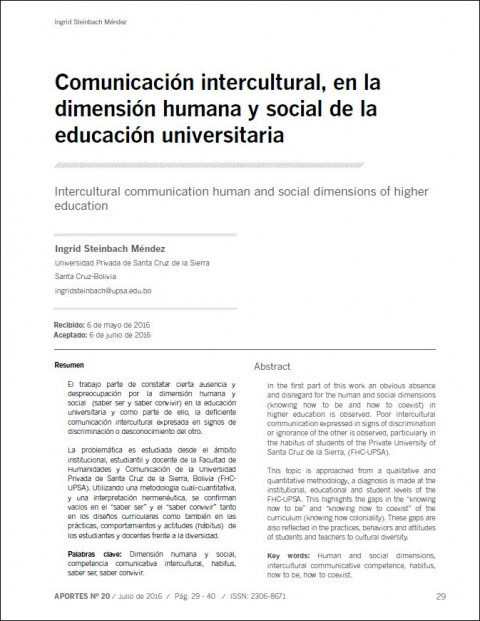 Intercultural Communication Human and Social Dimensions of Higher Education Année de publication: 2016 Auteur: Ingrid Steinbach Méndez Auteur institutionnel: Universidad Privada de Santa Cruz de la Sierra The starting point of this work is verifying the absence of and disregard for the human and social dimensions (knowing how to be and knowing how to coexist) in university education, including deficient intercultural communication manifested in discrimination ora lack of acknowledgement of the other. The problem is studied from the standpoints of the institution, the students and the faculty of the Faculty of Humanities and Communication of the Universidad Privada de Santa Cruz de la Sierra, Bolivia (FHC-UPSA). Using a qualitative quantitative methodology and a hermeneutic interpretation, voids are confirmed in the areas of "knowing how to be" and "knowing how to coexist" in the curricular designs as well as in the practices, behaviors and attitudes (habitus) of the students and faculty when faced with diversity. Comunicación intercultural, en la dimensión humana y social de la educación universitaria Année de publication: 2016 Auteur: Ingrid Steinbach Méndez Auteur institutionnel: Universidad Privada de Santa Cruz de la Sierra El trabajo parte de constatar una ausencia y despreocupación por la dimensión humana y social (saber ser y saber convivir) en la educación universitaria y como parte de ello, la deficiente comunicación intercultural expresada en signos de discriminación o desconocimiento del otro.La problemática es estudiada desde el ámbito institucional, estudiantil y docente de la Facultad de Humanidades y Comunicación de la Universidad Privada de Santa Cruz de la Sierra, Bolivia (FHC-UPSA). Utilizando una metodología cuali-cuantitativa, y una interpretación hermenéutica, se confirman vacíos en el "saber ser" y el "saber convivir" tanto en los diseños curriculares como también en las prácticas, comportamientos y actitudes (hábitus) de los estudiantes y docentes frente a la diversidad.