
Ressources
Explorez une large gamme de ressources sur le GCED afin d’approfondir votre compréhension et de renforcer vos activités de recherche, de plaidoyer, d’enseignement et d’apprentissage.
875 résultats trouvés
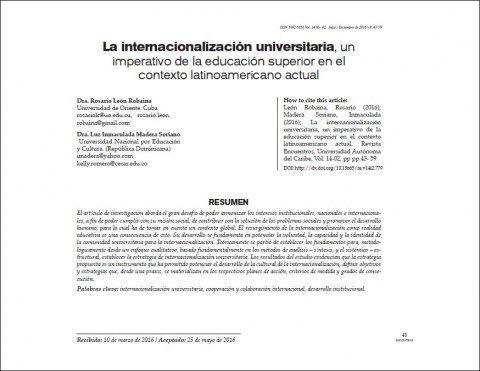 University Internationalization: A Higher Education Imperative in the Latin American Context Année de publication: 2016 Auteur: Rosario Leon Robaina | Luz Inmaculada Madera Soriano According to the author: "The article analyzes the challenge of being able to harmonize institutional, national and international interests, in order to fulfill the social mission of contributing to solving social problems and promoting human development, for which a global context has to be taken into account. The resurgence of educational internationalization is actually a consequence of this. Its development is founded on the will to enhance the capacity and identity of the university community for internationalization. Theoretically, the researchers started setting up the foundations from a qualitative approach, methodologically based on structural and systemic action research to establish the university internationalization strategy. The results show that the proposed strategy is an instrument that has enhanced the development of the internationalization culture, defining objectives and strategies, which from the praxis, are materialized in different action plans, using specific measurement criteria, and levels of achievement" The authors argument that a socially committed globalization is promoted. La internacionalización universitaria: un imperativo de la educación superior en el contexto latinoamericano actual Année de publication: 2016 Auteur: Rosario Leon Robaina | Luz Inmaculada Madera Soriano Segùn el autor: "El artículo de investigación aborda el gran desafío de poder armonizar los intereses institucionales, nacionales e internacionales, a fin de poder cumplir con su misión social, de contribuir con la solución de los problemas sociales y promover el desarrollo humano, para lo cual se ha de tomar en cuenta un contexto global. El resurgimiento de la internacionalización como realidad educativa es una consecuencia de esto. Su desarrollo se fundamenta en potenciar la voluntad, la capacidad y la identidad de la comunidad universitaria para la internacionalización. Teóricamente se partió de establecer los fundamentos para, metodo- lógicamente desde un enfoque cualitativo, basado fundamentalmente en los métodos de análisis – síntesis, y el sistémico – es- tructural, establecer la estrategia de internacionalización universitaria. Los resultados del estudio evidencian que la estrategia propuesta es un instrumento que ha permitido potenciar el desarrollo de la cultura de la internacionalización, definir objetivos y estrategias que, desde una praxis, se materializan en los respectivos planes de acción, criterios de medida y grados de consecución." Argumenta que se promueve una globalización soliidaria.
 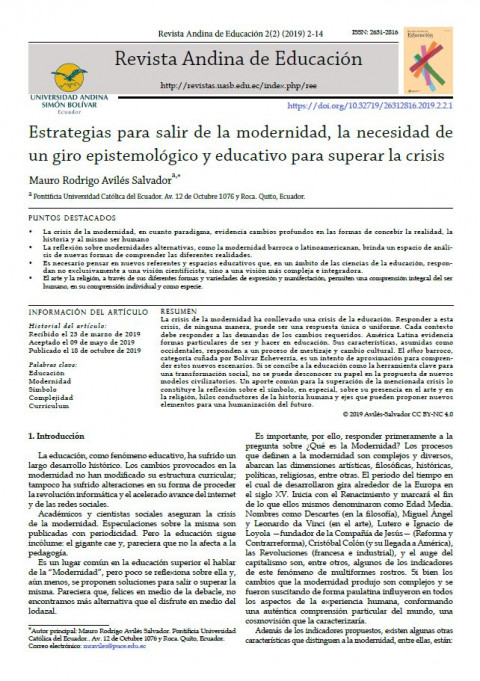 Strategies to Exit Modernity: The Need of an Educative and Epistemological Turn to Overcome the Crisis Année de publication: 2019 Auteur: Mauro Rodrigo Avilés Salvador According to the author: "the crisis of modernity has led to a crisis in education; and by no means can this crisis be tackled in a unique or uniform way. Every context has to respond to the demands of change that are requested. If education is conceived as the key tool for social transformation, its role in promoting new civilization models cannot be neglected. One way of overcoming the crisis may be by reflecting about the symbol, its presence in art and religion, areas that may promote new elements for a future humanization." Then, in the article, from a critical pespective, the author enfatizes the role of Latin America a leader for a "different" kind of change, a change based on the cultural latinamerican ethos. The author quotes Edgar Morin, and mentions the need of a plural education that favours democracy, based on Human Rights. However, although he mentions universal aspects, he does not mention a planetary citizenship and he criticizes the european model. Estrategias para salir de la modernidad: la necesidad de un giro epistemológico y educativo para superar la crisis Année de publication: 2019 Auteur: Mauro Rodrigo Avilés Salvador Según el autor: "la crisis de la modernidad ha conllevado una crisis de la educación. Responder a esta crisis, de ninguna manera, puede ser una respuesta única o uniforme. Cada contexto debe responder a las demandas de los cambios requeridos. Si se concibe a la educación como la herramienta clave para una transformación social, no se puede desconocer su papel en la propuesta de nuevos modelos civilizatorios. Un aporte para la superación de la crisis lo constituye la reflexión sobre el símbolo, sobre su presencia en el arte y en la religión, ejes que pueden proponer nuevos elementos para una humanización del futuro." Luego, en el artículo, desde una perspectiva crítica, el autor enfatiza el rol de América Latina como propiciador de un cambio "diferente", desde el ethos cultural que caracteriza lo "latinamericano". Cita a Edgar Morin y habla de la necesidad de una educación pluaral que favorezca la democracia, basada en los Derechos Humanos. Si bien menciona aspectos universales no menciona una ciudadanía planetaria y critica el modelo europeo.
 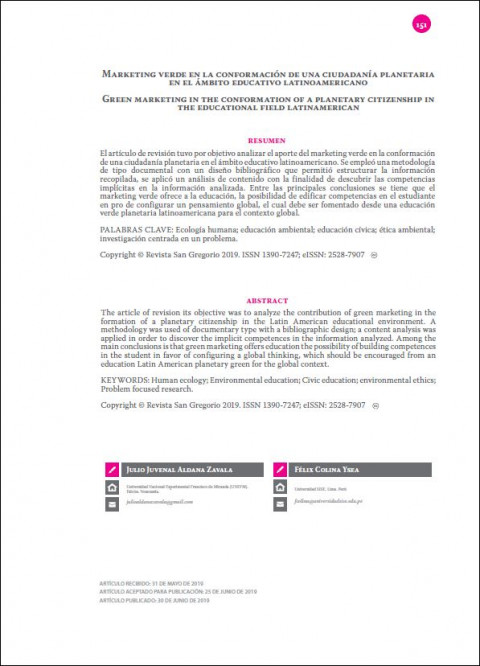 Green Marketing in the Conformation of a Planetary Citizenship in the Educational Field Latinamerican Année de publication: 2019 Auteur: Julio Juvenal Aldana Zavala | Félix Colina Ysea The article reviews and analyzes the contribution of green marketing in the formation of a planetary citizenship in the latin american educational systems. A documental and biblographic review methodology was used to gather and structure the information. The content of the documents was analyzed trying to discover the implicit competences for global citizenshipo present in the information. One of the main conclusions is that green marketing offers education the possibility of building competences that favour global thinking in students; thing that should be encouraged from a latin american green education perspective for the global context. Marketing verde en la conformación de una ciudadanía planetaria en el ámbito educativo latinoamericano Année de publication: 2019 Auteur: Julio Juvenal Aldana Zavala | Félix Colina Ysea El artículo de revisión tuvo por objetivo analizar el aporte del marketing verde en la conformación de una ciudadanía planetaria en el ámbito educativo latinoamericano. Se empleó una metodología de tipo documental con un diseño bibliográfico que permitió estructurar la información recopilada, se aplicó un análisis de contenido con la finalidad de descubrir las competencias implícitas en la información analizada. Entre las principales conclusiones se tiene que el marketing verde ofrece a la educación, la posibilidad de edificar competencias en el estudiante en pro de configurar un pensamiento global, el cual debe ser fomentado desde una educación verde planetaria latinoamericana para el contexto global.
 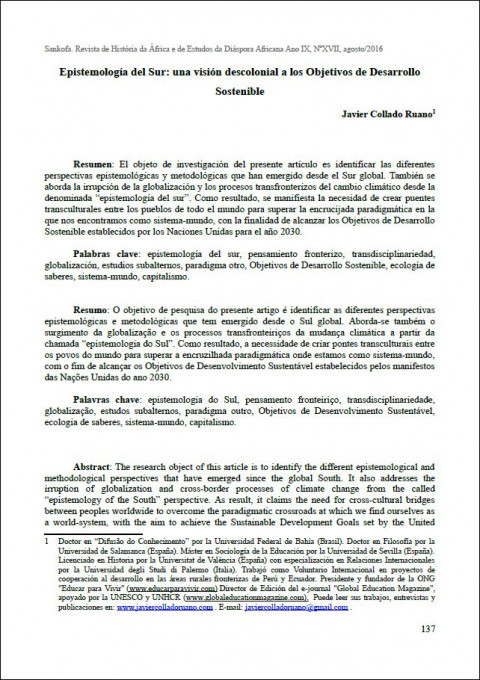 Epistemology from the South: A Decolonized Vision of the Objectives for Sustainable Development Année de publication: 2016 Auteur: Javier Collado Ruano Auteur institutionnel: Universidade de Sao Paulo The research object of this article is to identify the different epistemological and methodological perspectives that have emerged from the global South. It also addresses the irruption of globalization and cross-border processes of climate change from the called “epistemology of the South” perspective. As a result, it claims the need for cross-cultural bridges between people from all over the world to overcome the paradigmatic crossroads at which we find ourselves as a world-system, with the aim to achieve the Sustainable Development Goals set by the United Nations for the year 2030. Epistemología del Sur: una visión descolonial a los Objetivos de Desarrollo Sostenible Année de publication: 2016 Auteur: Javier Collado Ruano Auteur institutionnel: Universidade de Sao Paulo El objeto de investigación del presente artículo es identificar las diferentes perspectivas epistemológicas y metodológicas que han emergido desde el Sur global. También se aborda la irrupción de la globalización y los procesos transfronterizos del cambio climático desde la denominada “epistemología del sur”. Como resultado, se manifiesta la necesidad de crear puentes transculturales entre los pueblos de todo el mundo para superar la encrucijada paradigmática en la que nos encontramos como sistema-mundo, con la finalidad de alcanzar los Objetivos de Desarrollo Sostenible establecidos por los Naciones Unidas para el año 2030.
  Planetary Citizenship Année de publication: 2016 Auteur: Edgar Montiel The blog contains and article where many worldiwide problems that humans are facing are described, and it states that it is necessary to modifiy the way in which we live by adopting a practical education that will enable sustainable life in the planet as it would consider environmental sustainability and peaceful international cooperation from diverse perspectives. Ciudadanía Planetaria Année de publication: 2016 Auteur: Edgar Montiel El blog contiene un artículo donde se describen los problemas actuales que enfrenta la humanidad a escala planetaria y se arguye que se precisas modificar la forma en que vivimos adoptando una educación práctica de vida sostenible que tenga en cuenta el medio ambiente y la cooperación internacional pacífica desde la diversidad.