
Ressources
Explorez une large gamme de ressources sur le GCED afin d’approfondir votre compréhension et de renforcer vos activités de recherche, de plaidoyer, d’enseignement et d’apprentissage.
874 résultats trouvés
 Citizenship and Development in the XXI Cities: Polis and Civitas or Just Urbs? Année de publication: 2016 Auteur: Joselito Fernández Tapia The article aims to determine the problems of the city as polis, civitas and urbs, to identify its characteristics and emphasize the serious problem that means the centrality of the urbs in the modern city. It analyzes aspects of public space, citizenship and city, as interrelated, recovering from urban studies, political and social analysis of the city, to better characterize their problems. From the literature and existing studies we found that civitas and polisare in crisis, and reduced danger of disappearing, to result in a urbs, utilitarian and less and less symbolic value. The result is poverty, greater inequality and social fragmentation, fear, insecurity, isolation, weakening of the civitas and polis, disenfranchisement, depoliticization and dehumanization; against the hegemonic and development of real estate market. It is concluded that dominates the urbs, which, as all the problems of the city needs to be rethought from the civitas and polis. Ciudadanía y desarrollo en las ciudades del siglo XXI: ¿polis y civitas o sólo urbs? Année de publication: 2016 Auteur: Joselito Fernández Tapia El artículo tiene por objetivo determinar la problemática de la ciudad como polis, civitas y urbs, para identificar sus características y enfatizar el grave problema que significa la centralidad de la urbs en la ciudad moderna. Analiza los aspectos del espacio público, la ciudadanía y la ciudad de forma interrelacional; recupera los estudios desde el análisis urbanístico, político y social de la ciudad para caracterizar mejor la problemática de ésta. A partir de la reflexión teórica y los estudios existentes se encuentra que civitas y polis están en crisis, reducidas y en peligro de desaparición para dar lugar a una urbs utilitaria y con cada vez menos valor simbólico. El resultado de ello es pobreza, mayores desigualdades y fragmentación social; miedo, inseguridad, aislamiento, debilitamiento de la civitas y de la polis como proceso de desciudadanización, despolitización y deshumanización frente a la urbanización hegemónica de las inmobiliarias y el mercado. En conclusión, la urbs es dominante, por tanto, así como la problemática de la ciudad necesita repensarse desde la civitas y la polis.
  Bring Global Citizenship in Colombia Année de publication: 2015 Auteur: Nathalia Sarmiento The blog from the Universidad Extremado from Colombia defines what global citizenship is and its ideals, and promotes a citizenship of this type for Colombia. It states that a humanistic and universal perspective, committed with human development, will foster greater liberty, equality, justice, an active citizenship and the education that goes with it. Apuéstale a la ciudadanía global en Colombia Année de publication: 2015 Auteur: Nathalia Sarmiento El blog de la Universidad Externado de Colombia define lo que es la ciudadanía global y sus cometidos, y propone una ciudadanía de este tipo para Colombia. Asegura que desde una perspectiva humanista y universal, comprometida con el desarrollo humano, promoverá mayor libertad, igualdad, justicia, ciudadanía activa y la educación de ella.
  Safe to Learn: Ending Violence in and Through Schools Année de publication: 2019 Auteur institutionnel: End Violence Against Children Safe to Learn – is an initiative dedicated to ending violence in and through schools so children are free to learn, thrive and pursue their dreams. Safe to Learn presents an opportunity to unlock the multiple win of ending violence in schools, improving learning outcomes, better leveraging investments in education, and raising awareness and change attitudes towards violence against children. To date, 11 countries have endorsed Safe to Learn’s Call to Action, which sets out in high-level terms what needs to happen to end violence in schools. These countries include Cambodia, Georgia, Ghana, Honduras, Mexico, Moldova, Nepal, Sierra Leone, South Africa, South Sudan, Uganda and El Salvador.
  Journal on Education in Emergencies: Special Issue on Refugees and Education, Part I (Vol. 5, No.1 December 2019) Année de publication: 2019 Auteur: Sarah Dryden-Peterson | Jo Kelcey | S. Garnett Russell Auteur institutionnel: Inter-agency Network for Education in Emergencies (INEE) This special issue of JEiE—the first of two parts—showcases research on important developments in the field of refugee education across several regions, including the Middle East, Latin America, and Africa. The issue includes four research articles, one interview, two field notes, and three book reviews.The contributing authors describe and analyze how international agencies, state bureaucracies, local organizations and their partners, and refugees shape the structures that influence the education of refugees, both historically and in the present, and how these actors imagine their roles. In so doing, the authors help to untangle key questions about how responsibility for meeting refugees’ educational needs and aspiration is taken up and shared. The articles in this issue include immediate and long-term lessons for how refugee education is designed and experienced.
 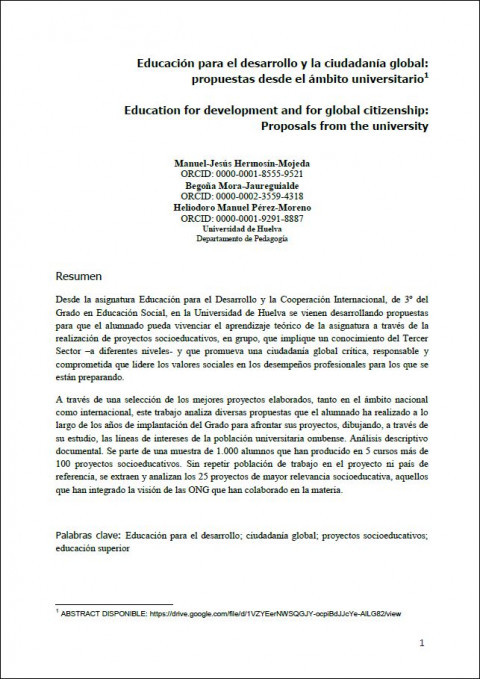 Education for Develpment and for Global Citizenship: Proposals from the University Année de publication: 2018 Auteur: Manuel- Jesús Hermosín-Mojeda | Begoña Mora-Jaureguialde | Heliodoro Manuel Pérez-Moreno From the “Education for Development and International Cooperation” course, which is part of the Social Education career at the University of Huelva, students are performing some social activities to experience different theoretical concepts through social-educational projects that the students, in teams, organize and carry out during the semester. These projects promote, committed and responsible global citizens who can promote social changes in the careers they are persuing. Educación para el desarrollo y la ciudadanía global: propuestas desde el ámbito universitario Année de publication: 2018 Auteur: Manuel- Jesús Hermosín-Mojeda | Begoña Mora-Jaureguialde | Heliodoro Manuel Pérez-Moreno Desde la asignatura Educación para el Desarrollo y la Cooperación Internacional, de 3º del Grado en Educación Social, en la Universidad de Huelva se vienen desarrollando propuestas para que el alumnado pueda vivenciar el aprendizaje teórico de la asignatura a través de la realización de proyectos socioeducativos, en grupo. Estos proyectos promueven ciudadanos globales críticos, responsables y comprometidas capaces de promover cambios sociales en las carreras para los que se están preparando.
 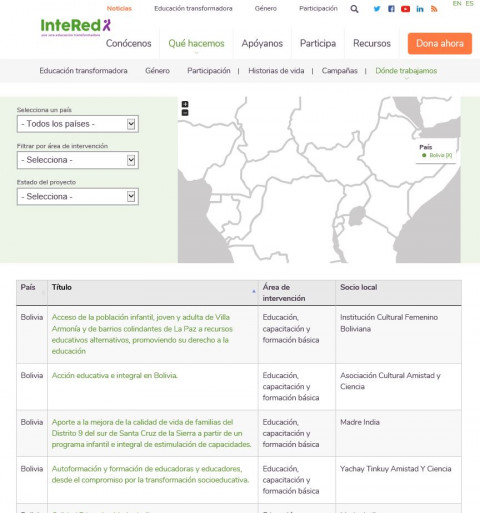 InteRed. Educational Projects in Bolivia Année de publication: 2019 Auteur institutionnel: InteRed InteRed carries out educational projects to solve specific social problems around the planet. The projects tackle things such as poverty, health, access to education, Human Rights, access to food, among other things. InteRed. Proyectos educativos en Bolivia Année de publication: 2019 Auteur institutionnel: InteRed InteRed lleva a cabo projectos educacionales intentando resolver problemas específicos en el planeta. Los proyectos abordan cuestiones como pobreza, salud, acceso a la educación, Derechos Humanos, acceso a alimentos, entre otras cosas.