
Ressources
Explorez une large gamme de ressources sur le GCED afin d’approfondir votre compréhension et de renforcer vos activités de recherche, de plaidoyer, d’enseignement et d’apprentissage.
3,225 résultats trouvés
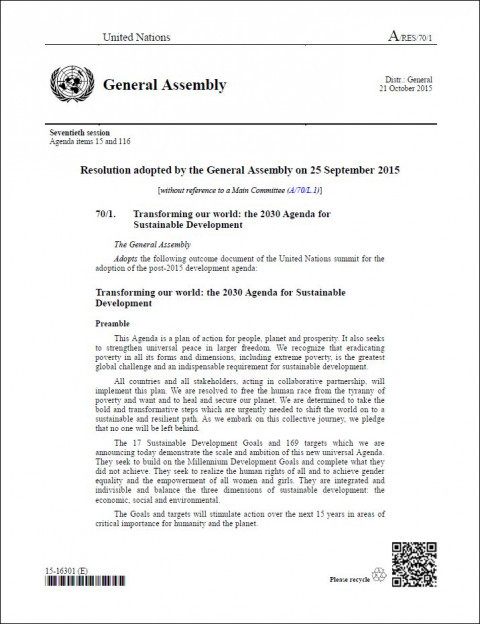 Transforming our world: the 2030 Agenda for Sustainable Development Année de publication: 2015 Auteur institutionnel: United Nations (UN) This Agenda is a plan of action for people, planet and prosperity. It also seeks to strengthen universal peace in larger freedom. We recognize that eradicating poverty in all its forms and dimensions, including extreme poverty, is the greatest global challenge and an indispensable requirement for sustainable development. All countries and all stakeholders, acting in collaborative partnership, will implement this plan. We are resolved to free the human race from the tyranny of poverty and want and to heal and secure our planet. We are determined to take the bold and transformative steps which are urgently needed to shift the world on to a sustainable and resilient path. As we embark on this collective journey, we pledge that no one will be left behind.The 17 Sustainable Development Goals and 169 targets which we are announcing today demonstrate the scale and ambition of this new universal Agenda. They seek to build on the Millennium Development Goals and complete what they did not achieve. They seek to realize the human rights of all and to achieve gender equality and the empowerment of all women and girls. They are integrated and indivisible and balance the three dimensions of sustainable development: the economic, social and environmental. The Goals and targets will stimulate action over the next 15 years in areas of critical importance for humanity and the planet.
 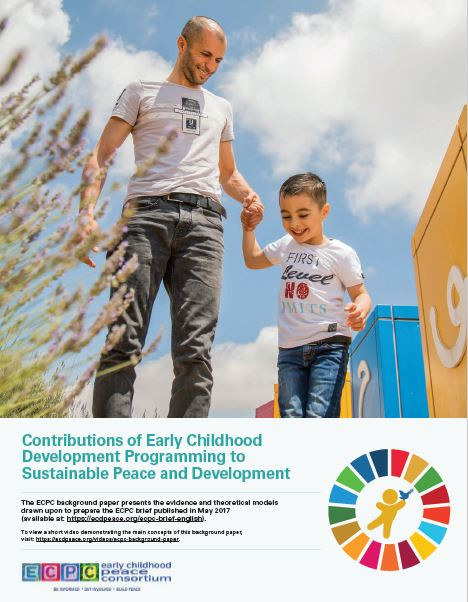 Contributions of Early Childhood Development Programming to Sustainable Peace and Development Année de publication: 2018 Auteur: Chelsea K. Donaldson | Friedrich W. Affolter | Liliana Angelica Ponguta | Rima Salah | Pia R. Britto | James Leckman | Paul Connolly | Siobhan Fitzpatrick | Pauline Walmsley By intervening early and engaging with children’s families, ECD services offer a unique opportunity to make a cost-effective and sustainable impact on interrupting cycles of poverty and violence. Given that efforts towards sustainable peace must encompass all sectors and address all societal levels, there is a crucial need for implementing “multi-level ECD services” that center on the whole child and engage his or her surrounding ecological context. These comprehensive ECD services can not only improve child development outcomes, but also strengthen competencies in caregivers, address stressors and conflict drivers in the community and build institutional capacities to reduce structural violence. The purpose of this background paper is to merge insights from both micro and macro-level perspectives to demonstrate how ECD services can be leveraged to sustainable peace and development. While peacebuilding experts have traditionally focused on macro-level strategies such as government reform or economic rehabilitation interventions, ECD practitioners have focused primarily on micro-level interventions of individual children and families without much exploration of how ECD services can be leveraged to mitigate risks of conflict and transform relationships across communities and regions.
  Address by Irina Bokova, Director-General of UNESCO, on the occasion of the Mahatma Gandhi Institute of Education for Peace and Sustainable Development; New Delhi, 11 November 2012 Année de publication: 2012 Auteur institutionnel: UNESCO. Director-General, 2009-2017 (Bokova, I.G.) This address was presented by Irina Bokova, Director-General of UNESCO on the occasion of the Mahatma Gandhi Institute of Education for Peace and Sustainable Development. Discours de Mme Irina Bokova, Directrice générale de l'UNESCO, à l'occasion de l'Institut Mahatma Gandhi d'éducation pour la paix et le développement durable; New Delhi, le 11 Novembre 2012 Année de publication: 2012 Auteur institutionnel: UNESCO. Director-General, 2009-2017 (Bokova, I.G.) Cette adresse a été présentée par Irina Bokova, Directrice générale de l'UNESCO à l'occasion de l'Institut Mahatma Gandhi d'éducation pour la paix et le développement durable. Address by Irina Bokova, Director-General of UNESCO, on the occasion of the Inaugural Lecture on: Diverse Societies, Inclusive Democracies: New Skills for a Sustainable World, Organized by the Mahatma Gandhi Institute of Education for Peace Année de publication: 2014 Auteur institutionnel: UNESCO. Director-General, 2009-2017 (Bokova, I.G.) This document is the address of Irina Bokova, Director-General of UNESCO, on the occasion of the inaugural lecture on: Diverse Societies, Inclusive Democracies: New Skills for a Sustainable World, organized by the Mahatma Gandhi Institute of Education for Peace in Delhi, India, 25 November 2014. She insisted the importance of social integration, the human rights for all and education for sustainable development. Address by Irina Bokova, Director-General of UNESCO, on the occasion of the Inaugural Lecture on: Diverse Societies, Inclusive Democracies: New Skills for a Sustainable World, Organized by the Mahatma Gandhi Institute of Education for Peace Année de publication: 2014 Auteur institutionnel: UNESCO. Director-General, 2009-2017 (Bokova, I.G.) Ce document est le discours de Irina Bokova, Directrice générale de l'UNESCO, à l'occasion de la conférence inaugurale sur: les sociétés diversifiées, les démocraties inclusives: De nouvelles compétences pour un monde durable, organisé par l'Institut Mahatma Gandhi d'Éducation pour la Paix à Delhi, Inde, le 25 Novembre 2014. Elle a insisté sur l'importance de l'intégration sociale, le droit de l'homme pour tous et éudcation pour le développement durable. 이리나 보코바 유네스코 사무총장의 취임 기념 공개 강연: 다양한 사회, 포괄적 민주주의: 지속가능한 세계를 위한 새로운 기술, ‘마하트마 간디 평화와 지속가능발전 교육연구소’(Mahatma Gandhi Institute of Education for Peace and Sustainable Development)주최, 2014년 11월 25일 인도, 델리. Année de publication: 2014 Auteur institutionnel: UNESCO. Director-General, 2009-2017 (Bokova, I.G.) 이 문서는 2014년 11월 25일, 인도 델리에서 ‘다양한 사회, 포괄적 민주주의: 지속가능한 세계를 위한 새로운 기술’을 주제로 ‘마하트마 간디 평화와 지속가능발전 교육연구소’(Mahatma Gandhi Institute of Education for Peace and Sustainable Development)가 주최한 이리나 보코바 유엔 사무총장의 취임 기념 공개 강연의 내용이다. 여기에서 그녀는 사회 통합의 중요성과 모든 사람을 위한 인권, 지속가능한 발전을 위한 교육을 주장했다.
  ПОЛОЖЕНИЕ С ПРАВАМИ ЧЕЛОВЕКА В МИРЕ АПРЕЛЬ 2024 Année de publication: 2024 Auteur institutionnel: Amnesty International Le Rapport d’Amnesty International décrit la situation des droits humains dans le monde en 2023 dans 155 pays différents. Les équipes de journalistes et d’enquêteurs de l'ONG peignent un portrait plutôt sombre, avec notamment un recul du droit des femmes, les conséquences dramatiques du réchauffement climatique sur les populations les plus vulnérables, le recul du droit de manifester, ou encore la prolifération de la haine en ligne dans le monde. La multiplication des conflits armés et le choc du 7 octobre ont également eu des conséquences dramatiques. Cependant, quelques bonnes nouvelles sont aussi à noter, avec des avancées pour les droits des personnes LGBTI par exemple. Amnesty International Report describes the human rights situation worldwide in 2023 in 155 different countries. TheNGO's teams of journalists and investigators paint a rather gloomy picture, with, in particular, a decline in women's rights, the dramatic consequences of global warming on the most vulnerable populations, a decline in the right to protest, and the proliferation of online hate around the world. The multiplication of armed conflicts and the shock of October 7 have also had dramatic consequences. However, there is some good news too, with advances in LGBTI rights for example. The State of the World’s Human Rights: April 2024 Année de publication: 2024 Auteur institutionnel: Amnesty International Le Rapport d’Amnesty International décrit la situation des droits humains dans le monde en 2023 dans 155 pays différents. Les équipes de journalistes et d’enquêteurs de l'ONG peignent un portrait plutôt sombre, avec notamment un recul du droit des femmes, les conséquences dramatiques du réchauffement climatique sur les populations les plus vulnérables, le recul du droit de manifester, ou encore la prolifération de la haine en ligne dans le monde. La multiplication des conflits armés et le choc du 7 octobre ont également eu des conséquences dramatiques. Cependant, quelques bonnes nouvelles sont aussi à noter, avec des avancées pour les droits des personnes LGBTI par exemple. Amnesty International Report describes the human rights situation worldwide in 2023 in 155 different countries. TheNGO's teams of journalists and investigators paint a rather gloomy picture, with, in particular, a decline in women's rights, the dramatic consequences of global warming on the most vulnerable populations, a decline in the right to protest, and the proliferation of online hate around the world. The multiplication of armed conflicts and the shock of October 7 have also had dramatic consequences. However, there is some good news too, with advances in LGBTI rights for example.
  World Migration Report 2024 Année de publication: 2024 Auteur institutionnel: Organisation Internationale pour les Migrations (OIM) The World Migration Report 2024 provided by the IOM aims at providing a better understanding of the migration phenomenon through a series of key questions: What is the proportion of migrants in the world? Are most migrants men or women? Which are the main host countries? The interactive edition presents only some of the key information contained in the full report.