
Ressources
Explorez une large gamme de ressources sur le GCED afin d’approfondir votre compréhension et de renforcer vos activités de recherche, de plaidoyer, d’enseignement et d’apprentissage.
661 résultats trouvés
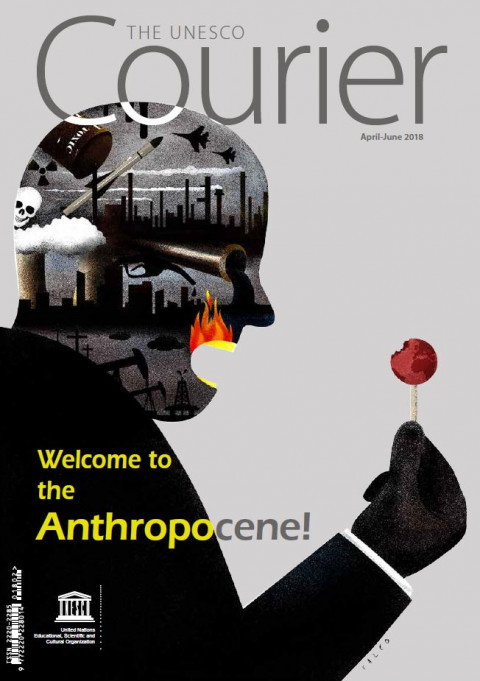 Welcome to the Anthropocene! (The UNESCO Courier no. 2, April-June 2018) Année de publication: 2018 Auteur institutionnel: UNESCO In the Ideas section of this issue, three internationally celebrated academics consider the notion of diversity – Mireille Delmas-Marty, a member of the Institut de France; Souleymane Bachir Diagne, Senegalese philosopher; and Abdourahman Waberi, novelist and diarist from Djibouti. With these articles, the Courier marks the celebrations of the World Day for Cultural Diversity for Dialogue and Development (21 May) and the International Day for Biological Diversity (22 May).Our Guest for this issue is Bibi Russell, a fashion designer from Bangladesh. A former top model in London, she quit the catwalk to devote herself to using fashion for development. She is currently working in India, helping young women, some of whom were trafficked as children, to find their bearings and start a new life.To mark UNESCO’s Africa Week in May, we focus on youth in the West and the South of the continent, in our Current Affairs section. After visiting Athens, World Book Capital 2018, we travel to Canada’s Northwest territories, on the other side of the world, to discover the people of Great Bear Lake, in the Tsá Tué biosphere reserve – established and looked after by the indigenous community that lives there.Finally, Zoom invites us to follow an ordinary day in the life of Qello, a 13-year old girl in Ethiopia, hour by hour.The UNESCO Courier celebrates its 70th birthday in 2018. Each issue this year will feature an article that looks back at this extraordinary adventure. In this issue, Roberto Markarian, Rector of the University of the Republic, Uruguay, recounts the story of the role the Courier has played in his life. Bienvenue dans l'Anthropocène! (Le Courrier de l'UNESCO no. 2; Avril-Juin 2018) Année de publication: 2018 Auteur institutionnel: Organisation des Nations Unies pour l'éducation, la science et la culture (UNESCO) Selon les uns, l’Anthropocène n’est qu’un autre nom pour l’époque que nous appelons Holocène, les humains ayant commencé à exercer une pression sur l’environnement depuis 10 000ans, c’est-à-dire depuis leur sédentarisation et l’invention de l’agriculture. Selon d’autres, l’Anthropocène commencerait autour de 1800, avec la révolution industrielle. D’autres encore voient l’Anthropocène éclore dupremier champignon atomique de 1945. Malgré ces divergences, très rares sont ceux qui ne reconnaissent pas qu’au cours du dernier demi-siècle l’état de la planète s’est dégradé plus rapidement et plus dramatiquement que jamais : amasgigantesques de plastique sur les plages et dans les mers, développement sans précédent de nouveaux matériaux qui couvrent la surface terrestre et ne se recyclent que très peu, sols gorgés d’engrais, augmentation du taux d’acidité des mers, tauxde pollution sans précédent, érosion des forêts tropicales, dérèglement desécosystèmes, extinction massive des espèces et diminution drastique de la biodiversité, réchauffement climatique...À qui la faute ? Auxhumains – répond lamajorité des scientifiques. Reste à savoir si nous devrions tous porter la même charge deresponsabilité. Certains blâmant avant tout le système capitaliste né en Occident, parlent de Capitalocène ou d’Occidentalocène. Courons-nous à la catastrophe? Des voix s’élèvent pour prophétiser la fin du monde! Des notions comme Chtulhucène ou Thanatocène sont avancées pour signifier que le monstre rôde, quela mort nous guette... Des experts, bien plus modérés, n’en sont pas moins inquiets face à l’indécision des décideurs. «Tout se passe comme si l’humanité, léthargique, attendait la fin du film et le moment où les héros viendront tout arranger et où nous serons tous heureux pour toujours», lira-t-on dans ces pages.Le débat fait rage, les solutions tardent à venir. Le Courrier fait le point.
 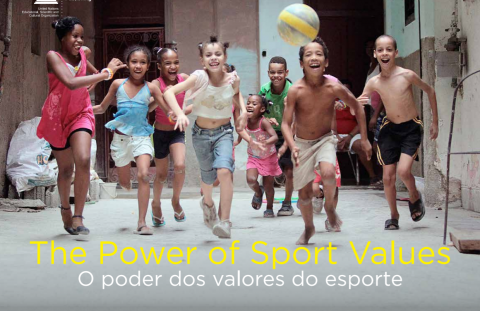 The Power of Sport Values Année de publication: 2016 Auteur institutionnel: UNESCO In the contexts of malnutrition, conflict, inactivity and unemployment, sport can act as springboard for social transformation, as a gateway to rounded development and as a facilitator for inclusive and responsible citizenship. Not only is sport a bridge between individuals and nations, it can also be an active tool for overcoming stereotypes, rising above exclusion and fostering citizenship. The Power of Sport Values is a collection of the best 15 entries of UNESCO’s photo contest on the power of sport values, selected from over 300 photos submitted by photographers from 76 countries all around the world. Be it in South Sudan, Kazakhstan, Mexico, Bangladesh or Cuba, sport provides joy, fosters inclusion and strengthens social mobilization.
 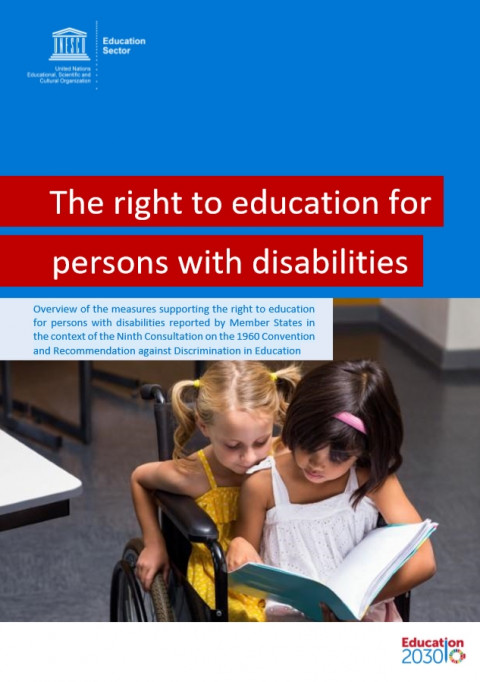 The Right to Education for Persons with Disabilities Année de publication: 2019 Auteur institutionnel: UNESCO Persons with disabilities are often excluded from the education system, whether out-of-school entirely, educated in separate institutions or participating in a mainstream system which is not adapted to their needs and abilities. The 2030 Agenda commitment to ‘leave no one behind’ has reinforced the global discourse towards inclusive, equitable education. As part of its mandate, UNESCO monitors the implementation of the 1960 Convention and Recommendation against Discrimination in Education. During the Ninth Consultation on the implementation of this instrument, almost all Member States reported upon measures that they have taken in relation to the right to education for persons with disabilities. This document compiles practical examples extracted from these reports for information sharing and advocacy.
  Transforming Lives through Education Année de publication: 2018 Auteur: Anne Müller | Cristina Stanca-Mustea Auteur institutionnel: UNESCO 1945-2018: This book invites the reader on a fascinating photographic journey that highlights UNESCO’s work in promoting education across the world for more than seven decades. Above all, it testifies to the power of education to transform lives, build self-confidence, contribute to economic and social progress, and promote intercultural understanding.Through this book, the reader will discover the history of UNESCO’s work in education from its foundation to its current role as global leader for the coordination of Goal 4 of the United Nations 2030 Agenda for Sustainable Development, dedicated to education.The publication highlights the important milestones, normative advances, innovations and outstanding projects in our history, which bear witness to our humanistic vision of education. Drawing on a rich archive of photographs, some of them little known, this book illustrates the scale and diversity of UNESCO’s education programme across the globe. Transformer la vie grâce à l'éducation Année de publication: 2018 Auteur: Anne Müller | Cristina Stanca-Mustea Auteur institutionnel: Organisation des Nations Unies pour l'éducation, la science et la culture (UNESCO) 1945-2018 : cet ouvrage vous invite à un passionnant voyage photographique qui témoigne de l’action de l’UNESCO pour promouvoir l’éducation à travers le monde depuis maintenant plus de sept décennies. Il témoigne avant tout du pouvoir de l’éducation pour transformer les vies, développer la confiance en soi, contribuer au progrès économique et social, favoriser la compréhension interculturelle.En parcourant cet ouvrage, le lecteur découvrira l’histoire de l’action de l’UNESCO en matière d’éducation, depuis ses débuts jusqu’à son rôle actuel de chef de file, au niveau mondial, pour la coordination de l’Objectif de développement durable 4 dédié à l’éducation, dans le cadre de l’Agenda 2030 défini par les Nations Unies.Ce livre reflète les jalons que nous avons posés, les avancées normatives et les innovations que nous avons réalisées, les projets phares que nous avons conduits et rend compte de notre vision humaniste de l’éducation. S’appuyant sur de riches archives photographiques, don't certaines sont peu connues, ce livre illustre l’ampleur et la variété du programme d’éducation de l’UNESCO à travers le monde.
  Agree to Differ Année de publication: 2015 Auteur institutionnel: UNESCO Dialogue on the basis of respect, tolerance, human rights and dignity has never been so important. This is the spirit of the International Decade for the Rapprochement of Cultures (2013-2022). The International Decade originates in the United Nations General Assembly Resolution 67/104 adopted in December 2012, co-sponsored by Kazakhstan and designating UNESCO as lead agency. This drew on a Resolution of the UNESCO General Conference and the experience of the 2010 International Year for the Rapprochement of Cultures which UNESCO led forward with activities across the world.The objective of the International Decade is to promote mutual understanding and respect for diversity, rights and equal dignity between peoples, through intercultural dialogue and concrete initiatives. This is essential for all societies today, undergoing deep transformation. The surge of conflict, acts of violence, extremism and intolerance pose a threat to peace, undermining the unity of humanity and calling on us all to redouble our efforts to advance a culture of peace, through dialogue, the safeguarding of cultural heritage, and the promotion of global citizenship education.The International Decade for the Rapprochement of Cultures embodies a commitment to explore new articulations between cultural diversity and universal values. The rapprochement of cultures calls for a commitment to the principles of human dignity and solidarity as the corner stones of living together within and between societies, making the most of all sources of diversity.This publication bears testimony to the urgency of addressing contemporary challenges through intercultural and interreligious dialogue in order to deepen understanding and cooperation for peace. Through concrete examples, including experiences at the community level from across the world, the publication showcases why cultural diversity, intercultural dialogue and responsive democratic governance are vital for the enhancement of mutual understanding, the growth of tolerance, and the building of bridges of mutual respect and dignity.
  Global Citizenship Education: Taking It Local Année de publication: 2018 Auteur institutionnel: UNESCO UNESCO is leading global efforts on Global Citizenship Education (GCED), which is at the core of Target 4.7 of Sustainable Development Goal 4 on Education. To address the perception that the concept of GCED is concerned mainly with global matters and maybe dissociated from local needs and realities, UNESCO has identified local/national/traditional precepts and concepts that are similar to the UNESCO understanding of global citizenship.As culturally relevant expressions of GCED and to contribute to building peace through the implementation of GCED, the concepts identified here can serve as entry-points to teach and learn about GCED in more locally relevant ways. Education à la citoyenneté mondiale: pour une approche locale Année de publication: 2018 Auteur institutionnel: Organisation des Nations Unies pour l'éducation, la science et la culture (UNESCO) L’UNESCO mène les efforts mondiaux portant sur l’éducation à la citoyenneté mondiale, qui est au coeur de la cible 4.7 de l’Objectif 4 de développement durable sur l’éducation. Afin de clarifier la perception selon laquelle le concept de l’éducation à la citoyenneté mondiale concerne principalement des questions mondiales et qu’il est peut-être dissocié des réalités et des besoins locaux, l’UNESCO a identifié des préceptes et des concepts locaux/nationaux/traditionnels qui sont comparables à la compréhension qu’a l’UNESCO de la citoyenneté mondiale. En tant qu’expressions culturellement pertinentes de l’éducation à la citoyenneté mondiale, et dans le but de contribuer à l’édification de la paix grâce à la mise en oeuvre de l’éducation à la citoyenneté mondiale, les concepts identifiés dans ce document peuvent servir de points d’entrée pour enseigner l’éducation à la citoyenneté mondiale et pour l’apprendre, de manière plus pertinente au niveau local.
 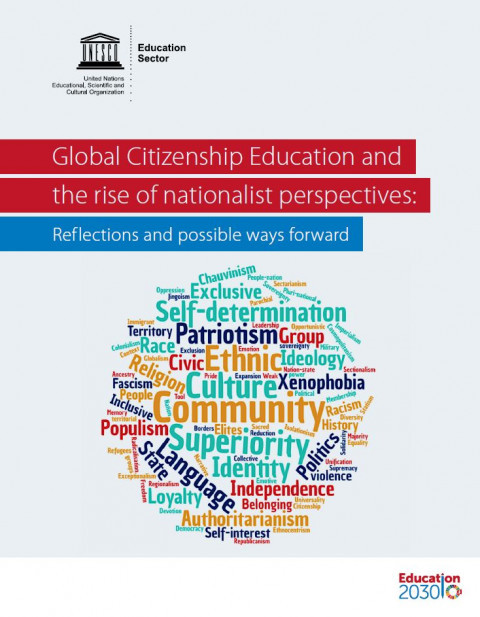 Global Citizenship Education and the Rise of Nationalist Perspectives: Reflections and Possible Ways Forward Année de publication: 2018 Auteur institutionnel: UNESCO | APCEIU Over the past few years, many have observed a rise in nationalist perspectives across the world. These trends raise questions about the role of education and, in particular, one of UNESCO’s key areas of work in the field of education, namely Global Citizenship Education (GCED), which seeks to equip learners with the skills, values and attitudes needed to contribute to the development of peaceful and just societies. This paper seeks to clarify the evidence of the rise of nationalist perspectives and its causes, and to lay out how GCED is challenged by this phenomenon. It recommends ways forward for education stakeholders in promoting GCED, in order to strengthen ‘learning to live together’ by embedding GCED meaningfully in local and country contexts.