
Ressources
Explorez une large gamme de ressources sur le GCED afin d’approfondir votre compréhension et de renforcer vos activités de recherche, de plaidoyer, d’enseignement et d’apprentissage.
3,435 résultats trouvés
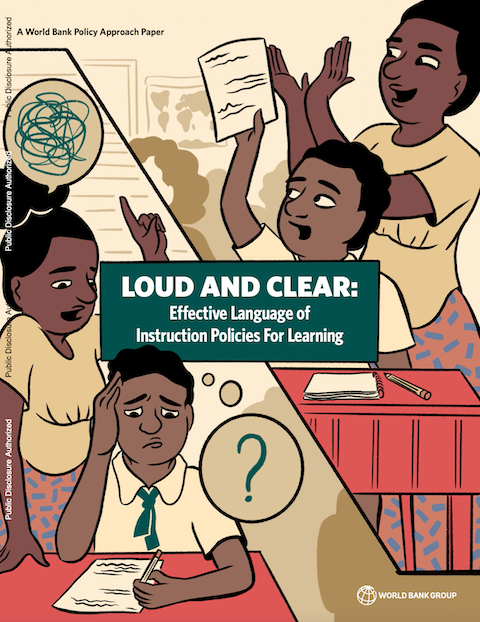 Haut et fort: Politiques efficaces de Langue d’Enseignement Pour l’Apprentissage Année de publication: 2021 Auteur institutionnel: World Bank Ce document décrit la nouvelle approche de la politique de la Banque mondiale en matière de langue d’enseignement, en tant que composante dans l’opérationnalisation du paquet de politique de littératie en appui au nouvel objectif d’apprentissage de la banque. Cette nouvelle approche vise à soutenir les progrès dans le domaine des politiques et des interventions en matière de LE (Langue d'Enseignement), dans la mesure où les défis liés à la PLE(Politique de Langue d'Enseignement) sont identifiés et traités à la lumière du contexte de chaque pays.
 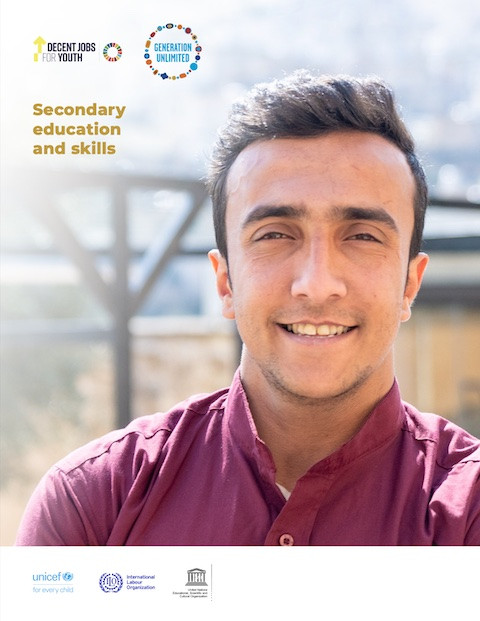 Secondary Education and Skills Année de publication: 2020 Auteur institutionnel: Generation Unlimited | Global Initiative on Decent Jobs for Youth All young people need access to quality education and learning that would help them develop the skills, knowledge, attitudes and values they need to find and retain productive work, to make informed decisions, and to positively engage in their communities. However, millions of young people remain out of school or do not have access to quality learning opportunities. The COVID-19 pandemic and the resulting economic downturn have made the challenges facing young people even more pressing, as shrinking labour markets leave low-skilled young people with fewer choices, and render them more vulnerable to exploitation.There is a need for a radical re-think of what works, seeking a radical improvement in traditional curricula, the number of trained professional teachers, student–teacher ratios, and the teaching methods and strict school timetables that have become less relevant to the current needs of young people.The aim of this guide is to support the Generation Unlimited strategic priorities, and to inform policy makers and social partners, so as to guide action on investment, policy change and delivery, increasing the likelihood of successful outcomes and decent jobs for young people.
  Manual for Reporting Violent Extremism and Terrorism Année de publication: 2021 Auteur institutionnel: Albanian Media Institute Contemporary journalists and media are responsible for informing the public, but this is made challenging in the age of disinformation and when citizens are victims of “false” information, sometimes as a result of propaganda produced by extremist or terrorist groups.This new circumstance requires a new ethical and professional awareness. In this context, Albanian Media Institute convened a group of experts that created a set of guidelines that media can follow when covering violent extremism and terrorism. These are based in part on international texts, the UNESCO handbook for journalists Terrorism and the media and other professional guidelines, as well as on the experience of the Albanian media coverage of violent extremism. The guidelines review current legal regulation that affects media coverage; the basic principles of editorial work and reporting; particular nuances and features to consider when covering terrorism; the role of social media; and the challenge of hate speech that might incite violent extremism and terrorism. Ethical journalists are rightly wary of being told how to do their job so we recognize that the reality of reporting terrorism cannot be limited by a strict instruction manual. These suggestions are therefore offered as potential guidance, providing reporters and editors who cover these issues with thoughts and ideas that may help them deal with professional challenges they face in their everyday work.
  Caring for Women Subjected to Violence: A Who Curriculum For Training Health-Care Providers Année de publication: 2019 Auteur institutionnel: World Health Organization (WHO) This curriculum draws on the work of many people around the world dedicated to preventing and responding to all forms of violence against women and girls. WHO would like to thank all of those who contributed and who shared their training exercises and experiences, many of which have been incorporated into this manual. Atención para las mujeres que han sufrido violencia: Programa de capacitación de la OMS dirigido a los prestadores de servicios de salud Année de publication: 2019 Auteur institutionnel: World Health Organization (WHO) Este programa de capacitación se basa en el trabajo de muchas personas de todo el mundo que se dedican a prevenir y responder frente a todas las formas de violencia contra las mujeres y las niñas.
 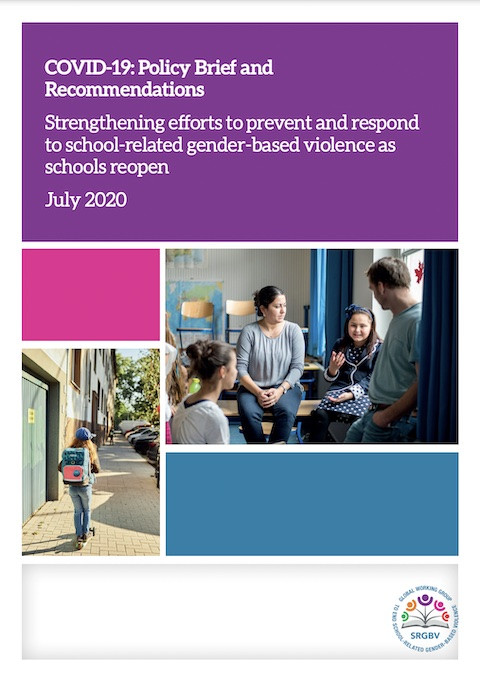 COVID-19: Policy Brief and Recommendations; Strengthening Efforts to Prevent and Respond to School-Related Gender-Based Violence as Schools Reopen Année de publication: 2020 Auteur institutionnel: United Nations Girls' Education Initiative (UNGEI) This policy brief is targeted at policymakers and practitioners working in gender, education and child protection fields. It draws from emerging evidence on the gendered implications of COVID-19 on violence as well as research from previous health emergencies regarding the impacts of school closures on gender-based violence. Working on the principle of ‘Build Back Better’, this brief may be used to advocate for improved attention to school- related gender-based violence (SRGBV).
 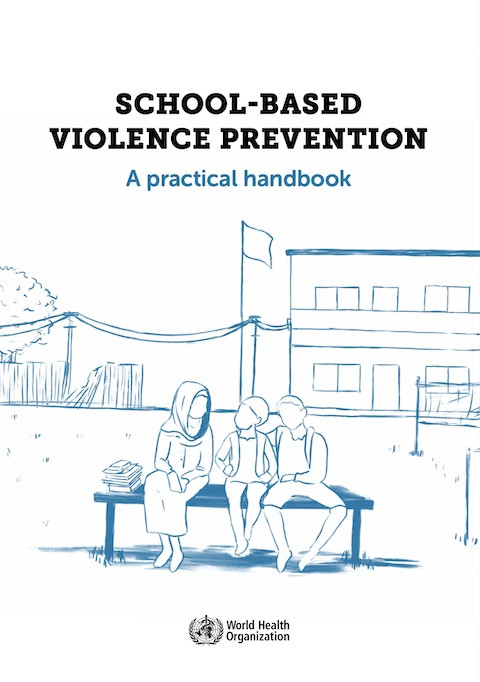 School-Based Violence Prevention: A Practical Handbook Année de publication: 2019 Auteur institutionnel: World Health Organization (WHO) School-based violence prevention: a practical handbook is a World Health Organization (WHO) resource for school officials and educators to help prevent violence in and around schools. The handbook gives advice on how schools can embed violence prevention within their routine activities and across the points of interaction schools provide with children, parents and other community members. Prevención de la violencia en la escuela: Manual práctico Année de publication: 2019 Auteur institutionnel: World Health Organization (WHO) Este recurso, Prevención de la violencia en la escuela: manual práctico, trata sobre la escuela, la educación y la prevención de la violencia. Ofrece orientación a los funcionarios escolares y a las autoridades de Educación sobre el modo en que las escuelas pueden incorporar la prevención de la violencia a sus actividades habituales y en todos los puntos de interacción facilitan con los niños, los progenitores y otros miembros de la comunidad. La puesta en práctica del manual contribuirá en gran medida a la consecución de los ODS y otros objetivos mundiales de salud y desarrollo. Prévention de la violence à l’école : Guide pratique Année de publication: 2019 Auteur institutionnel: World Health Organization (WHO) Cette ressource intitulée Prévention de la violence à l’école : guide pratique, porte sur l’école, l’éducation et la prévention de la violence. Ce guide conseille le personnel des écoles et les autorités chargées de l’éducation quant à la façon dont les établissements scolaires peuvent intégrer la prévention de la violence dans leurs activités de routine. Il leur propose également de réfléchir au lieu même qu’est l’école, à savoir un espace d’interaction et de communication entre parents, enfants et les autres membres de la communauté. S’il est mis en œuvre, ce manuel contribuera grandement à la réalisation des ODD et d’autres objectifs mondiaux en matière de santé et de développement.
 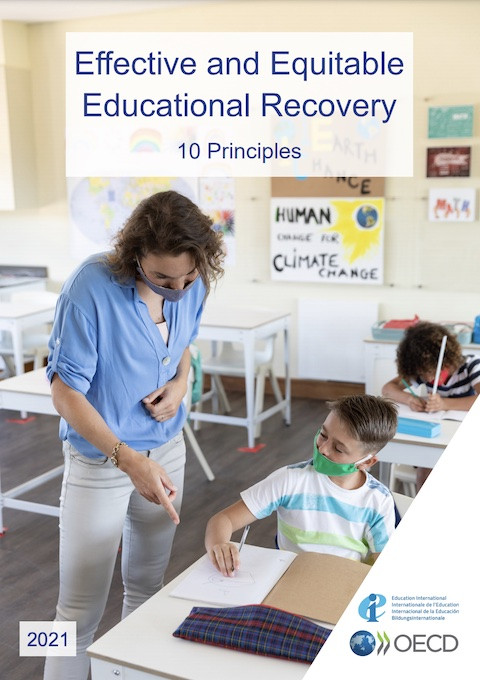 Effective and Equitable Educational Recovery: 10 Principles Année de publication: 2021 Auteur institutionnel: Education International (EI) | Organisation for Economic Co-operation and Development (OECD) The COVID-19 pandemic has led to the frequent closure of school buildings in most countries in the world and has interrupted the school attendance of at least 1.2 billion students in 2020 and 2021. Although many education systems have been able to adapt in varying degrees, the pandemic has shown that countries’ current learning infrastructures are highly vulnerable to external shocks.While schools have shown great resilience in trying to compensate for the crisis, they need to be better prepared for similar challenges. Education systems must ensure the continuity of learning which must be the centrepiece of all considerations.Acknowledging the disruption that the health crisis has brought about and its likely impact on educational quality and equity, the OECD Secretariat and Education International have, based on their respective work during the pandemic, jointly established 10 principles that can facilitate the collaboration of education authorities, the teaching profession and their organisations to navigate the crisis effectively and reshape education systems after the pandemic to reach greater levels of educational quality and equity.Education systems around the world have been facing similar challenges but generated diverse approaches and experiences. The intention is also for these principles to contribute to a framework for international cooperation and peer learning.