
Ressources
Explorez une large gamme de ressources sur le GCED afin d’approfondir votre compréhension et de renforcer vos activités de recherche, de plaidoyer, d’enseignement et d’apprentissage.
1,443 résultats trouvés
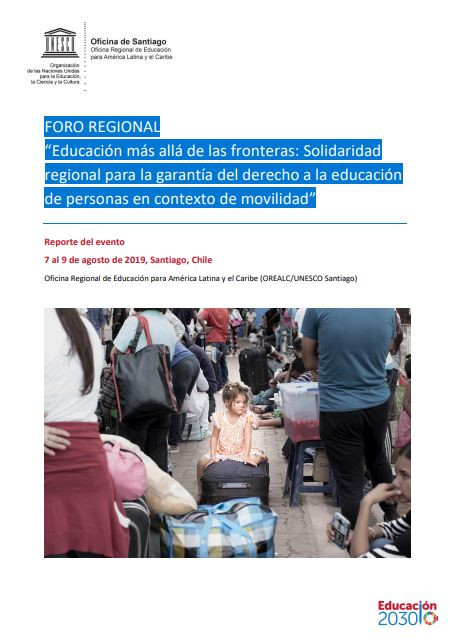 Foro regional: Educación más allá de las Fronteras: Solidaridad Regional para la Garantía del Derecho a la Educación de Personas en Contexto de Movilidad; reporte del evento Année de publication: 2019 Auteur institutionnel: UNESCO Santiago El aumento sustantivo de la movilidad intrarregional, la progresiva transformación de la procedencia de la población en contexto de movilidad y la presencia de flujos masivos de desplazamiento en los últimos años han supuesto importantes desafíos para los Estados. Particularmente, en establecer las maneras en que las personas migrantes, refugiadas, solicitantes de asilo y retornadas puedan ejercer sus derechos fundamentales. Entre estos derechos, el derecho a la educación emerge como una herramienta para proteger la dignidad humana, especialmente considerando su capacidad de promover la garantía de otros derechos y de constituirse, por tanto, en un derecho multiplicador. Un compromiso central de la Agenda 2030 adoptada por los Estados Miembros es “no dejar a nadie atrás”, por lo que considerar las necesidades de protección de las personas en situación de movilidad resulta urgente. El logro de los Objetivos de Desarrollo Sostenible depende de nuestra respuesta a este desafío mundial y regional.
 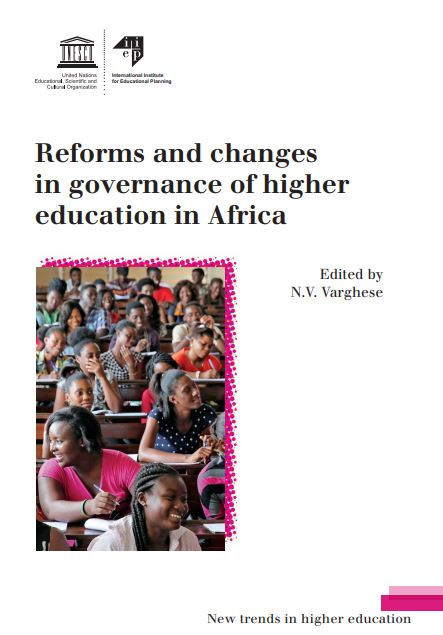 Reforms and Changes in Governance of Higher Education in Africa Année de publication: 2016 Auteur: N.V. Varghese Auteur institutionnel: UNESCO International Institute for Educational Planning (IIEP) Higher education in Africa has received favourable political attention and funding support in the period following independence. The rationale for state funding was questioned in the 1980s, and the higher education reforms in the 1990s centred on finding alternative ways of financing and on improving the managerial efficiency of universities. This focus was reflected in the market-friendly reforms that led to the privatization of public institutions and the promotion of private institutions. These reforms resulted in substantial changes in the governance and management of higher education. IIEP initiated a research study to analyse the reforms and to understand their effects on the governance of higher education at institutional and national levels. Based on studies carried out in Ethiopia, Ghana, Kenya, Nigeria, and South Africa, this book shows how the reforms have effected changes in the governance and management of institutions of higher education in Africa.
  Tajik cultural identity and multiculturalism Année de publication: 2014 Auteur: Khamrokhon Zarifi The article is devoted to issues of history, cultural identity and the heritage of the Tajik people. The issues of preservation and continuity of cultural diversity, as well as the phenomenon of multiculturalism are discussed.
  Be a buddy, not a bully: experiences of sexual and gender minority youth in Tamil Nadu schools Année de publication: 2019 Auteur: Menon C. Sunil, Chakrapani. Venkatesan, Jadav. Sarita Auteur institutionnel: UNESCO New Delhi We at UNESCO recognize that no country can achieve Sustainable Development Goal 4 - to ensure inclusive and equitable quality education and promote lifelong learning opportunities for all - if students are discriminated against or experience violence because of their actual or perceived sexual orientation and gender identity. This study conducted under the overall guidance of the School Education Department, Government of Tamil Nadu highlights our shared commitment to prevent and address bullying in educational institutions. We are confident that this report will be an effective tool for evidence based advocacy with school education departments and go a long way in promoting a comprehensive education sector response to SOGIE-based bullying, which includes enabling policy environments; inclusive curriculum and learning materials; professional development programmes for teachers and other school staff; support for learners including awarenessraising activities; and an overall school environment that is safe, nonviolent and that understands and appreciates diversity.
 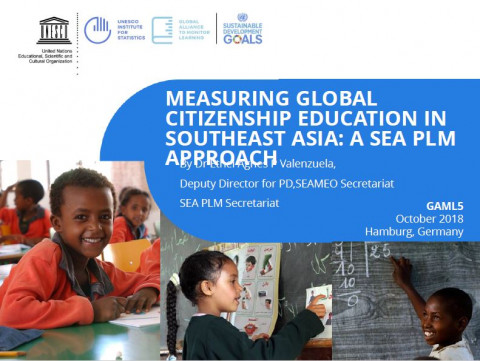 Measuring Global Citizenship Education in Southeast Asia: A SEA PLM Approach Année de publication: 2018 Auteur: Ethel Agnes P. Valenzuela Auteur institutionnel: Southeast Asian Ministers of Education Organization (SEAMEO) | UNESCO Institute for Statistics (UIS) Audit of Curricula for the Southeast Asia Primary Learning Metrics (March 2016), an early issue confronted in developing an assessment framework for SEA-PLM wasdetermining how to design and construct a single assessment program across all ASEAN member countries.The design and approach needed to take account of the similarities and differences in the curriculum frameworks in each country for the four domains that were to be assessed through SEA-PLM: Mathematics, Reading, Writing, and Global Citizenship.
  Pour une démocratie engagée: Vox Populi et l'éducation à la citoyenneté dans les écoles du Québec Année de publication: 2017 Auteur: Ariane Godbout Auteur institutionnel: Fondation Jean-Charles-Bonenfant Au tournant des années 2000, les acteurs politiques du Québec ont décidé d'intégrer l'éducation à la citoyenneté dans le nouveau Programme de Formation de l'École québécoise. Cette mesure, qui visait à contrer le désengagement des jeunes de la sphère politique, a cependant posé de nombreux problèmes aux acteurs du milieu scolaire lorsqu'est venu le temps de la mettre en pratique, au point où l'on envisage maintenant de retirer des pans importants de cette composante du cursus des élèves québécois. L'essai proposé vise à comprendre l'origine de ces obstacles et à proposer des manières dont l'Assemblée nationale et le Directeur Général des Élections du Québec, avec le programme Vox Populi, pourraient mieux appuyer les acteurs du milieu scolaire en matière d'éducation à la citoyenneté.
 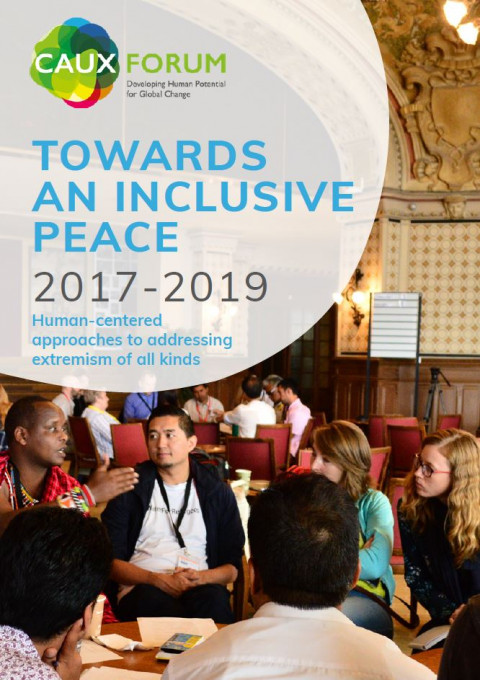 Towards an Inclusive Peace, 2017-2019: Human-centered Approaches to Addressing Extremism of All Kinds Année de publication: 2018 Auteur: Eliana Jimeno | Johannes Langer Auteur institutionnel: Initiatives of Change Switzerland Current approaches to violent extremism which excessively focus on counter terrorism and increasing military capacity, have failed to either stop violence or create peace. On the contrary, they have led to distrust in government institutions and alienation of large sections of the population.Doubling down on these past approaches will not resolve the issue. A new approach is needed and Towards an Inclusive Peace can offer it. Come and learn about human-centred approaches that prioritize sustainable peace, while dealing with root causes, advancing human rights, strengthening communities and enabling development.
  Education on the Holocaust and on Anti-Semitism : An overview and analysis of Educational Approaches Année de publication: 2006 Auteur institutionnel: OSCE. Office for Democratic Institutions and Human Rights (ODIHR) This study provides both the background on what is already being done in the field of Holocaust education and the identification of good practices to support future efforts by OSCE states and civil society. It also highlights new challenges that need to be addressed in education on both the Holocaust and on anti-Semitism. The first part of the study is based on information provided to the ODIHR by national ministries of education; national delegations of the Task Force for International Cooperation on Holocaust Education, Remembrance and Research (ITF); experts; educators; Jewish communities; and NGOs, in response to a questionnaire sent out by the ODIHR between December 2004 and April 2005. Comprehensive recommendations regarding Holocaust education conclude this first part of the overview. The second part of this report constitutes a first step in this regard: using country overviews on four OSCE states, it highlights the need to supplement Holocaust education in response to new forms of anti-Semitism and provides a number of relevant recommendations. (By the publisher)
 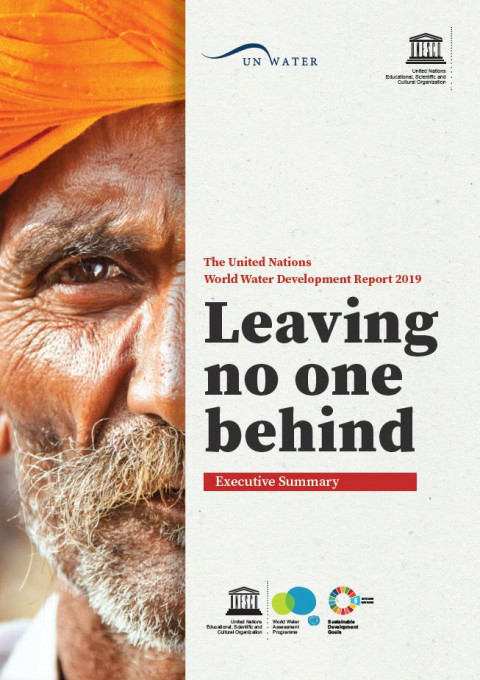 [Summary] The United Nations World Water Development Report 2019: Leaving No One Behind; Executive Summary Année de publication: 2019 Auteur: Richard Connor | Stefan Uhlenbrook | Engin Koncagül Auteur institutionnel: UNESCO World Water Assessment Programme (WWAP) People from different groups are ‘left behind’ for different reasons. Discrimination, exclusion, marginalization, entrenched power asymmetries and material inequalities are among the main obstacles to achieving the human rights to safe drinking water and sanitation for all and realizing the water-related goals of the 2030 Agenda. Poorly designed and inadequately implemented policies, inefficient and improper use of financial resources, as well as policy gaps fuel the persistence of inequalities in access to safe drinking water and sanitation. Unless exclusion and inequality are explicitly and responsively addressed in both policy and practice, water interventions will continue to fail to reach those most in need and who are likely to benefit most.Improving water resources management and providing access to safe and affordable drinking water and sanitation for all is essential for eradicating poverty, building peaceful and prosperous societies, and ensuring that ‘no one is left behind’ on the road towards sustainable development. These goals are entirely achievable, provided there is a collective will to do so. [Resumen] Informe Mundial de las Naciones Unidas sobre el Desarrollo de los Recursos Hídricos 2019:no dejar a nadie atrás, resumen ejecutivo Année de publication: 2019 Auteur: Richard Connor | Stefan Uhlenbrook | Engin Koncagül Auteur institutionnel: UNESCO World Water Assessment Programme (WWAP) Personas de distintos grupos “se quedan atrás” por diferentes motivos. Discriminación, exclusión, marginación, asimetrías de poder arraigadas y desigualdades materiales se encuentran entre los principales obstáculos para lograr los derechos humanos al agua potable segura y al saneamiento para todos y para alcanzar los objetivos relacionados con el agua de la Agenda 2030. Las políticas mal diseñadas y aplicadas de manera inadecuada, un uso ineficaz e inadecuado de los recursos financieros, así como las brechas en las políticas, alimentan la persistencia de las desigualdades en el acceso al agua potable segura y al saneamiento. A menos que la exclusión y la desigualdad se aborden de forma explícita y responsable tanto en las políticas como en la práctica, las intervenciones sobre el agua seguirán fracasando a la hora de llegar a los más necesitados y a quienes probablemente beneficiarían más.Mejorar la gestión de los recursos hídricos y facilitar el acceso al agua potable y saneamiento seguros y asequibles para todo el mundo es esencial para erradicar la pobreza, construir sociedades pacíficas y prósperas y garantizar que “no dejar a nadie atrás” en el camino hacia un desarrollo sostenible. Estos objetivos son plenamente alcanzables, siempre que exista la voluntad colectiva de hacerlo.