
Ressources
Explorez une large gamme de ressources sur le GCED afin d’approfondir votre compréhension et de renforcer vos activités de recherche, de plaidoyer, d’enseignement et d’apprentissage.
1,472 résultats trouvés
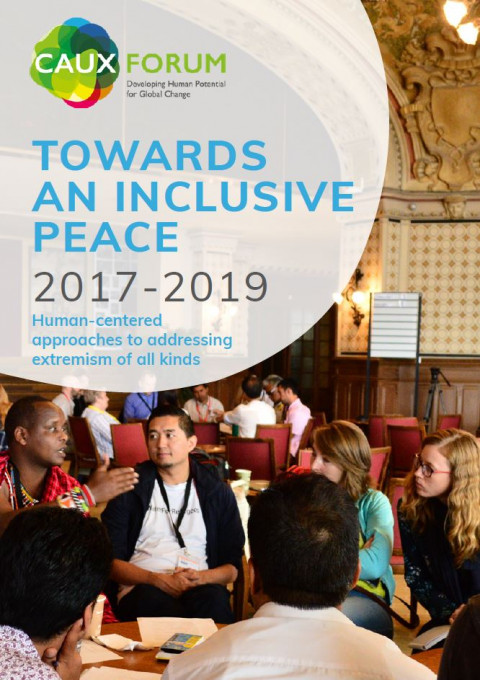 Towards an Inclusive Peace, 2017-2019: Human-centered Approaches to Addressing Extremism of All Kinds Année de publication: 2018 Auteur: Eliana Jimeno | Johannes Langer Auteur institutionnel: Initiatives of Change Switzerland Current approaches to violent extremism which excessively focus on counter terrorism and increasing military capacity, have failed to either stop violence or create peace. On the contrary, they have led to distrust in government institutions and alienation of large sections of the population.Doubling down on these past approaches will not resolve the issue. A new approach is needed and Towards an Inclusive Peace can offer it. Come and learn about human-centred approaches that prioritize sustainable peace, while dealing with root causes, advancing human rights, strengthening communities and enabling development.
  Global Citizenship in Sub-Saharan Africa Année de publication: 2015 Auteur: Akemi Yonemura Auteur institutionnel: Éducation des Adultes et Développement Learners today are required to develop a comprehensive understanding of local, national and global challenges, so that they can influence the political, social, cultural, economic and environmental development both in their societies and their personal lives. UNESCO has been promoting education for peace and sustainable development as the overarching goal of its education programme, focusing on transformative education through Global Citizenship Education (GCED). This paper discusses GCED in Sub-Saharan Africa in the context of the post-2015 education agenda, with a particular focus on adult education. Ciudadanía mundial en el África Subsahariana Année de publication: 2015 Auteur: Akemi Yonemura Auteur institutionnel: Éducation des Adultes et Développement En la actualidad, a los alumnos se les exige desarrollar una concepción global de los problemas locales, nacionales y mundiales, para que sean capaces de influir en el desarrollo político, social, cultural y económico, tanto en su sociedad como en su vida personal. La UNESCO ha estado promoviendo la educación para la paz y el desarrollo sostenible como objetivo integral de su programa de educación, concentrándose en la educación transformativa por medio de la educación para la ciudadanía mundial (ECM). En este trabajo se analiza la ECM en el África Subsahariana (ASS), en el contexto de la agenda educativa posterior a 2015, con especial énfasis en la educación de adultos.
  The Failure of Living-Together in Rwanda: What is the Responsibility of History Textbooks? Année de publication: 2013 Auteur: Éric Mutabazi Auteur institutionnel: McGill University. Faculty of Education Rwanda, landlocked in the Great Lakes region in Central Africa, has known war and massacres resulting in the 1994 genocide. Many critics and researchers have attempted to explain the reasons behind the inhuman and monstrous massacres that ravaged this country. While political, historical and economical factors are more often invoked to justify these horrible events, this article seeks to draw attention to the responsibility of history textbooks in the failure of living-together in pre-genocide Rwanda. Our analysis of textbook content reveals that certain values transmitted through the teaching of Rwanda’s history has generated injustice, inequality, victimisation, suffering, etc., at school and in society. We attempt to demonstrate how textbook content contributed to the failure of living-together in Rwanda and we propose alternative perspectives to guide the development of content that can contribute to peace, unity and living-together in post-genocide Rwanda. Échec du vivre-ensemble au Rwanda : quelle est la responsabilité des manuels scolaires d’histoire ? Année de publication: 2013 Auteur: Éric Mutabazi Auteur institutionnel: McGill University. Faculty of Education Le Rwanda, enclavé dans la région des Grands Lacs en Afrique centrale, a connu la guerre et les massacres aboutissant au génocide de 1994. Plusieurs penseurs et chercheurs ont tenté d’expliquer les raisons de ces massacres inhumains et monstrueux qui ont ravagé ce pays. Alors que les facteurs politiques, historiques et économiques sont plus souvent évoqués pour justifier ces horribles événements, cette contribution consiste à dégager la responsabilité des manuels scolaires d’histoire dans l’échec du vivre-ensemble au Rwanda avant le génocide. Notre analyse des contenus des manuels scolaires révèle que certaines valeurs transmises à travers l’enseignement de l’histoire du Rwanda ont généré toutes sortes d’injustices, d’inégalités, de victimisation, de souffrances, etc., à l’école et dans la société. Nous essaierons de montrer en quoi le contenu des manuels a contribué à l’échec du vivre-ensemble au Rwanda et nous proposerons des perspectives qui pourraient guider l’élaboration du nouveau contenu contribuant à la paix, à l’unité et au vivre-ensemble au Rwanda après le génocide.
  2018 유네스코 평화누리 활동보고서 Année de publication: 2018 Auteur institutionnel: 유네스코한국위원회 ‘유네스코 평화누리 사업’은 2013년 ‘유네스코 볼론티어 프로젝트’라는 이름으로, 대학생들의 사회 참여를 높이고 역량을 강화하기 위해 시작되었다. 2018년 에는 유엔 지속가능발전목표의 17개 목표를 주제로, 청년들 스스로 자신들이 살아가는 지역사회 현장의 지속가능성을 위협하는 문제에 대한 개선방안을 기획하고 실행함으로써 청년들이 사회변화의 주체(agents of social innovation)로 성장할 수 있도록 지원하고 있다.유네스코한국위원회는 평화누리 사업을 통해 전국 대학(원)생 및 청년으로 구성된 동아리(5-20명)를 선발하여 소정의 활동지원금을 지원한다. 또한 유네스코 본부·한국위원회 관련 정보 및 공지 안내, 워크숍 및 활동보고회 개최, 각종 네트워크 활용 지원, 프로젝트 현장 지원 등 청년들의 성공적인 활동을 위해 함께 노력하고 있다.목표하는 활동 분야의 전문가나 대학 교수를 자문위원으로 위촉할 수 있고, 전체 인원 중 대표 및 부대표를 포함한 80%가 대학생이라면 기존·신설·연합·프로젝트 성 팀 모두 관계없이 지원 가능하다. 유네스코는 우리의 현재이자 미래인 청년들을 세계의 다양한 이슈에 대해 해결방안을 찾아내고 창의력을 이용해 변화를 만드는 필수적인 존재라고 보고 있으며 이에 유네스코한국위원회는 청년들이 사회문제에 보다 관심을 가지고 그들의 활동과 노력이 더 나은 사회를 만들 수 있도록 지지하고 지원하며 청년의 사회참여를 독려합니다. 많은 대학(원)생·청년들이 유네스코 평화누리 사업을 포함한 유네스코한국위원회의 청년 활동에 참여하여 유네스코의 이념에 함께 동참해주기를 바란다.
  [Video] Citizenship and Human Rights Education for Change Année de publication: 2019 Auteur institutionnel: Global Campus of Human Rights In increasingly selective, violent and intolerant times, it becomes crucial to reinforce our capacities to deal with topical, controversial and contested issues undermining our human dignity and to promote the supportive values of non-discrimination, democracy, intercultural dialogue and peace. Teaching and learning about democratic citizenship, human rights and EU common values represents an opportunity to react and counter the negative forces of our time.This MOOC aims to foster the promotion of Human Rights Education and EU common values through the transfer of knowledge about the definitions, frameworks and content of Human Rights Education as well as the analysis of existing and innovative practices on teaching styles, approaches and methods.
  Éducation à la citoyenneté 3e année (Ressources pour l’éducation à la citoyenneté : L’enseignement intentionnel et direct des compétences essentielles à la citoyenneté) Auteur institutionnel: Concentus Fondation pour L'education a la citoyennete Les citoyens engagés remettent en question, examinent de manière critique, soutiennent et défendent les droits et responsabilités d’une démocratie sur des plans multiples. Ils travaillent à comprendre les problèmes, dissimulés ou manifestes, qui relèvent des enjeux de la citoyenneté et d’élaborer les plans d’action appropriés pour y apporter des solutions. Ils développent aussi leur compréhension des avantages et de la richesse que la diversité et le multiculturalisme apportent aux Canadiens.Les citoyens engagés s’efforcent d’aborder les questions depuis une variété de points de vue. Les élèves vont commencer à explorer les méthodes de résolution des conflits et à examiner et à pratiquer les actions qui contribuent à la paix et à l’ordre. L’exploration du raisonnement critique dans ce domaine de la citoyenneté encourage les élèves à essayer de comprendre un point de vue différent du leur.
  [فيديو] منع التطرف العنيف Année de publication: 2017 Auteur institutionnel: INEE و لتوضيح دور التعليم في منع التطرف العنيف .ويتناول الفيديو الذي يستغرق مدته ٥ دقائق - وهو متاح باللغات الإنجليزية والعربية والفرنسية والإسبانية والبرتغالية - بعض التعريفات الخاصة ببرنامج التعليم والتدريب المهني ودور التعليم في تعزيز بيئات شاملة ومنصفة وتشجيع التفكير النقدي وتعزيز التسامح واحترام التنوع، مما يساهم في توسيع التماسك الاجتماعي والحد من العنف بجميع أشكاله.لمزيد من المعلومات حول التعليم و منع التطرف العنيف يرجى زيارة موقع الإيني، حيث يمكنكم/ن العثور على الأنشطة والموارد الرئيسية، بما في ذلك كتالوج المنسقين/ات لموارد منع التطرف العنيف. [Video] Preventing Violent Extremism (English w/subtitles) Année de publication: 2017 Auteur institutionnel: Inter-agency Network for Education in Emergencies (INEE) The number of violent extremist attacks committed across the world has increased sharply in recent years. And there are more attacks on schools and students than ever before. So, why is this happening and what can be done to change this pattern?The Inter-Agency Network for Education in Emergencies (INEE) has developed a whiteboard video to illustrate education’s role in preventing violent extremism (PVE). The 5-minute video -- available in English, Arabic, French, Spanish, and Portuguese -- looks at some definitions of PVE and education’s role in fostering inclusive and equitable environments, encouraging critical thinking, promoting tolerance and respect for diversity, and thereby contributing to wider social cohesion and the reduction of violence in all forms.For further information on education and PVE, please visit the INEE website (www.ineesite.org/preventing-violent-extremism), where you can find key activities and resources, including a curated catalogue of PVE resources.