
Ressources
Explorez une large gamme de ressources sur le GCED afin d’approfondir votre compréhension et de renforcer vos activités de recherche, de plaidoyer, d’enseignement et d’apprentissage.
684 résultats trouvés
 Marco de competencias para docentes en materia de IA Année de publication: 2025 Auteur: Fengchun Miao | Mutlu Cukurova Auteur institutionnel: UNESCO Orientación para docentes sobre el uso y el mal uso de la IA en la educaciónLa IA procesa enormes cantidades de información, genera nuevos contenidos y ayuda a la toma de decisiones mediante análisis predictivos. En el ámbito educativo, la IA ha transformado la relación tradicional docente-estudiante, creando una nueva dinámica docente-IA-estudiante. Este cambio exige replantear los roles de los docentes y las competencias que necesitan en la era de la IA. Sin embargo, son pocos los países que han definido estas competencias o desarrollado programas nacionales para capacitar a los docentes en IA, lo que deja a muchos educadores sin una orientación adecuada.El Marco de competencias en materia de IA para docentes aborda esta brecha al definir los conocimientos, habilidades y valores que los docentes deben dominar en la era de la IA. Desarrollada bajo los principios de protección de los derechos de los docentes, del fortalecimiento de la capacidad de acción humana y de la promoción de la sostenibilidad, la publicación describe 15 competencias que atraviesan cinco dimensiones: una forma de pensar centrada en el ser humano, la ética de la IA, los fundamentos y aplicaciones de la IA, la pedagogía de la IA, y la IA para el aprendizaje profesional. Estas competencias se clasifican en tres niveles de progresión: adquirir, profundizar y crear.Como una referencia global, esta herramienta orienta el desarrollo de marcos nacionales de competencias en IA, brinda insumos para los programas de formación docente y ayuda a diseñar parámetros de evaluación. También ofrece estrategias para que los docentes desarrollen conocimientos sobre IA, apliquen principios éticos y apuntalen su crecimiento profesional.
  Référentiel de compétences en IA pour les enseignants Année de publication: 2025 Auteur: Fengchun Miao | Mutlu Cukurova Auteur institutionnel: UNESCO Guider les enseignants à propos de l’usage judicieux ou problématique de l’IA en éducationL’intelligence artificielle (IA) traite une grande quantité d’informations, génère de nouveaux contenus et aide à la prise de décision grâce à des analyses prédictives. Dans le domaine de l’éducation, l’IA a transformé la relation traditionnelle entre l’enseignant et l’apprenant en un triptyque dynamique entre l’enseignant, l’IA et l’apprenant. Cette évolution exige de repenser le rôle des enseignants et les compétences dont ils ont besoin à l’ère de l’IA. Pourtant, peu de pays ont défini ces compétences ou élaboré des programmes nationaux pour former les enseignants à l’IA, ce qui prive de nombreux éducateurs d’un cadre adéquat.Le Référentiel de compétences en IA pour les enseignants comble cette lacune : il définit les connaissances, les habiletés et les valeurs que les enseignants doivent maîtriser à l’ère de l’IA. Élaborée dans le respect de la protection des droits des enseignants, de l’accroissement de l’agentivité humaine et de la promotion de la durabilité, la publication présente 15 compétences réparties en cinq composantes : une approche de l’IA centrée sur l’humain, l’éthique de l’IA, les fondements et les applications de l’IA, la pédagogie de l’IA et l’IA pour l’apprentissage professionnel. Ces compétences sont classées selon trois niveaux de progression : acquérir, approfondir, créer.En tant que référence internationale, cet outil sert de guide pour l’élaboration de référentiels nationaux de compétences en IA, apporte des informations sur les programmes de formation des enseignants et aide à définir des paramètres d’évaluation des apprentissages. Il fournit également aux enseignants des stratégies pour développer leurs connaissances en matière d’IA, respecter des principes éthiques et soutenir leur développement professionnel.
  Consultation Paper on AI Regulation: Emerging Approaches Across the World Année de publication: 2024 Auteur: Juan David Gutiérrez Auteur institutionnel: UNESCO Since 2016, over thirty countries have passed laws explicitly mentioning AI, and in 2024, the discussion about AI bills in legislative bodies has increased globally. This policy brief aims to inform legislators about the different regulatory approaches to artificial intelligence (AI) being considered worldwide by legislative bodies. The brief explains nine emerging regulatory approaches, each illustrated with specific cases worldwide. The order in which the nine AI regulatory approaches are presented is deliberately structured to guide readers from less interventionist, light-touch regulatory measures to more coercive, demanding approaches. These regulatory approaches are not mutually exclusive and AI bills often combine two or more approaches:1. Principles-Based Approach2. Standards-Based Approach3. Agile and Experimentalist Approach4. Facilitating and Enabling Approach5. Adapting Existing Laws Approach6. Access to Information and Transparency Mandates Approach7. Risk-Based Approach8. Rights-Based Approach9. Liability Approach The policy brief suggests parliamentarians how they can address three key questions before adopting AI regulations:1. Why regulate? Determine whether regulation is needed to address public problems, fundamental and collective rights, or desirable futures.2. When to regulate? Reach a consensus on why regulation is needed, map available regulatory instruments, compare them with other policy instruments, and assess the feasibility of adopting the former.3. How to regulate? Identify a combination of AI regulatory approaches that are tailored to specific contexts.
 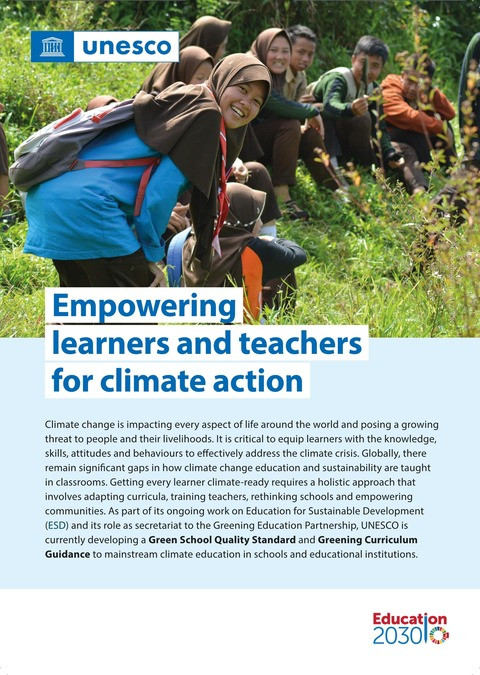 Empowering Learners and Teachers for Climate Action Année de publication: 2023 Auteur institutionnel: UNESCO Climate change is impacting every aspect of life around the world and posing a growing threat to people and their livelihoods. It is critical to equip learners with the knowledge, skills, attitudes and behaviours to effectively address the climate crisis. Globally, there remain significant gaps in how climate change education and sustainability are taught in classrooms. Getting every learner climate-ready requires a holistic approach that involves adapting curricula, training teachers, rethinking schools and empowering communities. As part of its ongoing work on Education for Sustainable Development (ESD) and its role as secretariat to the Greening Education Partnership, UNESCO is currently developing a Green School Quality Standard and Greening Curriculum Guidance to mainstream climate education in schools and educational institutions.
  Kit de herramientas global sobre IA y el estado de derecho para el poder judicial Année de publication: 2023 Auteur: Miriam Stankovich | Ivana Feldfeber | Yasmín Quiroga | Marianela Ciolfi Felice | Vukosi Marivate Auteur institutionnel: UNESCO ¿Qué es la Inteligencia artificial (IA)? ¿Cómo funciona? Y lo que es más importante, ¿cómo se abre camino en el contexto judicial? Tecnologías como la IA han existido durante décadas, pero solo recientemente han comenzado a usarse en una variedad de entornos de justicia y aplicación de la ley. Si bien la IA tiene un inmenso potencial para el sistema de justicia, ya que ayuda a los jueces a tomar mejores decisiones, mejora la eficiencia, aumenta el acceso y ayuda a detectar y prevenir el delito, también existen algunas cuestiones importantes que las partes interesadas en la justicia deben tener en cuenta mientras se preparan para un futuro en el que la IA se utiliza cada vez más en los sistemas de justicia. En 2022, la UNESCO lanzó dos evaluaciones de necesidades. En primer lugar, a través de la Encuesta de evaluación de necesidades de inteligencia artificial de la UNESCO en África, el 90 % de los 32 países encuestados solicitaron apoyo para el desarrollo de capacidades para el poder judicial en materia de IA. Al mismo tiempo, una segunda encuesta mundialde actores judiciales en 100 países subrayó la necesidad de comprender mejor el uso de la IA en la administración de justicia y sus repercusiones jurídicas más amplias en las sociedades. El “Kit de herramientas mundial sobre la IA y el Estado de derecho” para el Poder Judicial responde a estas necesidades y proporciona a los actores judiciales (jueces, fiscales, fiscales estatales, abogados públicos, universidades de derecho e instituciones de formación judicial) el conocimiento y las herramientas necesarias para comprender los beneficios y riesgos de la IA en su trabajo. El kit de herramientas ayudará a los actores judiciales a mitigar los posibles riesgos de la IA para los derechos humanos al brindar orientación sobre las leyes, principios, normas y jurisprudencia internacional de derechos humanos relevantes que sustentan el uso ético de la IA.
  Enhancing TVET through Digital Transformation in Developing Countries Année de publication: 2023 Auteur institutionnel: UNESCO Technological advancements and digitalization are profoundly reshaping our work and lifestyle, business models and operations, and government policy choices. Digital transformation in technical and vocational education and training (TVET) is the planned and structured introduction of automated and streamlined processes within institutions and national technical and vocational education and training (TVET) systems through digital technology, with the goal of enhancing their scope, scale, efficiency and effectiveness and ultimately, driving their more sustainable development. This document provides overall perspective and five country case studies on digital transformation in TVET. Most countries studied face similar enabling factors: the digital infrastructure available; legal and policy frameworks; focused institutional change to improve the acquisition of digital skills; and the promotion of equality and inclusivity. To understand how digital transformation in TVET is occurring, the report analyses it at four levels: technical and technological development; curriculum and qualifications; teaching and learning using technology; and its contribution to the sustainability and resilience of societies.
  Chile: Artificial Intelligence Readiness Assessment Report Année de publication: 2023 Auteur institutionnel: UNESCO The Readiness Assessment Methodology (RAM) is a diagnostic tool intended to assist Member States in upholding their commitment to the Recommendation by helping them understand how prepared they are to implement AI ethically and responsibly for all their citizens. The RAM questionnaire forms the basis for the first section of this readiness assessment report, providing a comprehensive but detailed overview of laws, institutions, and the cultural, social, and human capital landscape shaping AI. This is then complemented in the second section by a summary of concerns and priorities raised during a national multistakeholder consultation that was conducted in 2023. Finally, the third section presents a roadmap and recommendations for building capacities across national institutions, laws and policies, and human capital, to achieve a responsible AI ecosystem aligned with the UNESCO Recommendation. As the very first country to complete the RAM and the country report, Chile is blazing the trail not only for Latin America but the world. We applaud the initiative the Chilean government has taken to update its AI strategy putting ethics and governance front and centre, and thank them for inviting UNESCO to assist in this endeavour. The report presented here reveals a complex and rapidly-changing landscape. In the legal and regulatory dimension, the 2021 National Artificial Intelligence Policy (NAIP) represents a substantive and wide-ranging commitment to developing AI. One of the key recommendations of this report is to fully integrate the UNESCO Recommendation into the NAIP’s axis of Ethics, Regulation, and Socioeconomic Impacts. Notably, the RAM reveals the pressing need to update legislation around data protection and cybersecurity to meet the challenges of AI. It also highlights several areas the Chilean government is actively working to develop. [...] Overall, this report presents a fundamentally optimistic vision that we at UNESCO share: that ethical governance and responsible regulation of AI is entirely consistent with innovation and economic growth, and is essential for ensuring a technological ecosystem that benefits the public good. In drawing a clear line from the RAM data through to the multistakeholder consultations and the recommendations, Chile has a clear roadmap for how to get there. (This text has been extracted from the Foreword of the publication)
  Guidelines for the governance of digital platforms: safeguarding freedom of expression and access to information through a multi-stakeholder approach Année de publication: 2023 Auteur institutionnel: UNESCO Guidelines for an Internet for TrustSafeguarding freedom of expression and the right to information while dealing with dis- and misinformation, hate speech, and conspiracy theories requires a multistakeholder approach. This is the reason why UNESCO, the leading UN agency for the promotion and protection of freedom of expression and to information, is launching Guidelines for the Governance of Digital Platforms. The Guidelines outline a set of duties, responsibilities and roles for States, digital platforms, intergovernmental organizations, civil society, media, academia, the technical community and other stakeholders to enable the environment where freedom of expression and information are in the core of digital platforms governance processes. The Guidelines were produced through a multi-stakeholder consultation that gathered more than 10,000 comments from 134 countries. These global-scale consultations fostered inclusive participation, ensuring a diversity of voices to be heard, including those from groups in situation of marginalization and vulnerability. Cultivating an Internet of Trust is a shared responsibility among all stakeholders. It calls upon us all to sustain an enabling environment for freedom of expression and the right to information.
  Countering Online Hate Speech Année de publication: 2015 Auteur: Iginio Gagliardone | Danit Gal | Thiago Alves | Gabriela Martinez Auteur institutionnel: UNESCO The present report provides a global overview of the dynamics characterizing hate speech online and some of the measures that have been adopted to counteract and mitigate it, highlighting good practices that have emerged at the local and global levels. While the study offers a comprehensive analysis of the international, regional and national normative frameworks developed to address hate speech online, and their repercussions for freedom of expression, it places particular emphasis on social and non-regulatory mechanisms that can help to counter the production, dissemination and impact of hateful messages online. Combattre les discours de haine sur internet Année de publication: 2015 Auteur: Iginio Gagliardone | Danit Gal | Thiago Alves | Gabriela Martinez Auteur institutionnel: UNESCO Le présent rapport offre un panorama mondial des dynamiques caractéristiques des discours de haine en ligne et des mesures prises pour les combattre et les contenir, en mettant en évidence les bonnes pratiques qui ont émergé au niveau local comme au niveau international. Si l’étude fournit une analyse exhaustive des cadres normatifs internationaux, régionaux et nationaux mis en place pour lutter contre les discours de haine en ligne et de leurs répercussions sur la liberté d’expression, elle met particulièrement l’accent sur les mécanismes sociaux et non réglementaires qui peuvent contribuer à lutter contre la production, la diffusion et l’impact des messages de haine en ligne.