
Ressources
Explorez une large gamme de ressources sur le GCED afin d’approfondir votre compréhension et de renforcer vos activités de recherche, de plaidoyer, d’enseignement et d’apprentissage.
1,322 résultats trouvés
 Quelques constats à propos de la transmission scolaire de la Shoah en Suisse This study is based on interviews conducted among teachers from the French-speaking cantons of Switzerland to determine how the history and memory of the Shoah are transmitted in the schools: it is at the intersection of the teaching of history and of social perception. The interviews reveal the high standards the teachers set for themselves. Consequently, they are caught between their own perception of the uniqueness of the Shoah and their concern that its exceptional nature might not be shared by their students. Thus, the combination of the exceptional nature of the subject and the teachers’ concern becomes a veritable pedagogical leitmotif that translates both the strength of their conviction and their difficulty in expressing it through effective teaching strategies. It is one of the factors that lead certain teachers to compare the Shoah with other genocides. And yet, when these teachers broach the subject of genocide in a comparative way, the uniqueness of the Shoah stands out, in their eyes, and is reinforced by the strong identification that a majority of them feel with the victims. (By the author)
 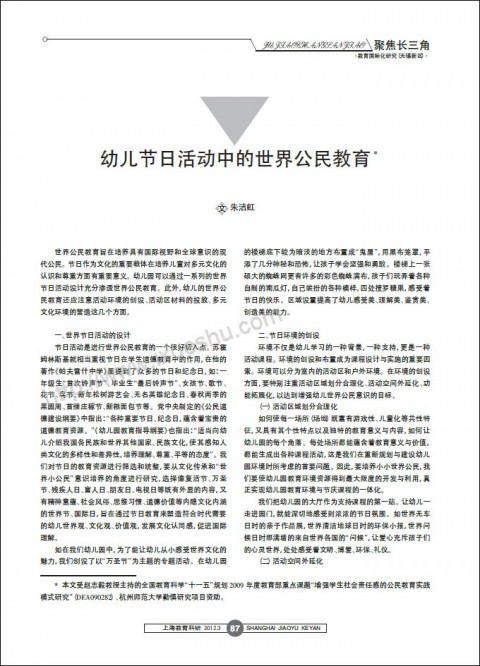 Global Citizenship Education in Children's Festivals Année de publication: 2012 Auteur: zhu jiehong Global citizenship education aims at cultivating modern citizens with an international outlook and global awareness. As an important carrier of culture, festivals play an important role in cultivating children's understanding and respect for multiculturalism. Kindergarten can fully pass the idea of global citizenship education through a series of world festival activities. In addition, global citizenship education of young children should pay attention to the creation of the activity environment, the use of materials in the activity area, and the creation of a multicultural environment. 幼儿节日活动中的世界公民教育 Année de publication: 2012 Auteur: zhu jiehong 世界公民教育旨在培养具有国际视野和全球意识的现代公民。节日作为文化的重要载体在培养儿童对多元文化的认识和尊重方面有重要意义。幼儿园可以通过一系列的世界节日活动设计充分渗透世界公民教育。此外,幼儿的世界公民教育还应注意活动环境的创设、活动区材料的投放、多元文化环境的营造这几个方面。
 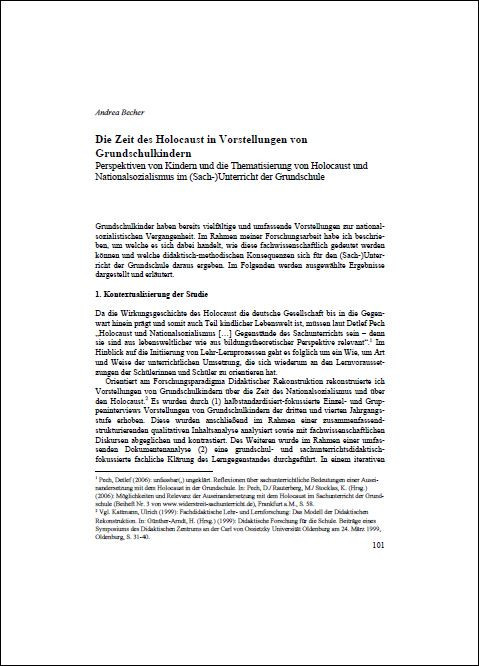 The Time Period of the Holocaust in the Beliefs of Primary School Children – Children’s Perspectives and the Thematization of the Holocaust and National Socialism in Primary-School Instruction (in General Subjects) Année de publication: 2012 Auteur: Andrea Becher The original title: Die Zeit des Holocaust in Vorstellungen von Grundschulkindern – Perspektiven von Kindern und die Thematisierung von Holocaust und Nationalsozialismus im (Sach-)Unterricht der Grundschule(In I. Enzenbach, C. Klätte, & D. Pech, (Eds.). Kinder und Zeitgeschichte: Jüdische Geschichte und Gegenwart, Nationalsozialismus und Antisemitismus, Supplement, 8, pp. 101–120) This is a summary of a study of German primary school children’s beliefs about the Holocaust, based on interviews conducted in two classes in 2005. The author finds that the children almost exclusively focus on Hitler; that one can find “latent anti-Semitic fragments” in their statements; that, even without formal education, the pupils still possess knowledge about the Holocaust; and their main source of information about Nazi Germany seems to be family members. However, the family narratives mainly touch upon everyday-life and avoid the topic of the Holocaust. From these findings, the author argues that one could and should teach the Holocaust already in the German primary school. The above abstract is taken from the International Holocaust Remembrance Alliance Education Research Project. Please also consult the full list of abstracts in 15 languages and the accompanying publication Research in Teaching and Learning about the Holocaust: A Dialogue Beyond Borders. Ed: IHRA, Monique Eckmann, Doyle Stevick, Jolanta Ambrosewicz-Jacobs, 2017, Metropol Verlag.
 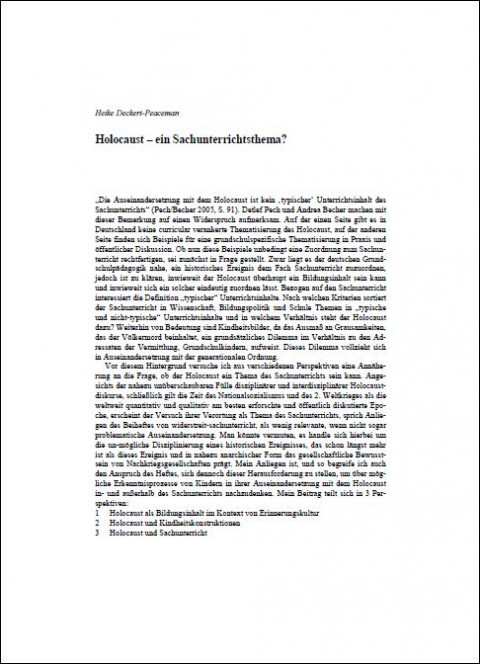 The Holocaust – A Theme for Instruction in General Subjects? Année de publication: 2006 Auteur: H. Deckert-Peaceman The original title: Holocaust – ein Sachunterrichtsthema?(Möglichkeiten und Relevanz der Auseinandersetzung mit dem Holocaust im Sachunterricht der Grundschule. Supplement, 3, pp. 35–50) An interesting discussion about the Holocaust as a topic for younger children, and especially about the use of youth literature in Holocaust education, but not an empirical analysis.The above abstract is taken from the International Holocaust Remembrance Alliance Education Research Project. Please also consult the full list of abstracts in 15 languages and the accompanying publication Research in Teaching and Learning about the Holocaust: A Dialogue Beyond Borders. Ed: IHRA, Monique Eckmann, Doyle Stevick, Jolanta Ambrosewicz-Jacobs, 2017, Metropol Verlag. Learning about the Holocaust through Art This website, hosted by the World ORT and the Beit Lohamei Haghetaot, gives the teacher and students the opportunity to explore and learn about the Holocaust through the Arts. It makes available biographies, a retrospective of Jewish artists' masterpieces and hands-on and artistic activities. L'apprentissage de l'Holocauste à travers l'art Ce site, hébergé par World ORT et le Beit Lohamei Haghetaot, donne à l'enseignant et aux étudiants la possibilité d'explorer et d'en apprendre davantage sur l'Holocauste à travers les arts. Il rend les biographies disponibles, une rétrospective des chefs-d'œuvre et des artistes juifs et les mains sur les activités artistiques.
  Handbuch Nationalsozialismus und Holocaust. Historisch-politisches Lernen in Schule, außerschulischer Bildung und Lehrerbildung. The educational field of National Socialism and the Holocaust is an indispensable part of historical-political learning in schools, non-formal education and teacher training. This manual gives new impetus to the theoretical discussion as well as to the practical educational work. Basic theoretical texts are complemented by methodological suggestions as well as by accounts based on personal experience and presentations of projects with national and international perspectives. The fact that today, more than sixty years after the events, adolescents have hardly any direct access to this phase of German and European history, and the question of how to deal with this challenge, are here of central importance. The contributions in the manual focus on the following themes: The fundamentals of National Socialism and the Holocaust as an educational field. School practices: Learning from classroom instruction. School practices: Learning from projects. Practices in teacher education. Practices in memorial sites and non-formal educational institutions. International approaches. (By the publisher)
  The Education We Want: An Advocacy Toolkit Année de publication: 2014 Auteur: James Edleston | Dan Smith | Sumaya Saluja | David Crone | Chernor Bah | Emily Laurie Auteur institutionnel: A World at School | UN Global Education First Initiative - Youth Advocacy Group (YAG) | Plan International Developed by Plan International, A World at School and the Youth Advocacy Group of the Global Education First Initiative, this toolkit was made for and by young people to advocate for quality education.Packed full of ideas, tools and inspiring stories, it helps children and youth to effectively carry out their own advocacy campaign.Although this advocacy toolkit focuses on education, its tips and ideas are applicable to young people advocating for a variety of development and rights issues.
  The Education We Want: Workshop Facilitator Guide For the Advocacy Toolkit Année de publication: 2014 Auteur: Daniel Smith | James Edleston | Tom Burke | Emily Laurie Auteur institutionnel: A World at School | UN Global Education First Initiative - Youth Advocacy Group (YAG) | Plan International This guide is intended as a resource to accompany the ‘Education we want: An Advocacy’. It aims to provide a wide range of workshop activities for those who intend to Understand, Plan or Do their education advocacy using workshop based approaches.Workshops are an effective way of involving others in advocacy. They can support you in carrying out research, drafting a plan and building skills for action.The successful delivery of workshops relies on effective preparation, good facilitation skills and a commitment to support people’s learning and development.