
Ressources
Explorez une large gamme de ressources sur le GCED afin d’approfondir votre compréhension et de renforcer vos activités de recherche, de plaidoyer, d’enseignement et d’apprentissage.
1,472 résultats trouvés
 [Vídeo] Previniendo el Extremismo Violento (subtítulos en español) Année de publication: 2017 Auteur institutionnel: Inter-agency Network for Education in Emergencies (INEE) El número de ataques extremistas violentos cometidos en todo el mundo ha aumentado considerablemente en los últimos años. Y hay más ataques que nunca en las escuelas y hacia estudiantes. Entonces, ¿por qué está sucediendo esto y qué se puede hacer para cambiar este patrón?La Red Interinstitucional para la Educación en Situaciones de Emergencia (INEE) ha desarrollado un video de pizarra para ilustrar el papel de la educación en la prevención del extremismo violento (PVE). El video de 5 minutos - disponible con subtítulos en inglés, árabe, francés, español y portugués - examina algunas definiciones de PVE y el papel de la educación en fomentar ambientes inclusivos y equitativos, fomentar el pensamiento crítico, promover la tolerancia y el respeto a la diversidad, Contribuyendo así a una mayor cohesión social ya la reducción de la violencia en todas sus formas.Para más información sobre educación y PVE, visite el sitio web de la INEE (www.ineesite.org/preventing-violent-extremism), donde encontrará actividades clave y recursos, incluyendo un catálogo de recursos de PVE.
  INEE Thematic Paper: An Introduction to Education and Preventing Violent Extremism Année de publication: 2017 Auteur institutionnel: Inter-agency Network for Education in Emergencies (INEE) This paper was conceptualized and developed by the INEE Education Policy Working Group subgroup on Youth, Violence and Peacebuilding. Though there remains limited consensus on how to define violent extremism, this paper highlights some of the more commonly used concepts and working definitions, presents current thinking and up-to-date research, and provides some examples of how education can contribute to preventing violent extremism. INEE does not take a particular stance.The paper is the most recent addition to the INEE’s work gathering resources on education and preventing violent extremism (PVE) from around the world, which may help policy-makers, teachers, principals, trainers, and researchers understand better the link between education and violent extremism and promote the positive ‘face’ of education. Documento temático de la INEE: una introducción a la educación y la prevención del extremismo violento Année de publication: 2017 Auteur institutionnel: Inter-agency Network for Education in Emergencies (INEE) Sigue habiendo un consenso limitado sobre cómo definir el extremismo violento. Este documento destaca algunos de los conceptos y definiciones comúnmente utilizadas, aunque la INEE no adopta ninguna particular.El documento presenta el pensamiento actual y la investigación actualizada, y proporciona algunos ejemplos de cómo la educación puede contribuir a la prevención de la violencia. Document thématique de l'INEE: Introduction à l'éducation et prévention de l'extrémisme violent Année de publication: 2017 Auteur institutionnel: Inter-agency Network for Education in Emergencies (INEE) Le sous-groupe de travail sur la jeunesse, la violence et la consolidation de la paix du Groupe de travail sur les politiques d'éducation de l'INEE a eu l'idée de cette thématique et a développé le document.Le consensus sur la définition de l'extrémisme violent reste limité. Cet article présente certains des concepts et des définitions pratiques les plus usuels, sachant toutefois que l'INEE ne prend pas de position sur la question. Le document présente les réflexions actuelles et la recherche à jour, et fournit quelques exemples de la façon dont l'éducation peut contribuer à la prévention de la violence. [Vidéo] Prévention de l'extrémisme violent (sous-titres en français) Année de publication: 2017 Auteur institutionnel: Inter-agency Network for Education in Emergencies (INEE) Le nombre d’attaques extrémistes violentes perpétrées dans le monde ces dernières années a gravement augmenté. Il y a de plus en plus d’attaques contre les écoles et les étudiants qu’avant. Pourquoi cela se passe-t-il et que pouvons nous faire pour changer ce schéma?Cette vidéo de 5 minutes-- disponible avec des sous-titres en anglais, français, espagnol et portugais-- présente des définitions de PVE et du rôle de l’éducation afin de promouvoir des environnements inclusifs et équitables, qui encouragent la pensée critique, la promotion de la tolérance et du respect pour la diversité et contribuent ainsi à une plus grande cohésion sociale et à la réduction de la violence sous toutes ses formes.Pour plus d’informations sur l’éducation et PVE, veuillez visiter la page web de l’INEE (www.ineesite.org/preventing-violent-extremism),où vous pourrez trouver des activités clés et des ressources, y compris un catalogue des ressources PVE.
  Promoting the culture of dialogue between cultures in the Arab world Année de publication: 2013 Auteur: Selim El Sayegh Auteur institutionnel: UNESCO Beirut The major challenge of the Arab uprisings resides in the youth drive. Accounting for 60 per cent of the Arab population, Youth have been calling for political and economic reforms. During the revolts, these claims have become more radical seeking a fundamental change. This gradual evolution, from a relatively partial change to a more absolute comprehensive one, ushers in a new era with a different intellectual construct. With the ousting of dictatorships, all civil society forces are unleashed with huge actual and potential resources mobilized to contribute to building up the new order. Groups of solidarity, communities, parties, associations, and organizations of all nature among many others put forward new ideas and adequate action plans. Liberty thus acclaimed becomes the outcry for dignity, honor and pride. Never before in the Arab world has the individual had such a central place as it does today. An individual fully grasping the possibilities of restored liberty and recognized dignity gives birth to a new citizen acting in a new paradigm; a new citizen that seeks a transcendence of the ego to relate the individual to the common good. This fresh paradigm empowers the individual as a citizen in the name of equality, while simultaneously recognizing the right of difference of each citizen when it comes to belonging to a culture or sub‐culture. The right to be different involves more than the right to differ and to dispute and by the same token, the obligation of peaceful settlement. The right to be different, by belonging to a culture or a sub‐culture means in a new era of liberty and dignity, the obligation to conduct a transformation of the patterns generating disputes and conflicts among cultures. Henceforth, the issue of promoting the culture of intercultural dialogue in the aftermath of the Arab revolts represents major characteristics that will be reflected hereafter. Promouvoir la culture du dialogue entre les cultures dans le monde Arabe Année de publication: 2013 Auteur: Selim El Sayegh Auteur institutionnel: UNESCO Beirut Le défi majeur des soulèvements arabes réside dans le lecteur de la jeunesse. Comptabilisation de 60 pour cent de la population arabe, de la jeunesse ont été réclame des réformes politiques et économiques. Pendant les révoltes, ces créances sont devenues plus radicales à la recherche d'un changement fondamental. Cette évolution progressive, d'un changement relativement partielle à l'une complète plus absolue, ouvre la voie à une nouvelle ère avec une construction intellectuelle différente. Avec l'éviction des dictatures, toutes les forces de la société civile se déchaînent avec d'énormes ressources réelles et potentielles mobilisées pour contribuer à l'édification du nouvel ordre. Des groupes de solidarité, les communautés, les partis, les associations et organisations de toute nature parmi beaucoup d'autres mettent en avant de nouvelles idées et plans d'action adéquats. Liberté ainsi acclamé devient le cri de la dignité, l'honneur et la fierté. Jamais auparavant dans le monde arabe a l'individu avait une telle place centrale comme il le fait aujourd'hui. Un individu de saisir pleinement les possibilités de la liberté restaurée et reconnue la dignité donne naissance à un nouveau citoyen agissant dans un nouveau paradigme; un nouveau citoyen qui cherche une transcendance de l'ego de relier l'individu au bien commun. Ce nouveau paradigme permet l'individu en tant que citoyen au nom de l'égalité, tout en reconnaissant en même temps le droit à la différence de chaque citoyen en ce qui concerne l'appartenance à une culture ou sous-culture. Le droit d'être différent implique plus que le droit à la différence et à contester et par le fait même, l'obligation de règlement pacifique. Le droit à la différence, par l'appartenance à une culture ou d'une sous-culture signifie une nouvelle ère de liberté et de dignité, l'obligation de procéder à une transformation des modèles de génération de différends et les conflits entre les cultures. Dès lors, la question de la promotion de la culture du dialogue interculturel dans la foulée des révoltes arabes représente les principales caractéristiques qui seront reflétées ci-après.
  Que valent les apprentissages en histoire, géographie et éducation à la citoyenneté ? : Colloque international des didactiques de l'histoire, de la géographie et de l'éducation à la citoyenneté Année de publication: 2014 Auteur: Caroline Leininger | Angelina Ogier | Sylvain Genevois Auteur institutionnel: Institut national de recherche pédagogique L’histoire et la géographie scolaires, de même que l’éducation à la citoyenneté, sont des domaines sensibles, liés au politique et au contexte social et sociétal dans lequel ils s’inscrivent. Si les recherches en didactique ont constaté dans les années 1990 une grande stabilité de l’histoire et la géographie scolaires, elles interrogent aujourd’hui plus spécifiquement les changements curriculaires et les recompositions qu’ils entraînent (thèmes des deux dernières éditions du colloque (Nantes, 2008, Lausanne 2009). Ces changements découlent de choix politiques et de savoirs universitaires, et redéfinissent le projet de ces disciplines et ses finalités. L'élève devient ainsi à l'issue de sa scolarité : un acteur de la société, un citoyen, un acteur économique, membre de communautés culturelles et politiques, un individu épanoui etc.Ce choix de finalités est aussi un choix de valeurs, explicites ou non dans les prescriptions, assumées ou non par les enseignants, par les élèves, les parents. Ce constat amène à questionner les articulations entre les apprentissages disciplinaires d’une part, et les apprentissages sociaux et politiques d’autre part. Les définitions de ces apprentissages, leur légitimité et leurs évaluations posent également question. Enseignants, décideurs, formateurs, didacticiens peuvent ainsi se demander ce que valent les apprentissages en histoire, en géographie et en éducation à la citoyenneté, tant du point de vue de leur reconnaissance disciplinaire et sociale que du point de vue des valeurs qui leur sont associées. Cet ouvrage cherche à questionner les articulations entre les apprentissages disciplinaires et les apprentissages sociaux et politiques.
  The SDGs and Cities INTERNATIONAL HUMAN MOBILITY Année de publication: 2018 Auteur institutionnel: International Centre for the Promotion of Human Rights | (ICPHR) The Handbook is to address new situations – and responses to these situations – generated by the global phenomenon of human mobility in urban spaces. Democracies are being threatened by the sustained growth of social gaps and the exclusion of vast sectors of the population from political systems and benefits of development, placing structural limits on the exercise of human rights. In this context, where new tensions and problems have arisen such as massive displacements of the population, the appearance of diverse types of extremism, of wars and conflicts and climate change in turn place these social sectors under conditions of structural inequality, exclusion and discrimination, as the main victims of human rights violations. This Handbook was prepared and published with the support and assistance of the UNESCO Sector for Social and Human Sciences through its Regional Science Bureau in Montevideo and the Latin American and Caribbean Coalition of Cities against Racism, Discrimination and Xenophobia.
 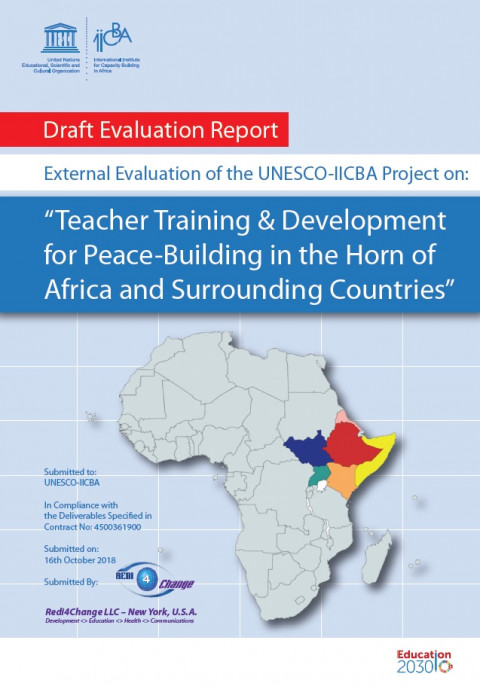 [Draft Evaluation Report] External Evaluation of the UNESCO-IICBA Project on: “Teacher Training & Development for Peace-Building in the Horn of Africa and Surrounding Countries” Année de publication: 2018 Auteur institutionnel: UNESCO International Institute for Capacity-Building in Africa (IICBA) The project on “Teacher Training and Development for Peace-Building in the Horn of Africa and Surrounding Countries” was designed by UNESCO-IICBA and financed by the Government of Japan. The project benefitted six conflict-affected countries; Ethiopia, Eritrea, Somalia, Kenya, Uganda, and South Sudan by building on the mandate and niche expertise of UNESCO-IICBA in teacher education, as well as benefiting from the empathetic insights and financing of the Government of Japan.This evaluation report analyses the design, implementation, and consolidation of the project to assess the likelihood that it can facilitate peace education as an effective and integral part of the national education systems. The project’s short timeframe and modest financing mean that the evaluation could not credibly deal with its outcomes and impact; but efforts are made to gauge the uptake and sustainability of this project as a vehicle for promoting peace education and so help to prevent violent conflict and cultivate a culture of peace in the countries concerned.