
Ressources
Explorez une large gamme de ressources sur le GCED afin d’approfondir votre compréhension et de renforcer vos activités de recherche, de plaidoyer, d’enseignement et d’apprentissage.
3,446 résultats trouvés
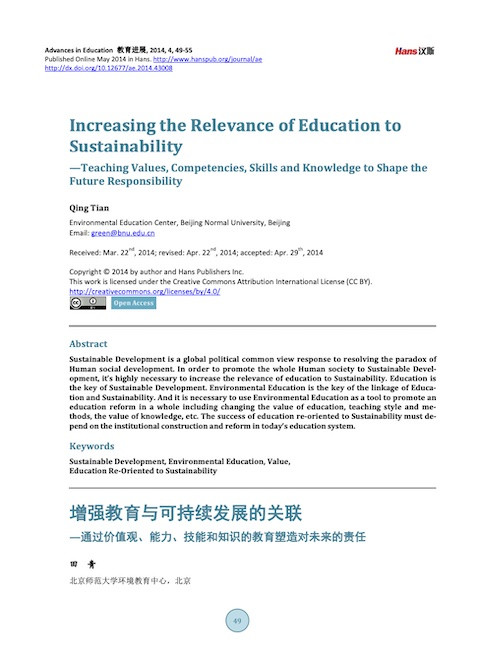 Increasing the Relevance of Education to Sustainability: Teaching Values, Competencies, Skills and Knowledge to Shape the Future Responsibility (Advances in Education; no. 4) Année de publication: 2014 Auteur: Qing Tian This paper introduces about using ecological education to promote sustainability development, and discusses how the education system can be changed to achieve such goals. 增强教育与可持续发展的关联: 通过价值观、能力、技能和知识的教育塑造对未来的责任 (教育进展; no. 4) Année de publication: 2014 Auteur: Qing Tian 本文介绍如何开展环境教育以促进可持续发展,并探索教育制度的改变如何促使这一目标得到实现。
 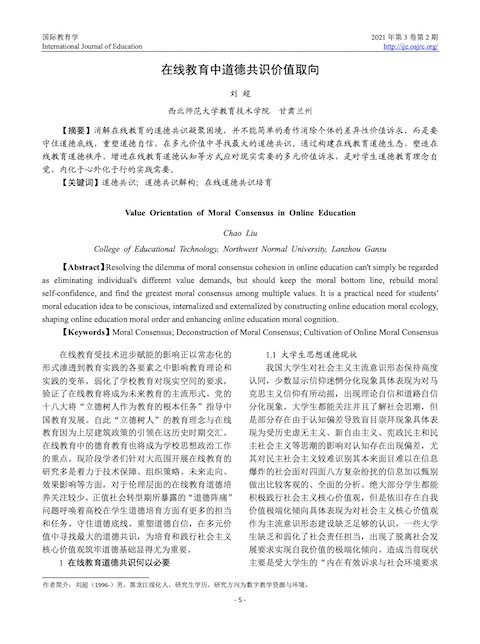 Value Orientation of Moral Consensus in Online Education (International Journal of Education; vol. 3, no. 2) Année de publication: 2021 Auteur: Chao Liu This paper discusses moral philosophy of. online education, and explores how to achieve moral consensus in online education. 在线教育中道德共识价值取向 (国际教育学; vol. 3, no. 2) Année de publication: 2021 Auteur: Chao Liu 本文探讨了在线教育道德哲学,并讨论了如何实现在线教育的道德共识。
 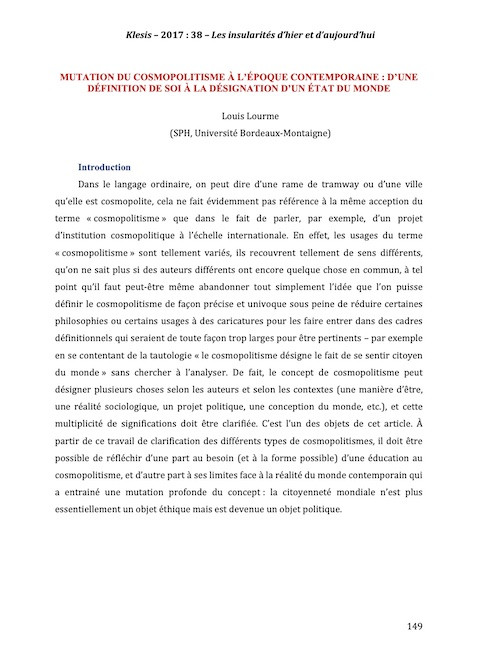 Mutation du cosmopolitisme à l’époque contemporaine : d’une définition de soi à la désignation d’un état du monde (Klesis Revue Philosophique; no. 38) Année de publication: 2017 Auteur: Louis Lourme Auteur institutionnel: Université Paul-Valéry Dans le langage ordinaire, on peut dire d’une rame de tramway ou d’une ville qu’elle est cosmopolite, cela ne fait évidemment pas référence à la même acception du terme « cosmopolitisme » que dans le fait de parler, par exemple, d’un projet d’institution cosmopolitique à l’échelle internationale. En effet, les usages du terme « cosmopolitisme » sont tellement variés, ils recouvrent tellement de sens différents, qu’on ne sait plus si des auteurs différents ont encore quelque chose en commun, à tel point qu’il faut peut-être même abandonner tout simplement l’idée que l’on puisse définir le cosmopolitisme de façon précise et univoque sous peine de réduire certaines philosophies ou certains usages à des caricatures pour les faire entrer dans des cadres définitionnels qui seraient de toute façon trop larges pour être pertinents – par exemple en se contentant de la tautologie « le cosmopolitisme désigne le fait de se sentir citoyen du monde » sans chercher à l’analyser. De fait, le concept de cosmopolitisme peut désigner plusieurs choses selon les auteurs et selon les contextes (une manière d’être, une réalité sociologique, un projet politique, une conception du monde, etc.), et cette multiplicité de significations doit être clarifiée. C’est l’un des objets de cet article. À partir de ce travail de clarification des différents types de cosmopolitismes, il doit être possible de réfléchir d’une part au besoin (et à la forme possible) d’une éducation au cosmopolitisme, et d’autre part à ses limites face à la réalité du monde contemporain qui a entrainé une mutation profonde du concept : la citoyenneté mondiale n’est plus essentiellement un objet éthique mais est devenue un objet politique.
 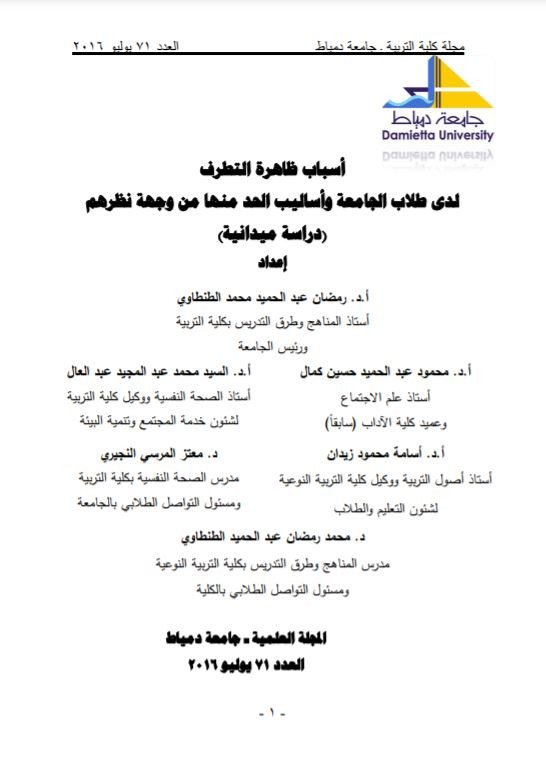 أسباب ظاهرة التطرف لدى طالب الجامعة وأساليب الحد منها من وجهة نظرهم) دراسة ميدانية ( Année de publication: 2016 Auteur: Ramadan Abdel-Hamid Mohamed El-Tantawi | Mahmoud Abdel-Hamid Hussein Kamal | El-Sayed Mohamed Abdel-Meguid Abdel-Aal | Osama Mahmoud Zidan | Moataz El-Morsi El-Nagari | Mohamed Ramadan Abdel-Hamid El-Tantawi Auteur institutionnel: Damietta University تسعى الدراسة الى التعرف على الأسباب التي تؤدي الى انتشار ظاهرة التطرف. وأيضا مناقشة الأساليب الأكثر جدوى ومناسبة في الحد من ظاهرة التطرف. وتنتهي الورقة بوضع توصيات وحلول للحد من هذه الظاهرة. The Causes of the Phenomenon of Extremism Among University Students and Methods of Reducing it from Their Point of View (A Field Study) Année de publication: 2016 Auteur: Ramadan Abdel-Hamid Mohamed El-Tantawi | Mahmoud Abdel-Hamid Hussein Kamal | El-Sayed Mohamed Abdel-Meguid Abdel-Aal | Osama Mahmoud Zidan | Moataz El-Morsi El-Nagari | Mohamed Ramadan Abdel-Hamid El-Tantawi Auteur institutionnel: Damietta University The study seeks to identify the reasons that lead to the spread of the phenomenon of extremism. And also discuss the most feasible and appropriate methods in curbing the phenomenon of extremism. The paper ends with recommendations and solutions to reduce this phenomenon.
  The Puzzle of Citizenship by Birthright (The Ethics Forum; vol. 7, no. 2) Année de publication: 2012 Auteur: Ayelet Shachar Auteur institutionnel: University of Montreal This paper is the French translation of Ayelet Shachar’s introduction, «The Puzzle of Birthright Citizenship», digitally reproduced by permission of the publisher from The Birthright Lottery : Citizenship and Global Inequality, Cambridge, Mass.: Harvard University Press, pp.1-18. © 2009 by the President and Fellows of Harvard College. Translation by Martin Provencher. Le casse-tête de la citoyenneté par droit de naissance (The Ethics Forum; vol. 7, no. 2) Année de publication: 2012 Auteur: Ayelet Shachar Auteur institutionnel: University of Montreal Cet article est la traduction française de l’introduction du livre d’Ayelet Shachar, «The Puzzle of Birthright Citizenship», avec la permission de l’éditeur, tirée de The Birthright Lottery : Citizenship and Global Inequality, Cambridge, Mass.: Harvard University Press, pp.1-18. © 2009 President and Fellows of Harvard College. Traduction de Martin Provencher.
  Is History Teaching in Quebec Instrumentalized by Citizenship Education? (Bulletin d'histoire politique; vol. 21, no. 3) Année de publication: 2013 Auteur: Félix Bouvier | Philippe Chamberland | Marie-Line Belleville Auteur institutionnel: Association québécoise d'histoire politique | VLB Éditeur In 2001, the Quebec Ministry of Education made the decision to formally join, for the first time, the teaching of history and education to citizenship. Logical according to many, since implicit" since the very beginning. beginnings of public schools, in Quebec as in most Western countries”, the association had to respond to the Western context encountered by democratic societies and characterized by the increase in population movements and the globalization of the economy. In secondary school since 2005, the associated teaching of the two subjects aims to promote a harmonious living together to preserve social cohesion. However, a problem remains. history with regard to civic education has long been recognized, the attribution of responsibility for political socialization and the shaping of consciousness citizen of students to history teachers risk instrumentalizing this subject? In other words, is it not dangerous to assert, as the Assistant Deputy Minister for Preschool, Elementary and Secondary Education Pierre Bergevin does, “that now history must above all serve as education for citizenship”? This association poses the question that François Audigier evokes, namely, should we proceed from history and question the latter's contribution to citizen consciousness, or proceed from the aspects of citizen consciousness that one wishes to construct and then determine the historical objects which should be studied? The experience of comparable nations on a planetary scale makes us doubt the relevance of the association of the two disciplines. In fact, some Western democracies are worried about the quality of the civic education of their young people since the waves of industrialization and the great wars of the XIXth and XXth centuries which changed manners forever: intensification of migrations, upheavals social roles, loss of influence of religions, etc. Thus, although Great Britain has for some time taken the path taken by Quebec, France clearly dissociates the teaching of history from that of civic education. In order to understand all the ins and outs of the issue, we first provide a portrait of the context at the origin of the association of history and education for citizenship. Then, we will discuss the arguments in favor of combining the two subjects, especially in Great Britain, France and Australia. Finally, our gaze will focus on the case of Quebec and the type of privileged citizenship, in order to determine whether the teaching of history is not instrumentalised for the benefit of a citizenship education valuing the concealment of conflicts and divergences and if, to use the writings of Robert Martineau, the Ministry of Education has sacrificed the history class on the altar of citizenship education.