
Ressources
Explorez une large gamme de ressources sur le GCED afin d’approfondir votre compréhension et de renforcer vos activités de recherche, de plaidoyer, d’enseignement et d’apprentissage.
1,473 résultats trouvés
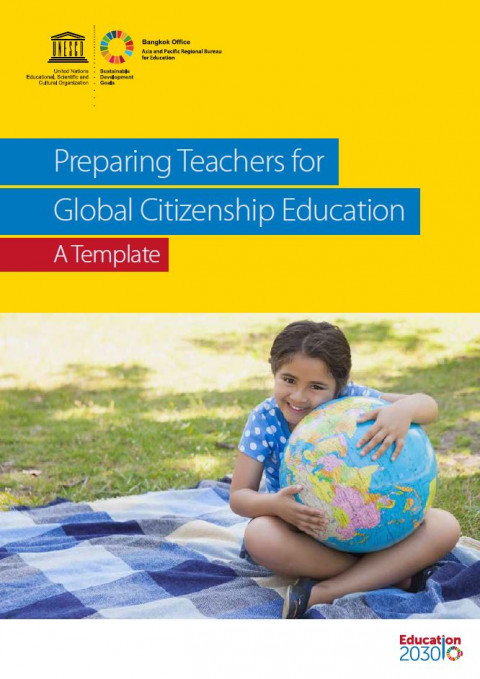 Preparing Teachers for Global Citizenship Education: A Template Année de publication: 2018 Auteur institutionnel: UNESCO Bangkok The UNESCO Asia-Pacific Regional Bureau for Education in Bangkok, Thailand, has taken up the task to promote GCED through a project that focuses on teachers who are key players in transferring appropriate values, knowledge and skills to their students. With support from the Korean Funds-in-Trust, one output of the project is this guide: Preparing Teachers for Global Citizenship Education: A Template.This publication provides useful information on integrating GCED concepts, principles and activities into curricula and teaching practices covering a broad spectrum of issues and pedagogies. It contains exemplars illustrating how GCED can be integrated into various subject areas. Diverse resources and materials listed in the document also offer readers a wide range of references. Underscoring the pragmatic objective of this work is the need for teachers to become global citizens themselves. Подготовка учителей к образованию в духе глобальной гражданственности: Шаблон Année de publication: 2018 Auteur institutionnel: UNESCO Bangkok Подготовка учителей к воспитанию в духе глобальной гражданственности: данный Шаблон - это ответ на вопрос преподавателей и методистов о практической информации и советом о том, как они могут внедрять воспитание в духе глобальной гражданственности (ВГГ) в свои педагогические практики. Эта публикация представляет собой концептуальную основу для трансформационного образования, иллюстрирует искусство преподавания ВГГ с примерами творческой педагогики, предоставляет примеры для демонстрации того, как ВГГ можно интегрировать в разные тематические области и отсылает читателей к богатому списку ресурсов.
 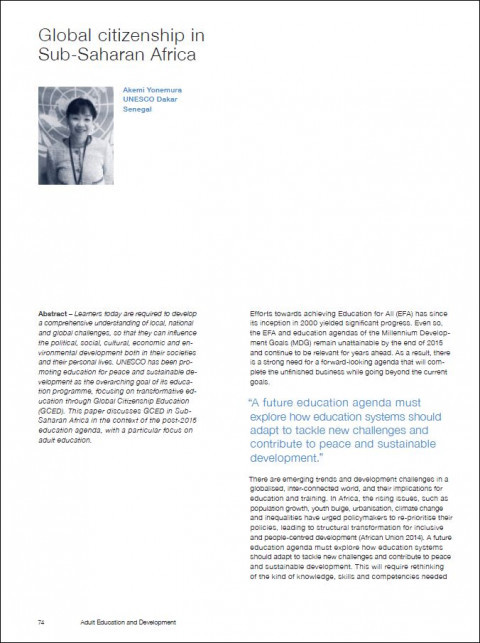 La citoyenneté mondiale en Afrique subsaharienne Année de publication: 2015 Auteur: Akemi Yonemura Auteur institutionnel: Éducation des Adultes et Développement Les apprenants doivent aujourd’hui bien comprendre les défis locaux, nationaux et mondiaux afin de pouvoir exercer une infl uence sur le développement politique, social, culturel, économique et environnemental, tant au sein de leurs sociétés que dans la vie privée. L’UNESCO a fait la promotion de l’éducation pour la paix et le développement durable en tant qu’objectifs fondamentaux de son programme d’éducation, se concentrant pour cela sur une éducation transformatrice par le biais de l’éducation à la citoyenneté mondiale (ECM). Cet article se penche sur l’ECM en Afrique subsaharienne dans le contexte du calendrier de l’éducation pour l’après-2015, et s’intéresse tout particulièrement à l’éducation des adultes.
  Dakar Office: Annual Report 2017 Année de publication: 2018 Auteur institutionnel: UNESCO Dakar Across the globe, the 2030 Agenda remains the unifying tool of the international community in the construction of a prosperous, peaceful, and sustainable world for all. The 17 Sustainable Development Goals are the expression of a shared global and transformative vision to change the world and improve the well-being of all peoples. UNESCO plays a transformative role in the implementation of this agenda, thanks to its education, culture, sciences and communication and information programmes.This annual report underlines the drive and spirit of our team in promoting innovation to uphold the 2030 and 2063 Agendas. It is a resounding testament to the unwavering forts of our team in 2017, and the depth of their commitment to advance the ideals and objectives of UNESCO.The 2017 Annual Report of the UNESCO Regional Office covers seven countries in the region: Burkina Faso, Cabo Verde, Guinea-Bissau, Niger, Senegal, The Gambia as well as Mali, supported by the national office in Bamako.
 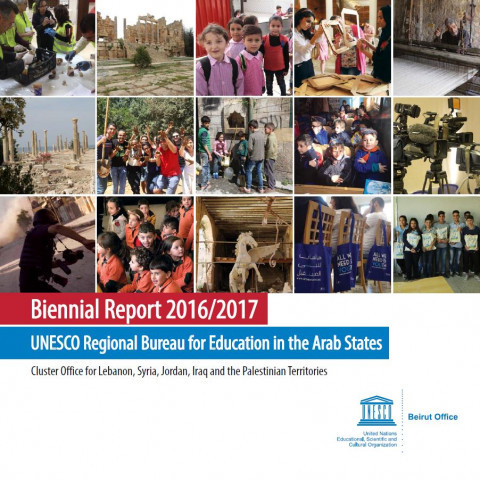 Biennial Report 2016/2017: UNESCO Regional Bureau for Education in the Arab States Année de publication: 2018 Auteur institutionnel: UNESCO Beirut As Regional Bureau for Education, UNESCO Beirut is the lead coordinator for SDG 4 in the Arab Region. We strive to provide tangible support for each Member State in the region, taking into account national needs and priorities, thereby employing nationally relevant approaches. More specifically, our work aims to address both the humanitarian and development aspects brought about by the protracted crisis in Syria through bridging the learning gaps for the youth, both for Syrian refugees and vulnerable youth in host communities. Our response also targets teachers, mentors and facilitators as well as Ministries’ technical officials. The crisis in Syria has created a need for specific support in education in emergencies and quality education to which we actively engage from both, upstream analytical and capacity building and downstream operational levels. UNESCO Beirut has also strengthened its leadership to respond to the deliberate destruction of cultural heritage, illicit trafficking, and attacks against individuals on religious or cultural grounds. We raise the alarm to protect heritage in danger, assessing damages to World Heritage sites in conflict. We also raise awareness among the public about the values of cultural heritage and the need to protect it for future generations. In today’s diverse societies, the Organization’s fundamental humanist mission guides us to support people, especially the youth, in understanding each other and working together to build lasting peace and enables people to create and use knowledge for just and inclusive societies. We continue to advocate free, independent and pluralistic media in print, broadcast and online to enhance freedom of expression as a contributor to peace, sustainability, poverty eradication and human rights. This biennial report summarizes the work and achievements accomplished between 2016 and 2017 by our office.
 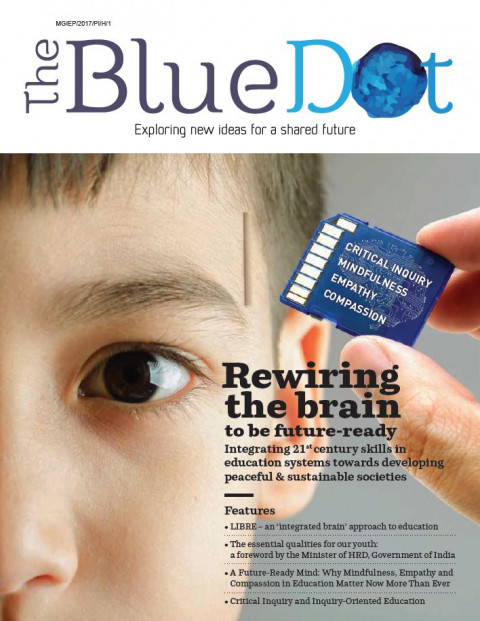 Rewiring the Brain to be Future-ready: Integrating 21st Century Skills in Education Systems Towards Developing Peaceful & Sustainable Societies (The Blue Dot Issue 6, 2017) Année de publication: 2017 Auteur institutionnel: Mahatma Gandhi Institute of Education for Peace and Sustainable Development (MGIEP) In the sixth issue of the Blue Dot, we focus on the importance of these 21st century skills for the young. The issue includes a foreword by the Minister of Human Resource Development, Government of India on the importance of inculcating 21st century skills in education systems and our Cover Story, which introduces UNESCO MGIEP’s LIBRE programme that follows an ‘integrated brain’ approach to education.Additionally, we feature opinions by specialists from academia, research and the industry on the lacuna present in existing education systems and the opportunities available to address this gap by introducing socio-emotional skills and inquiry oriented learning into curricula. Amongst various experts, we hear from Ines Kudo and Joan Hartley from The World Bank on the importance of ‘Teaching empathy and compassion in schools’; Prof. K.P. Mohanan on ‘Critical Inquiry and Inquiry oriented education’ and Dr. Marilee Bresciani Ludvik on how mindfulness forms the foundation for cultivating compassion.Further, we present excerpts from a collection of ‘Ask me Anything’ sessions focused on socioemotional skills, hosted on Knowledge Commons, UNESCO MGIEP’s knowledge sharing platform.We have been honoured to have the opportunity to host and learn from experts such as Dr. Richard Davidson, recognised as one of ‘The 100 most influential people in the world’ in 2006 by the Time Magazine and Chade-Meng Tan, currently the Chairman of Search Inside Yourself Leadership Institute and Co-chair of One Billion Acts of Peace, which has been nominated eight times for the Nobel Peace Prize.
 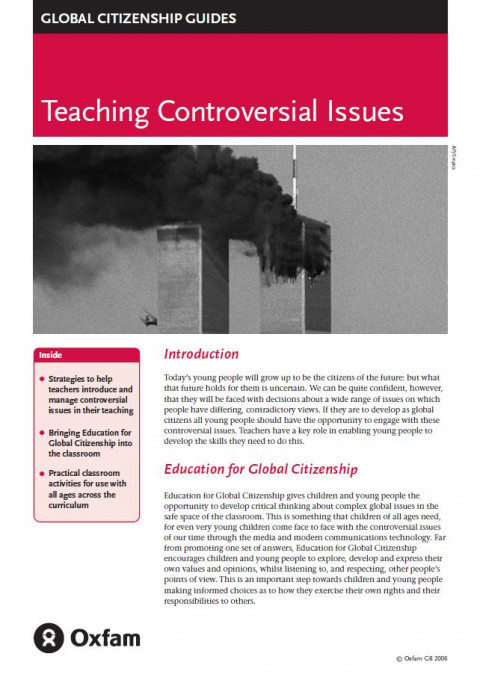 Global Citizenship Guides: Teaching Controversial Issues Année de publication: 2006 Auteur institutionnel: Oxfam GB This guide aims to demonstrate how, by enhancing young people’s ability to handle controversial issues, teachers can support and develop them as global citizens.This guide explores:what controversial issues arewhy controversial issues should be taughtwhy some issues are, or can become, controversialwhat guidance exists for handling controversial issuesclassroom strategies for handling and exploring controversial issuessome practical activities for teaching controversial issues.
  Democratic Interference in Africa as Institution and Context Année de publication: 2014 Auteur: Joseph Keutcheu Auteur institutionnel: Études internationales This study describes the international intervention within states as ritualized in the context of the rise of democracy as a matter of global concern. The formation of an international benchmark for the democratic management of the state in Africa constrains « entrepreneurs of intervention » as well as the as « importers » of institutional models in this continent. The implementation of international policy instruments to promote democracy opens the possibility to observe realistic logic at work in the various forms of intervention. It also allows perceiving interventionism and reception of « institutional models » in Africa as « interaction rituals » in the sense that Goffman sees it. L’« ingérence démocratique » en Afrique comme institution, dispositif et scène Année de publication: 2014 Auteur: Joseph Keutcheu Auteur institutionnel: Études internationales La présente étude décrit l’ingérence comme étant ritualisée dans un contexte de montée en puissance de la démocratie en tant que sujet de préoccupation internationale. La formation d’un référentiel international de la gestion démocratique de l’État en Afrique s’impose ainsi aussi bien aux « entrepreneurs d’intervention » qu’aux « importateurs » de modèles institutionnels dans ce continent. La mise en oeuvre d’instruments internationaux d’action publique de promotion de la démocratie ouvre la possibilité de voir des logiques réalistes à l’oeuvre dans les différentes formes d’intervention. Elle permet également d’envisager l’interventionnisme et la réception de « modèles institutionnels » en Afrique comme des « rites d’interaction » au sens où Goffman l’entend.
  Concepts and Actors’ Perceptions of Living Together in Basic Education Textbooks in Ivory Coast Année de publication: 2013 Auteur: Goïta Ouattara Kanndanan Insiata Auteur institutionnel: McGill University. Faculty of Education This article first highlights the concepts of living together in basic education textbooks in Ivory Coast. Second, it identifies the perceptions of these concepts by the actors (trainers and learners) as well as the media used for instruction. To address these two concerns, the methodology consisted of a content analysis of textbooks and current program guides, as well as an analysis of interviews with the actors. The results indicate that solidarity, peace, tolerance, discipline, and inter-ethnic alliance are concepts, among others, taught to instil a culture of peace in potential future socio-political actors. In addition, these concepts are positively perceived and appropriated by the actors.