
Ressources
Explorez une large gamme de ressources sur le GCED afin d’approfondir votre compréhension et de renforcer vos activités de recherche, de plaidoyer, d’enseignement et d’apprentissage.
1,407 résultats trouvés
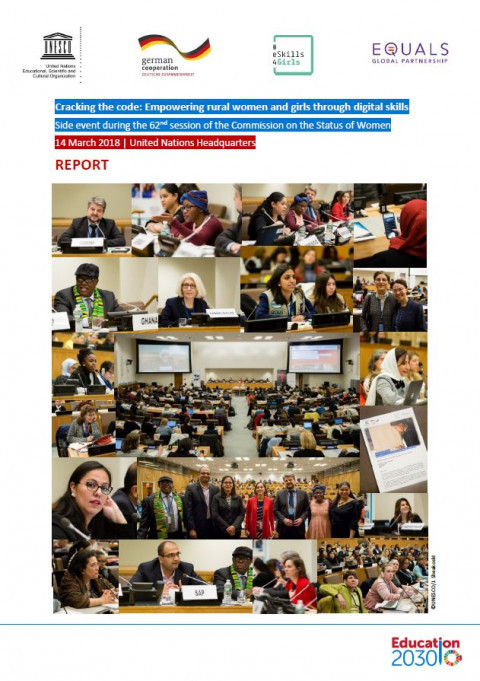 Cracking the Code: Empowering Rural Women and Girls through Digital Skills; Side Event during the 62nd Session of the Commission on the Status of Women, 14 March 2018, United Nations Headquarters: Report Année de publication: 2018 Auteur institutionnel: UNESCO | Germany. Federal Ministry for Economic Cooperation and Development (BMZ) UNESCO and the German Federal Ministry of Economic Cooperation and Development (BMZ) co-organised the side event ‘Cracking the code: Empowering rural women and girls through digital skills’ on 14 March 2018, United Nations Headquarters in New York, on the margins of the 62nd session of the CSW. More than 500 participants participated in the event while a broad global audience followed the discussions through live webcast.This report provides an overview of the discussions and examples of government, civil society organizations, and private sector initiatives to close the gender digital gap and empower rural girls and women to be ICT users, creators and innovators through gender-responsive digital skills training as well as science, technology, engineering and mathematics (STEM) education more broadly.
 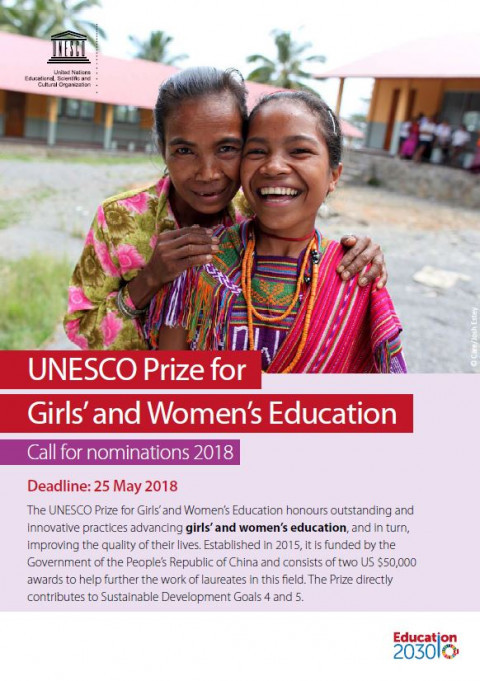 UNESCO Prize for Girls' and Women's Education: Call for Nominations 2018 Année de publication: 2018 Auteur institutionnel: UNESCO The UNESCO Prize for Girls’ and Women’s Education honours outstanding and innovative practices advancing girls’ and women’s education, and in turn, improving the quality of their lives. Established in 2015, it is funded by the Government of the People’s Republic of China and consists of two US $50,000 awards to help further the work of laureates in this field. The Prize directly contributes to Sustainable Development Goals 4 and 5. Prix UNESCO pour l'éducation des filles et des femmes: appel à candidatures 2018 Année de publication: 2018 Auteur institutionnel: Organisation des Nations Unies pour l'éducation, la science et la culture (UNESCO) Le Prix UNESCO pour l'éducation des filles et des femmes honore les pratiques exemplaires et novatrices qui font progresser l'éducation des filles et des femmes et, par conséquent, améliorent la qualité de leur vie. Crée en 2015, il est financé par le gouvernement de la République populaire de Chine et consiste de deux prix de 50 000 dollars des États-Unis afin d’aider les lauréats à poursuivre leur travail dans ce domaine. Le prix contribue directement aux objectifs de développement durable 4 et 5.
 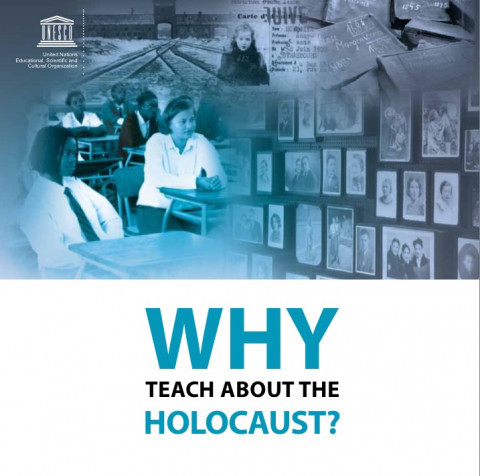 为什么要进行关于反犹大屠杀的教育? Année de publication: 2014 Auteur institutionnel: 联合国教科文组织 (UNESCO) The Holocaust was a turning point in human history. Understanding the genocide of the Jewish people and other crimes perpetrated by the Nazi regime remains of great signi cance in the modern world.Regardless of where we live or who we are, learning about this universal history can help engage students in a critical re action about the roots of genocide and the necessity to nurture peace and human rights to prevent such atrocities in the future.This short introduction provides an essential overview on education about the Holocaust that can support policymakers, educators and students alike in their understanding of genocide and why it is vital that we continue to teach about the Holocaust today.
 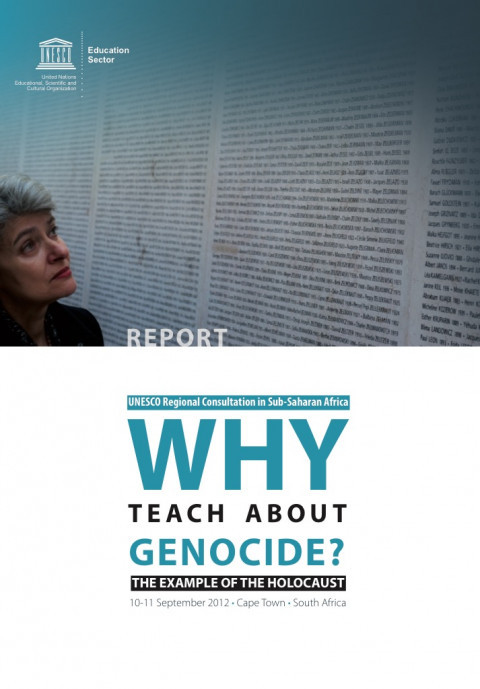 UNESCO Regional consultation in sub-saharan Africa: Why teach about genocide? The example of the Holocaust, 10-11 Septembre 2012, Cape Town, South Africa: report Année de publication: 2013 Auteur institutionnel: UNESCO The rst UNESCO consultation on « Why Teach about Genocide? The Example of the Holocaust » was organized following the UNESCO General Conference resolution 34C/61 on Holocaust Remembrance. The consultation of Member States is part of a series of initiatives launched by UNESCO to promote education about the Holocaust and other genocides, in particular with a view to contributing to the prevention of genocide and mass atrocities and promoting education for peace.The consultation took place in Cape Town, South Africa, on 10-11 September 2012 in the presence of senior representatives from the Ministries of Education of 14 countries in Sub-Saharan Africa. The following countries were represented: BENIN, BURUNDI, DEMOCRATIC REPUBLIC OF THE CONGO, CÔTE D’IVOIRE, ETHIOPIA, REPUBLIC OF MAURITIUS, NAMIBIA, KENYA, RWANDA, SENEGAL, SOUTH AFRICA, TANZANIA, TOGO and ZAMBIA. Experts in Holocaust and genocide studies from various countries and institutions were invited to present key issues throughout the consultation and participate in the discussions. The consultation was supervised by the Education Sector of UNESCO/Division of Education for Peace and Sustainable Development/Section of Education for Peace and Human Rights and UNESCO Regional Bureau for Education in Africa (BREDA, Dakar, Senegal)The main purpose of the meeting was to discuss how the history of the Holocaust, and more generally the history of genocide, could be included in the curricula of participating countries. The meeting also clari ed various conceptual and pedagogical issues, and paved the way for further cooperation between UNESCO and participating Ministries of Education on how to launch new educational programmes in interested countries.
  Issues and Trends in Education for Sustainable Development Année de publication: 2018 Auteur: Alexander Leicht | Julia Heiss | Wonjung Byun Auteur institutionnel: UNESCO Education for Sustainable Development (ESD) is globally acknowledged as a powerful driver of change, empowering learners to take the decisions and actions needed to build a just and economically viable society respectful of both the environment and cultural diversity.This publication comes at a moment of heightened global interest in addressing sustainability challenges through education in order to achieve the targets of the 2030 Sustainable Development Agenda. ESD is not only recognized as a key enabler of sustainable development but an integral element of all quality education. By exploring key issues related to ESD policy and practice, UNESCO aims to help accelerate the reorientation of education towards achieving a sustainable and resilient world. Enjeux et tendances de l'éducation en vue du développement durable Année de publication: 2018 Auteur: Alexander Leicht | Julia Heiss | Wonjung Byun Auteur institutionnel: Organisation des Nations Unies pour l'éducation, la science et la culture (UNESCO) L’éducation en vue du développement durable (EDD) est universellement considérée comme un puissant vecteur de changement qui donne aux apprenants les moyens de prendre les décisions nécessaires et d’agir pour bâtir une société juste et économiquement viable, respectueuse de l’environnement et de la diversité culturelle. Cet ouvrage paraît dans un contexte mondial marqué par un intérêt accru pour les efforts visant à relever les défis du développement durable par le biais de l’éducation, afin d’atteindre les objectifs du Programme de développement durable à l’horizon 2030. L’EDD est non seulement reconnue comme un moteur indispensable du développement durable, mais aussi comme un élément constitutif d’une éducation de qualité. En explorant les principaux enjeux liés aux politiques et aux pratiques d’EDD, l’UNESCO entend accélérer la réorientation de l’éducation vers un monde plus durable et plus résilient.
  Права человека: назад в будущее (Курьер ЮНЕСКО no. 4, октябрь-декабрь 2018 года) Année de publication: 2018 Auteur institutionnel: Организация Объединенных Наций по вопросам образования, науки и культуры (UNESCO) Среди авторов этого номера «Курьера ЮНЕСКО» – Морис Добб, Гарольд Дж. Ласки, Бенедетто Кроче, Олдос Хаксли, Ло Чун-Шу, Арнольд Шёнберг и другие выдающиеся деятели прошлого столетия. По случаю 70-летия Всеобщей декларации прав человека, принятой 10 декабря 1948 года, мы решили вернуться в прошлое, чтобы с большей ясностью смотреть в будущее. Поэтому текущий номер так и называется: «Назад в будущее». Представим же, что сейчас вновь 1946 год. Над миром витает жуткий призрак тотальной войны, и международное сообщество испытывает «потребность выступить с совместным заявлением морального характера, в котором оно могло бы в должной мере выразить всеобщее негодование и надежду на лучшее будущее, какой бы утопичной она ни казалась», – поясняет специалист по социальной антропологии Марк Гудэйл во вступительной статье к подготовленной с его помощью рубрике «Широкий обзор». Материалы этой рубрики знакомят читателей с малоизвестным фактом из истории Всеобщей декларации прав человека – всемирным опросом, проведенным ЮНЕСКО по инициативе первого Генерального директора Джулиана Хаксли с целью определения философских принципов, лежащих в основе прав человека. Решение о его проведении было принято на 1-й сессии Генеральной конференции ЮНЕСКО, состоявшейся в ноябре-декабре 1946 года, а сам опрос был проведен годом позже. Руководство этим масштабным проектом осуществлял молодой французский философ Жак Аве. В опросе, призванном заложить основы для размышлений о правах человека, приняли участие яркие представители интеллектуальной элиты послевоенного общества. Несмотря на прошедшие с тех пор 70 лет, поднятые в ходе этого проекта вопросы по-прежнему чрезвычайно актуальны. Столь же актуальны и рисунки нашего гостя, перуанского художника Фернандо Брисе, черпающего вдохновение в «том особом периоде, когда идея прогресса действительно открывала многочисленные перспективы». Этому периоду он посвятил серию под названием The Book of Needs («Книга потребностей»), рисунки из которой виртуозно воспроизводят страницы «Курьера ЮНЕСКО» за 1948-1954 год. Большую часть из них можно увидеть в приложении к текущему номеру журнала.
  تقرير اليونسكو العالمي: الاستثمار في التنوع الثقافي والحوار بين الثقافات Année de publication: 2009 Auteur institutionnel: منظمة الأمم المتحدة للتربية والعلم والثقافة (UNESCO) أن المعاني التي ارتبطت بهذا المصطلح، الذي يكاد يشمل كل شيء، متنوعة تماماً كما أنها كثيرة التغير. فالبعض يعتبر التنوع الثقافي عاملاً ايجابياً في حد ذاته، فهو يدلّ على تقاسم الثروة التي تجسدها كل ثقافة من ثقافات العالم، وبذلك يوضح الروابط التي توحدنا جميعاً في سياق عمليات التبادل والحوار. ويعتبر آخرون أن الفوارق الثقافية هي التي تجعلنا نعجز عن تبيّن إنسانيتنا المشتركة وهي بالتالي تكمن في جذور الكثير من النزاعات. ويصبح هذا التشخيص الأخير أقوى احتمالاً اليوم مع ما نتج عن العولمة من زيادة في نقاط التفاعل والاحتكاك بين الثقافات أدت إلى توترات وانسحابات ومطالبات تتعلق بالهوية، وبخاصة مما له طابع ديني، أصبحت مصادر محتملة للنزاع. ولذا، فإن التحدي الأساسي يتمثل في طرح رؤية منسجمة متماسكة للتنوع الثقافي توضح أن التنوع الثقافي، بدلاً من أن يكون مصدراً للخطر، يمكن أن يفيد العمل على صعيد المجتمع الدولي. وهذا بالذات هو الهدف الأساسي للتقرير الحالي.
  International Task Force on Teachers for Education 2030 Strategic Plan 2018–2021 Année de publication: 2018 Auteur institutionnel: UNESCO With the end of the EFA era, the TTF has decided to articulate its activities around the newly adopted international education goals. The Strategic Plan 2018–2021 builds on the Sustainable Development Goals (SDGs), especially the SDG 4.c target on teachers, and the Education 2030 Incheon Declaration and Framework for Action adopted in 2015.