
Ressources
Explorez une large gamme de ressources sur le GCED afin d’approfondir votre compréhension et de renforcer vos activités de recherche, de plaidoyer, d’enseignement et d’apprentissage.
1,322 résultats trouvés
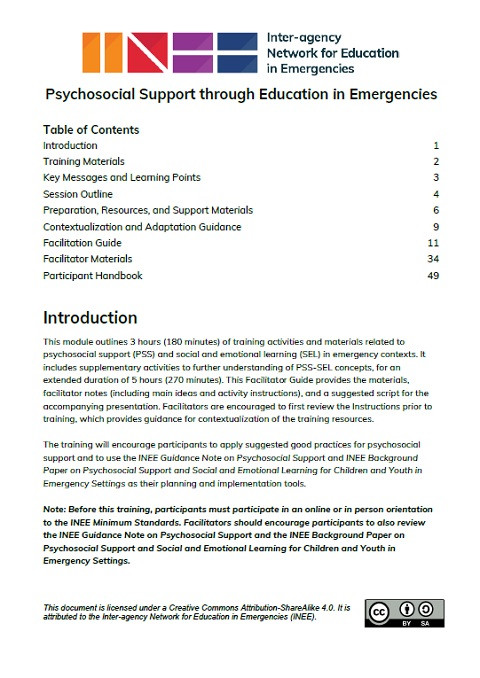 Apoyo Psicosocial a través de la Educación en Situaciones de Emergencia Année de publication: 2019 Auteur institutionnel: Inter-agency Network for Education in Emergencies (INEE) Este módulo ofrece 3 horas (180 minutos) de actividades de formación y materiales relacionados con el apoyo psicosocial (PSS, por sus siglas en inglés) y el aprendizaje socioemocional (SEL, por sus siglas en inglés) en situaciones de emergencia. Incluye actividades complementarias para una mayor comprensión de los conceptos PSS-SEL, con una duración ampliada de 5 horas (270minutos). Esta Guía del Facilitador proporciona los materiales, las notas del facilitador (incluyendo las ideas principales y las instrucciones de las actividades), además de un guión propuesto para la presentación que se adjunta. Se recomienda a los facilitadores que primero revisen las instrucciones antes de pasar a la formación, ya que contienen directrices para la contextualización de los recursos de la formación. Le soutien psychosocial par l'éducation en situations d'urgence Année de publication: 2019 Auteur institutionnel: Inter-agency Network for Education in Emergencies (INEE) Ce module est une présentation de 3 heures (180 minutes) d'activités de formation et de matériel concernant le soutien psychosocial (SPS) et l'apprentissage social et émotionnel (ASE) en contextes d'urgence. Il comprend également des activités supplémentaires permettant d'approfondir la compréhension des concepts de SPS-ASE, et ce, pour une durée prolongée de 5 heures (270 minutes). Le présent guide du facilitateur contient le matériel, les notes de facilitation (y compris les idées principales et les instructions pour les activités) et une suggestion de script pour la présentation associée. Il est suggéré aux facilitateurs d'étudier, avant la formation, les instructions qui fournissent des repères pour la contextualisation des ressources de formation.
  Décode la h@ine! Jette la violence!: Guide de prévention contre les discours de haine en ligne à l'usage des 12-18 ans Année de publication: 2019 Auteur: Khalid Aoutail Auteur institutionnel: UNESCO Rabat Ce guide, conçu à partir d'une collecte des données sur l'expression de la haine en ligne sous toutes ses formes, et de leur analyse, propose des modules simples à comprendre afin d'accompagner celles et ceux qui le souhaitent dans la création d'un réseau virtuel d'échange pacifié. Les recommandations présentes ici ne se limitent pas à l'expression de la haine en ligne mais abordent toutes les formes de violences qui peuvent exister.
 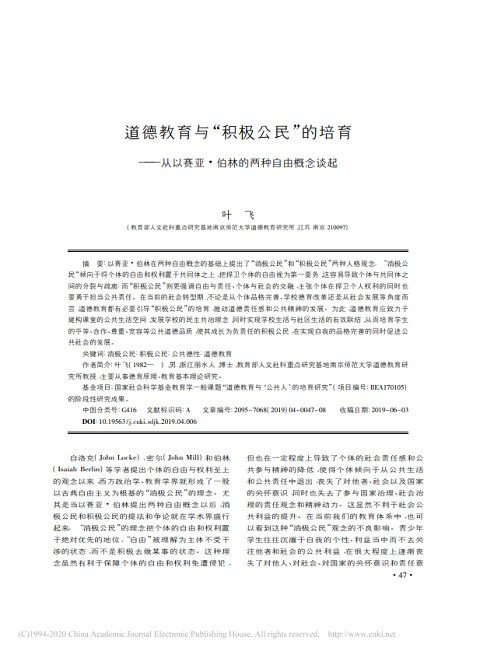 Moral Education and the Cultivation of Positive Citizen: Insights from Isaiah Berlin’s Conceptualization of Two Types of Freedom Année de publication: 2019 Auteur: Ye Fei Auteur institutionnel: 苏州大学 On the basis of a binary model of freedom, Isaiah Berlin distinguished two types of citizenship: “negative citizen” and “active citizen”. “Negative citizens” tend to place individual freedom and rights above the community, and to defend the individual freedom as the top priority, which readily leads to the division and alienation between the individual and the community. “Active citizens”, on the other hand, tend to place a greater emphasis on the close relationship between freedom and responsibility and the integration of individual and the society, advocating that individuals shall have the courage to assume public responsibility while defending their individual rights. In the ongoing social transformation, moral education shall guide the cultivation of “active citizens” and promote the development of moral responsibility and public spirit, which is valid practice with relation to individual personality improvement, school moral education reform, and social development. To this end, moral education should be devoted to constructing a public living space in the classroom, developing the concept of democratic co-governance in schools, and meanwhile establishing an effective connection between schools and communities. Thus, students can be expected to become responsible and positive citizens who treasure such public virtues as equality, cooperation, respect, and tolerance, and who shall contribute to the progress of public life in building a respectable character.
 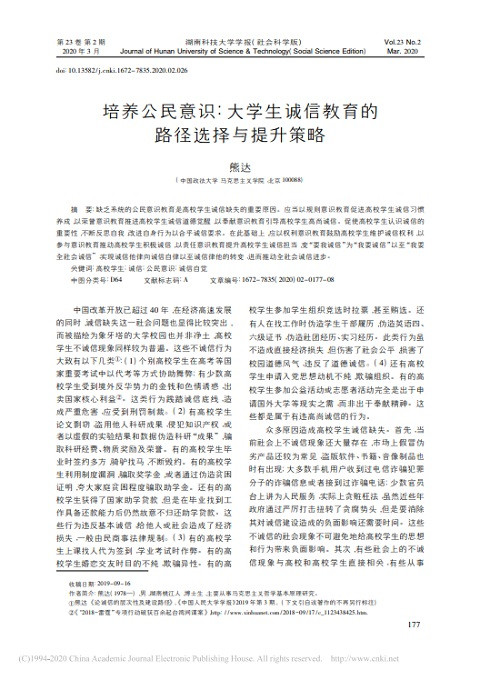 Cultivating Civic Consciousness: The Path Choice and Promotion Strategy of Honesty Education for College Students Année de publication: 2020 Auteur: Xiong Da Auteur institutionnel: Hunan University of Science and Technology To solve the problem of college students’ lack of honesty,we need to find the root cause first. The lack of systematic civic education is an important reason for college students’ lack of honesty. We should promote the cultivation of college students’ good faith habit with the education of rule consciousness, promote the awakening of college students’ good faith morality with the education of honor consciousness, and guide college students’ noble good faith with the education of dedication consciousness. We should promote college students to understand the importance of honesty, constantly make self-reflections, improve their behavior to meet the requirements of honesty. On this basis, we should encourage college students to maintain the right of honesty by right awareness education, promote college students to be honest actively by participation awareness education, enhance college students’ responsibility of honesty by responsibility awareness education, change the idea from “I am wanted to be honest” to “I want to be honest by myself” and “I want the whole society to be honest”, so as to transform from heteronomy to self-discipline and even to be disciplined with honesty, and promote the whole society to make great progress in honesty. 培养公民意识: 大学生诚信教育的路径选择与提升策略 Année de publication: 2020 Auteur: Xiong Da Auteur institutionnel: 湖南科技大学 缺乏系统的公民意识教育是高校学生诚信缺失的重要原因。应当以规则意识教育促进高校学生诚信习惯 养成,以荣誉意识教育推进高校学生诚信道德觉醒,以奉献意识教育引导高校学生高尚诚信。促使高校学生认识诚信的 重要性,不断反思自我,改进自身行为以合乎诚信要求。在此基础上,应以权利意识教育鼓励高校学生维护诚信权利,以 参与意识教育推动高校学生积极诚信,以责任意识教育提升高校学生诚信担当,变“要我诚信”为“我要诚信”以至“我要 全社会诚信”,实现诚信他律向诚信自律以至诚信律他的转变,进而推动全社会诚信进步。
 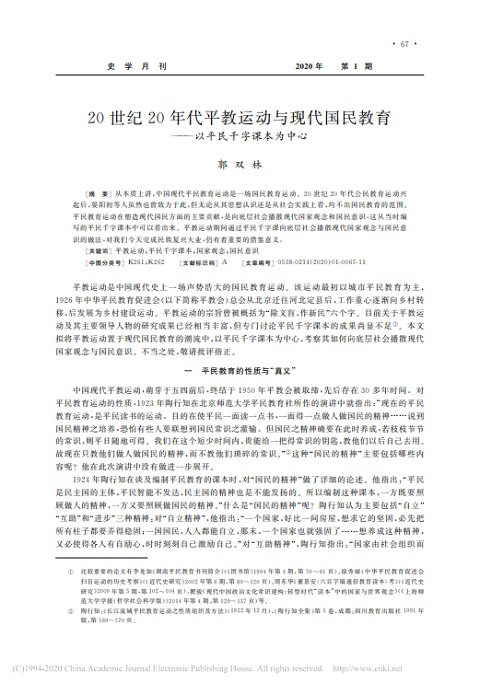 The Mass Education Movement and the Modern National Education in the 1920s: Centering on the Textbook of One Thousand Chinese Characters for Civilian Année de publication: 2020 Auteur: Guo Shuanglin Auteur institutionnel: Historiographic Studies The Mass Education Movement was essentially a kind of national education movement in modern China. After the rise of the Civic Education Movement in the 1920s, James Yen and others had been devoted to the development of this movement. But no matter from the perspective of their ideological understanding or from the angle of their social practices, their civic education movement was undoubtedly within the scope of national education. The main contribution of the Mass Education Movement on shaping the modern nationals was to disseminate the concept of modern state and national consciousness to the lower level of the society, which could be seen from the compilation of the textbook of One Thousand Chinese Characters for Civilians at that time. Even today, the Mass Education Movement’s act of disseminating the concept of modern state and national consciousness to the lower level of the society through the textbook is One Thousand Chinese Character of Civilians still has important reference value for us to achieve the great rejuvenation of the Chinese nation. 20世纪20年代平教运动与现代国民教育—以平民千字课本为中心 Année de publication: 2020 Auteur: Guo Shuanglin Auteur institutionnel: Historiographic Studies 从本质上讲,中国现代平民教育运动是一场国民教育运动。20世纪20年代公民教育运动兴 起后,晏阳初等人虽然也曾致力于此,但无论从其思想认识还是从社会实践上看,均不出国民教育的范围。 平民教育运动在塑造现代国民方面的主要贡献,是向底层社会播散现代国家观念和国民意识,这从当时编 写的平民千字课本中可以看出来。平教运动期间通过平民千字课向底层社会播散现代国家观念与国民意 识的做法,对我们今天完成民族复兴大业,仍有着重要的借鉴意义。
  A Contemporary Exploration of the Thought of Ye Shengtao upon the Foundation of Developing Virtues for Planting Humans Année de publication: 2020 Auteur: Ren Sumin Auteur institutionnel: Chinese Educational Science Against the background of the new times of “developing virtues for planting humans”as the fundamental mission of educational development for establishing Socialism with Chinese characteristics, this article attempts to analyze the thoughts of Ye Sheng from the perspective of their implications for this new times. Ye’s thoughts on moral education are grounded upon the notion of “Learning to be”, thus with lots of insights for practice, and this demonstrates the meaning and aims of moral education in modern China, and constructs the contents and core of moral education in modern China. Grounded upon “Learning to be” as the principle, this thoughts concludes the principle and method of moral education for modern China. This thought on moral education is also founded on educational practice in modern China, which carries the wonderful tradition of Chinese educational thoughts, and there wisdom for moral education practice for modern China. They also demonstrate the nature and principle for today’s moral education with Chinese characteristics, and consolidate the thought of “developing virtues for planting humans” as a fundamental mission in preparing the next generation as leaders for the socialist society. 立德树人背景下叶圣陶德育思想时代内涵探析 Année de publication: 2020 Auteur: Ren Sumin Auteur institutionnel: Chinese Educational Science 在新时代以立德树人为根本任务的中国特色社会主义教育发展背景下,重温叶圣陶德育思想, 深度挖掘其时代内涵,非常具有现实意义。叶圣陶德育思想以 “做人”为根本,阐明了中国现代德育的 意义和目的; 以 “人生”为主题,构建了中国现代德育的内容和核心; 以 “人本”为遵循,总结了中国 现代德育的原则和方法。这一德育思想,基于中国现代教育实践,继承发展中华优秀传统教育思想,深 刻总结了我国现代德育实践的经验和智慧,揭示了中国特色现代德育的本质和规律,为新时代教育落实 立德树人根本任务,培养社会主义建设者和接班人,提供了宝贵借鉴。