
Ressources
Explorez une large gamme de ressources sur le GCED afin d’approfondir votre compréhension et de renforcer vos activités de recherche, de plaidoyer, d’enseignement et d’apprentissage.
1,726 résultats trouvés
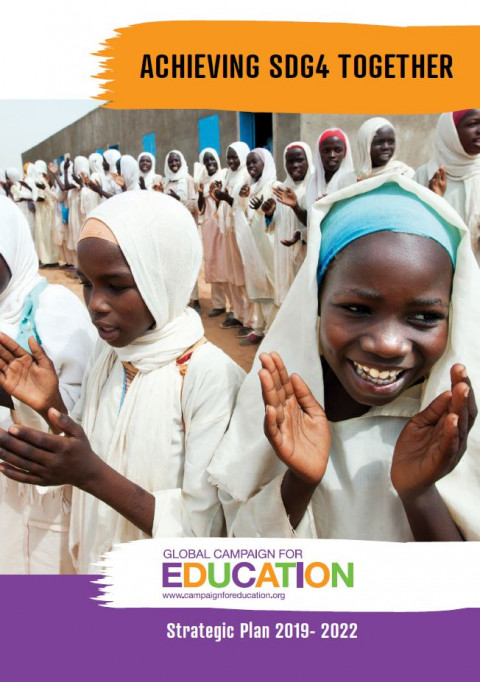 Achieving SDG 4 Together: Strategic Plan 2019 - 2022 Année de publication: 2018 Auteur institutionnel: Global Campaign for Education (GCE) The 2019-2022 strategic plan of the Global Campaign for Education was adopted during the 6th World Assembly of the movement in November 2018, Kathmandu. The plan identifies 4 priority strategic areas: Inclusivity and non-discrimination, Transformative education, Education in emergencies and Financing education. The plan also focus on strengthening the global movement and integrating youth voices.On the eve of celebrating its 20th anniversary, the Global Campaign for Education (GCE) is the largest civil society organisation movement working to promote the human right to education and to put pressure on governments and the international community to fulfil their commitments to provide free, inclusive, quality public education and lifelong learning for all, particularly for children. Our regional and national coalitions encompass many thousands of civil society organisations and represent millions of individuals across the world. Each is independent, and all are united by the commitment to the human right to education, and to achieving change through the mobilisation of citizens and civil society.
  Transforming Systems in Times of Adversity: Education and Resilience; White Paper Année de publication: 2019 Auteur: Ritesh Shah Auteur institutionnel: United States Agency for International Development (USAID) This white paper was commissioned to provide USAID, including Missions, Regional Bureaus, Pillar Bureaus, and the Office of U.S. Foreign Disaster Assistance (OFDA), with an overview of global and Agency thinking and practice on education and resilience and a foundation and justification for positioning USAID education efforts more concretely within a resilience frame.The white paper is organized into three key sections. The first section outlines the business case for resilience, explaining how and why resilience is an important consideration for education programs to consider in contexts of crisis and conflict and how education is well poised as a sector to contribute to strengthening resilience. The second section presents a conceptual framework for understanding how resilience operates through and within the education sector and program interventions. The third section provides a series of key considerations for developing and supporting USAID education programs with a resilience lens or focus.
  Ending Learning Poverty : What Will It Take? Année de publication: 2019 Auteur institutionnel: World Bank In recent years, it has become clear that many children around the world are not learning to read proficiently. As a major contributor to human capital deficits, the learning crisis undermines sustainable growth and poverty reduction. To spotlight this crisis, we are introducing the concept of Learning Poverty, drawing on new data developed in coordination with the UNESCO Institute for Statistics.
 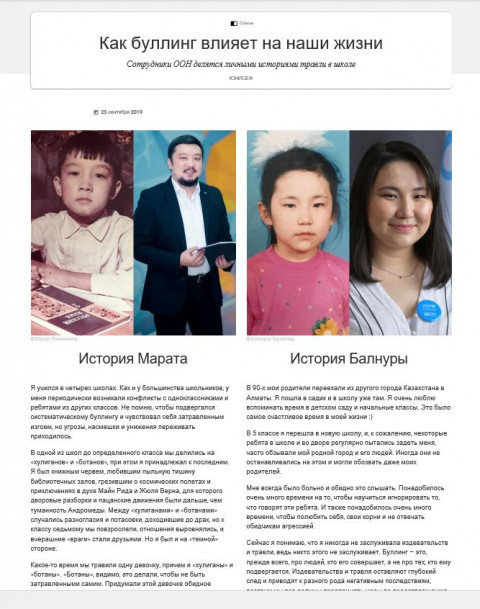 How Bullying Affects Our Lives Année de publication: 2019 Auteur institutionnel: UNICEF Kazakhstan In this article, UN staff members share personal stories showing how they dealt with bullying at school. Как буллинг влияет на наши жизни Année de publication: 2019 Auteur institutionnel: UNICEF Kazakhstan В данной статье сотрудники ООН делятся личными историями травли в школе.
  Accountability for Gender Equality Année de publication: 2018 Auteur: Elaine Unterhulter | Amy North | Orlanda Ward The aim of this paper is to consider approaches to understanding and evaluating accountability in education from the perspective of concerns with gender equality in education. This task has a number of facets and complexities, because ‘gender’ is not one simple set of relationships, and the notion of gender equality in education can be read in a number of different ways. Thus developing adequate conceptualizations for the key terms (accountability, and gender equality and education) needs to take account of gender as a particularly fluid, contextually located and contested idea signaling processes, which link with different formulations of policy and practice to enhance gender equality and accountability in education.In this paper we look at a range of different meanings of accountability, distilled in the main GEM Report (UNESCO, 2017) and consider their implications in relation to debates about gender and gender equality in education. The aim of the paper is to develop a ‘bespoke’ interpretation of accountability and different forms of gender equality in education through which we can assess a number of research studies and country examples of forms of accountability.This paper is also background paper prepared for the 2018 Global education monitoring report gender review: Meeting our commitments to gender equality in education.
 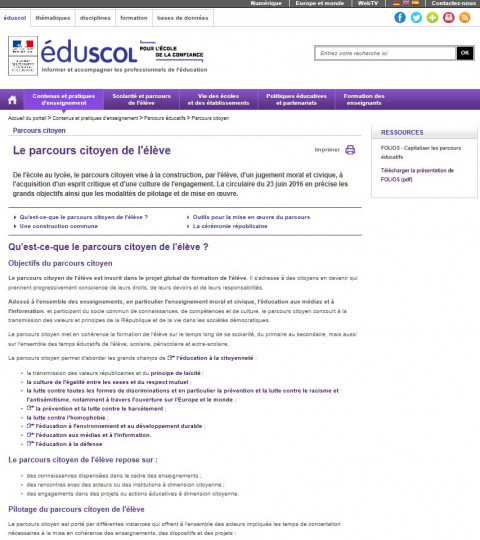 Le parcours citoyen de l'élève Année de publication: 2016 Auteur institutionnel: éducscol De l'école au lycée, le parcours citoyen vise à la construction, par l'élève, d'un jugement moral et civique, à l'acquisition d'un esprit critique et d'une culture de l'engagement. La circulaire du 23 juin 2016 en précise les grands objectifs ainsi que les modalités de pilotage et de mise en œuvre. Qu'est-ce-que le parcours citoyen de l'élève ? Une construction commune Outils pour la mise en œuvre du parcours La cérémonie républicaine
  La fondation Zentrum fir politesch Bildung : Un centre pour l’éducation à la citoyenneté Année de publication: 2016 Auteur institutionnel: Fondation Zentrum fir politesch Bildung | Le Gouvernement du Grand-Duché de Luxembourg L’éducation à la citoyenneté fait partie des priorités du gouvernement dans le cadre de la politique éducative. Il s’agit de préparer le citoyen, durant son enfance et sa jeunesse, à la transition vers sa vie d’adulte responsable, capable de participer activement à une société en constante évolution, en faisant preuve de tolérance, de respect et d’esprit critique.Le gouvernement a opté pour la création d’une structure indépendante, chargée d’élaborer les concepts pour une éducation à la citoyenneté, tant à l’école que dans les structures d’accueil, de centraliser les efforts, de développer des offres pédagogiques, de mettre en place des campagnes d’information et de promouvoir la compréhension de la démocratie et la participation politique des enfants et des jeunes, …Ce Centre pour l’éducation à la citoyenneté - Zentrum fir politesch Bildung – prend la forme d’une fondation de droit privé afin de garantir son autonomie.
 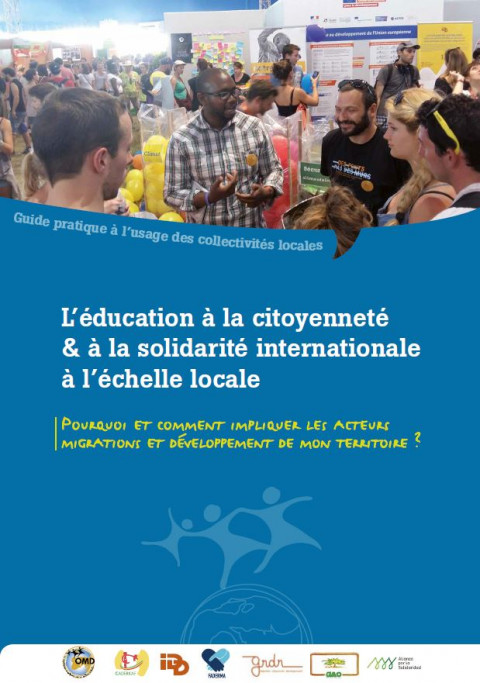 L’éducation à la citoyenneté & à la solidarité internationale à l’échelle locale : Guide pratique à l’usage des collectivités locales Auteur institutionnel: Les OMD pour les OMD Dans le cadre du programme « les OMD pour les OMD », le Grdr et ses partenaires ont édité un guide présentant l’offre d’Education à la Citoyenneté et à la Solidarité Internationale (EADSI) portée par les acteurs migrations & développement. Il est prioritairement destiné aux collectivités territoriales et à tous les acteurs locaux engagés dans la solidarité internationale qui souhaitent mobiliser les associations de migrants. Ce guide a été produit avec le soutien financier de l’Union européenne et de l’Agence française de développement.L’éducation à la citoyenneté et à la solidarité internationale, demeure un canal de communication privilégié entre citoyens et décideurs pour comprendre et agir collectivement. Ce guide entend promouvoir les initiatives engagées par le mouvement associatif de solidarité internationale issu des migrations en France, en Espagne et en Italie. Ces organisations ont définit les contours d’une offre citoyenne qui positionne la migration comme une réponse aux enjeux du développement, témoins de l’interdépendance qui caractérise les échanges mondiaux et pousse les acteurs locaux à s’engager à l’échelle internationale.Ce guide (L’éducation à la citoyenneté & à la solidarité internationale à l’échelle locale) présente en deux grands chapitres les atouts et les pratiques des acteurs de solidarité internationale issus des migrations en matière d’animation territoriale et de plaidoyer. Il se fonde sur l’expérience des partenaires du programme « Les OMD pour les OMD ». Il vise ainsi à renforcer les liens entre les collectivités et leurs partenaires, sur la base d’animations citoyennes qui peuvent être menées conjointement à l’échelle d’un quartier, d’une ville ou d’une région.Ce travail est le fruit d’une coopération étroite entre associations en France, en Espagne et en Italie impliquées dans la construction d’une offre d’EADSI portant sur les enjeux de migrations & développement.
 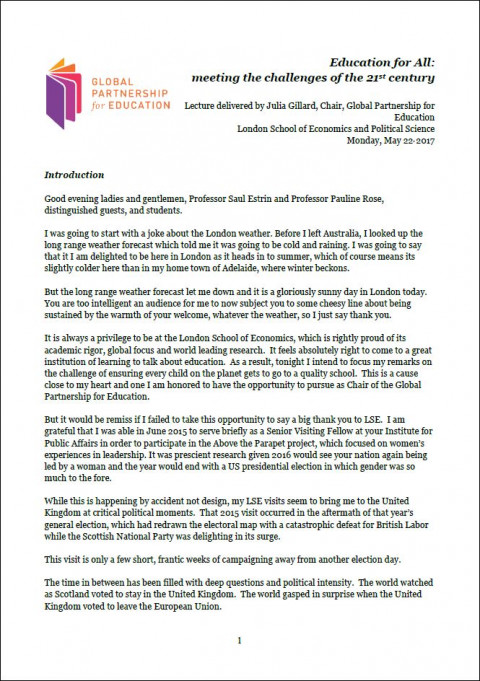 Education for All: Meeting the Challenges of the 21st Century Année de publication: 2017 Auteur institutionnel: Global Partnership for Education (GPE) In this speech at the London School of Economics on May 22 2017, Julia Gillard, Board Chair of the Global Partnership for Education, described the global education crisis that the world is facing, and how investing in inclusive, quality education is urgently needed to achieve sustainable development.