
Ressources
Explorez une large gamme de ressources sur le GCED afin d’approfondir votre compréhension et de renforcer vos activités de recherche, de plaidoyer, d’enseignement et d’apprentissage.
2,661 résultats trouvés
 联合国土著人民权利宣言 Année de publication: 2018 Auteur institutionnel: United Nations (UN) 本文件为联合国为保护土著权利所制定的宣言。
  Systèmes éducatifs africains et orientations internationales pour l’éducation au XXIe siècle (Revue internationale d’éducation de Sèvres; no. 77) Année de publication: 2018 Auteur: Abdeljalil Akkari Auteur institutionnel: France Education International L’agenda Éducation 2030 fait partie des 17 objectifs de développement durable des Nations unies. Tout d’abord, questionnons l’utilité des déclarations internationales en matière d’éducation. On observe en effet que les objectifs ambitieux sont repris d’une conférence internationale à l’autre. En réalité, il faut souligner le caractère à la fois utopique mais aussi mobilisateur de ces orientations. Leur intérêt se situe essentiellement dans leur capacité à mobiliser ressources (notamment financières). Sur le plan national, un agenda international porté par les Nations Unies a une valeur symbolique forte. Il marque un cap, un horizon vers lequel la communauté éducative internationale veut tendre. La nouveauté de l’agenda 2030 est qu’il a pour ambition de réunir l’ensemble des nations sur des objectifs similaires et universels.2Il est utile de se demander ce que les États membres de l’ONU font d’un agenda international. La réponse à cette question dépend de la puissance des États et de leur place dans la géopolitique mondiale. Pour les États les plus puissants, l’agenda exerce une influence relativement limitée sur leurs politiques éducatives domestiques, en dehors du choc ponctuel lié à la publication des résultats des études comparatives internationales. En revanche, pour les États les plus dépendants de l’aide internationale à l’éducation, la conformité avec les orientations d’un agenda international peut leur permettre d’accéder à des financements indispensables pour le développement ou simplement le maintien de leurs systèmes éducatifs.
  التمييز على أساس الجنس.. هل المرأة هي الضحية دوماً؟ Année de publication: 2017 Auteur institutionnel: DW TV بعد سنوات طويلة من الصمت أقدمت ممثلات وعارضات أزياء شهيرات على كسر حاجز الخوف وكشفن عن انتهاكات المنتج الشهير هارفي واينستين بحقهن. هذه الفضيحة دفعت بمئات الآلاف من النساء إلى نشر قصصهن المؤلمة في شبكات التواصل. فأين يبدأ التمييز الجنسي؟ وما مدى تفشي هذه الظاهرة في الواقع؟ وهل المرأة هي دائماً الضحية؟ هذه الأسئلة يتم مناقشها في هذا البرنامج. Discrimination on the Basis of Sex.. Is the Woman Always the Victim? Année de publication: 2017 Auteur institutionnel: DW TV After many years of silence, famous actresses and models broke the barrier of fear and revealed the violations of the famous producer Harvey Weinstein against them. This scandal prompted hundreds of thousands of women to publish their painful stories in social networks. Where does gender discrimination begin? And how widespread is this phenomenon in reality? Is the woman always the victim? These questions are discussed in this program.
 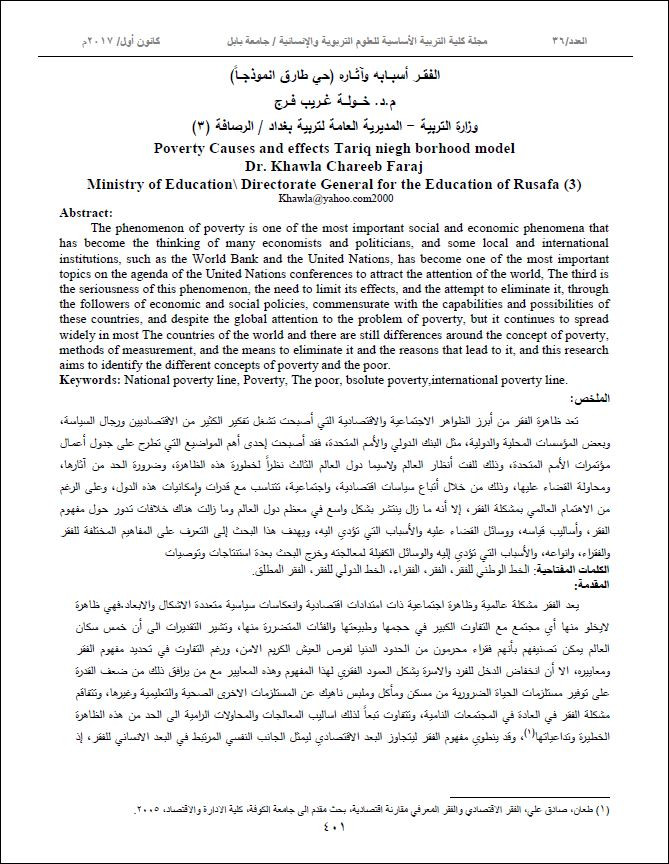 الفقر أسبابه وآثاره (حي طارق انموذجا) Année de publication: 2017 Auteur: Khawla Chareeb Faraj Auteur institutionnel: University of Babylon تعد ظاهرة الفقر من أبرز الظواهر الاجتماعية والاقتصادية التي أصبحت تشغل تفكير الكثير من الاقتصاديين ورجال السياسة، وبعض المؤسسات المحلية والدولية، مثل البنك الدولي والأمم المتحدة، فقد أصبحت إحدى أهم المواضيع التي تطرح على جدول أعمال مؤتمرات الأمم المتحدة، وذلك للفت أنظار العالم ولاسيما دول العالم الثالث نظرا لخطورة هذه الظاهرة، وضرورة الحد من آثارها، ومحاولة القضاء عليها، وذلك من خلال أتباع سياسات اقتصادية، واجتماعية، تتناسب مع قد ا رت وامكانيات هذه الدول، وعلى الرغم من الاهتمام العالمي بمشكلة الفقر، إلا أنه ما ا زل ينتشر بشكل واسع في معظم دول العالم وما ا زلت هناك خلافات تدور حول مفهوم الفقر، وأساليب قياسه، ووسائل القضاء عليه والأسباب التي تؤدي اليه، ويهدف هذا البحث إلى التعرف على المفاهيم المختلفة للفقر، وانواعه، والأسباب التي تؤدي إليه والوسائل الكفيلة لمعالجته وخرج البحث بعدة استنتاجات وتوصيات. Poverty Causes and Effects: Tareq Neighborhood as a Model Année de publication: 2017 Auteur: Khawla Chareeb Faraj Auteur institutionnel: University of Babylon The phenomenon of poverty is one of the most important social and economic phenomena that has become the thinking of many economists and politicians, and some local and international institutions, such as the World Bank and the United Nations, has become one of the most important topics on the agenda of the United Nations conferences to attract the attention of the world, The third is the seriousness of this phenomenon, the need to limit its effects, and the attempt to eliminate it, through the followers of economic and social policies, commensurate with the capabilities and possibilities of these countries, and despite the global attention to the problem of poverty, but it continues to spread widely in most The countries of the world and there are still differences around the concept of poverty, methods of measurement, and the means to eliminate it and the reasons that lead to it, and this research aims to identify the different concepts of poverty and the poor.
  موجز التقرير العالمي حول الإعاقة Année de publication: 2011 Auteur institutionnel: World Health Organization (WHO) | World Bank قامت منظمة الصحة العالمية بالاشتراك مع البنك الدولي في إصدار هذا التقرير العالمي حول الإعاقة، من أجل عرض البيِّنات اللازمة لوضع السياسات والبرامج المبتكرة القادرة على تحسين حياة ذوي الإعاقة، وتيسير تنفيذ اتفاقية الأمم المتحدة لحقوق الأشخاص ذوي الإعاقة التي تم تفعيلها في أيار/مايو من عام 2008. ويقدم التقرير العالمي تعريفا عن الإعاقة بوصفها مصطلحاً جامعاً يضم تحت مظلته الأشكال المختلفة للاعتلال/الخلل العضوي، ومحدودية النشاط، والقيود التي تحد من المشاركة. كما أن مصطلح الإعاقة يعود إلى السمات السلبية للتفاعل بين الأفراد الذين يعانون من حالة صحية ما )مثل الشلل الدماغي، أو متلازمة داون، أو الاكتئاب(، وبين العوامل الشخصية والبيئية )مثل المواقف السلبية، وانعدام إتاحة وسائل النقل والمباني العامة، والدعم الاجتماعي المحدود).ثم يقدم اقتراحات بخطوات يمكن أن تتخذ من قبل كافة الأطراف المعنية –ومنها الحكومات، ومنظمات المجتمع المدني، ومنظمات الأشخاص ذوي الإعاقة – من أجل إيجاد بيئات ممكِّنة، وتطوير خدمات التأهيل والدعم، وضمان الحماية الاجتماعية الكافية، وإطلاق سياسات وبرامج شاملة، وتفعيل المعايير والتشريعات الجديدة والقائمة، وذلك لصالح ذوي الإعاقة والمجتمع على نطاقه الأوسع. وينبغي أن يكون ذوو الإعاقة هم المركز الذي تتمحور حوله هذه المساعي. كما يلقي الضوء على العقبات والعوائق المتباينة التي يواجهها ذوو الإعاقة - عقبات تتعلق بما يصادفونه من مواقف واتجاهات، وعقبات مادية، ومالية – وكلها عقبات يسهل التعامل معها والتصدي لها. يقدم توصيات للعمل على المستويات المحلية والوطنية والدولية، ومن ثم فهو أداة لا تقدر بثمن. Summary of the World Report on Disability Année de publication: 2011 Auteur institutionnel: World Health Organization (WHO) | World Bank The World Health Organization and the World Bank jointly produced this global report on disability, in order to present the evidence needed to develop innovative policies and programs capable of improving the lives of people with disabilities, and to facilitate the implementation of the United Nations Convention on the Rights of Persons with Disabilities that was activated in May of 2008. The World Report provides a definition of disability as an umbrella term that includes under its umbrella various forms of organ impairment/dysfunction, limited activity, and participation limitations. The term disability also refers to the negative features of the interaction between individuals with a health condition (such as cerebral palsy, Down syndrome, or depression), and between personal and environmental factors (such as negative attitudes, lack of access to transportation and public buildings, and limited social support).It then presents suggestions for steps that can be taken by all concerned parties - including governments, civil society organizations, and organizations of persons with disabilities - in order to create enabling environments, develop rehabilitation and support services, ensure adequate social protection, launch comprehensive policies and programs, and activate new standards and legislation List, for the benefit of people with disabilities and society at large. People with disabilities should be the centerpiece of these endeavours. It also sheds light on the various obstacles and barriers faced by persons with disabilities - obstacles related to the attitudes and trends they encounter, and physical and financial obstacles - all of which are easy to deal with and address. It provides recommendations for action at the local, national and international levels, and is thus an invaluable tool.
 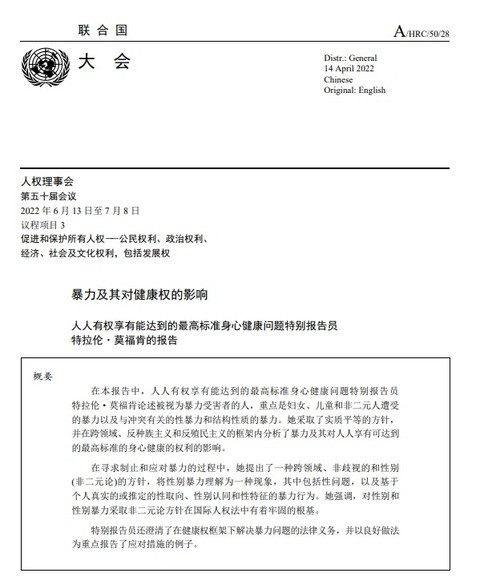 Violence and its Impact on the Right to Health - Report of the Special Rapporteur on the Right of Everyone to the Enjoyment of the Highest Attainable Standard of Physical and Mental Health Année de publication: 2022 Auteur institutionnel: UN Human Rights This document is a special report of the UN Special Rapporteur on Human Rights on violence and its impact on the right to health, including the legal framework, an inclusive approach, the identification of multiple forms of violence, and reasonable responses. 暴力及其对健康权的影响 - 人人有权享有能达到的最高标准身心健康问题特别报告员的报告 Année de publication: 2022 Auteur institutionnel: UN Human Rights 该文件是联合国人权事务特别报告员关于暴力问题及其对健康权影响的特别报告,包括法律框架、包容性的方针、对多种形式暴力的识别以及应对措施。