
Ressources
Explorez une large gamme de ressources sur le GCED afin d’approfondir votre compréhension et de renforcer vos activités de recherche, de plaidoyer, d’enseignement et d’apprentissage.
1,450 résultats trouvés
 Introducing quality assurance of education for democratic citizenship in schools - comparative study of 10 countries Année de publication: 2009 Auteur institutionnel: Council of Europe For over a decade the Council of Europe has been working on policies in the field of education for democratic citizenship (EDC). One result has been that the Committee of Ministers of the Council of Europe agreed on a recommendation stating that EDC is central to educational politics, and that it is a “factor for innovation in terms of organising and managing overall education systems, as well as curricula and teaching methods” (Recommendation Rec(2002)12). According to this recommendation, European governments acknowledged their responsibility for ensuring the cultural basis of democracy through education. However, politics is not so simple that supranational recommendations are immediately translated into policy in national states. This gap between agreed and realised policies has been termed a “compliance gap”. One of the most logical reasons for noncompliance comes from a lack of awareness or competences. Therefore the Council of Europe concentrated on producing materials that could help raise awareness and develop competences. Key products resulting from this effort have been collected as an “EDC/HRE Pack” since 2005.This collection covers the areas of policy making, democratic governance of educational institutions, teacher training and quality assurance. The “Tool for Quality Assurance of Education for Democratic Citizenship in Schools” (Bîrzea et al., 2005), which is one of these materials, forms the reference document for this study.This study analyses relevant conditions and possible activities with regard to implementing the tool in 10 national educational systems. As relevant conditions, the study considers the existing attempts to deliver educational quality within countries, together with the teacher training programmes that accompany these attempts. As possible activities, national adaptations of the tool, and various ways of working with different target groups, are also taken into account.The following sections provide background information concerning the project. This will help the reader understand why the tool needs to be adapted in different circumstances. Section 2 presents points of reference that open theoretical perspectives on the work presented. Section 3 provides a rationale for the selection of participating countries and gives and describes the methodology used when conducting this study. Finally, Section 4 provides an overview of the remaining contents of this book.
  Citizens as Users of Languages and Digital Technology Année de publication: 2021 Auteur institutionnel: European Centre for Modern Languages (ECML) | Council of Europe A recent meta-analysis of the literature portrays male and female citizens who are users of languages and digital technologies. This helps to understand the goals of an education aimed at developing male and female citizens capable of using digital technology in a competent, informed, safe, responsible, ethical, and critical manner. Citoyens et citoyennes usagers et usagères des langues Année de publication: 2021 Auteur institutionnel: European Centre for Modern Languages (ECML) | Conseil de l'Europe Une méta-analyse de la littérature récente dresse le portrait des citoyens et citoyennes usagers et usagères de langues et du numérique. Cela permet de connaitre les objectifs d’une éducation qui vise le développement de citoyens et citoyennes capables d’utiliser le numérique d’une façon compétente, informée, sûre, responsable, éthique et critique.
 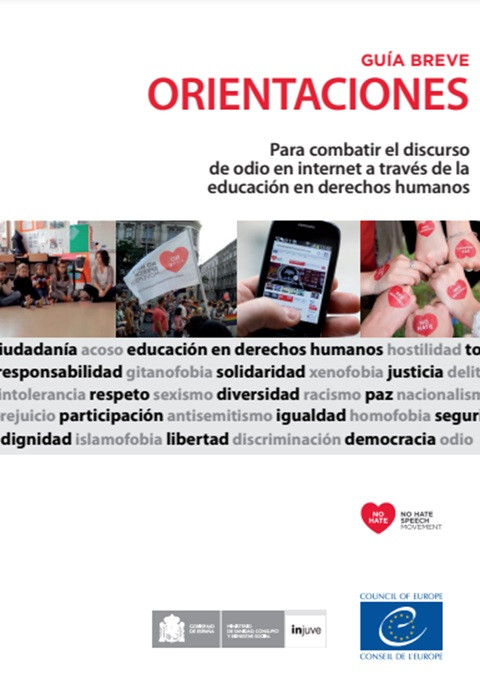 Brief Guidance Guide: To Combat Hate Speech on the Internet Through Human Rights Education Année de publication: 2016 Auteur: Ellie Keen | Mara Georgescu Auteur institutionnel: Youth Institute | Council of Europe The Youth Institute has published “Bookmarks”, a guide to combat hate speech on the Internet, which aims to be a brief and useful manual for the dissemination of concepts related to human rights and freedom of expression, as well as to raise and face the challenge of defending these rights on the Internet from a young perspective. It also aims to become a practical tool for action, training and awareness-raising work, aimed at both young people themselves and trainers, to establish in a simple way the essential concepts related to online hate speech and provide mechanisms to combat it. Guía breve orientaciones: Para combatir el discurso de odio en internet a través de la educación en derechos humanos Année de publication: 2016 Auteur: Ellie Keen | Mara Georgescu Auteur institutionnel: Youth Institute | Council of Europe El Instituto de la Juventud ha editado “Orientaciones”, una guía para luchar contra el odio en internet que pretende ser un breve manual útil para la difusión de los conceptos relacionados con los derechos humanos y la libertad de expresión, así como plantear y afrontar el reto de defender estos derechos en internet desde una perspectiva joven. También nace con el objetivo de convertirse en una herramienta práctica para la acción, el trabajo formativo y de sensibilización, dirigida tanto a los propios jóvenes como a los formadores, para fijar de manera sencilla los conceptos esenciales relacionados con el discurso de odio online y aportar mecanismos para combatirlo.
  Programs of Peace Education in Pre-University Education on the Light of Some Countries’ Experiences and the Extent of Benefit in Egypt Année de publication: 2014 Auteur: Amel Ahmed Hassan Mohamed Auteur institutionnel: Association of Arab Educators Education for peace has got an international, regional and local interests, in particular, today's world desperately needs more than ever before to face the problems afflicting the human race, and the conflict expected to increase in the coming years. This situation confirms the importance of achieving peace in all dimensions with oneself, family, society, and the environment.This study aimed to investigate the experiences of some countries in the field of education for peace and to draw some benefits from them. For achieving this aim, the study followed the Descriptive-Analytic Approach because of its appropriateness to the nature of the study. The sample of study dealt with three experiments in the field of education for peace in Northern Ireland, Bosnia and Herzegovina, and Sierra Leone, which were chosen after passing through a relatively long period of conflicts and disputes. By analyzing the three experiments, the similarities and differences among countries were reviewed in terms of, period and nature of conflict, foundations, objectives and content of the programs, teacher training. The study achieved some benefits through reviewing literature and analyzing the three experiences. The suggestions of the study were classified under some themes, including: foundations of peace education, its objectives, contents, and teacher training. برامج التربية من أجل السلام بالتعليم قبل الجامعي في بعض الدول وامكانية الاستفادة منها في مصر Année de publication: 2014 Auteur: Amel Ahmed Hassan Mohamed Auteur institutionnel: Association of Arab Educators تحظى التربية من أجل السلام باهتمام دولي وإقليمي ومحلى، ولا سيما أن عالم اليوم أحوج أكثر من ذي قبل لمواجهة المشكلات التي يعاني منها الجنس البشري والصراعات المرتقب زيادتها في السنوات القادمة؛ هذا بالإضافة إلى تنامي معدلات العنف المجتمعي ومظاهره؛ مما يدعم ضرورة السعي لتحقيق السلام بكافة أبعاده مع النفس وفي الأسرة وداخل المجتمع ومع البيئة. لذا هدفت هذه الدراسة إلى رصد تجارب بعض الدول في مجال التربية من أجل السلام وتقديم أوجه الاستفادة منها للارتقاء بمستوى تقديم هذا الاتجاه التعليمي المعاصر بنظام التعليم بمصر. لتحقيق هذا الهدف تم الاستناد إلى المنهج الوصفي التحليلي حيث أنه أكثر ملائمة لطبيعة الدراسة، وقد تكونت عينة الدراسة من ثلاث تجارب في مجال التربية من أجل السلام بالدول الآتية: إيرلندا الشمالية، والبوسنة والهرسك، وسيراليون، والتي تم اختيارها لكونها عاصرت فترة من الصراعات والنزاعات الطويلة نسبياً، تلتها مبادرات لدمج التربية من اجل السلام في النظام التعليمي. وقد تم تحليل التجارب الثلاث في ضوء عدد من المحاور شملت: السياق العام للدولة، والجهود المبكرة للتربية من أجل السلام، وأسسها، وأهدافها، وأليات تضمينها في نظام التعليم، وتدريب المعلمين بكل دولة. وقد توصلت الدراسة إلى عدد من الدروس المستفادة التي تم رصدها من خلال ما ورد من أدبيات عربية وأجنبية، وتجارب الدول الثلاث، والتي تم تصنيفها تحت المحاور الآتية: فترة الصراع وطبيعته، أسس التربية من أجل السلام، وأهدافها، وأليات تضمينها في نظام التعليم، وتدريب المعلمين.
  Guidelines on Human Rights Education for Secondary School Systems Année de publication: 2012 Auteur institutionnel: OSCE. Office for Democratic Institutions and Human Rights (ODIHR) These guidelines, which focus on human rights education in secondary schools, aim to support systemic and effective human rights learning for all young people. They were prepared on the basis of broad consultations involving teachers, teachers’ unions, teacher trainers, educational administrators, NGO specialists, and representatives from intergovernmental agencies and national human rights institutions.The current document presents approaches to be adopted when planning or implementing human rights education for secondary schools related to six key structural areas: the human rights-based approach to human rights education; core competencies; curricula; teaching and learning processes; evaluation; and professional development and support of educational personnel. The guidelines also offer a list of key materials to assist in planning, implementing and evaluating human rights education in schools. Final report of the roundtable: challenges of education for peace, intercultural and inter-religious dialogue in Georgia, Armenia and Azerbaijan Année de publication: 2007 Auteur institutionnel: Union Century 21 (Georgia) The Roundtable Meeting was organized in Tbilisi in June, (24 -27) 2007. The meeting gathered participants of the ToT course in all three countries of the Caucasus, which happened to be a sort of “première” given the region’s tensions. It was important to bring together teachers and social workers from 18 regions of Georgia as well as from the neighboring countries like Azerbaijan and Armenia ( a total amount of 40 persons (some travelled at their own expenses). Civil Society was thus well represented and will be involved in project realization with a multiplier effect once they get back to the regions or countries. The tentative programme of the meeting identifies common challenges in this field and setting up of common action plan in addressing them. This was possible with the notable participation of a facilitator and the openness of those who attended this workshop. They were also keen to draw attention to the authorities from their educational systems to implement these grassroots activities so as to attract attention not only on a regional level but on the international level too and inform international organizations about the outcomes as well as the further steps planned.
  Public Universities and Neoliberal Common Sense: Seven Iconoclastic Thesis Année de publication: 2014 Auteur: Carlos Alberto Torres Auteur institutionnel: Universidad Nacional de Tres de Febrero (UNTREF) Neoliberalism has utterly failed as a viable model of economic development, yet the politics of culture associated with neoliberalism is still in force, becoming the new common sense shaping the role of government and education. This ‘common sense’ has become an ideology playing a major role in constructing hegemony as moral and intellectual leadership in contemporary societies. Neoliberal globalisation, predicated on the dominance of the market over the state and on deregulatory models of governance, has deeply affected the university in the context of ‘academic capitalism’. The resulting reforms, rationalised as advancing international competitiveness, have affected public universities in four primary areas: efficiency and accountability, accreditation and universalisation, international competitiveness and privatisation. There is also growing resistance to globalisation as top-down-imposed reforms reflected in the public debates about schooling reform, curriculum and instruction, teacher training and school governance. Many question whether neoliberal reforms attempt to limit the effectiveness of universities as sites of contestation of the national and global order and thus undermine the broader goals of education. Neoliberal reforms have limited access and opportunity along class and racial lines, including limiting access to higher education through the imposition of higher tuition and reduced government support to institutions and individuals.