
Ressources
Explorez une large gamme de ressources sur le GCED afin d’approfondir votre compréhension et de renforcer vos activités de recherche, de plaidoyer, d’enseignement et d’apprentissage.
3,226 résultats trouvés
 خطتنا المشتركة : تقرير الأمين العام Année de publication: 2021 Auteur institutionnel: United Nations (UN) يستشرف تقرير "خطتنا المشتركة" السنوات الخمس والعشرين المقبلة ويمثل رؤية الأمين العام بشأن مستقبل التعاون العالمي وتعزيز تعددية الأطراف على أسس تقوم على الشمول والتواصل والفعالية. وقد قدم الأمين العام تقريره إلى الجمعية العامة في شهر أيلول/سبتمبر وذلك قبل نهاية دورتها الخامسة والسبعين. Our Common Agenda: Report of the Secretary-General Année de publication: 2021 Auteur institutionnel: United Nations (UN) “Our Common Agenda” report looks ahead to the next 25 years and represents the Secretary-General’s vision on the future of global cooperation and reinvigorating inclusive, networked, and effective multilateralism. The Secretary-General presented his report to the General Assembly in September 2021 before the end of the 75th session of the General Assembly. Nuestra Agenda Común: Informe del Secretario General Année de publication: 2021 Auteur institutionnel: United Nations (UN) El informe sobre Nuestra Agenda Común examina los próximos 25 años y refleja la visión del Secretario General sobre el futuro de la cooperación mundial y la revitalización de un multilateralismo inclusivo, interconectado y eficaz. El Secretario General presentó su informe a la Asamblea General en septiembre de 2021, antes de que finalizara el septuagésimo quinto período de sesiones de la Asamblea. Notre programme commun: Rapport du Secrétaire général Année de publication: 2021 Auteur institutionnel: United Nations (UN) Dans ce rapport qui envisage les 25 prochaines années, le Secrétaire général expose la façon dont il conçoit à l’avenir la coopération mondiale et la manière dont l’on pourrait revitaliser le multilatéralisme pour en faire un multilatéralisme plus efficace, plus inclusif et fonctionnant davantage en réseau. Il présentera ce rapport à l’Assemblée générale en septembre, avant la fin de la soixante-quinzième session. Наша общая повестка дня: Доклад генерального секретаря Année de publication: 2021 Auteur institutionnel: United Nations (UN) Доклад «Наша общая повестка дня» охватывает период в 25 лет и представляет собой видение Генерального секретаря будущего глобального сотрудничества и активизации инклюзивной, сетевой и эффективной многосторонней деятельности. Генеральный секретарь представил свой доклад Генеральной Ассамблее в сентябре 2021 года до окончания 75-й сессии Генеральной Ассамблеи. 我们共同的议程:秘书长的报告 Année de publication: 2021 Auteur institutionnel: United Nations (UN) 关于我们的共同议程的报告展望未来25年的前进道路,描绘了秘书长关于开创全球合作新未来和重振包容性、网络化、卓有成效的多边主义的愿景。秘书长于2021年9月大会第七十五届会议闭幕之前向大会提交了这份报告。
 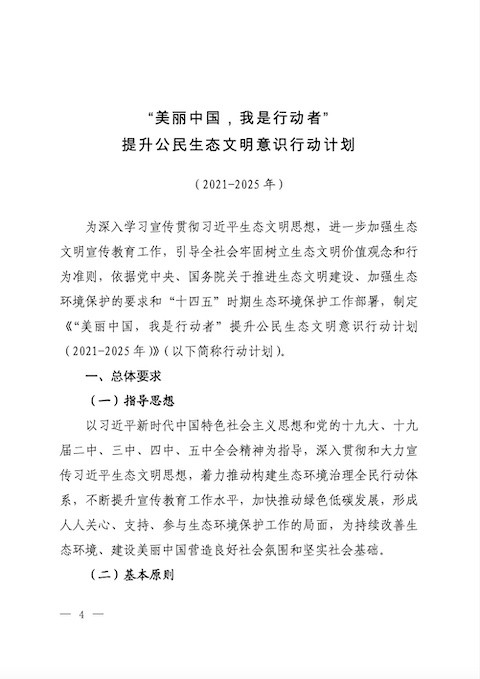 "Beautiful China, I Am a Doer" Action Plan for Raising Citizens' Awareness of Ecological Civilization (2021-2025) Année de publication: 2021 Auteur institutionnel: Government of the People’s Republic of China The policy was developed by the Chinese government to promote the development of environmental protection concepts among Chinese citizens and to build a system to engage citizens in environmental protection efforts. It includes a detailed action plan and pays particular attention to how to develop ecological awareness and habits among young people through the education system. “美丽中国,我是行动者” 提升公民生态文明意识行动计划(2021-2025年) Année de publication: 2021 Auteur institutionnel: Government of the People’s Republic of China 该政策由中国政府制定,旨在促进中国公民发展环境保护理念,建设一个体系,促使公民参与环境保护工作。内容包括详尽的行动计划,并特别关注如何通过教育体系培养青少年生态意识和习惯。
 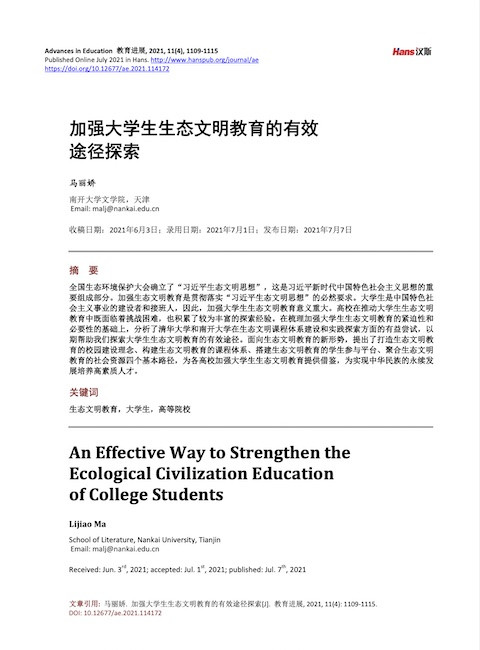 An Effective Way to Strengthen the Ecological Civilization Education of College Students (Advances in Education; vol. 11, no. 4) Année de publication: 2021 Auteur: Lijiao Ma Using Tsinghua University and Nankai University as two examples, this paper discusses different ways of carrying out ecological education in Chinese universities. 加强大学生生态文明教育的有效途径探索 (教育进展; vol. 11, no. 4) Année de publication: 2021 Auteur: Lijiao Ma 本文以清华大学和南开大学为例,探讨在中国的大学中开展生态文明教育的有效途径。