
Ressources
Explorez une large gamme de ressources sur le GCED afin d’approfondir votre compréhension et de renforcer vos activités de recherche, de plaidoyer, d’enseignement et d’apprentissage.
1,473 résultats trouvés
 ¿A qué suena la paz? La reconciliación, un ejercicio de todos Année de publication: 2015 Auteur: Leonel Narváez | Magda López | María Angéliza Bueno Auteur institutionnel: Center for Research and Popular Education / Program for Peace (CINEP/PPP) En este podcast se analiza el concepto de reconciliación y los retos que enfrenta Colombia de cara a un posible escenario de posacuerdo con las FARC. ¿Qué aportes se deben hacer desde la política pública para continuar procurando caminos para la reconciliación? ¿Cuál es el papel de los ciudadanos y las ciudadanas para llevar a cabo este proceso satisfactoriamente? ¿Estamos listos para reconciliarnos?
  Human Rights Defense in Colombia: A Bet in the Midst of Adversity Année de publication: 2015 Auteur: Petrit Baquero | Nancy Arévalo | Claudia Erazo Auteur institutionnel: Center for Research and Popular Education / Program for Peace (CINEP/PPP) This podcast analyzes the panorama of human rights in Colombia and the protection of its defenders, in a context full of challenges and threats to their lives. Defensa de los DD. HH. en Colombia: Una apuesta en medio de la adversidad Année de publication: 2015 Auteur: Petrit Baquero | Nancy Arévalo | Claudia Erazo Auteur institutionnel: Center for Research and Popular Education / Program for Peace (CINEP/PPP) This podcast analyzes the panorama of human rights in Colombia and the protection of its defenders, in a context full of challenges and threats to their lives.
  Basic Elements of Forgiveness and Reconciliation Theory Année de publication: 2018 Auteur: Leonel Narváez Gómez Auteur institutionnel: Fundación para la Reconciliación This text presents the theoretical bases for forgiveness and reconciliation that support the pedagogy and actions of the Foundation for Reconcilation. Elementos básicos de la teoría del Perdón y la Reconciliación Année de publication: 2018 Auteur: Leonel Narváez Gómez Auteur institutionnel: Fundación para la Reconciliación En este texto se presentan las bases teóricas para el perdón y la reconciliación que sustentan la pedagogía y acciones de la Fundación para la Reconcliación.
  Citizenship Competencies: From the Standards to the Classroom; Proposal for Integration into Academic Areas Année de publication: 2004 Auteur: Enrique Chaux | Juanita Lleras | Ana María Velásquez Auteur institutionnel: Colombia. Ministerio de Educación Nacional | Universidad de los Andes This book presents a proposal on how citizenship education can be promoted in schools. It offers ideas on how to integrate citizenship education within the daily life of educational institutions and, in particular, with education in traditional academic areas, with concrete examples of activities that can be implemented in the classroom. Competencias Ciudadanas: De los Estándares al Aulas; Una propuesta de integración a las áreas académicas Année de publication: 2004 Auteur: Enrique Chaux | Juanita Lleras | Ana María Velásquez Auteur institutionnel: Colombia. Ministerio de Educación Nacional | Universidad de los Andes Este libro presenta una propuesta sobre cómo puede promoverse la formación ciudadana en la escuela. Ofrece ideas sobre cómo integrar la formación ciudadana con la vida cotidiana de las instituciones educativas y, en particular, con la formación en las áreas académicas tradicionales, con ejemplos concretos de actividades que pueden implementarse en las aulas.
 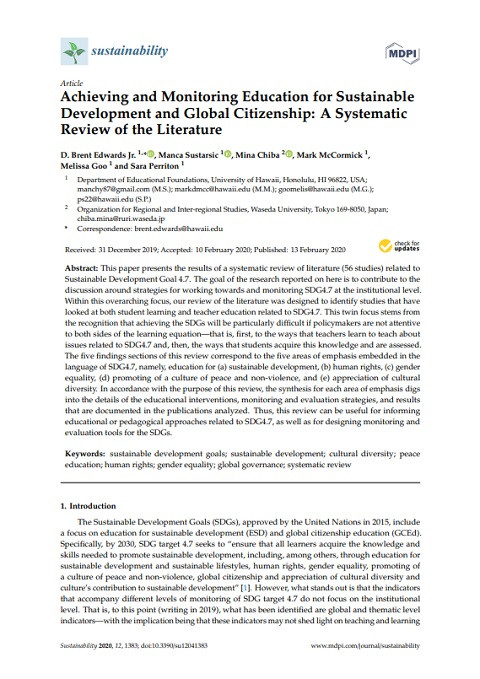 Achieving and Monitoring Education for Sustainable Development and Global Citizenship: A Systematic Review of the Literature (Sustainability 2020; Vol. 12, No. 4) Année de publication: 2020 Auteur: Brent Edwards | Manca Sustarsic | Mina Chiba | Mark McCormick | Melissa Goo | Sara Perriton Auteur institutionnel: Multidisciplinary Digital Publishing Institute (MDPI) This paper presents the results of a systematic review of literature (56 studies) related to Sustainable Development Goal 4.7. The goal of the research reported on here is to contribute to the discussion around strategies for working towards and monitoring SDG4.7 at the institutional level. Within this overarching focus, our review of the literature was designed to identify studies that have looked at both student learning and teacher education related to SDG4.7. This twin focus stems from the recognition that achieving the SDGs will be particularly difficult if policymakers are not attentive to both sides of the learning equation—that is, first, to the ways that teachers learn to teach about issues related to SDG4.7 and, then, the ways that students acquire this knowledge and are assessed. The five findings sections of this review correspond to the five areas of emphasis embedded in the language of SDG4.7, namely, education for (a) sustainable development, (b) human rights, (c) gender equality, (d) promoting of a culture of peace and non-violence, and (e) appreciation of cultural diversity. In accordance with the purpose of this review, the synthesis for each area of emphasis digs into the details of the educational interventions, monitoring and evaluation strategies, and results that are documented in the publications analyzed. Thus, this review can be useful for informing educational or pedagogical approaches related to SDG4.7, as well as for designing monitoring and evaluation tools for the SDGs.
  Transitional Justice and Education: Learning Peace (Advancing Transitional Justice Series) Année de publication: 2017 Auteur: Clara Ramírez-Barat | Roger Duthie Auteur institutionnel: Social Science Research Council (SSRC) | United Nations Children's Fund (UNICEF) After periods of conflict and authoritarianism, education institutions often need to be reformed or rebuilt. But in settings where education has been used to support repressive policies and human rights violations, or where conflict and abuses have resulted in lost educational opportunities, legacies of injustice may pose significant challenges to effective reform. Peacebuilding and development perspectives, which normally drive the reconstruction agenda, pay little attention to the violent past. Transitional Justice and Education: Learning Peace presents the findings of a collaborative research project of the International Center for Transitional Justice and UNICEF on the relationship between transitional justice and education in peacebuilding contexts. The book examines how transitional justice can shape the reform of education systems by ensuring programs are sensitive to the legacies of the past, how it can facilitate the reintegration of children and youth into society, and how education can engage younger generations in the work of transitional justice.
  La migration et le Programme 2030 : Un guide à l’usage des praticiens Année de publication: 2018 Auteur: Elisa Mosler Vidal Auteur institutionnel: International Organization for Migration (IOM) Ce guide est destiné aux acteurs gouvernementaux, à la fois nationaux et locaux, qui sont impliqués dans des activités de mise en œuvre des Objectifs de développement durable, y compris ceux qui travaillent spécifiquement dans le domaine de la migration et ceux d’autres secteurs qui souhaitent intégrer la question de la migration. Il s’adresse également aux acteurs gouvernementaux qui travaillent dans le domaine de la migration et souhaitent intégrer les ODD dans leur travail.L’objectif de ce guide est d’aider les responsables politiques à mettre en œuvre les aspects des ODD qui touchent à la migration. Les responsables politiques peuvent utiliser ce guide pour intégrer la migration dans les activités de développement à l’échelle locale ou nationale, par l’élaboration et la mise en œuvre d’interventions qui portent sur la migration dans le cadre des ODD. Ces interventions peuvent se présenter sous forme de lois, de politiques, de programmes, de projets ou d’autres activités et peuvent être liées à des thèmes de base de la migration ou intégrer la migration dans les activités d’un autre secteur. Par exemple, les responsables politiques peuvent utiliser ce guide pour élaborer des interventions qui sont directement consacrées à la traite des personnes, ainsi que des interventions dans le secteur de la santé qui permettent de protéger les victimes de la traite des personnes.Pour les acteurs disposant d’une expérience de l’intégration de la migration, ce guide offre une nouvelle approche qui repose sur le Programme 2030. Pour ceux qui ne possèdent aucune expérience de l’intégration de la migration, il présente les liens entre la migration et le développement dans le cadre des ODD, et les mesures à prendre compte tenu de ces liens.