
Ressources
Explorez une large gamme de ressources sur le GCED afin d’approfondir votre compréhension et de renforcer vos activités de recherche, de plaidoyer, d’enseignement et d’apprentissage.
950 résultats trouvés
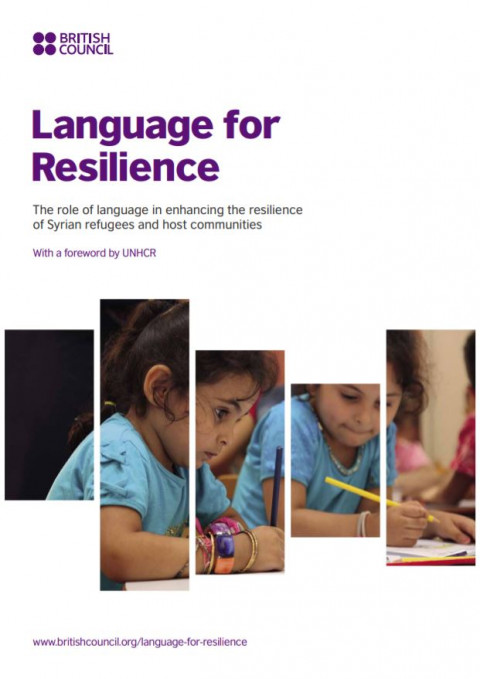 Language for Resilience: The Role of Language in Enhancing the Resilience of Syrian Refugees and Host Communities Année de publication: 2018 Auteur: Tony Capstick | Marie Delaney Auteur institutionnel: British Council | UN. Office of the United Nations High Commissioner for Refugees (UNHCR) The Language for Resilience report examines the impact of language on refugees and host communities affected by the Syrian crisis, identifying the different ways that language skills enhance resilience and providing suggestions for programme responses that address key needs.The report shows that for children and young people attending schools or post-school education, and for educators in host communities handling influxes of refugee students, quality language learning improves attainment and attendance and builds safer and more inclusive classrooms. It also illustrates how creative approaches to language education can support the development of life skills and help meet psycho-social needs.
  Comment être citoyen du monde? Année de publication: 2015 Auteur: Radhi Meddeb Auteur institutionnel: TEDxCarthage | TEDx Talks Le monde a salué la Révolution tunisienne comme étant celle des technologies de l'information et des communications. Cela est vrai en partie, car les jeunes tunisiens ont déjoué la censure, ont relayé les images de la révolte et des protestations. Mais en même temps, l'usage de l'ordinateur et d'Internet reste aujourd'hui très en deçà des normes internationales. Plus encore, il présente des disparités régionales majeures. Des cyberbases dans l'ensemble des régions tunisiennes peuvent donner à chaque tunisien un passeport vers la modernité et la citoyenneté.
  Ensuring High Quality Primary Education for Children from Mobile Populations: A Desk Study Année de publication: 2017 Auteur: Stephanie Bengtsson | Caroline Dyer Auteur institutionnel: Educate A Child (EAC) | German Federal Ministry for Economic Cooperation and Development (GIZ) This study focuses on provision for primary school-aged children amongst communities of refugees and Internally Displaced People (IDPs), mobile pastoralists and seasonally migrating workers. For refugee and IDP children, policy, coordination and implementation challenges include: inconsistent ratification and enforcement of conventions and agreements protecting refugees and IDPs; the disproportionate impact of forced displacement on low and middle income countries (LMICs); the lack of a shared agenda among a wide range of stakeholders with differing mandates; and inadequate forced displacement terminology. Promising and emerging policy, coordination and implementation strategies include: expanding existing rights documents and agreements and building policy from the ground up; enshrining forcibly displaced people’s rights to education in national laws and policy; genuine engagement with affected communities; utilising the Education Cluster and other existing multi-stakeholder networks for knowledge sharing and collaboration; and collaborating across sectors to address the needs of the whole child. Financing challenges include: unpredictable and low funding for refugee and IDP education; weak capacity to absorb funds at the national and local level; an over-reliance on short-term financing mechanisms; donor dependence and a lack of funding sustainability; and inappropriate distribution of funds within education programming.
  Women Empowerment in Saudi Arabia - Human Rights Commission Année de publication: 2019 Auteur institutionnel: HRCSaudi The symposium on women's empowerment in the Kingdom was held on Thursday, 03/30/1440 H, organized by the Human Rights Commission and in cooperation with the United Nations Office in Riyadh at the Ritz Carlton Hotel.
 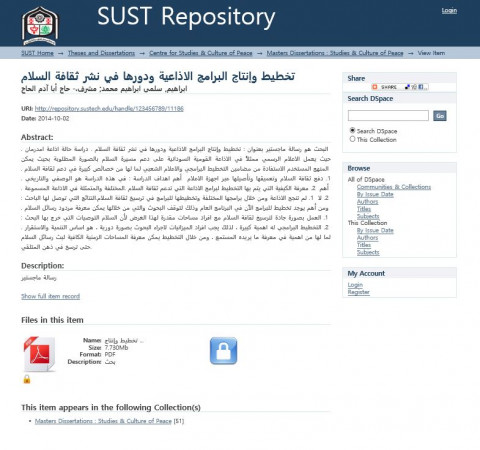 تخطيط وإنتاج البرامج الاذاعية ودورها في نشر ثقافة السلام Année de publication: 2014 Auteur: Ibrahim, Salma Ibrahim Auteur institutionnel: Sudan University of Science and Technology البحث هو رسالة ماجستير بعنوان : تخطيط وإنتاج البرامج الاذاعية ودورها في نشر ثقافة السلام . دراسة حالة اذاعة امدرمان . حيث يعمل الاعلام الرسمي ممثلاً في الاذاعة القومية السودانية على دعم مسيرة السلام بالصورة المطلوبة بحيث يمكن الاستفادة من مضامين التخطيط البرامجي والاعلام الشعبي لما لها من خصائص كبيرة في دعم ثقافة السلام . المنهج المستخدم في هذه الدراسة هو الوصفي والتاريخي . أهم اهداف الدراسة : 1. دفع ثقافة السلام وتعميقها وتأصيلها عبر اجهزة الاعلام المختلفة والمتمثلة في الاذاعة المسموعة . 2. معرفة الكيفية التي يتم بها التخطيط لبرامج الاذاعة التي تدعم ثقافة السلام . أهم النتائج التي توصل لها الباحث : 1. لم تنجح الاذاعة ومن خلال برامجها المختلفة وتخطيطها للبرامج في ترسيخ ثقافة السلام. 2. لا يوجد تخطيط للبرامج الآن في البرنامج العام وذلك لتوقف البحوث والتي من خلالها يمكن معرفة مردود رسائل السلام . ومن أهم التوصيات التي خرج بها البحث : 1. العمل بصورة جادة لترسيخ ثقافة السلام مع افراد مساحات مقدرة لهذا الغرض لأن السلام هو اساس التنمية والاستقرار . 2. التخطيط البرامجي له اهمية كبيرة ، لذلك يجب افراد الميزانيات لاجراء البحوث بصورة دورية ، لما لها من اهمية في معرفة ما يريده المستمع ، ومن خلال التخطيط يمكن معرفة المساحات الزمنية الكافية لبث رسائل السلام حتى ترسخ في ذهن المتلقي. Planning and Producing Radio Programs and Their Role in Spreading a Culture of Peace Année de publication: 2014 Auteur: Ibrahim, Salma Ibrahim Auteur institutionnel: Sudan University of Science and Technology The research is a master thesis entitled: Planning and producing radio programs and its role in spreading a culture of peace. Omdurman radio case study. Where the official media, represented by the Sudanese National Radio, works to support the peace process in the required manner so that the contents of program planning and popular media can be taken advantage of because of its great characteristics in supporting the culture of peace. The method used in this study is descriptive and historical.The most important objectives of the study: Promote, deepen and deepen the culture of peace through the various media outlets represented in the audio station. Know how to plan radio programs that support a culture of peace.The most important results that the researcher reached: The radio, through its various programs and its planning of programs, did not succeed in consolidating the culture of peace. There is no program planning now in the general program in order to stop researches, through which the outcome of peace messages can be known.Among the most important recommendations that came out of the research: Work in earnest to establish a culture of peace with individuals with appreciable spaces for this purpose, because peace is the foundation for development and stability. Program planning is of great importance. Therefore, budgets must be set up to conduct research periodically, because of its importance in knowing what the listener wants, and through planning it is possible to know enough time spaces to broadcast peace messages in order for the recipient to be entrenched in the mind of the recipient.
 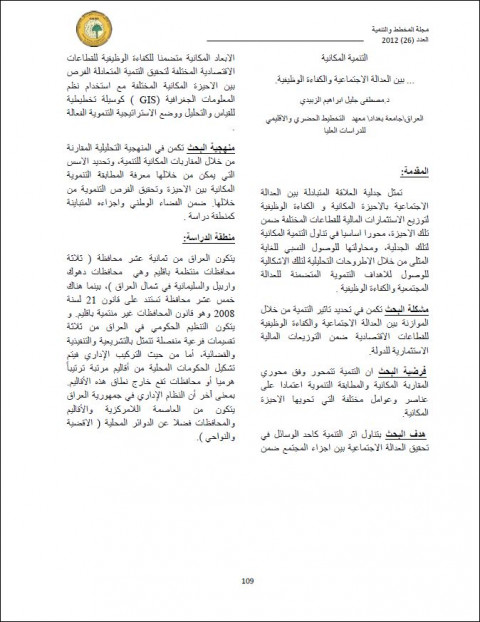 التنمية المكانية ... بين العدالة الاجتماعية والكفاءة الوظيفية Année de publication: 2012 Auteur: Mustafa Jalil Ibrahim Al-Zubaidi Auteur institutionnel: جامعة بغداد تمثل جدلية العلاقة المتبادلة بين العدالةالاجتماعية بالاحيزة المكانية و الكفاءة الوظيفية لتوزيع الاستثمارات المالية للقطاعات المختلفة ضمن تلك الاحيزة، محورا اساسيا في تناول التنمية المكانية لتلك الجدلية، ومحاولتها للوصول النسبي للغاية المثلى من خلال الاطروحات التحليلية لتلك الاشكالية للوصول للاهداف التنموية المتضمنة للعدالة المجتمعية والكفاءة الوظيفية . Spatial Development ... Between Social Justice and Functional Competence Année de publication: 2012 Auteur: Mustafa Jalil Ibrahim Al-Zubaidi Auteur institutionnel: University of Baghdad The dialectic of the interrelationship between social justice in the spatial area and the functional efficiency of the distribution of financial investments of the different sectors within that area is a key focus in addressing the spatial development of that dialectic, and its attempt to reach the most optimal relative through analytical theses of these problems to reach the developmental goals that include social justice and functional efficiency.
 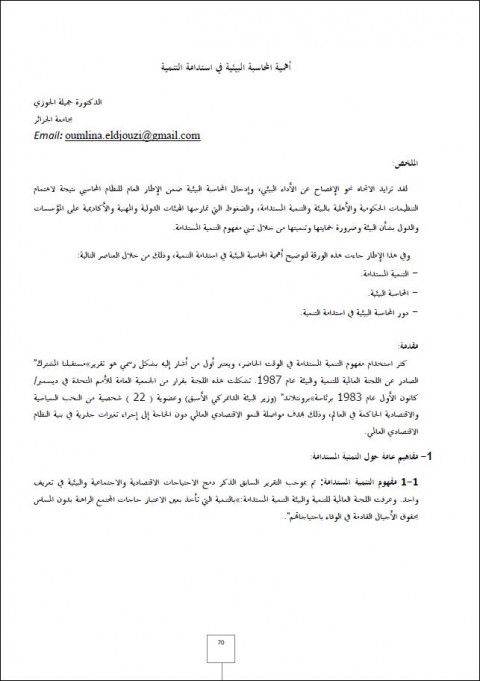 أهمية المحاسبة البيئية في استدامة التنمية Année de publication: 2013 Auteur: Jamila aljawzii Auteur institutionnel: Kasdi Merbah University لقد تزايد الاتجاه نحو الإفصاح عن الأداء البيئي، وإدخال المحاسبة البيئية ضمن الإطار العام للنظام المحاسبي نتيجة لاهتمام التنظيمات الحكومية والأهلية بالبيئة والتنمية المستدامة، والضغوط التي تمارسها الهيئات الدولية والمهنية والأكاديمية على المؤسسات والدول بشأن البيئة وضرورة حمايتها وتنميتها من خلال تبني مفهوم التنمية المستدامة. وفي هذا الإطار جاءت هذه الورقة لتوضيح أهمية المحاسبة البيئية في استدامة التنمية، وذلك من خلال العناصر التالية: - التنمية المستدامة. - المحاسبة البيئية. - دور المحاسبة البيئية في استدامة التنمية. The Importance of Environmental Accounting in the Sustainability of Development Année de publication: 2013 Auteur: Jamila aljawzii Auteur institutionnel: Kasdi Merbah University The trend towards disclosure of environmental performance and the introduction of environmental accounting within the general framework of the accounting system has increased as a result of the concern of government and civil organizations for the environment and sustainable development, and the pressure exerted by international, professional and academic bodies on institutions and countries on the environment and the need to protect and develop them through the adoption of the concept of sustainable development. In this context, this paper explains the importance of environmental accounting for sustainable development through the following elements: - Sustainable development. - Environmental accounting. - The role of environmental accounting in sustainable development.