
Ressources
Explorez une large gamme de ressources sur le GCED afin d’approfondir votre compréhension et de renforcer vos activités de recherche, de plaidoyer, d’enseignement et d’apprentissage.
1,322 résultats trouvés
 Critical Media Literacy and Popular Culture in ELA Classrooms Année de publication: 2021 Auteur: Jamila Lyiscott | Nicole Mirra | Antero Garcia Auteur institutionnel: National Council of Teachers of English (NCTE) This publication explores key issues on the Media Literacy impacting literacy educators and their students and articulate student-centered policy recommendations.
 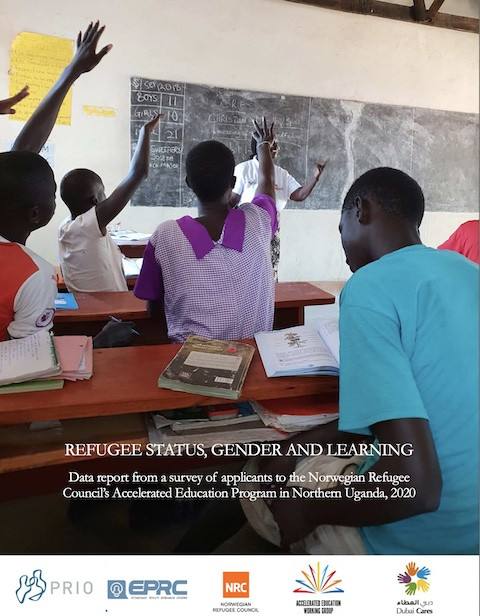 Refugee Status, Gender and Learning Année de publication: 2020 Auteur: Kendra Dupuy | Martin Flatø | Haakon Gjerløw | Andreas Kotsadam | Mette Løvgren | Francis Mwesigye | Siri Aas Rustad | Gudrun Østby Auteur institutionnel: Norwegian Refugee Council (NRC) | Dubai Cares | Accelerated Education Working Group (AEWG) | Economic Policy Research Center (EPRC) | Peace Research Institute Oslo (PRIO) This data report provides details from a survey of applicants to the Norwegian Refugee Council’s Accelerated Education Program in Northern Uganda, 2020. The surveys covered a range of topics, such as demographic and socioeconomic background, school attendance, academic skills, social control, feelings and perceptions on various topics, and future aspirations.
  Catch-up Programmes: 10 Principles for Helping Learners Catch Up and Return to Learning Année de publication: 2021 Auteur: Kayla Boisvert Auteur institutionnel: Accelerated Education Working Group (AEWG) Due to the COVID-19 pandemic, in which approximately 1.5 billion children and youth (nearly 85% of the world’s learners) were affected by school closures,1 the AEWG anticipates that catch-up programmes will be deployed extensively to meet the needs of learners who missed out on several months to approximately one year of education due to the disruption. Therefore, building on the AEWG’s programme definitions and our expertise in AE and other non-formal or alternative education options that accelerate the acquisition of knowledge and skills, the AEWG developed this set of principles and action points for catch-up programmes.
  Human Rights Storytelling: Manual For the Educators Année de publication: 2018 Auteur institutionnel: Huristo Project Consortium Huristo project developed a methodology about awareness and advocacy about the European Human Rights Charter as a part of global citizenship education with low skilled adult learners (refugees and migrants living in the city and natives living in rural places). This methodology is based on digital storytelling: participants work on personal narratives illustrating different topics of the charter.The main result for the adult learners are increased digital skills, reading and writing skills, awareness about the Human Rights Charter and European citizenship. The work on the Charter and the personal narratives also improve participants’ analytic media literacy, interpersonal and intercultural skills, but also core skills for employability, such as teamwork, problem solving, learning to learn and communication. Additionally, the adult trainers who are involved increase their teaching skills using digital media and the methodology of digital storytelling in particular.
 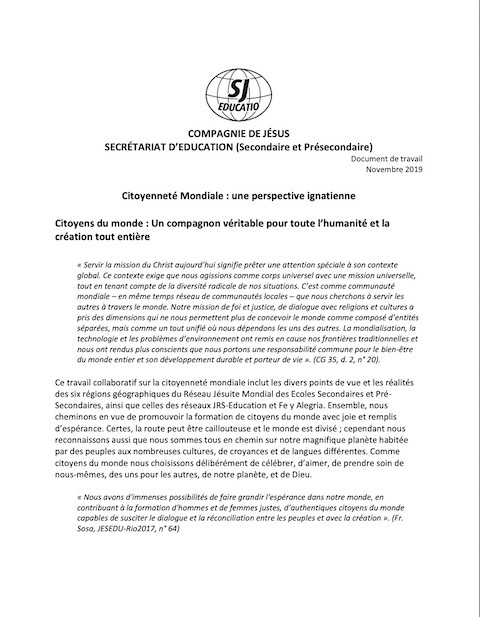 Citoyenneté mondiale: Une définition ignatienne Année de publication: 2019 Auteur institutionnel: Educate Magis Sont citoyens du monde ceux qui recherchent en permanence à approfondir leur propre conscience de leur place et de leur responsabilité, localement et globalement, dans un monde de plus en plus interconnecté ; sont citoyens du monde ceux qui sont solidaires des autres dans la poursuite d’une terre durable et d’un monde plus humain, comme véritables compagnons dans la mission de réconciliation et de justice. La Taskforce du Secrétariat sur la Citoyenneté Mondiale offre une définition ignatienne de la citoyenneté mondiale, ainsi que quelques questions directrices et un cadre pour intégrer les PAU et la Charte d’Engagements JESEDU-Rio2017 à les dimensions mondiale dans nos écoles jésuites. Ce travail intègre et s’appuie sur le matériel existant sur la citoyenneté mondiale rassemblé par la communauté mondiale.
 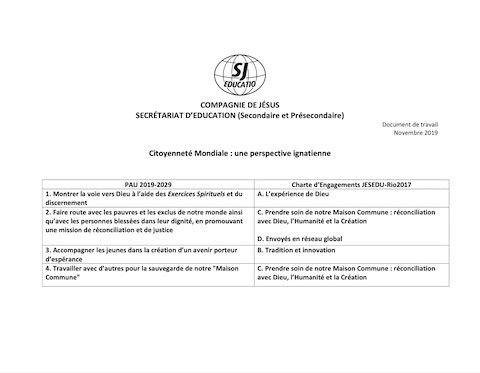 Citoyenneté mondiale: Une perspective ignatienne Année de publication: 2019 Auteur institutionnel: Educate Magis Ce tableau suit est un modèle qui présente des suggestions d’activités pour chaque région, province, établissement ou département éducatif, qui peuvent être utilisées comme exemples ou comme guides et qui peuvent être mises en œuvre et développées d’une manière adaptée à chaque situation ou besoin spécifique.
 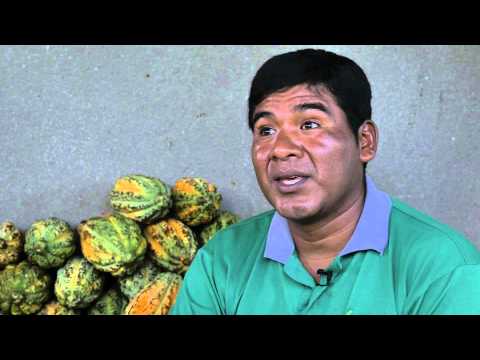 Changeons le commerce, pas le climat Année de publication: 2015 Auteur institutionnel: Artisans du Monde Cette vidéo donne la parole aux producteurs, premières victimes des conséquences de la hausse des températures.Cette vidéo est un des supports: de la mallette pédagogique "Le grand voyage d'un chocolat équitable" du kit "Consommer responsable, l'alimentation" co-édité avec CANOPE
 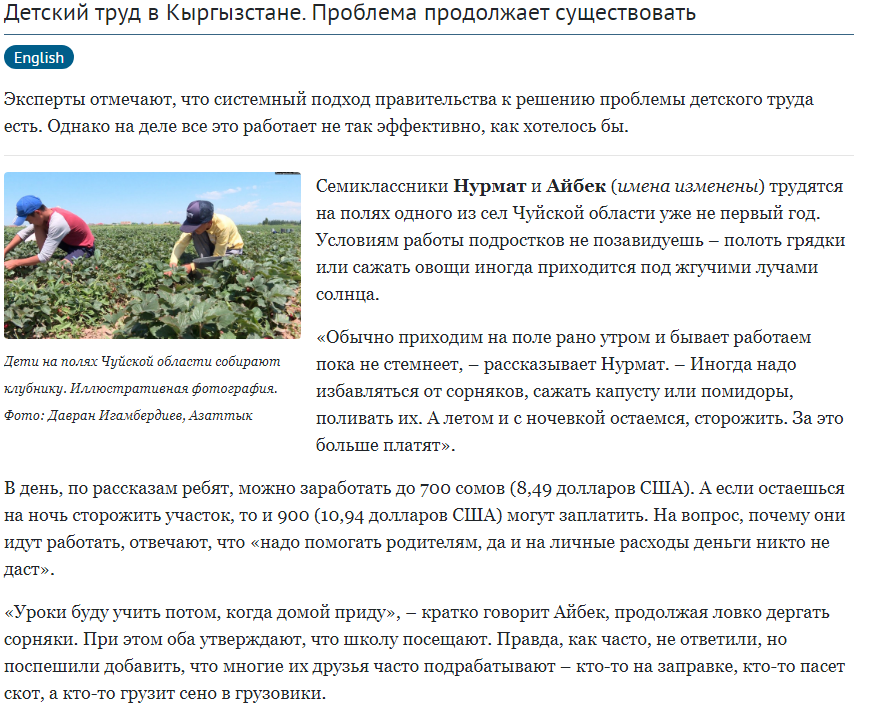 Child Labour in Kyrgyzstan: A Persisting Problem Année de publication: 2022 Auteur institutionnel: Central Asian Bureau for Analytical Reporting (CABAR) Experts note that in the presence of a systematic approach of the Kyrgyz Government to solve the problem of child labor, a number of challenges remain in practice. This article examines some of the reasons for the involvement of children in the labor market, including economic instability, mass migration of the population, rising poverty levels, the influence of local customs and traditions. The article also provides an overview of relevant statistical data and some national initiatives aimed at eliminating child labor. Детский труд в Кыргызстане: Проблема продолжает существовать Année de publication: 2022 Auteur institutionnel: Central Asian Bureau for Analytical Reporting (CABAR) Эксперты отмечают, что при наличии системного подхода правительства Кыргызстана к решению проблемы детского труда на практике сохраняется ряд вызовов. Данная статья рассматривает некоторые причины вовлечения детей в рынок труда, среди которых экономическая нестабильность, массовая миграция населения, рост уровня бедности, влияние местных обычаев и традиций. В статье также приведен обзор релевантных статистических данных и некоторых национальных инициатив, направленных на искоренение детского труда.
  Rethinking Pedagogy: Exploring the Potential Of Digital Technology In Achieving Quality Education Année de publication: 2019 Auteur: Lorena Alemán de la Garza | Alessandra Anichini | Péter Antal | Aurélie Beaune | Éric Bruillard | Diane Burke | Pedro Henrique Cacique Braga | Ruma Chakravarti | Sriya Chakravarti | Deng Chen | Lidiya Chikalova | Helen Crompton | Ilana De Almeida Souza Concilio | William Cope | Lorenz Denks | Matthew Farber | Giovanni Fonseca | Pintér Gergely | Marcela Georgina Gómez Zermeño | Russell Hazard | Laura Hosman | Mary Kalantzis | Kojanitz László | Xavier Levoin | Kristen Linzy | Arnab Mandal | Yoko Mochizuki | Ariam Mogos | Tünde-Lengyel Molnár | Matthew Montebello | Sadaqat Mulla | Sandra Gudiño Paredes | Christelle Pauty-Combemore | Boyka Parfitt | Réka Racsko | Irais Monserrat Santillán Rosas | Khitam Shraim | Jisoo Song | Avgoustos Tsinakos Auteur institutionnel: Mahatma Gandhi Institute of Education for Peace and Sustainable Development (MGIEP) With the exponential growth of digitally mediated communication, digital media and gaming, the landscape of what we understand as learning environments is changing significantly. Today the use of digital technology in education is attracting considerable public and policy attention as
well as private investment. With a rise in discourses both heralding and cautioning against the use of digital technology in education, there is a need to pool the expertise and experience on the use of technology in education from around the world to advance public debate and evidence-informed policymaking. Based on the literature review, mapping of digital education resources in circulation, and examples of implementation of digital education initiatives from around the world, this report aims to provide insights that would help lead to the wise, innovative and ethical use of digital technology in education as a new dimension in achieving SDG 4 — inclusive and equitable quality education and lifelong learning opportunities for all. By so doing, it also attempts to contribute to a rethink of teaching and learning in the face of enormous opportunities and challenges brought about by digital technology in the times of change and turmoil.
Rethinking Pedagogy: Exploring the Potential Of Digital Technology In Achieving Quality Education Année de publication: 2019 Auteur: Lorena Alemán de la Garza | Alessandra Anichini | Péter Antal | Aurélie Beaune | Éric Bruillard | Diane Burke | Pedro Henrique Cacique Braga | Ruma Chakravarti | Sriya Chakravarti | Deng Chen | Lidiya Chikalova | Helen Crompton | Ilana De Almeida Souza Concilio | William Cope | Lorenz Denks | Matthew Farber | Giovanni Fonseca | Pintér Gergely | Marcela Georgina Gómez Zermeño | Russell Hazard | Laura Hosman | Mary Kalantzis | Kojanitz László | Xavier Levoin | Kristen Linzy | Arnab Mandal | Yoko Mochizuki | Ariam Mogos | Tünde-Lengyel Molnár | Matthew Montebello | Sadaqat Mulla | Sandra Gudiño Paredes | Christelle Pauty-Combemore | Boyka Parfitt | Réka Racsko | Irais Monserrat Santillán Rosas | Khitam Shraim | Jisoo Song | Avgoustos Tsinakos Auteur institutionnel: Mahatma Gandhi Institute of Education for Peace and Sustainable Development (MGIEP) With the exponential growth of digitally mediated communication, digital media and gaming, the landscape of what we understand as learning environments is changing significantly. Today the use of digital technology in education is attracting considerable public and policy attention as
well as private investment. With a rise in discourses both heralding and cautioning against the use of digital technology in education, there is a need to pool the expertise and experience on the use of technology in education from around the world to advance public debate and evidence-informed policymaking. Based on the literature review, mapping of digital education resources in circulation, and examples of implementation of digital education initiatives from around the world, this report aims to provide insights that would help lead to the wise, innovative and ethical use of digital technology in education as a new dimension in achieving SDG 4 — inclusive and equitable quality education and lifelong learning opportunities for all. By so doing, it also attempts to contribute to a rethink of teaching and learning in the face of enormous opportunities and challenges brought about by digital technology in the times of change and turmoil.