
Ressources
Explorez une large gamme de ressources sur le GCED afin d’approfondir votre compréhension et de renforcer vos activités de recherche, de plaidoyer, d’enseignement et d’apprentissage.
875 résultats trouvés
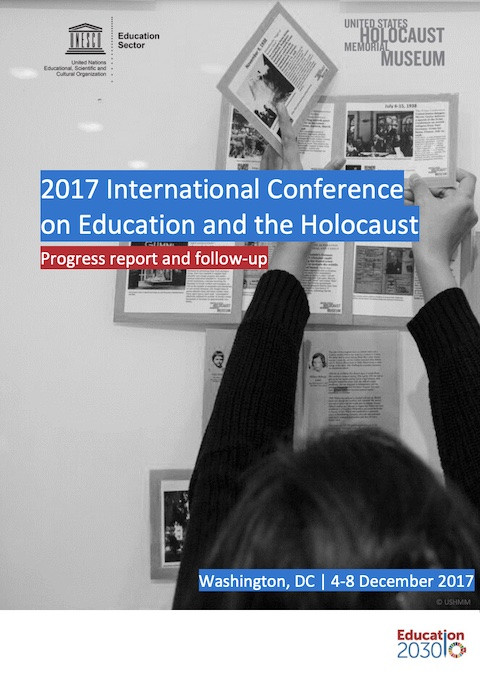 2017 International Conference on Education and the Holocaust: Progress Report and Follow-up Année de publication: 2018 Auteur institutionnel: UNESCO | United States Holocaust Memorial Museum (USHMM) From December 4-8 2017, UNESCO and the United States Holocaust Memorial Museum (USHMM) jointly organized the second International Conference on Education and the Holocaust (ICEH) in Washington, DC. The conference brought together 26 participants from 10 countries with the goal of strengthening their capacities to advance education about the Holocaust and genocide in their respective countries. Of great importance was the relevance of this education within the teams’ national contexts. The conference ultimately led to the development of 10 country-specific initiatives. The 2017 ICEH cohort comprises representatives of institutions from Argentina, Colombia, India, Indonesia, Kenya, Mexico, Namibia, South Africa, Tunisia and Ukraine.
  Return to the Origin: Ancient Narratives about Humanity, Time and the World Année de publication: 2022 Auteur: Eduardo A. Rueda | Ana María Larrea | Augusto Castro | Óscar Bonilla | Nicolás Rueda | Carlos Guzmán Auteur institutionnel: Latin American Council of Social Sciences (CLACSO) | UNESCO In this brief reflection, only in an introductory way, two questions are addressed. The first has to do with the relevance or impertinence of a program to record the narratives of our original peoples about the origins and trajectories of humanity. In relation to this first point, they are interested in proposing the bases for an emancipatory approach, that is, counter-hegemonic, of the original narratives. The second question asks about the consequences that it has, for the self-understanding of the crises and tensions of current societies, to highlight non-Western conceptions of human origins and trajectories. Retornar al origen: Narrativas ancestrales sobre humanidad, tiempo y mundo Année de publication: 2022 Auteur: Eduardo A. Rueda | Ana María Larrea | Augusto Castro | Óscar Bonilla | Nicolás Rueda | Carlos Guzmán Auteur institutionnel: Latin American Council of Social Sciences (CLACSO) | UNESCO En esta breve reflexión se abordan, apenas de modo introductorio, dos cuestiones. La primera tiene que ver con la pertinencia o impertinencia de un programa de registro de las narrativas de nuestros pueblos originarios sobre los orígenes y trayectorias de la humanidad. Les interesa, en relación con este primer punto, proponer las bases para un abordaje emancipatorio, es decir, contrahegemónico, de las narrativas originarias. La segunda cuestión se interroga por las consecuencias que tiene, para la autocomprensión de las crisis y tensiones de las sociedades actuales, poner en evidencia concepciones no occidentales de los orígenes y las trayectorias humanas.
 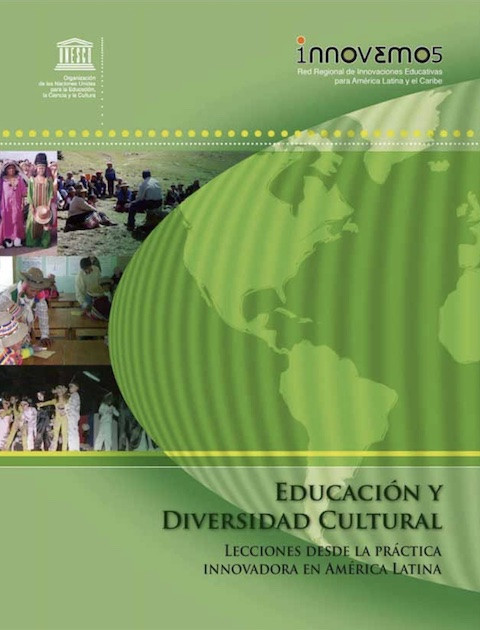 Educación y diversidad cultural: Lecciones desde la práctica innovadora en América Latina Année de publication: 2008 Auteur: Carolina Hirmas R. Auteur institutionnel: UNESCO Esta publicación, que constituye el segundo volumen de la colección, es el resultado del análisis y la reflexión acerca de un conjunto experiencias educati- vas innovadoras de varios países de Latinoamérica, que responden con pertinen- cia pedagógica al contexto cultural de los estudiantes y ofrecen una educación orientada al conocimiento, comprensión y diálogo entre personas de diferentes culturas. El aporte significativo de las experiencias referidas, reside en el reco- nocimiento y valoración de la diversidad étnica y cultural de sus estudiantes y comunidades, como punto de partida para el desarrollo de nuevos aprendizajes y afirmación de su identidad. A su vez, la vida en los centros educativos promueve relaciones interculturales de respeto y fraternidad en un contexto sociogeográfico local y subregional, caracterizado por la multiculturalidad.
 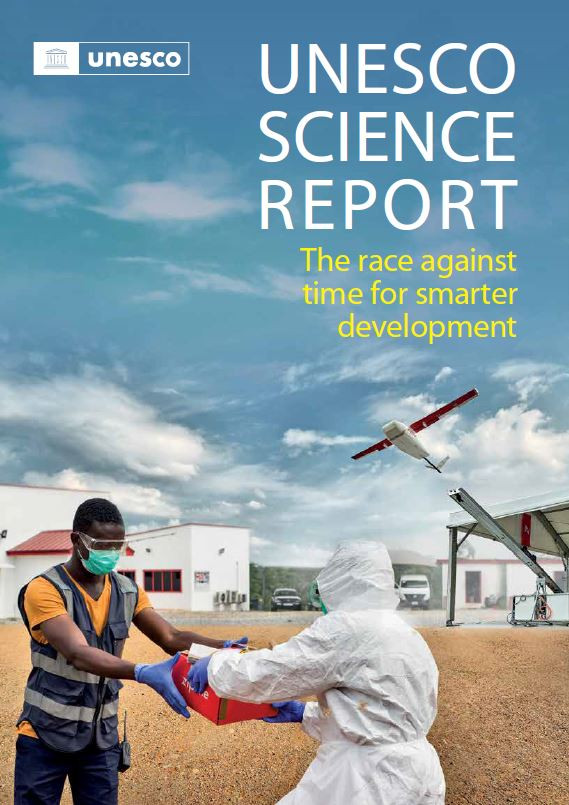 UNESCO Science Report: The Race Against Time for Smarter Development Année de publication: 2021 Auteur: Susan Schneegans | Tiffany Straza | Jake Lewis Auteur institutionnel: UNESCO This seventh edition of the report monitors the development path that countries have been following over the past five years from the perspective of science governance. It documents the rapid societal transformation under way, which offers new opportunities for social and economic experimentation but also risks exacerbating social inequalities, unless safeguards are put in place.The report concludes that countries will need to invest more in research and innovation, if they are to succeed in their dual digital and green transition. More than 30 countries have already raised their research spending since 2014, in line with their commitment to the Sustainable Development Goals. Despite this progress, eight out of ten countries still devote less than 1% of GDP to research, perpetuating their dependence on foreign technologies.
 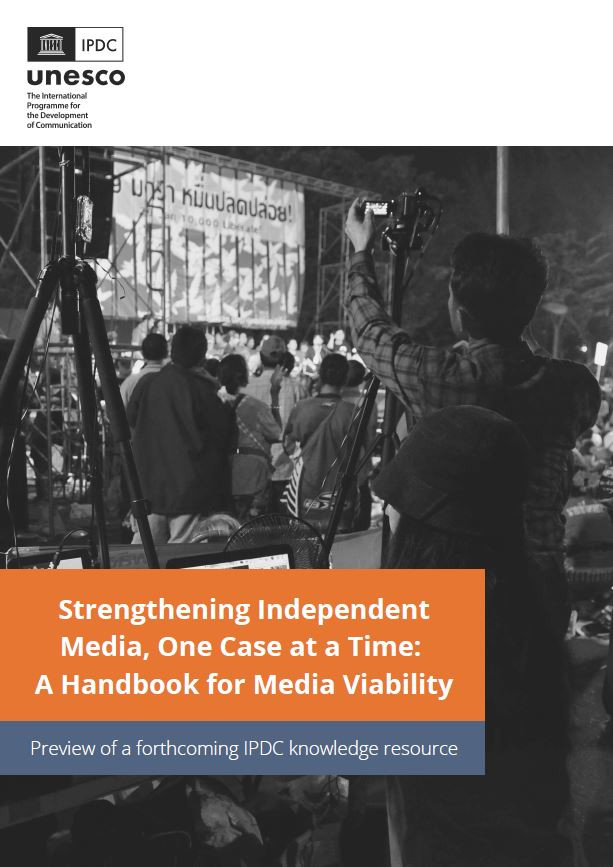 Strengthening Independent Media, One Case at a Time: A Handbook for Media Vability; Preview of a Forthcoming IPDC Knowledge Resource Année de publication: 2021 Auteur institutionnel: UNESCO “Strengthening Independent Media, One Case at a Time: A Handbook for Media Viability” will include case studies of innovative ideas from a wide variety of news media companies, mostly in the developing world, that are succeeding in difficult times and have lessons to share with others who are struggling. The handbook project was announced during the 65th meeting of the Bureau of the Intergovernmental Council of the International Programme for the Development of Communication (IPDC).This brochure includes highlights of some of the cases to be included, from community media in South Africa to a pure-play digital success in Indonesia, to a fact-checking network in Brazil to a covid response in Pakistan, and much more. The Handbook will be published in September 2021 and will be available for free on the website of the IPDC.
  The Impact of the COVID-19 Pandemic on Education: International Evidence From the Responses to Educational Disruption Survey (REDS) Année de publication: 2022 Auteur: Sabine Meinck | Julian Fraillon | Rolf Strietholt Auteur institutionnel: Организация Объединенных Наций по вопросам образования, науки и культуры (UNESCO) | International Association for the Evaluation of Educational Achievement (IEA) The COVID-19 pandemic disrupted education provision at an unprecedented scale, with education systems around the world being impacted by extended school closures and abrupt changes to normal school operations. The Responses to Educational Disruption Survey (REDS) investigated how teaching and learning were affected by the health crisis, and how education stakeholders responded to the educational disruption across and within countries. The study aimed to provide a systemic, multi-perspective, and comparative picture of the situation at the secondary education level (grade eight) in 11 countries spanning Africa, Asia, Arab region, Europe, and Latin America. While many other efforts exist that collect and provide similar information, they are mostly derived from non-representative rapid surveys and lack internationally comparable information from schools, collected in a systematic and scientific manner. The REDS International Report presents unique data, collected from countries, schools, teachers, and students for the first time, in chapters that cover several themes on which data were collected which include student and teacher well-being, students’ academic progress during the school closures, and the measures countries have implemented to keep all children learning. Initial findings provide evidence for better orienting and tailoring policy responses to crisis and provide invaluable information on what may be required to accelerate education, recover from crisis, and to strengthen the resilience of education systems in the future.
  The Effects of AI on the Working Lives of Women Année de publication: 2022 Auteur: Clementine Collett | Gina Neff | Livia Gouvea Gomes Auteur institutionnel: UNESCO | Inter-American Development Bank | Organisation for Economic Co-operation and Development (OECD) The use of AI technologies will affect women’s opportunities for work, and their position, status and treatment in the workplace. Around the globe, women in the labour force earn less than men, spend more time undertaking unpaid child- and elder-care jobs, hold fewer senior positions, participate less in science, technology, engineering and mathematics (STEM) fields, and tend to hold more precarious jobs overall. In harnessing AI, governments, institutions and companies must narrow gender gaps rather than perpetuate or exacerbate them. This report, by the IDB, OECD and UNESCO, outlines current knowledge of the impact that AI systems have on women’s opportunities for work, and their position, treatment and status in the workforce. It does so by exploring how AI is used within and outside the workplace, and how it could be used in the future. It looks at the potential impact of new and emerging AI technologies on the skills that employers will require, on how women look for and are hired for jobs, and on how jobs are structured through automated monitoring and oversight. The report maps the opportunities and challenges that AI presents for the working lives of women and highlights the complexities that varying national and regional contexts present for understanding the impact of AI on the work of women. The report also notes that current research does not offer a complete or definite picture of how AI impacts the working lives of women and calls for further research and analysis in this area. Los efectos de la IA en la vida laboral de las mujeres Année de publication: 2022 Auteur: Clementine Collett | Gina Neff | Livia Gouvea Gomes Auteur institutionnel: UNESCO | Inter-American Development Bank | Organisation for Economic Co-operation and Development (OECD) El uso de tecnologías de IA afectará las oportunidades de las mujeres en el trabajo y su posición, status y tratamiento en el ámbito laboral. Alrededor del mundo, en la fuerza laboral las mujeres ganan menos que los varones, dedican más tiempo a trabajo no remunerado cuidando a niños y ancianos, tienen menos puestos sénior, participan menos en los campos de ciencia, tecnología, ingeniería y matemáticas (STEM por sus siglas en inglés) y tienden, en general, a tener trabajos más precarios. Al utilizar la IA, los gobiernos, las instituciones y las empresas deberán achicar las brechas de género y no perpetuarlas o exacerbarlas. Este informe del BID, la OCDE y UNESCO resume el conocimiento actual respecto del impacto que tienen los sistemas de IA sobre las oportunidades laborales de las mujeres, y sobre su posición, tratamiento y estatus en la fuerza laboral. En esta línea, el informe explora cómo se usa la IA dentro y fuera del ámbito laboral y cómo podría ser usada en el futuro. Mira el impacto potencial de las tecnologías de IA nuevas y emergentes sobre las habilidades que requerirán los empleadores, la manera en que las mujeres buscan empleo y son contratadas y cómo se estructuran los empleos a través del monitoreo y la supervisión automatizados. El informe presenta un mapa de las oportunidades y los desafíos que presenta la IA para la vida laboral de las mujeres y pone de manifiesto las complejidades que los diversos contextos nacionales y regionales presentan para comprender el impacto de la IA sobre el trabajo de las mujeres. El informe también toma nota de que la investigación actual no ofrece una mirada completa o definitiva respecto de cómo impacta la IA sobre la vida laboral de las mujeres e insta a la realización de más investigación y análisis en este campo. Les effets de l’IA sur la vie professionnelle des femmes Année de publication: 2022 Auteur: Clementine Collett | Gina Neff | Livia Gouvea Gomes Auteur institutionnel: UNESCO | Inter-American Development Bank | Organisation for Economic Co-operation and Development (OECD) L'utilisation des technologies d'IA aura une incidence sur les opportunités de travail des femmes, ainsi que sur leur position, leur statut et leur traite,ent sur le lieu de travail. Partout dans le monde, les femmes dans la population active gagnent moins que les hommes, passent plus de temps à s'occuper des enfants et des personnes âgées sans être rémunérées, occupent moins de postes à responsabilités, sont moins présentes dans les domaines des sciences, de la technologie, de l'ingénierie et des mathématiques(STEM) et ont tendance à occuper des emplois plus précaires dans l'ensemble. En exploitant l'IA, les gouvernements, les institutions et les entreprises doivent réduire les inégalités femmes-hommes plutôt que les perpétuer ou de les exacerber. Ce rapport, rédigé par la BID, l'OCDE et l'UNESCO, présente les connaissances actuelles sur position, leur traitement et leur statut dans la population active. Pour ce faire, il explore à l'avenir. Il examine l'impact potentiel des technologies d'IA nouvelles et naissantes sur les cométences dont les employeurs auront besoin, sur la manière dont les femmes structurés grâce à un contrôle et une surveillance automatisée. Le rapport dresse la liste des opportunités et des défis que l'IA présente pour la vie professionnelle des femmes et souligne les complexités que présentent les différents contextes nationaux et régionaux pour comprendre l'impact de l'IA sur le travail des femmes. Le rapport note également que les recherches actuelles ne permettent pas de dresser un tableau complet ou précis de l'impact de l'IA sur la vie professionnelle des femmes et appelle à poursuivre les recherches et les analyses dans ce domaine.