
Ressources
Explorez une large gamme de ressources sur le GCED afin d’approfondir votre compréhension et de renforcer vos activités de recherche, de plaidoyer, d’enseignement et d’apprentissage.
1,180 résultats trouvés
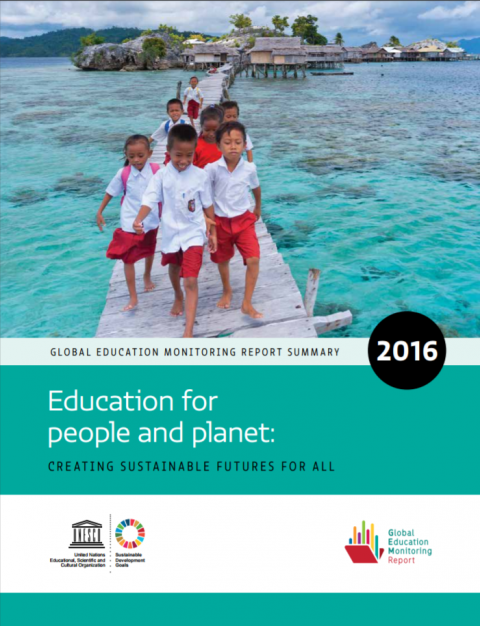 L'Education pour les peuples et la planète: créer des avenirs durables pour tous, résumé du rapport mondial de suivi sur l'éducation, 2016 Année de publication: 2016 Auteur institutionnel: UNESCO The GEM Report provides an authoritative account of how education is the most vital input for every dimension of sustainable development. Better education leads to greater prosperity, improved agriculture, better health outcomes, less violence, more gender equality, higher social capital and an improved natural environment. Education is key to helping people around the world understand why sustainable development is such a vital concept for our common future. Education gives us the key tools – economic, social, technological, even ethical – to take on the SDGs and to achieve them. These facts are spelled out in exquisite and unusual detail throughout the report. Yet the report also emphasizes the remarkable gaps between where the world stands today on education and where it has promised to arrive as of 2030. La Educación al servicio de los pueblos y el planeta: creación de futuros sostenibles para todos, resumen del informe de seguimiento de la educación en el mundo 2016; Année de publication: 2016 Auteur institutionnel: UNESCO The GEM Report provides an authoritative account of how education is the most vital input for every dimension of sustainable development. Better education leads to greater prosperity, improved agriculture, better health outcomes, less violence, more gender equality, higher social capital and an improved natural environment. Education is key to helping people around the world understand why sustainable development is such a vital concept for our common future. Education gives us the key tools – economic, social, technological, even ethical – to take on the SDGs and to achieve them. These facts are spelled out in exquisite and unusual detail throughout the report. Yet the report also emphasizes the remarkable gaps between where the world stands today on education and where it has promised to arrive as of 2030. Образование в интересах людей и планеты: ПОСТОЕНИЕ УСТОЙЧИВОГО БУДУЩЕГО ДЛЯВСЕХ, РЕЗЮМЕ ВСЕМИРНОГО ДОКЛАДА ПО МОНИТОРИНГУ ОБРАЗОВАНИЯ, 2016 Année de publication: 2016 Auteur institutionnel: UNESCO The GEM Report provides an authoritative account of how education is the most vital input for every dimension of sustainable development. Better education leads to greater prosperity, improved agriculture, better health outcomes, less violence, more gender equality, higher social capital and an improved natural environment. Education is key to helping people around the world understand why sustainable development is such a vital concept for our common future. Education gives us the key tools – economic, social, technological, even ethical – to take on the SDGs and to achieve them. These facts are spelled out in exquisite and unusual detail throughout the report. Yet the report also emphasizes the remarkable gaps between where the world stands today on education and where it has promised to arrive as of 2030. 教育造福 人类与地球:为全民创造可持续的未来, 2016 全球教育监测报告; 摘要 Année de publication: 2016 Auteur institutionnel: UNESCO The GEM Report provides an authoritative account of how education is the most vital input for every dimension of sustainable development. Better education leads to greater prosperity, improved agriculture, better health outcomes, less violence, more gender equality, higher social capital and an improved natural environment. Education is key to helping people around the world understand why sustainable development is such a vital concept for our common future. Education gives us the key tools – economic, social, technological, even ethical – to take on the SDGs and to achieve them. These facts are spelled out in exquisite and unusual detail throughout the report. Yet the report also emphasizes the remarkable gaps between where the world stands today on education and where it has promised to arrive as of 2030. التعليم من أجل الناس والكوكب: بناء مستقبل مستدام للجميع Année de publication: 2016 Auteur institutionnel: UNESCO The GEM Report provides an authoritative account of how education is the most vital input for every dimension of sustainable development. Better education leads to greater prosperity, improved agriculture, better health outcomes, less violence, more gender equality, higher social capital and an improved natural environment. Education is key to helping people around the world understand why sustainable development is such a vital concept for our common future. Education gives us the key tools – economic, social, technological, even ethical – to take on the SDGs and to achieve them. These facts are spelled out in exquisite and unusual detail throughout the report. Yet the report also emphasizes the remarkable gaps between where the world stands today on education and where it has promised to arrive as of 2030.
 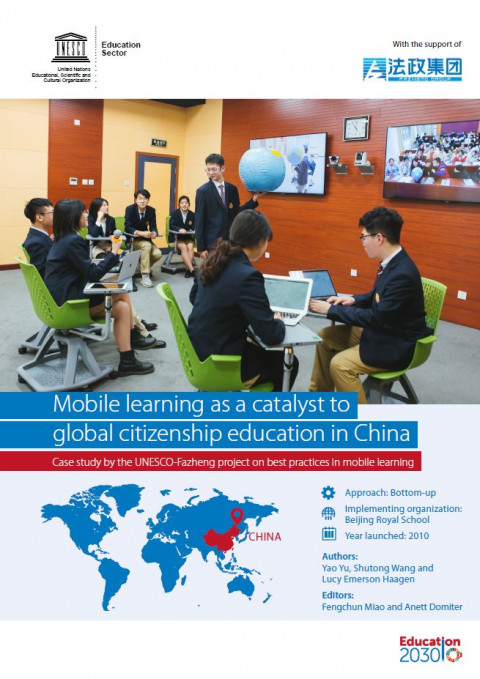 Mobile Learning as a Catalyst to Global Citizenship Education in China: Case Study by the UNESCO-Fazheng Project on Best Practices in Mobile Learning Année de publication: 2019 Auteur: Yao Yu | Shutong Wang | Lucy Emerson Haagen Auteur institutionnel: UNESCO The Beijing Royal School was one of the pioneer schools in China in incorporating mobile learning into pedagogical transformation. Its mobile learning programme started in 2010. Stemming from the school’s orientation towards global citizenship education, the Beijing Royal School recognizes mobile learning as both driver and enabler for supporting the development of students’ cognitive, socio-emotionaland behavioural dimensions, organized around knowledge acquisition, understanding and respect for difference and diversity, and responsible engagement with global issues. It takes advantage of a variety of mobile apps to support students’ multilingual education, and uses open educational resources (OER) to support multicultural education, taking advantage of the up-to-date worldwide data and information available on the web. It also engages with students from other countries in projects and courses that help the students to widen their understanding of diverse cultures and social contexts. Overall, this case study illustrates how to use mobile technologies to support the implementation of a well-defined and clearly structured educational vision by embedding the use of mobile technologies in students’ daily learning lives.
 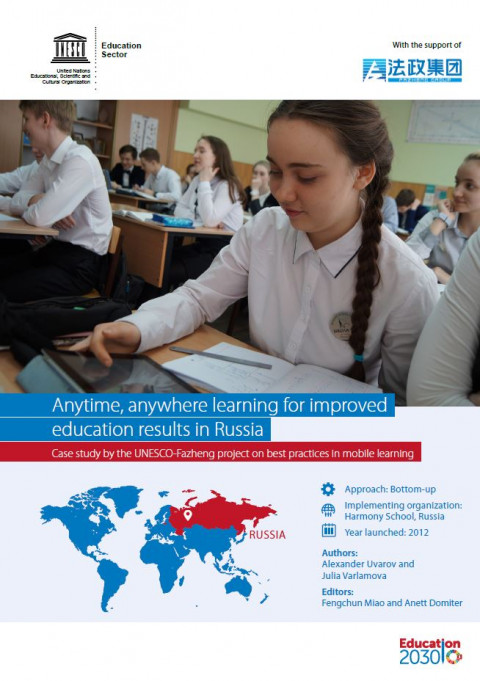 Anytime, Anywhere Learning for Improved Education Results in Russia: Case Study by the UNESCO-Fazheng Project on Best Practices in Mobile Learning Année de publication: 2019 Auteur: Alexander Uvarov | Julia Varlamova Auteur institutionnel: UNESCO The Harmony School in Izhevsk is a regular municipal school located in one of the city districts of the capital city of the Udmurt Republic in Russia. Students come to Harmony school from different cultural and social environments, with various physical and mental abilities, and the school is eager to create the best conditions for learning and developing for each of them. In 2012, Harmony School took a part in the School of Digital Age project supported by the federal Skolkovo project and the Russian branch of Microsoft. The mobile technologies in the school are implemented as a tool for anytime and anywhere learning to differentiate and individualize learning to improve education results.According to the school vision, mobile learning technologies should provide all students and teachers anytime and anywhere access to a variety of teaching and learning materials and digital instruments and students who are unable to attend classes should be able to continue their systematic studies. The mobile learning model should enable every student to experience independent learning activities in the digital educational environment and improve their educational results with new methods and organizational forms of teaching and learning. To implement this vision, the new school-wide teaching and learning practices including online/blended learning, mobile learning in the classroom and outside-classroom learning have been developed and used actively. The new in-school teachers’ professional development model has become a crucially important element for the project’s success.
  Measuring Global Citizenship Education: A Collection of Practice and Tools Année de publication: 2017 Auteur institutionnel: Center for Universal Education at Brookings | UNESCO | UN Global Education First Initiative - Youth Advocacy Group (YAG) The idea of global citizenship has existed for several millennia. In ancient Greece, Diogenes declared himself a citizen of the world,1 while the Mahaupanishads of ancient India spoke of the world as one family.2 Today, education for global citizenship is recognized in many countries as a strategy for helping children and youth prosper in their personal and professional lives and contribute to building a better world.This toolkit is intended to shed light on one aspect of operationalizing global citizenship education (GCED): how it can be measured. This toolkit is the result of the collective efforts of the Global Citizenship Education Working Group (GCED-WG), a collegium of 90 organizations and experts co-convened by the United Nations Educational, Scientific, and Cultural Organization (UNESCO), the Center for Universal Education (CUE) at the Brookings Institution, and the United Nations Secretary General’s Global Education First Initiative’s Youth Advocacy Group (GEFI-YAG). To gather the measurement tools in this collection, the working group surveyed GCED programs and initiatives that target youth (ages 15–24).3 For the purposes of this project, GCED was defined as any educational effort that aims to provide the skills, knowledge, and experiences and to encourage the behaviors, attitudes, and values that allow young persons to be agents of long-term, positive changes in their own lives and in the lives of people in their immediate and larger communities (with the community including the environment).This toolkit begins with a brief review of opinions on why GCED is important and the variety of definitions of GCED. We follow the report with a catalog of 50 profiles of assessment efforts, each describing practices and tools to measure GCED at the classroom, local, and national levels. Note that the survey does not represent an exhaustive list but may be regarded as a living document that will grow as the field of GCED itself grows around the world.Broadly speaking, the assessment efforts in this survey may be categorized across achieving three goals: (1) fostering the values/attitudes of being an agent of positive change; (2) building knowledge of where, why, and how to take action toward positive change; and (3) developing self-efficacy for taking effective actions toward positive change.Today, global challenges such as climate change, migration, and conflict will require people to do more than just think about solutions. They will require effective action, by both individuals and communities. Education for global citizenship is one means to help young people develop the knowledge, skills, behaviors, attitudes, and values to engage in effective individual and collective action at their local levels, with an eye toward a long-term, better future at the global level. We offer this toolkit to provide guidance for educators, policymakers, non-governmental organizations, civil society, and researchers, and to inform this conversation.
  Distance Learning Solutions Année de publication: 2020 Auteur institutionnel: UNESCO The list of educational applications, platforms and resources below aim to help parents, teachers, schools and school administrators facilitate student learning and provide social care and interaction during periods of school closure. Most of the solutions curated are free and many cater to multiple languages. While these solutions do not carry UNESCO’s explicit endorsement, they tend to have a wide reach, a strong user-base and evidence of impact. They are categorized based on distance learning needs, but most of them offer functionalities across multiple categories. Solutions d’apprentissage à distance Année de publication: 2020 Auteur institutionnel: UNESCO La liste d’applications et de plates-formes éducatives ci-dessous vise à aider parents, enseignants, établissements et responsables pédagogiques à faciliter l’apprentissage des élèves et à assurer des interactions et des services sociaux pendant la fermeture des écoles. La plupart des solutions sont gratuites et plusieurs sont multilingues. Bien qu’elles ne soient pas explicitement soutenues par l’UNESCO, ces solutions ont généralement une large portée, de nombreux utilisateurs et une efficacité avérée. Elles sont classées par type de besoin pédagogique mais la plupart présente des fonctionnalités relevant de plusieurs catégories.