
Ressources
Explorez une large gamme de ressources sur le GCED afin d’approfondir votre compréhension et de renforcer vos activités de recherche, de plaidoyer, d’enseignement et d’apprentissage.
1,473 résultats trouvés
 Discrimination, mobbing et égalité Auteur institutionnel: Amnesty International. Swiss Section Ces 7 fiches pédagogiques(Stéréotypes et discrimination, Inégalités professionnelles, Discrimination dans la recherche d'emploi, Parlons mobbing!, Conflit ou mobbing? Déclaration contre le mobbing à l'école, Freedom from discrimination) portent sur les thématiques de la discrimination, de l'égalité et du mobbing (relation conflictuelle sur le lieu de travail, aussi bien entre collègues qu'entre supérieurs et subordonnés), en lien avec l'article 2 de la Déclaration universelle des droits de l’homme.
 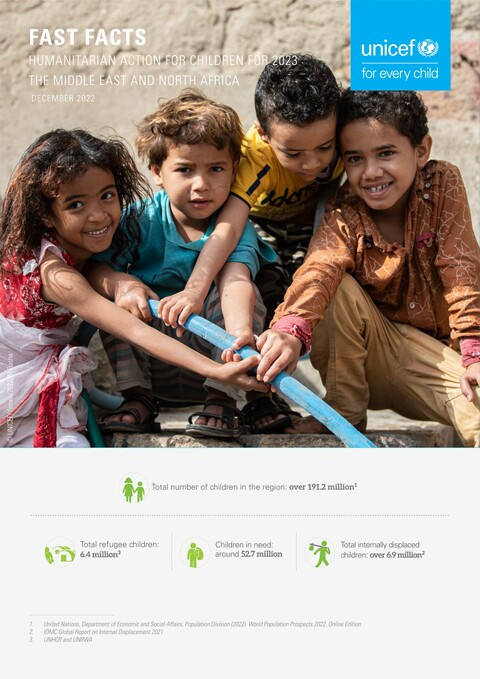 Humanitarian Action for Children in the Middle East and North Africa for 2023: Fast Facts Année de publication: 2022 Auteur institutionnel: UNICEF Middle East and North Africa Total number of children in the region: over 191.2 million Total refugee children: 6.4 million Children in need: around 52.7 million Total internally displaced children: over 6.9 million UNICEF MENA is appealing for US$ 2.6 billion to respond to the ongoing humanitarian crises and children’s humanitarian needs around the region. العمـل الإنسـاني مـن أجـل الأطفـال في الشـرق الأوسـط وشـمال أفريقيا للعام ٢٠٢٣; حقائـق سـريعة Année de publication: 2022 Auteur institutionnel: UNICEF Middle East and North Africa إجمالي عدد الأطفال في المنطقة: أكثر من 191.2 مليون طفلالأطفال المحتاجون: 52.7 مليون طفلمجموع النازحين من الأطفال: أكثر من 6.4 ملايين طفلمجموع اللاجئين من الأطفال: 6.4 مليون طفلتطلق اليونيسف نداءً للحصول على 2,6 مليار دولار أمريكي للاستجابة للأزمات الإنسانية المستمرة واحتياجات الأطفال الإنسانية في المنطقة.
 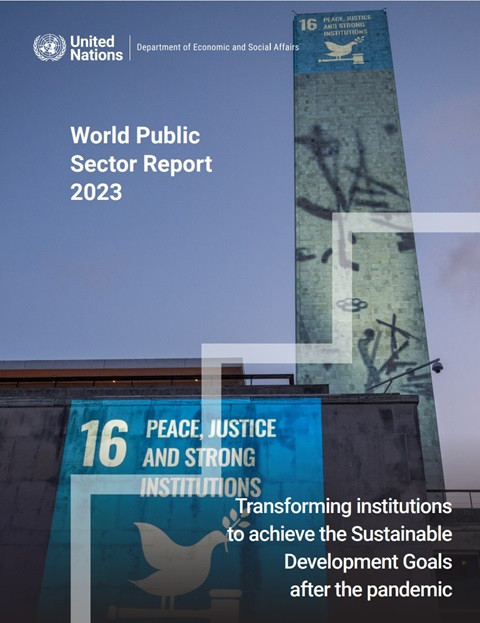 World Public Sector Report 2023: Transforming Institutions to Achieve the Sustainable Development Goals After the Pandemic Année de publication: 2023 Auteur institutionnel: United Nations (UN) The World Public Sector Report 2023 examines the role that national institutional and governance innovations and changes that emerged during the COVID-19 pandemic can play in advancing progress towards the 2030 Agenda for Sustainable Development. The report focuses on three main questions: How can Governments reshape their relationship with people and other actors to enhance trust and promote the changes required for more sustainable and peaceful societies? How can Governments assess competing priorities and address difficult policy trade-offs that have emerged since 2020? What assets and innovations can Governments mobilize to transform the public sector and achieve the SDGs? The report addresses them in chapters composed of short overviews followed by a set of in-depth contributions from a wide range of experts which examine institutional changes observed in different contexts, sectors and policy processes and explore the potential of those with a positive impact on the achievement of the SDGs to be sustained beyond the pandemic. The report aims to draw attention to institutional change as a key component of the societal transformations required to realize the 2030 Agenda for Sustainable Development.
 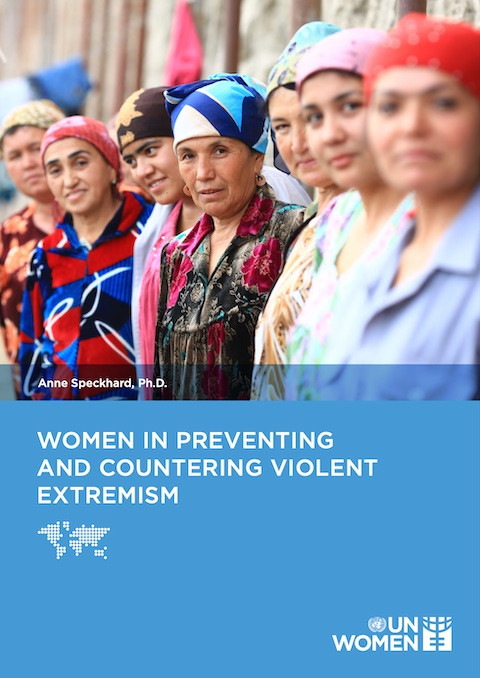 A Training Manual: Women in Preventing and Countering Violent Extremism Année de publication: 2021 Auteur: Anne Speckhard Auteur institutionnel: United Nations Entity for Gender Equality and the Empowerment of Women (UN Women) This publication serves as guidance for actors involved in the prevention and countering of violent extremism (P/CVE) in Europe and Central Asia including state officials, members of non-governmental organizations, community activists, staff of UN agencies, international and regional organizations to help them understand violent extremism’s gender dimensions. It is designed as a training guide, for staff and trainers who are working with different counterparts engaged in P/CVE, and want to help create more effective and gender-sensitive responses. Participants may for example include civil society activists, women leaders, teachers, journalists, lawyers, social workers, religious authorities, youth, police, local and national governmental officials. The five modules in this guide include learning objectives, explanatory text, warm-up activities, practical exercises, references for further reading and empirical experiences from the region of Europe and Central Asia. Modules may be used all together or one-by-one. The ideal timeframe for delivering the training using all the modules is at least two and a half days (half day per unit). The training is suitable for groups of five to twenty-five people. When organizing the workshop consider gender, age and diversity factors to have the richest learning experience possible. Participants should feel that they are in a safe space where they can openly share their ideas and experiences. Needed materials are indicated for the different exercises. As the guide is aimed at increasing the awareness of persons with different levels of sensitivity and knowledge on violent extremism and gender equality, across Europe and Central Asia, it is an introduction which readers should complement with other resources for deeper and more technical insights. The training should also be tailored to the participants’ interests and needs and to the local context.
 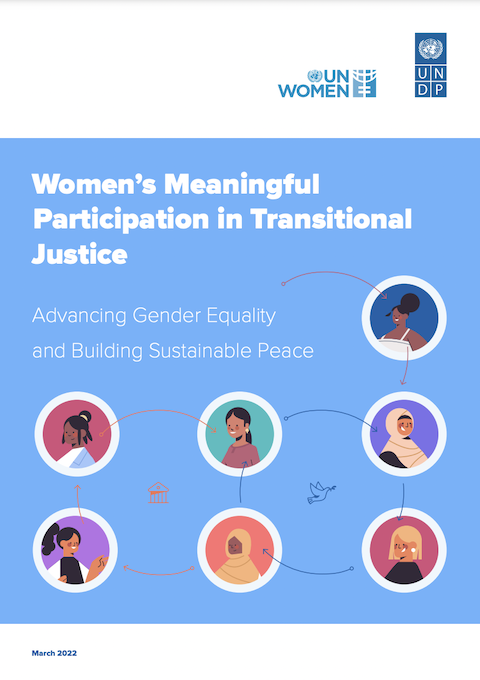 Women’s Meaningful Participation in Transitional Justice: Advancing Gender Equality and Building Sustainable Peace Année de publication: 2022 Auteur: Lorena Mellado | Emily Kenney | Hariwa Adil Auteur institutionnel: United Nations Entity for Gender Equality and the Empowerment of Women (UN Women) | United Nations Development Programme (UNDP) This detailed research paper explores what women’s meaningful participation in transitional justice means and “looks like” in policy and practice. It focuses specifically on women and addressing the unique barriers to women’s meaningful participation in transitional justice processes as a result of gender-based discrimination.This publication reviews the current policy framework and assertions for women’s meaningful participation in transitional justice and highlights critical gaps between policy and practice. The research paper suggests a definition for women’s meaningful participation in transitional justice, as well as typologies of women stakeholders and roles that women play within transitional justice.
 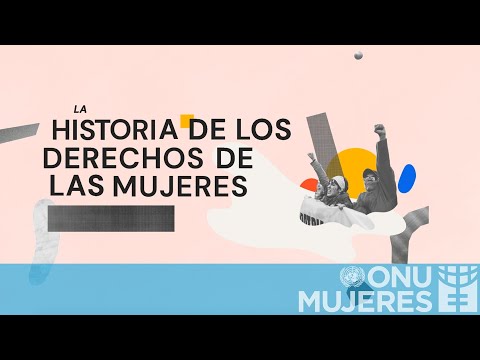 A World History of Women’s Rights in 3 Minutes Année de publication: 2020 Auteur institutionnel: United Nations Entity for Gender Equality and the Empowerment of Women (UN Women) How far have we advanced in the global fight for equal rights and how much remains to be done? From suffrage campaigns around the world to the rise of the #MeToo movement and digital activism, we've made little progress. However, the fight for gender equality is far from over. Meet remarkable women and discover the grassroots movements and historic milestones that have helped change the world for women and girls. Una historia mundial de los derechos de las mujeres en 3 munutos Année de publication: 2020 Auteur institutionnel: United Nations Entity for Gender Equality and the Empowerment of Women (UN Women) ¿Cuánto hemos avanzado en la lucha mundial por lograr la igualdad de derechos y cuánto queda por hacer? Desde las campañas sufragistas en todo el mundo al surgimiento del movimiento #MeToo y el activismo digital, hemos progresado poco a poco. Sin embargo, la lucha por la igualdad de género está lejos de haber acabado. Conoce a mujeres notables y descubre los movimientos de base y los hitos históricos que han contribuido a cambiar el mundo para las mujeres y las niñas.
  Practical Legal Guide for Women in Algeria Année de publication: 2023 Auteur: Fériel Khelil | Saadia Gacem Auteur institutionnel: Fondation Friedrich-Ebert This practical legal guide, in Arabic and French, enables women in Algeria to find out about their rights, the laws that protect them, but also the legislative inequalities they will encounter in their life course, through tools for practical understanding of the laws. It was produced by Feriel Khelil, jurist with the Réseau Wassila/Avife association, and Saadia Gacem, doctoral student in anthropology and feminist activist, and supported by the Friedrich Ebert Foundation. Guide juridique pratique à l'usage des femmes en Algérie Année de publication: 2023 Auteur: Fériel Khelil | Saadia Gacem Auteur institutionnel: Fondation Friedrich-Ebert Ce guide juridique pratique, en arabe et en français, permet aux femmes en Algérie de connaître leurs droits, les lois qui les protègent mais également les inégalités législatives qu’elles rencontreront dans leur parcours de vie, à travers des outils de compréhension pratique des lois. Il a été réalisé par Feriel Khelil, juriste au sein de l’association Réseau Wassila/Avife et Saadia Gacem, doctorante en anthropologie et militante féministe et soutenu par la Fondation Friedrich Ebert.