
Ressources
Explorez une large gamme de ressources sur le GCED afin d’approfondir votre compréhension et de renforcer vos activités de recherche, de plaidoyer, d’enseignement et d’apprentissage.
3,229 résultats trouvés
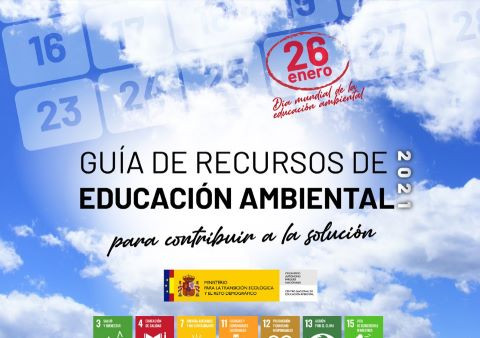 2021 Environmental Education Resource Guide to Contribute to the Solution Année de publication: 2021 Auteur: Mabel Fernández Izard | Ester Bueno González | Rosario Toril Moreno | Teresa Antolín García | Carmen García Valcárcel | Gema Herranz Aparicio | Isabel Matesanz Miguel | Antonio Moreno Rodríguez | Carmen García Cocero | Pedro Llorente Encinas Auteur institutionnel: Spain. Ministry for Economic Transition and the Demographic Challenge Environmental education is the essential essence of all the projects, works and services offered by the National Center for Environmental Education (CENEAM). This Environmental Education Resource Guide offers first reading of the fundamental documents in environmental education, followed by resources and tools to put it into practice. The vast majority of the resources are accessible and downloadable from the Internet and you can also consult them in the Catalog of the CENEAM Documentation Center. Guía de recursos de educación ambiental 2021 para contribuir a la solución Année de publication: 2021 Auteur: Mabel Fernández Izard | Ester Bueno González | Rosario Toril Moreno | Teresa Antolín García | Carmen García Valcárcel | Gema Herranz Aparicio | Isabel Matesanz Miguel | Antonio Moreno Rodríguez | Carmen García Cocero | Pedro Llorente Encinas Auteur institutionnel: Spain. Ministry for Economic Transition and the Demographic Challenge La educación ambiental es la esencia primordial de todos los proyectos, trabajos y servicios ofrecidos desde el Centro Nacional de Educación Ambiental (CENEAM). Esta Guía de Recursos de Educación Ambiental ofrece lecturas en primer lugar de los documentos fundamentales en la educación ambiental, seguido de recursos y herramientas para ponerla en práctica. Los recursos, en su gran mayoría, son accesibles y descargables desde Internet y además, podéis consultarlos en el Catálogo del Centro de Documentación del CENEAM.
  Libraries and Sustainable Development: A Growing Relationship (Documentation et bibliothèques; vol. 63, no. 3) Année de publication: 2017 Auteur: Pascale Guertin | Valérie Poirier-Rouillard Auteur institutionnel: Association pour l'avancement des sciences et des techniques de la documentation (ASTED) Green roofs, geothermal systems, sustainable materials, recycling and reuse are words that spontaneously come to mind when it comes to sustainable development.But what does this concept really mean? How does it manifest itself, concretely, in our environment, in our life habits? The library ecosystem is increasingly giving way to the precepts of sustainable development, by its civic nature and its mission to share knowledge, but also by its inspirational nature and with new ideas.In Québec and internationally, various green library projects that are focused on the needs and development of the communities they serve are plentiful and distinctive, giving rise to a new discourse that harmoniously interweaves existing considerations and imperatives without compromising the needs of future generations.The following article summarises the principal components of a project undertaken during a summer course taught by Réjean Savard, namely SCI6372 – Aspects internationaux et comparés de l’information. It is the result of a field trip organised by the École de bibliothéconomie et des sciences de l’information (EBSI) in Germany, Prague and Strasbourg during the summer of 2016. It provides an overview of the initiatives of some libraries around the world, and invites us to reflect on the role of the green library. Les bibliothèques et le développement durable: Un lien de plus en plus fort (Documentation et bibliothèques; vol. 63, no. 3) Année de publication: 2017 Auteur: Pascale Guertin | Valérie Poirier-Rouillard Auteur institutionnel: Association pour l'avancement des sciences et des techniques de la documentation (ASTED) Toits verts, systèmes géothermiques, matériaux durables, recyclage et réutilisation sont des termes qui viennent spontanément à l’esprit lorsqu’il est question de développement durable.Mais que signifie véritablement ce concept ? Comment se manifeste-t-il, concrètement, dans notre environnement, dans nos habitudes de vie ? L’écosystème qu’est la bibliothèque laisse de plus en plus de place aux préceptes du développement durable, par sa nature citoyenne et sa mission de partage du savoir, mais aussi d’inspiration et d’idées nouvelles.Autant au Québec qu’à l’international, divers projets de bibliothèques vertes, axées sur les besoins et le développement de leur communauté, abondent et se démarquent, laissant place à un discours nouveau, où s’entremêlent harmonieusement les considérations et impératifs actuels, sans compromis quant aux besoins des générations futures.Le présent texte reprend des éléments du travail réalisé dans le cadre du cours SCI6372 – Aspects internationaux et comparés de l’information donné à l’été 2016 par Réjean Savard (qui a fait suite au voyage d’études organisé par l’EBSI en Allemagne, à Prague et à Strasbourg à l’été 2016) et propose un survol des initiatives de quelques bibliothèques dans le monde et invite à réfléchir au rôle de la bibliothèque verte.
  유네스코학교 길라잡이: 밑동부터 차근차근 (개정판) Année de publication: 2022 Auteur: 김다영 | 박현주 | 유성상 | 이신애 | 이하은 | 임재민 | 정다정 Auteur institutionnel: 유네스코한국위원회 본 자료는 2020년 출간된 유네스코학교 길라잡이 밑동부터 차근차근의 2022년 개정판이다. 개정판에서는 유네스코학교 활동을 위한 최신 자료 및 한일교사대화 공동수업과 평화프로젝트 등 여러 활동의 결과를 추가 수록하였다.
 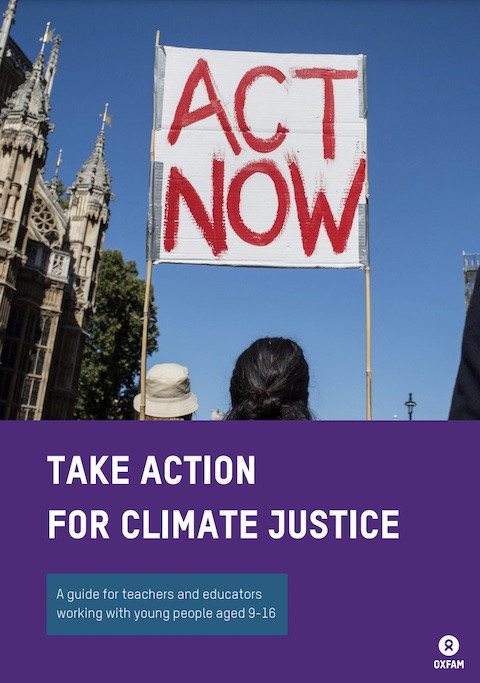 Take Action for Climate Justice: A Guide for Teachers and Educators Working With Young People Aged 9-16 Année de publication: 2022 Auteur institutionnel: Oxfam GB Aimed at teachers and educators, this short guide contains practical advice, classroom activities and helpful planning tools to inspire and motivate young people aged 9-16 to take action for our planet and its people.There are many ways in which we can all take climate action, from making individual lifestyle changes to participating in collective community responses that target the systemic causes of the climate emergency, and all are important. Taking action can develop young people’s sense of agency, build skills such as leadership and decision-making, and help them to build empathy and manage eco-anxiety. This guide supports young people to take action by sharing the message about climate justice, raising awareness and influencing others to help make change happen.A recent survey by Inter Climate Network found that more than 80 per cent of young people aged 11–18 were concerned about climate change, with half of them already choosing to take climate action. Almost all of those taking action are doing so at home, with only a third acting on climate change in school. Another key finding was that many young people do not feel they have the power to effect change, citing barriers such as a lack of knowledge about what they can do, insufficient time provided in school for positive climate action, and a sense that individual actions have little impact without wider structural change.
 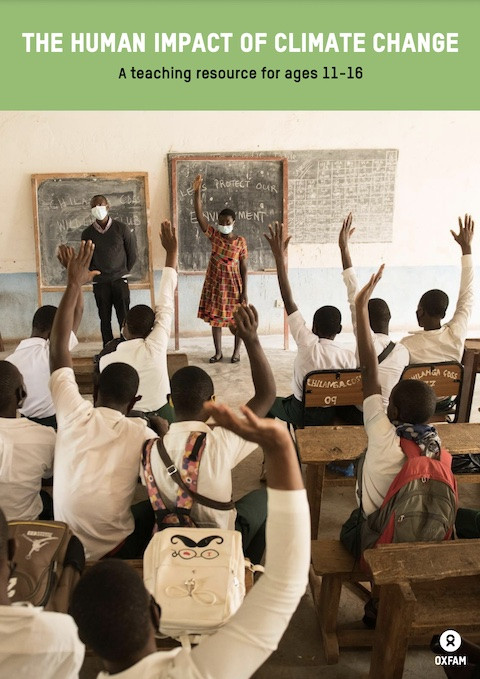 The Human Impact of Climate Change: A Teaching Resource for Ages 11-16 Année de publication: 2021 Auteur institutionnel: Oxfam GB These activities for ages 11-16 explore the human impact of the climate emergency and provide new spaces, approaches and opportunities for climate education and social action. This is in response to the call to action by Teach the Future (2020) who presented research on the current state and future of climate education in the UK. Their report discovered an overwhelming demand for climate education in schools alongside low levels of teacher knowledge about how to effectively deliver climate education and a narrow range of curriculum areas where it is taught. This resource frames the climate emergency as a human rights and people-centred issue and supports teachers to promote a sense of agency and empowerment within young people. This in turn is recognised as one strategy to help young people manage eco-anxiety, as well as disillusionment and disengagement with climate issues. This resource is suitable as both a curriculum resource and to inform social action by young people (for example, in GCSE Citizenship Studies)
  احتجاجات التلاميذ من أجل حماية المناخ Année de publication: 2019 Auteur institutionnel: DW Channel أصبحت التغيرات المناخية من ارتفاع درجة حرارة الأرض ومنسوب مياه البحار الشغل الشاغل للكثيرين وخاصة الشباب منهم، فقد اشتهرت الناشطة البيئية السويدية غريتا تونبيرغ ذات الـ 16 ربيعا عبر نشاطها ضد التلوث المناخي وانتقل تأثيرها إلى الشباب الألماني، والهدف هو التأثير على الساسة من أجل مستقبل أفضل لهم وللعالم. يستعرض الفيديو وثائقي من انتاج قناة DW عن وقفة احتجاجية للتلاميذ عما يحدث بخصوص التغير المناخي. Students Protesting for Climate Protection Année de publication: 2019 Auteur institutionnel: DW Channel Climate change from global warming and sea levels has become a preoccupation for many, especially young people. The 16-year-old Swedish environmental activist Greta Thunberg became famous for her activism against climate pollution and her impact was transmitted to German youth, and the goal is to influence politicians for a better future for them. And for the world. The video shows a documentary produced by DW about a protest stand by students about what is happening regarding climate change.
  Statement on Ecology and Environment of China Année de publication: 2021 Auteur institutionnel: 中国生态环境部 This Statement presents the ecological and environment situation in China in 2020, including the challenges it faces and the measures it has taken.