
Ressources
Explorez une large gamme de ressources sur le GCED afin d’approfondir votre compréhension et de renforcer vos activités de recherche, de plaidoyer, d’enseignement et d’apprentissage.
1,450 résultats trouvés
 Défenseur des Droits Année de publication: 2011 Auteur institutionnel: Défenseur des Droits Le Défenseur des droits est une autorité constitutionnelle indépendante chargée de veiller au respect des libertés et des droits des citoyens par les administrations et organismes publics. Selon l'article 71-1 de la Constitution, le Défenseur des droits "veille au respect des droits et libertés par les administrations de l'État, les collectivités territoriales, les établissements publics, ainsi que par tout organisme investi d'une mission de service public, ou à l'égard duquel la loi organique lui attribue des compétences". Ce site permet aux habitant de France de connaître leurs droits, demander de l'aide à la défenseur des droits et recense les évènements en lien avec les droits en France et des ressources pour connaître ses droits (produits par la défenseur des droits). The Defender of Rights is an independent constitutional authority responsible for ensuring that citizens' rights and freedoms are respected by public administrations and bodies. According to article 71-1 of the French Constitution, the Défenseur des droits "ensures that rights and freedoms are respected by the administrations, local authorities, public establishments and any body entrusted with a public service mission, or for which the organic law grants it powers". This site enables French residents to find out about their rights, ask for help from the Defender of Rights, and lists events related to rights in France, as well as resources for finding out about your rights (produced the Defender of Rights).
  Commission Canadienne des Droits de la Personne Auteur institutionnel: Commission Canadienne des Droits de la Personne La Commission canadienne des droits de la personne est l'organisme de surveillance des droits de la personne à l'échelon fédéral. La Commission est indépendante du gouvernement et agit dans l'intérêt public. Elle contribue à ce que chaque personne au Canada soit traitée équitablement, peu importe son identité. Elle est responsable de représenter l'intérêt public et de demander des comptes au gouvernement du Canada quant aux enjeux de droits de la personne. Sur cette page, vous trouverez des ressources pour mettre en place une politique inclusive dans vos secteurs de travail notamment sur la prévention du racisme, de l'intolérance religieuse et des droits aux travailleurs en situation de handicap The Canadian Human Rights Commission is Canada's human rights watchdog. We work for the people of Canada and operate independently from the Government. The Commission helps ensure that everyone in Canada is treated fairly, no matter who they are. We are responsible for representing the public interest and holding the Government of Canada to account on matters related to human rights. On this page, you'll find resources to help you implement an inclusive policy in your areas of work, including the prevention of racism, religious intolerance and the rights of workers with disabilities.
  Kiffe Ta Race Année de publication: 2018 Auteur institutionnel: Binge Audio Pourquoi le mot « race » est-il tabou ? Qu’en est-il quand on est, à la fois, victime de discriminations raciales et sexuelles ? Comment assumer son identité plurielle ? Un mardi sur deux, Rokhaya Diallo et Grace Ly reçoivent un·e invité·e pour explorer les questions raciales sur le mode de la conversation et du vécu. Why is the word "race" taboo? What happens when you are both a victim of racial and sexual discrimination? How do you come to terms with your plural identity? Every other Tuesday, Rokhaya Diallo and Grace Ly welcome a guest to explore racial issues in a conversational, real-life setting.
  Qui a peur des Juifs ? Antisémitisme, la tentation perpétuelle Année de publication: 2023 Auteur institutionnel: Illana Weizman Dans cette série podcast, la sociologue Illana Weizman questionne les expériences juives et l’hostilité subie par cette population en compagnie d’intellectuel-les, d’artistes, de chercheurs-euses, de militant-es ou de politiques rencontré·es des deux côtés de la frontière franco-suisse.Où en est la lutte contre l’antisémitisme aujourd’hui? Quand les courants antiracistes prônent l’écoute des concernés, n’est-il pas temps de l’appliquer pleinement aux Juifs? In this podcast series, sociologist Illana Weizman discusses the Jewish experience and the hostility suffered by this population in the company of intellectuals, artists, researchers, activists and politicians from both sides of the Franco-Swiss border. When anti-racist currents advocate listening to those concerned, isn't it time to apply this fully to Jews?
 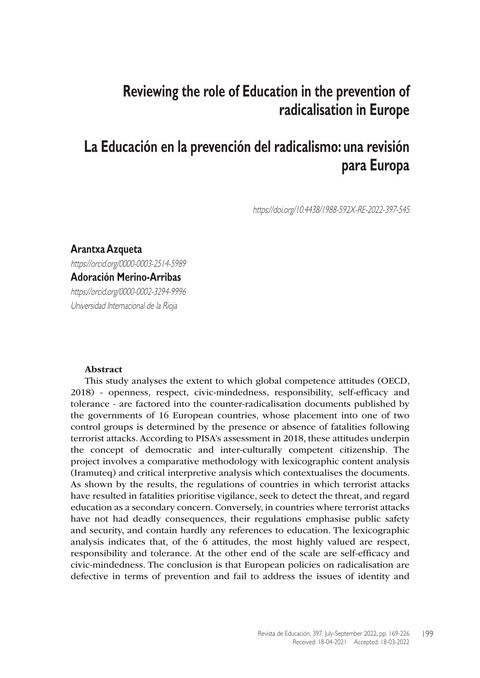 La educación en la prevención del radicalismo: una revisión para Europa Année de publication: 2022 Auteur: Arantxa Azqueta | Adoración Merino-Arribas Auteur institutionnel: Spain. Ministry of Education Esta investigación analiza si las actitudes de la competencia global (OECD, 2018) -apertura, respeto, conciencia cívica, responsabilidad, autoeficacia y tolerancia- se recogen en los documentos gubernamentales sobre prevención del radicalismo de 16 países europeos, aglutinados en dos grupos control, en función de la presencia o ausencia de víctimas mortales en los atentados. Estas actitudes, evaluadas por PISA en 2018, definen a una ciudadanía democrática e interculturalmente competente. Se emplea una metodología comparativa con un análisis de contenido lexicográfico mediante el software Iramuteq junto al análisis crítico-interpretativo que contextualiza los documentos.
  Les transformations des droits sociaux dans la globalisation Année de publication: 2019 Auteur: Jérôme Porta Auteur institutionnel: La Revue des Droits de l'Homme La globalisation des droits se manifeste par des phénomènes souvent décrits en termes de circulation ou transfert de droits. Parmi ces phénomènes, il en est un dont l’importance paraît croissante en matière sociale. Il s’agit du dépôt de droits sociaux sur des supports n’ayant pas pour objet de réglementer les rapports de travail, mais, d’encadrer les échanges commerciaux, de réguler la production de biens ou de produits, de promouvoir certaines politiques sociales ou encore de coordonner des politiques publiques nationales. Les clauses sociales présentes de manière croissante dans les accords de libre-échange ou l’adossement du socle européen des droits sociaux à un tableau d’indicateurs en sont des illustrations. Ces pratiques d’inclusion des droits du travailleur au sein de support économique, technique ou politique ne font pas véritablement objet d’attention pour elles-mêmes et sont trop souvent interprétés à partir de la normativité juridique. Cette extension de l’analyse juridique à de tels objets aboutit à ne commenter ces instruments qu’en terme d’écart au droit : ces droits sont-ils objets de sanction efficace ? Peuvent-ils être justiciables et invoqués devant un juge ? Ces préoccupations laissent dans l’ombre une question plus fondamentale, celle du changement qu’opère le passage d’une forme normative à une autre. Ces hybridations impliquent en effet une traduction, mieux une transformation. Tel est l’objet de la présente contribution. The globalization of rights is manifested by phenomena often described as the circulation or transfer of rights. Among these phenomena, there is one category, whose importance seems to be growing in international and european social matters. It is manifested by the filing of social rights on instruments not intended to regulate labour relations, but to regulate international trade, regulate the production of goods or products, promote certain social policies or even coordinate national public policies. The social clauses increasingly present in free trade agreements or the linking of the European social rights Pillar to a scoreboard of indicators are examples among many others of this. These practices of including workers' rights in economic, technical or political support do not really attract attention for themselves and are too often interpreted on the basis of legal normativity. This extension of the legal analysis to such objects leads to commenting on these instruments only in terms of deviation from the law : are these rights subject to effective sanctions ? Can they be justiciable and invoked before a judge ? These concerns leave a more fundamental question in the shadows, that of the changes brought about by the passage from one normative form to another. These hybridizations imply a translation, better a transformation. This is the purpose of this contribution to descriptib such a process and its implications.
  Teachers and Migrant Families: Pressing Communication (Iberoamerican Journal of Education; vol. 89, no. 1) Année de publication: 2022 Auteur: Mohamed Chamseddine Habib Allah Auteur institutionnel: Organization of Ibero-American States for Education, Science and Culture (OEI) This article presents the results of a study whose objective is to analyze the state of communication between migrant families and teachers in Early Childhood and Primary Education Centers in the Region of Murcia. Two questionnaires were chosen to develop a descriptive non-experimental quantitative research. The main results reveal that extracurricular activities are not part of the usual conversations between families and teachers. However, acceptable but improvable aspects are detected, such as delving into discipline issues, and student learning, etc. On the other hand, it is evident that the parents still do not go to visit the teachers on their own initiative to address the relevant elements of the teaching-learning process of their children. Docencia y familias migrantes: comunicación acuciante (Revista Ibero-americana de Educação; vol. 89, núm. 1) Année de publication: 2022 Auteur: Mohamed Chamseddine Habib Allah Auteur institutionnel: Organización de Estados Iberoamericanos para la Educación, la Ciencia y la Cultura (OEI) Este artículo presenta los resultados de un estudio cuyo objetivo es analizar el estado de comunicación entre las familias migrantes y los docentes en Centros Educativos de Educación Infantil y Primaria de la Región de Murcia. Se optó por dos cuestionarios homólogos para desarrollar una investigación de carácter cuantitativo no experimental de corte descriptivo. De los principales resultados se revela que las actividades extraescolares no forman parte de las conversaciones habituales entre las familias y el profesorado. Sin embargo, se detectan aspectos aceptables pero mejorables, como profundizar en los temas de disciplina, y el aprendizaje del alumnado, etc. Por otro lado, se evidencia que los progenitores siguen sin acudir a visitar a los docentes por iniciativa propia para abordar los elementos relevantes del proceso de enseñanza-aprendizaje de sus hijos e hijas.
 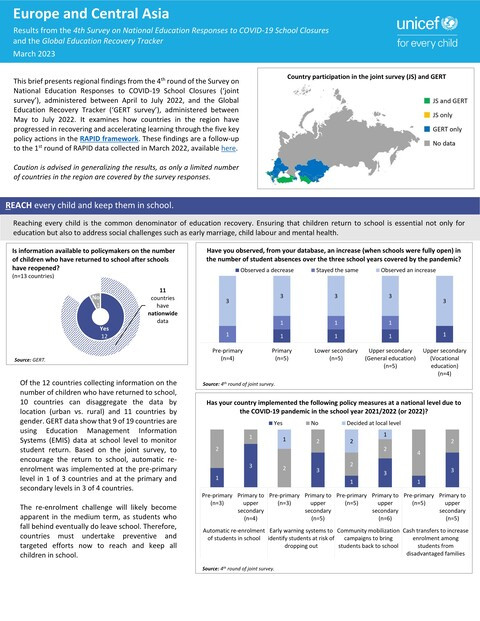 Education in a Post-COVID World: Towards a Rapid Transformation; Europe and Central Asia Regional Brief Année de publication: 2023 Auteur institutionnel: United Nations Children's Fund (UNICEF) On March 11, 2020, the World Health Organization declared COVID-19 a global pandemic, resulting in disruptions to education at an unprecedented scale. In response to the urgent need to recover learning losses, countries worldwide have taken RAPID actions to: Reach every child and keep them in school; Assess learning levels regularly; Prioritize teaching the fundamentals; Increase the efficiency of instruction; and Develop psychosocial health and wellbeing. This brief presents regional findings from the 4th round of the Survey on National Education Responses to COVID-19 School Closures (‘joint survey’), administered between April to July 2022, and the Global Education Recovery Tracker (‘GERT survey’), administered between May to July 2022. It examines how countries in the region have progressed in recovering and accelerating learning through the five key policy actions in the RAPID framework. These findings are a follow-up to the 1st round of RAPID data collected in March 2022.
  Educating for global competence: preparing our youth to engage the world Année de publication: 2011 Auteur: Veronica Boix Mansilla | Anthony Jackson Auteur institutionnel: Asia Society | Council of Chief State School Officers (CCSSO) Contemporary societies are marked by new global trends - economic, cultural, technological, and environmental shifts that are part of a rapid and uneven wave of globalization. The growing global interdependence that characterizes our time calls for a generation of individuals who can engage in effective global problem solving and participate simultaneously in local, national, and global civic life. Put simply, preparing our students to participate fully in today's and tomorrow's world demands that we nurture their global competence.This document introduces a definition of global competence developed by the Global Competence Task Force - a group of state education agency leaders, education scholars, and practitioners - under the auspices of the Council of Chief State School Officers EdSteps initiative (CCSSO-EdSteps) and the Asia Society Partnership for Global Learning (see page (iv) for task force participants). The definition builds on seminal work within the states and a broad range of organizations working to advance global knowledge and critical thinking skills. A process of careful articulation and vetting yielded the definition of global competence here proposed:Global competence is the capacity and disposition to understand and act on issues of global significance.Globally competent individuals are aware, curious, and interested in learning about the world and how it works. They can use the big ideas, tools, methods, and languages that are central to any discipline (mathematics, literature, history, science, and the arts) to engage the pressing issues of our time. They deploy and develop this expertise as they investigate such issues, recognize multiple perspectives, communicating their views effectively, and taking action to improve conditions.Educating for Global Competence: Preparing Our Youth to Engage the World is intended for classroom teachers, administrators, informal educators, policymakers, community leaders, researchers, parents, students, and all other stakeholders interested in preparing our youth for the 21st century. Becoming better at education for global competence involves rethinking practices and recognizing that there are no simple recipes for success. As such, this book is meant to be used flexibly - browse, make connections, and concentrate on the chapters that you find most pertinent to your work. Experiment with ideas, challenge concepts, and share with colleagues. Ultimately this book must work for you. It is meant to be read in the way that best meets your needs, inspires your curiosity, and proves fruitful in the classroom.Chapter one offers a rational for global education in our nation and worldwide. Chapter two introduces a conceptual framework for global competence and explains the key role of disciplinary and interdisciplinary foundations in student learning. Chapter three, four, five and six focus, respectively, on four core capacities associated with global competence: investigating the world, recognizing perspectives, communicating ideas, and taking action. Chapter seven considers core principles of instruction for teaching global competence. Chapter eight looks at what students and education institutions can do to promote global competence - and how they might create a culture of global competence for youth and adults. Finally, chapter nine places global competence in the larger framework of public education systems in and beyond the United States.