
Ressources
Explorez une large gamme de ressources sur le GCED afin d’approfondir votre compréhension et de renforcer vos activités de recherche, de plaidoyer, d’enseignement et d’apprentissage.
2,657 résultats trouvés
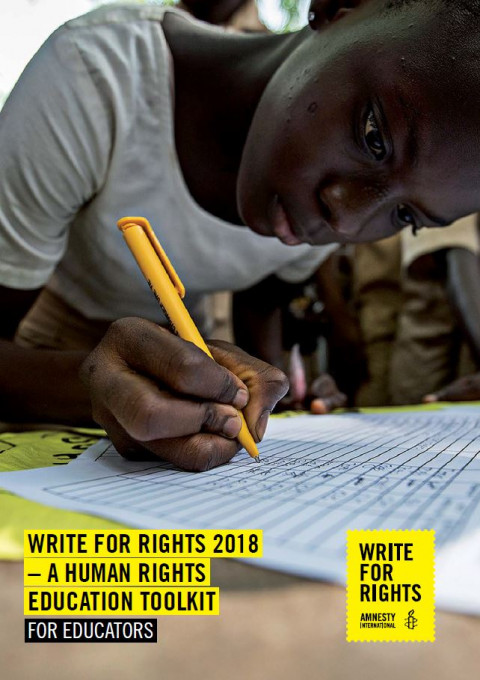 Write for Rights 2018: A Human Rights Education Toolkit for Educators Année de publication: 2018 Auteur institutionnel: Amnesty International The annual Write for Rights (W4R) campaign is one of Amnesty International’s biggest human rights events. In 2018 the campaign focuses on women human rights defenders who have suffered human rights violations or are at great risk because of the positions they have taken on certain human rights issues.This Human Rights Education toolkit was created to support teachers’ participation with their students in the W4R campaign. It provides a broad perspective on human rights issues and offers the opportunity to open young people’s minds to global concerns. By learning about and writing persuasive letters to help end human rights violations and achieve justice, teachers and students contribute to the international human rights movement and see for themselves how words can make a difference in the world.This toolkit was created for students aged 13 and above and is primarily designed for use in a school setting: both inside the classroom as well as in clubs or school-wide events. Activities can also be adapted for use in other, non-formal education contexts such as youth groups and community settings. The toolkit contains general activities on human rights and highlights six women human rights defenders from the W4R campaign who have made extraordinary contributions to the advancement of human rights around the world. Écrire pour les droits 2018: Manuel d´éducation aux droits humains pou les éducateurs et éducatrices Année de publication: 2018 Auteur institutionnel: Amnesty International La campagne annuelle Écrire pour les droits est l’une des plus importantes actions d’Amnesty International autour des droits humains. L’édition 2018 est axée sur les défenseures des droits humains qui sont victimes de violations de leurs droits fondamentaux ou en grand danger du fait de leur position sur certaines questions relatives aux droits humains.Le manuel Éducation aux droits humains vise à favoriser la participation des enseignant-e-s et de leurs élèves à la campagne Écrire pour les droits. Il offre une perspective large sur les questions relatives aux droits humains et la possibilité de sensibiliser les jeunes à des préoccupations mondiales. En en apprenant davantage et en rédigeant des lettres convaincantes pour aider à mettre fin aux violations des droits humains et à obtenir justice, les enseignant-e-s et leurs élèves contribuent au mouvement international des droits humains et voient par elles/eux-mêmes que les mots peuvent faire la différence.Ce manuel est destiné aux élèves de 13 ans et plus pour une utilisation en contexte scolaire, tant en classe que dans des clubs ou des manifestations organisées à l’école. Les activités peuvent cependant être adaptées à des contextes d’apprentissage plus informels comme des groupes de jeunes et des associations. Le manuel propose des activités générales sur les droits humains et met en avant six défenseures des droits humains choisies au titre de la campagne Écrire pour les droits qui ont apporté des contributions extraordinaires à la progression des droits fondamentaux dans le monde entier. Escribe por los derechos 2018: Carpeta de materiales de educación en derechos humanos para educadores/as Année de publication: 2018 Auteur institutionnel: Amnesty International La campaña anual Escribe por los Derechos es uno de los mayores eventos de derechos humanos de Amnistía Internacional. En 2018, la campaña se centra en defensoras de los derechos humanos que han sufrido violaciones de derechos humanos o corren grave riesgo a causa de la postura que han adoptado respecto a ciertas cuestiones de derechos humanos.Esta carpeta de materiales de Educación en Derechos Humanos se creó para ayudar a profesores y profesoras a participar con sus estudiantes en la campaña Escribe por los Derechos. Ofrece una amplia perspectiva de cuestiones de derechos humanos y brinda la oportunidad de abrir la mente de los y las jóvenes a cuestiones de preocupación mundiales. Al aprender sobre estas cuestiones y escribir cartas convincentes para ayudar a poner fin a las violaciones de derechos humanos y lograr justicia, los profesores y profesoras y sus estudiantes contribuyen al movimiento internacional de derechos humanos y ven con sus propios ojos cómo las palabras pueden hacer cambiar las cosas en el mundo.Esta carpeta se creó para estudiantes de a partir de 13 años y está concebida principalmente para utilizarla en un entorno escolar: tanto dentro del aula como en clubes o eventos de toda la escuela. Las actividades también se pueden adaptar para utilizarlas en otros contextos de educación no formal, como grupos de jóvenes y entornos comunitarios. La carpeta contiene actividades generales sobre derechos humanos y destaca el caso de seis defensoras de los derechos humanos de la campaña Escribe por los Derechos que han hecho contribuciones extraordinarias al progreso de los derechos humanos en todo el mundo.
  Guidelines on Human Rights Education for Secondary School Systems Année de publication: 2012 Auteur institutionnel: OSCE. Office for Democratic Institutions and Human Rights (ODIHR) These guidelines, which focus on human rights education in secondary schools, aim to support systemic and effective human rights learning for all young people. They were prepared on the basis of broad consultations involving teachers, teachers’ unions, teacher trainers, educational administrators, NGO specialists, and representatives from intergovernmental agencies and national human rights institutions.The current document presents approaches to be adopted when planning or implementing human rights education for secondary schools related to six key structural areas: the human rights-based approach to human rights education; core competencies; curricula; teaching and learning processes; evaluation; and professional development and support of educational personnel. The guidelines also offer a list of key materials to assist in planning, implementing and evaluating human rights education in schools.
  Addressing Anti-semitism in Schools: Training Curriculum for Primary Education Teachers Année de publication: 2020 Auteur institutionnel: UNESCO | OSCE. Office for Democratic Institutions and Human Rights (ODIHR) This OSCE/ODIHR and UNESCO co-publication aims to help primary school teachers to prevent and respond to anti-Semitism. The curriculum, intended for teacher trainers, is designed to be comprehensive, robust, practical and adaptable. It suggests concrete ways to address anti-Semitism and counter prejudice in and through education, while promoting human rights, global citizenship education, and gender equality.The co-publication is part of a series of four training curricula, designed for trainers of (1) primary school teachers, (2) secondary school teachers, (3) vocational school teachers, and (4) school directors.
  Addressing Anti-semitism in Schools: Training Curriculum for Secondary Education Teachers Année de publication: 2020 Auteur institutionnel: UNESCO | OSCE. Office for Democratic Institutions and Human Rights (ODIHR) This OSCE/ODIHR and UNESCO co-publication aims to help secondary school teachers to prevent and respond to anti-Semitism. The curriculum, intended for teacher trainers, is designed to be comprehensive, robust, practical and adaptable. It suggests concrete ways to address anti-Semitism and counter prejudice in and through education, while promoting human rights, global citizenship education, and gender equality.The co-publication is part of a series of four training curricula, designed for trainers of (1) primary school teachers, (2) secondary school teachers, (3) vocational school teachers, and (4) school directors.
  Addressing Anti-semitism in Schools: Training Curriculum for Vocational Education Teachers Année de publication: 2020 Auteur institutionnel: UNESCO | OSCE. Office for Democratic Institutions and Human Rights (ODIHR) This OSCE/ODIHR and UNESCO co-publication aims to help vocational school teachers to prevent and respond to anti-Semitism. The curriculum, intended for teacher trainers, is designed to be comprehensive, robust, practical and adaptable. It suggests concrete ways to address anti-Semitism and counter prejudice in and through education, while promoting human rights, global citizenship education, and gender equality.The co-publication is part of a series of four training curricula, designed for trainers of (1) primary school teachers, (2) secondary school teachers, (3) vocational school teachers, and (4) school directors.
  Addressing Anti-semitism in Schools: Training Curriculum for School Directors Année de publication: 2020 Auteur institutionnel: UNESCO | OSCE. Office for Democratic Institutions and Human Rights (ODIHR) This OSCE/ODIHR and UNESCO co-publication aims to help school directors to prevent and respond to anti-Semitism. The curriculum, intended for school director trainers, is designed to be comprehensive, robust, practical and adaptable. It suggests concrete ways to address anti-Semitism and counter prejudice in and through education, while promoting human rights, global citizenship education, and gender equality.The co-publication is part of a series of four training curricula, designed for trainers of (1) primary school teachers, (2) secondary school teachers, (3) vocational school teachers, and (4) school directors.
  دليل لفائدة المكونين و الوسطاء لإستعمال " دليل شباب تونس في تعلم الديمقراطية " Année de publication: 2013 Auteur institutionnel: UNESCO Rabat The main aim of these manual and guide is to raise awareness among Tunisian youth about the values of democracy, human rights and responsible citizenship, and empower youth to make their voice heard during this critical period in the Tunisian democratic transition.
  EDUCATION A LA CULTURE DE LA PAIX, AUX DROITS HUMAINS, A LA CITOYENNETE, A LA DEMOCRATIE ET A L’INTEGRATION REGIONALE MANUEL DE REFERENCE DE LA CEDEAO A L’USAGE DE LA FORMATRICE / DU FORMATEUR DE FORMATEURS/FORMATRICES Année de publication: 2013 Auteur institutionnel: UNESCO Dakar | Economic Community of West African States (ECOWAS) The manual comprises seven modules dealing with the Culture of Peace and Conflict Management; Human Rights; Civism and Citizenship; Democracy and Good Governance; Gender and Development; Public Health, Environment and Sustainable Development; and Regional Integration. Each module has sub-themes with introductions, reference materials, general objectives to guide the trainer and generic pedagogical tables that are flexible enough to be adapted to available teaching resources in the different ECOWAS countries. It is also suitable and adaptable to the training of teachers involved in both formal and non-formal education delivery at different levels of teaching and learning. The ultimate goal of the Manual is to build a critical mass of ECOWAS citizens equipped with competent skills, not only for cognitive and psycho-motor domains of education, but also affective skills for positive values, attitudes and behaviors that promote peace, tolerance and peaceful co-existence of community citizens.