
Ressources
Explorez une large gamme de ressources sur le GCED afin d’approfondir votre compréhension et de renforcer vos activités de recherche, de plaidoyer, d’enseignement et d’apprentissage.
2,162 résultats trouvés
 The SDGs and Cities INTERNATIONAL HUMAN MOBILITY Année de publication: 2018 Auteur institutionnel: International Centre for the Promotion of Human Rights | (ICPHR) The Handbook is to address new situations – and responses to these situations – generated by the global phenomenon of human mobility in urban spaces. Democracies are being threatened by the sustained growth of social gaps and the exclusion of vast sectors of the population from political systems and benefits of development, placing structural limits on the exercise of human rights. In this context, where new tensions and problems have arisen such as massive displacements of the population, the appearance of diverse types of extremism, of wars and conflicts and climate change in turn place these social sectors under conditions of structural inequality, exclusion and discrimination, as the main victims of human rights violations. This Handbook was prepared and published with the support and assistance of the UNESCO Sector for Social and Human Sciences through its Regional Science Bureau in Montevideo and the Latin American and Caribbean Coalition of Cities against Racism, Discrimination and Xenophobia.
  The SDGs AND CITIES INTERNATIONAL HUMAN MOBILITY Année de publication: 2018 Auteur institutionnel: International Centre for the Promotion of Human Rights | (ICPHR) The Handbook is to address new situations – and responses to these situations – generated by the global phenomenon of human mobility in urban spaces. Democracies are being threatened by the sustained growth of social gaps and the exclusion of vast sectors of the population from political systems and benefits of development, placing structural limits on the exercise of human rights. In this context, where new tensions and problems have arisen such as massive displacements of the population, the appearance of diverse types of extremism, of wars and conflicts and climate change in turn place these social sectors under conditions of structural inequality, exclusion and discrimination, as the main victims of human rights violations. This Handbook was prepared and published with the support and assistance of the UNESCO Sector for Social and Human Sciences through its Regional Science Bureau in Montevideo and the Latin American and Caribbean Coalition of Cities against Racism, Discrimination and Xenophobia.
 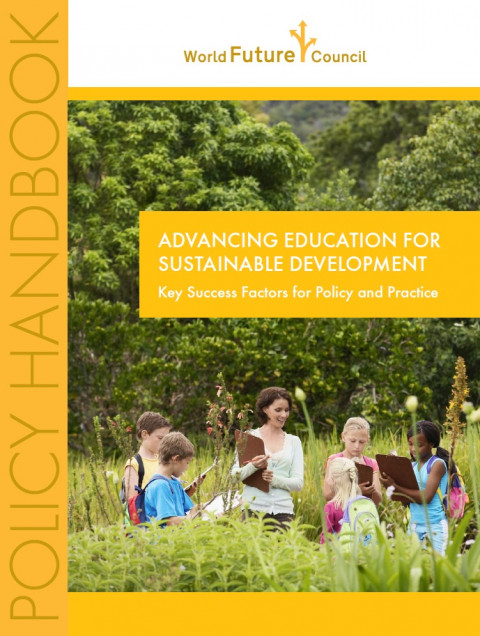 Policy Handbook: Advancing Education for Sustainable Development Année de publication: 2019 Auteur institutionnel: World Future Council Foundation Given the huge challenges the world faces, it is clear that we need to teach, learn and live in a fundamentally different manner. Education for Sustainable Development (ESD) is increasingly recognised as playing a central role in empowering learners of all ages to positively respond to local and global challenges and act in a more peaceful, just, inclusive and sustainable manner. This approach is already helping people develop the skills, values and attitudes necessary to create more resilient societies and transition towards the skilled, green, low-carbon economies of the future. This handbook explores some of the central success factors in policy, process and practice in some of the pioneering countries and contexts where ESD is being effectively embraced. It examines some of the major trends, case studies and challenges in introducing this more holistic, progressive, hands-on education.
  Digital kids Asia-Pacific: insights into children’s digital citizenship Année de publication: 2019 Auteur: Taeseob Shin | Hyeyoung Hwang | Jonghwi Park | Jian Xi Teng | Toan Dang Auteur institutionnel: UNESCO Bangkok This report responds to the growing needs of Member States in the Asia-Pacific region to understand children’s knowledge, behaviour and attitudes in a hyper-connected digital world. It aims to create a data-driven, conducive educational and policy environment that maximizes opportunities that Information and Communications Technology (ICT) offers, while minimizing potential threats that the same may pose. The report was also developed in the context of the Education 2030 Agenda identifying digital skills as one of the key competencies for youth and adults to achieve and monitor until 2030.
  L'Éducation au Développement la citoyenneté mondiale au coeur de l’école Année de publication: 2013 Auteur: Sarah Goffin Auteur institutionnel: Fédération des Associations de Parents de l'enseignement Officiel Éducation au Développement » (ED), « Éducation à la Citoyenneté Mondiale » (ECM) ou encore « sensibilisation à la solidarité Nord-Sud »… autant d’expressions obscures auxquelles sont confrontés les élèves de primaire et de secondaire, souvent sollicités par des ONG ou par leurs professeurs. Mais que se cache-t-il réellement derrière ces concepts ?C’est ce que nous allons chercher à identifier au cours de cette analyse : définir les concepts, décortiquer ce qui se passe en classe, comment, par qui et pourquoi.La question sera abordée sous divers angles et points de vue : celui des enseignants, des élèves et des intervenants extérieurs.
 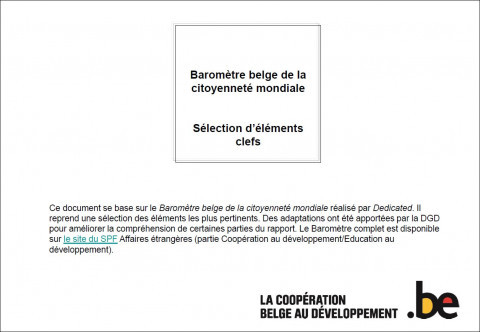 Baromètre belge de la citoyenneté mondiale: Sélection d’éléments clefs Auteur institutionnel: La coopération belge au développement Ce document se base sur le Baromètre belge de la citoyenneté mondiale réalisé par Dedicated. Il reprend une sélection des éléments les plus pertinents. Des adaptations ont été apportées par la DGD pour améliorer la compréhension de certaines parties du rapport. Le Baromètre complet est disponible sur le site du SPF Affaires étrangères (partie Coopération au développement/Education au développement).
 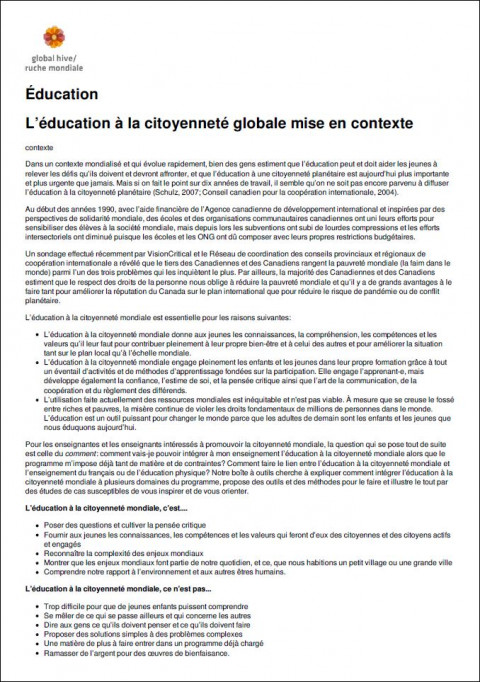 L'éducation à la citoyenneté globale mise en contexte Auteur institutionnel: Global Hive L’éducation à la citoyenneté mondiale est essentielle pour les raisons suivantes:L’éducation à la citoyenneté mondiale donne aux jeunes les connaissances, la compréhension, les compétences et les valeurs qu’il leur faut pour contribuer pleinement à leur propre bien-être et à celui des autres et pour améliorer la situation tant sur le plan local qu’à l’échelle mondiale.L’éducation à la citoyenneté mondiale engage pleinement les enfants et les jeunes dans leur propre formation grâce à tout un éventail d’activités et de méthodes d’apprentissage fondées sur la participation. Elle engage l’apprenant-e, mais développe également la confiance, l’estime de soi, et la pensée critique ainsi que l’art de la communication, de la coopération et du règlement des différends.L’utilisation faite actuellement des ressources mondiales est inéquitable et n'est pas viable. À mesure que se creuse le fossé entre riches et pauvres, la misère continue de violer les droits fondamentaux de millions de personnes dans le monde.L’éducation est un outil puissant pour changer le monde parce que les adultes de demain sont les enfants et les jeunes que nous éduquons aujourd’hui.Pour les enseignantes et les enseignants intéressés à promouvoir la citoyenneté mondiale, la question qui se pose tout de suite est celle du comment: comment vais-je pouvoir intégrer à mon enseignement l’éducation à la citoyenneté mondiale alors que le programme m’impose déjà tant de matière et de contraintes? Comment faire le lien entre l’éducation à la citoyenneté mondiale et l’enseignement du français ou de l’éducation physique? Notre boîte à outils cherche à expliquer comment intégrer l’éducation à la citoyenneté mondiale à plusieurs domaines du programme, propose des outils et des méthodes pour le faire et illustre le tout par des études de cas susceptibles de vous inspirer et de vous orienter.
 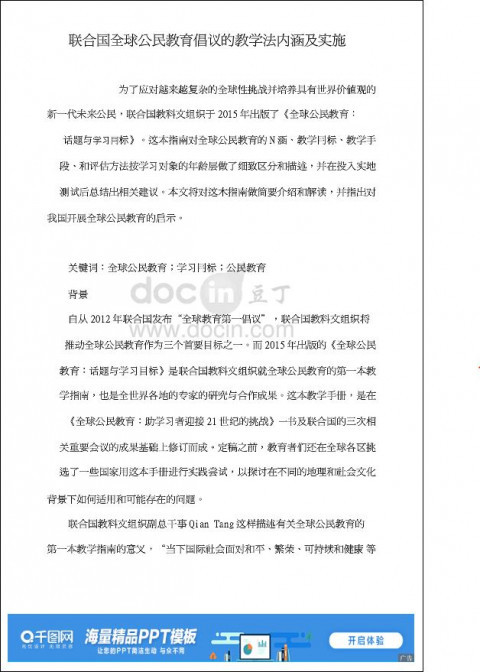 The Connotation and Implementation of the Teaching Method of the UN Global Citizenship Education Initiative Année de publication: 2017 Auteur institutionnel: Eastern Education In response to increasingly complex global challenges and the development of a new generation of future citizens with world values, UNESCO published Global Citizenship Education: Topics and Learning Objectives in 2015. This guide makes a detailed distinction and description of the connotation, teaching objectives, teaching methods, and assessment methods of global civic education according to the age level of the learning objects, and summarizes relevant recommendations after inputting field tests. This article will give a brief introduction and interpretation of this guide, and point out the implications for the development of global citizenship education in China. 联合国全球公民教育倡议的教学法内涵及实施 Année de publication: 2017 Auteur institutionnel: Eastern Education 为了应对越来越复杂的全球性挑战并培养具有世界价值观的新一代未来公民,联合国教科文组织于2015年出版了《全球公民教育:话题与学习目标》。这本指南对全球公民教育的内涵、教学目标、教学手段、和评估方法按学习对象的年龄层做了细致区分和描述,并在投入实地测试后总结出相关建议。本文将对这本指南做简要介绍和解读,并指出对我国开展全球公民教育的启示。
 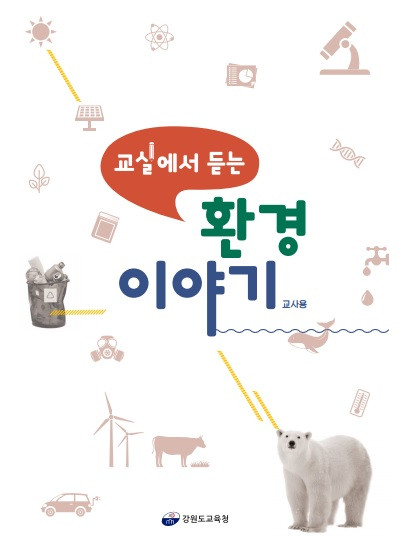 교사용: 교실에서 듣는 환경 이야기 Année de publication: 2022 Auteur: 김진영 | 박영식 | 유미리 | 이전기 | 이현지 | 정준영 | 홍성택 Auteur institutionnel: 강원도교육청 강원도에서 초등학교를 다니는 5, 6학년 학생을 위한 교재입니다. 쓰레기, 물 부족, 탄소중립, 기후변화, 신재생에너지 등 최근 이슈가 되고 있는 환경문제를 우리 지역 사례를 통해 쉽게 이해할 수 있도록 했습니다. 특히 과도한 위기의식이나 좌절감을 느끼지 않도록 부정적인 요소를 강조하지 않았습니다. 나의 삶과 환경이 어떤 관계가 있는지 생각해 볼 수 있는 기회가 될 것입니다.