
Ressources
Explorez une large gamme de ressources sur le GCED afin d’approfondir votre compréhension et de renforcer vos activités de recherche, de plaidoyer, d’enseignement et d’apprentissage.
1,445 résultats trouvés
 Promouvoir l’education a la citoyennete mondiale en afrique de l’ouest : Atelier international de renforcement de capacités des pays de la CEDEAO 07 – 09 Juillet 2015, Dakar, Sénégal Année de publication: 2015 Auteur institutionnel: Организация Объединенных Наций по вопросам образования, науки и культуры (UNESCO) Ce rapport est le fruitde l’atelier international de renforcement de capacités organisé par l’UNESCO dans l’objectif de renforcer les capacités des pays membres de la Communauté économique des États de l'Afrique de l'Ouest (CEDEAO) pour la promotion de l’Education à la citoyenneté mondiale aux niveaux nationaux et régionaux. Autonomiser des citoyens du mon de actifs et construire un sens d’appartenance à une humanité commune ne font pas uniquement partie du mandat de l’UNESCO mais sont aussi des problèmes prioritaires pour l’Afrique de l’Ouest. Ce rapport d’atelier fournit des ressources, stratégies et feuilles de routes pour l’avancée et une meilleure intégration de l’ECM dans les politiques et les programmes éducatifs en Afrique de l’Ouest. Les feuilles de route ont été proposées par les Etats membres eux-mêmes et leur mise en œuvre dépendra de la disponibilité des ressources et des partenariats potentiels.
 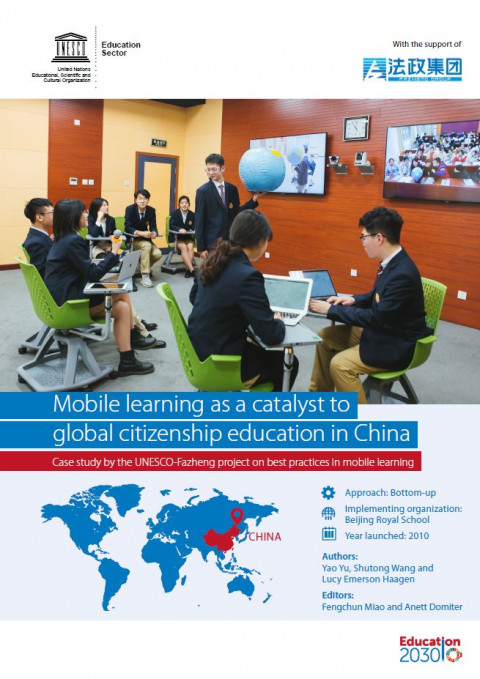 Mobile Learning as a Catalyst to Global Citizenship Education in China: Case Study by the UNESCO-Fazheng Project on Best Practices in Mobile Learning Année de publication: 2019 Auteur: Yao Yu | Shutong Wang | Lucy Emerson Haagen Auteur institutionnel: UNESCO The Beijing Royal School was one of the pioneer schools in China in incorporating mobile learning into pedagogical transformation. Its mobile learning programme started in 2010. Stemming from the school’s orientation towards global citizenship education, the Beijing Royal School recognizes mobile learning as both driver and enabler for supporting the development of students’ cognitive, socio-emotionaland behavioural dimensions, organized around knowledge acquisition, understanding and respect for difference and diversity, and responsible engagement with global issues. It takes advantage of a variety of mobile apps to support students’ multilingual education, and uses open educational resources (OER) to support multicultural education, taking advantage of the up-to-date worldwide data and information available on the web. It also engages with students from other countries in projects and courses that help the students to widen their understanding of diverse cultures and social contexts. Overall, this case study illustrates how to use mobile technologies to support the implementation of a well-defined and clearly structured educational vision by embedding the use of mobile technologies in students’ daily learning lives.
  UNESCO's Contribution to the Prevention of Violant Extremism Année de publication: 2016 Auteur institutionnel: UNESCO This document provides a summary of recent efforts by UNESCO to step up its action to prevent violent extremism, in the context of the United Nations Secretary-General’s Plan of Action on Violent Extremism, launched in January 2016. Building on its mandate and existing activities, UNESCO has adopted an intersectoral approach, paying particular attention to the needs of young people particularly at risk of radicalization.
 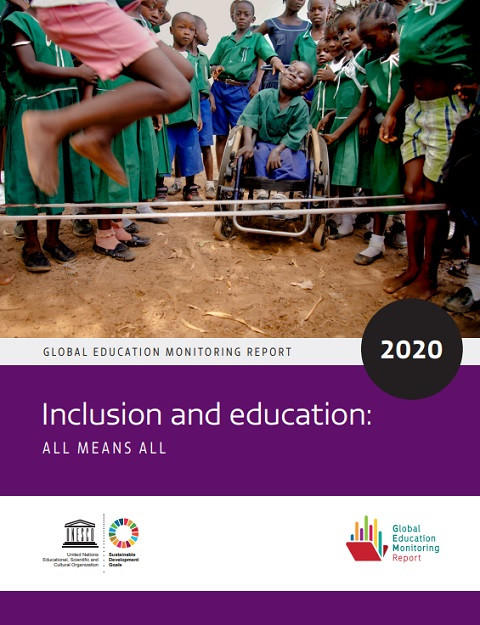 Informe de seguimiento de la educación en el mundo 2020: Inclusión y educación: Todos y todas sin excepción Année de publication: 2020 Auteur institutionnel: Global Education Monitoring Report Team | UNESCO En el Informe de Seguimiento de la Educación en el Mundo 2020 se examinan los mecanismos sociales, económicos y culturales que discriminan a niños, jóvenes y adultos desprotegidos, manteniéndolos excluidos de la educación o marginados dentro de ella. Estimulados por su compromiso de hacer realidad el derecho a la educación inclusiva, los países están ampliando su visión de la inclusión en la educación y otorgando a la diversidad un lugar central en sus sistemas. Sin embargo, la aplicación de leyes y políticas bienintencionadas suele flaquear. El informe, publicado a principios del decenio de acción que culmina en 2030 y en el contexto de la crisis de Covid-19 que ha exacerbado las desigualdades subyacentes, sostiene que la resistencia a atender las necesidades de todos los educandos es una verdadera amenaza para el logro de los objetivos mundiales de educación.En Inclusión y educación: todos y todas sin excepción se definen prácticas en materia de gobernanza y finanzas; planes de estudios, manuales escolares y evaluaciones; formación de los docentes; infraestructura escolar; y relaciones con los alumnos, los padres y las comunidades que pueden desbloquear el proceso hacia la inclusión. Se formulan recomendaciones de política para que la diversidad de los educandos sea una fuerza que se valora, una fuerza de cohesión social.Dos nuevos sitios web complementan la cuarta edición del Informe de Seguimiento de la Educación en el Mundo. Education Profiles (Perfiles educativos) describe la manera en que los países abordan la inclusión, y constituye un medio útil para el diálogo sobre políticas. Education Progress (El Progreso de la educación) brinda la oportunidad de interactuar con los datos y explorar una serie de indicadores del ODS 4.
 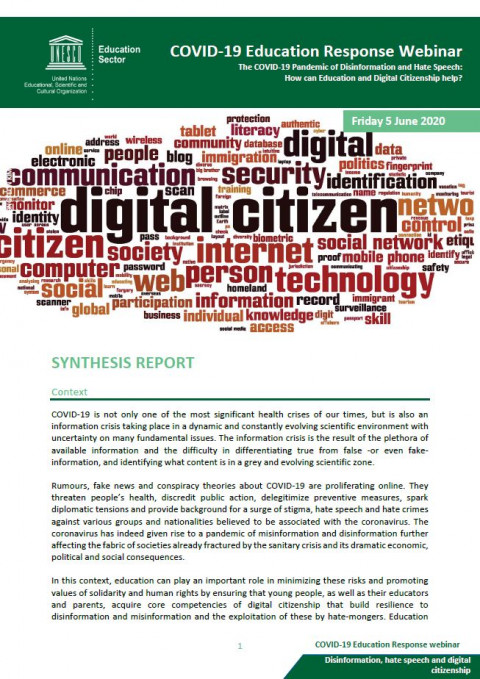 The COVID-19 Pandemic of Disinformation and Hate Speech: How can Education and Digital Citizenship Help? ; Synthesis Report Année de publication: 2020 Auteur institutionnel: UNESCO COVID-19 is not only one of the most significant health crises of our times, but is also an information crisis taking place in a dynamic and constantly evolving scientific environment with uncertainty on many fundamental issues. The information crisis is the result of the plethora of available information and the difficulty in differentiating true from false -or even fake- information, and identifying what content is in a grey and evolving scientific zone.In this context, education can play an important role in minimizing these risks and promoting values of solidarity and human rights by ensuring that young people, as well as their educators and parents, acquire core competencies of digital citizenship that build resilience to disinformation and misinformation and the exploitation of these by hate-mongers. Education can also help young people engage in the online environment in a safe, sensitive, critical, ethical and accountable way as well as encourage them to play a role in pioneering educational initiatives that contribute to promoting digital citizenship.
  Holocaust Education in a Global Context: Report Année de publication: 2013 Auteur institutionnel: UNESCO Teaching and learning about the Holocaust, which until this point had largely been a matter of regional interest, for Europeans, as well as North Americans and Israelis, became officially an issue of universal concern. Other countries are now invited to teach about the Holocaust even if they do not have a direct link to the event. This raises many issues concerning the pedagogical implications of this global perspective on Holocaust education. Why and how is the Holocaust taught in countries that have no connections with the genocide and the history of the Jewish people? How does this history connect and resonate with the preoccupations of these countries? Generally speaking, what could be the purposes and the benefits of teaching about the Holocaust globally?In order to address these issues, UNESCO organized an experts-meeting on 27 April 2012, in partnership with the Topography of Terror Foundation (Berlin, Germany). The purpose was specifically to clarify the following questions: What are the current trends of Holocaust education worldwide? How can the Holocaust be studied in a comparative fashion in the classroom? In which ways does Holocaust education contribute to the prevention of genocide? Furthermore, how is it taught in a human rights education perspective? Can the Holocaust provide a suitable framework to address other traumatic events of the past?
 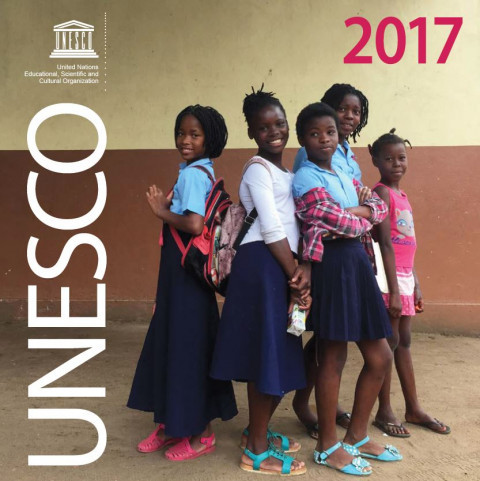 UNESCO 2017: Annual Report 2017 Année de publication: 2018 Auteur institutionnel: UNESCO This Annual Report takes stock of these actions and many others, undertaken during the mandate of the former Director-General, Irina Bokova, to whom I wish to pay tribute. The Report also reflects the professionalism and expertise of the Organization’s staff working across the world, and translating the 2030 Agenda for Sustainable Development’s Goals into action. The Report features UNESCO’s commitment to provide a world of justice, peace and sustainable development.Guided by the ideals of peace and progress, UNESCO represents a powerful force for transformation in the face of today’s challenges. It is also well-placed to share our wide-ranging experience and formulate the innovative ideas that the world currently needs, bearing in mind specific conditions on the ground and the need to respect local history and culture. Rapport UNESCO 2017 Année de publication: 2018 Auteur institutionnel: Organisation des Nations Unies pour l'éducation, la science et la culture (UNESCO) Ce rapport annuel dresse le bilan de ces actions et de nombreuses autres, engagées par la précédente Directrice générale, Irina Bokova, à qui je souhaite rendre hommage. Il reflète également le professionnalisme et l’expertise du personnel de l’UNESCO dans le monde entier, traduisant en actions les objectifs du Programme de développement durable à l’horizon 2030. Il met en mots et en images leur engagement pour construire un monde de justice, de développement durable et de paix.Guidée par les idéaux de paix et de progrès, l’UNESCO représente une puissante force de transformation face aux défis du monde contemporain. Elle est aussi le lieu par excellence pour partager la pluralité des expériences et faire naître les idées novatrices dont le monde a besoin – en tenant compte des spécificités du terrain, dans le respect des histoires et des cultures particulières.
 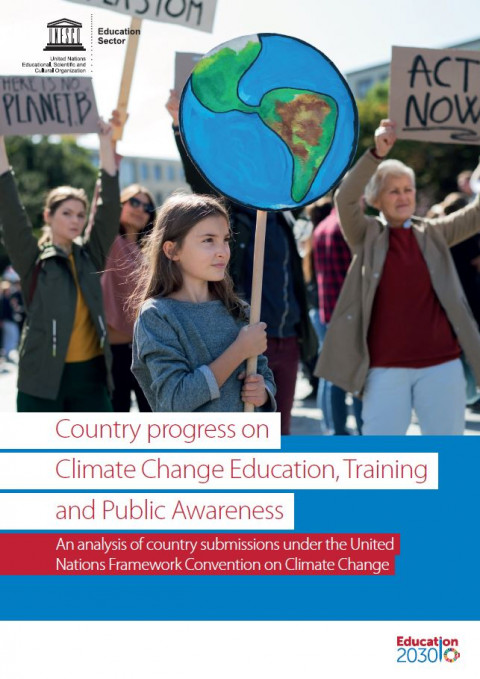 Country Progress on Climate Change Education, Training and Public Awareness: An Analysis of Country Submissions Under the United Nations Framework Convention on Climate Change Année de publication: 2019 Auteur institutionnel: UNESCO Since its entry into force, the 1992 United Nations Framework Convention on Climate Change (UNFCCC) in Article 6 has recognised the importance of ‘education, training and public awareness’ in mitigating ‘dangerous human interference with the climate system’. Article 12 of the Paris Agreement (2015) reaffirms this recognition.This document provides a status report on the implementation of climate change education in countries. It outlines key findings from an analysis of country submissions to the UNFCCC Secretariat as part of UNFCCC reporting processes and highlights achievements and remaining gaps in the area of climate change education.The analysis shows that almost all countries include some reference to climate change education in their country submissions under the UNFCCC reporting processes. This shows a certain level of commitment, which provides a good basis to further scale up educational responses to climate change. However, important gaps remain. Addressing them will be crucial in order to fully mobilize the power of education in response to this greatest challenge of our times. Progrès nationaux en matière d'éducation, de formation et de sensibilisation du public aux changements climatiques: Analyse des comptes rendus nationaux au titre de la Convention-cadre des Nations Unies sur les changements climatiques Année de publication: 2019 Auteur institutionnel: Organisation des Nations Unies pour l'éducation, la science et la culture (UNESCO) Depuis son entrée en vigueur, la Convention-cadre des Nations Unies sur les changements climatiques (CCNUCC, 1992) reconnaît, dans son article 6, l’importance de l’éducation, de la formation et de la sensibilisation du public pour atténuer toute perturbation anthropique dangereuse du système climatique. L’article 12 de l’Accord de Paris (2015) réaffirme cette prise de conscience.Le présent document dresse un état des lieux de la mise en place de l’éducation aux changements climatiques dans les pays. Il souligne les principaux résultats issusde l’analyse des comptes rendus nationaux présentés au Secrétariat de la CCNUCC dans le cadre du processus d’établissement des communications à ce titre. Il met en lumière les réalisations accomplies et les lacunes à combler dans le domaine de l’éducation aux changements climatiques.L’analyse démontre que pratiquement tous les pays mentionnent l’éducation aux changements climatiques dans leurs comptes rendus nationaux soumis dans le cadre du processus d’établissement des communications au titre de la CCNUCC. Cela démontre un certain niveau d’engagement, garantie d’une bonne base pour renforcer les actions éducatives face aux changements climatiques. Cependant, d’importantes disparités persistent. Il sera crucial de les résorber afin de mobiliser le plein potentiel de l’éducation pour affronter le plus grand défi de notre époque.