
Ressources
Explorez une large gamme de ressources sur le GCED afin d’approfondir votre compréhension et de renforcer vos activités de recherche, de plaidoyer, d’enseignement et d’apprentissage.
1,473 résultats trouvés
 Résonances: Dixième Anniversaire de l'Adoption de la Déclaration Universelle de l'UNESCO sur la Diversité Culturelle Année de publication: 2011 Auteur institutionnel: UNESCO This founding text was the first to acknowledge cultural diversity as “the common heritage of humanity”. It is with great pride that UNESCO is commemorating the 10th anniversary of the Declaration. Commemorate – from the Latin cum memorare – means quite literally “to remember together” or “to remember with”. This collection is compiled the voices of all those who have contributed to the heightening of human awareness by throwing into relief the inestimable value of cultural diversity. These excerpts from books, articles and statements by global intellectual and political leaders, artists and Nobel Prize-winners all call for the safeguarding of cultural diversity, which is inseparable from respect for human dignity. Their voices resound in bearing witness to the strength of cultural diversity and to its capacity to enlighten the minds of women and men. We are duty-bound to ensure that it is central to public policies and a resource for development and dialogue among nations. The United Nations was born of the determination of men and women “to save succeeding generations from the scourge of war...”. In accordance with that principle, UNESCO was established on a key idea, expressed at the very beginning of its Constitution: “... since wars begin in the minds of men, it is in the minds of men that the defences of peace must be constructed”. In the world today, globalized, connected and interdependent as never before, this mission is more vital than ever. The rapprochement of peoples and cultures requires a commensurately global awareness. Cultural diversity has always been at the heart of international relations. It is also, increasingly, a feature of the contemporary mixed and plural societies in which we live. In view of this reality, we must formulate appropriate public policies and rethink the mechanisms of social cohesion and civic participation. How can we build common ground on the basis of such diversity? How can we construct genuine moral and intellectual solidarity of humanity? Any new vision of humanism must be grounded itself in the dynamism and diversity of cultural heritage. It is a source of inspiration and knowledge to be shared and a means of broadening our horizons. The goal of the UNESCO Universal Declaration on Cultural Diversity is to provide keys and benchmarks for capitalizing on this wealth. There can be no sustainable governance if cultural diversity is not acknowledged. There can be no economic and social development if specific features of every culture are belittled and ignored. La contribución de la educación inicial para una sociedad sustentable Année de publication: 2009 Auteur institutionnel: UNESCO This report originates from the international workshop, ‘The Role of Early Childhood Education for a Sustainable Society’, jointly organized in Göteborg, Sweden, by Göteborg University, Chalmers University of Technology and the City of Göteborg, from 2 to 4 May 2007. It was attended by thirty-five participants from sixteen different countries (see ‘List of Participants’). The workshop was a follow-up to the international conference on education for sustainable development, ‘Learning to Change Our World’, held in May 2004, in Göteborg. It was one of four preparatory workshops leading to another international conference on education for sustainable development, to be organized in 2008 or 2009, in the same city. The aim of the four workshops is to discuss promoters and barriers related to learning for sustainability, and to propose recommendations for the upcoming international conference. The present workshop was conceived for the following reasons. First, our societies urgently require new kinds of education that can help prevent further degradation of our planet, and that foster caring and responsible citizens genuinely concerned with and capable of contributing to a just and peaceful world. Second, these new kinds of education must be available to all – not only a handful of people – and take place in various settings, including families and communities. Third, they must begin in early childhood, as the values, attitudes, behaviours and skills acquired in this period may have a long-lasting impact in later life. Thus, early childhood education clearly has an important place in the efforts to bring about sustainable development.
 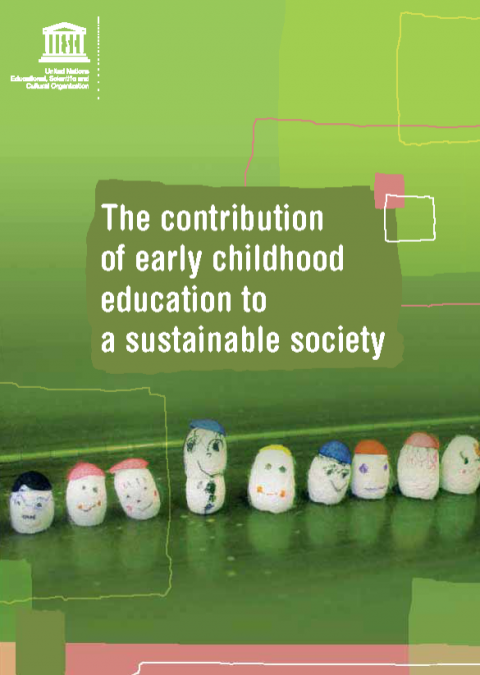 La contribution de l'éducation de la petite enfance à une société durable Année de publication: 2008 Auteur institutionnel: Organisation des Nations Unies pour l'éducation, la science et la culture (UNESCO) Ce rapport provient de l'atelier international, «Le rôle de l'éducation de la petite enfance pour une société durable», organisé conjointement à Göteborg, en Suède, par l'Université de Göteborg, Chalmers University of Technology et la ville de Göteborg, du 2 au 4 mai 2007. Il a réuni trente-cinq participants de seize pays différents (voir «Liste des participants»). L'atelier a été suivi à l'éducation de internationalconférenceon pour le développement durable, «Apprendre à changer notre monde», tenue en mai 2004, à Göteborg. Il était l'un des quatre ateliers préparatoires menant à une autre éducation internationalconférenceon pour le développement durable, qui sera organisée en 2008 ou 2009, dans la même ville. L'objectif des quatre ateliers est de discuter des promoteurs et des obstacles liés à l'apprentissage de la durabilité, et de proposer des recommandations pour la prochaine conférence internationale. Le présent atelier a été conçu pour les raisons suivantes. Tout d'abord, nos sociétés ont un besoin urgent de nouveaux types d'éducation qui peuvent aider à prévenir une nouvelle dégradation de notre planète, et qui favorisent les soins et les citoyens responsables véritablement concernés par et capables de contribuer à un monde juste et pacifique. Deuxièmement, ces nouvelles formes d'éducation doivent être aCECssibles à tous - non seulement une poignée de gens - et se déroulent dans divers milieux, y compris les familles et les communautés. Troisièmement, ils doivent commencer au début de l'enfance, comme les valeurs, les attitudes, les comportements et les compétences acquises dans cette période peuvent avoir un impact durable dans la vie plus tard. Ainsi, l'éducation de la petite enfance a clairement une place importante dans les efforts pour parvenir à un développement durable.
  Education 2030: Incheon declaration and framework for action towards inclusive and equitable quality education and lifelong learning for all Année de publication: 2015 Auteur institutionnel: UNESCO | United Nations Development Programme (UNDP) | United Nations Population Fund (UNFPA) | UN. Office of the United Nations High Commissioner for Refugees (UNHCR) | United Nations Children's Fund (UNICEF) | United Nations Entity for Gender Equality and the Empowerment of Women (UN Women) | World Bank This framework — painstakingly drafted over many months with input from governments, international agencies, civil society and experts — provides guidance for implementing the education commitments made in the 2030 Agenda for Sustainable Development at a national, regional and global level. In particular: it aims at mobilizing all countries and partners around Sustainable Education Goal 4 and its targets;it proposes ways of implementing, coordinating, financing and monitoring the new commitments; andit proposes indicative strategies which countries may wish to draw upon in developing their plans, taking into account different national realities, capacities and levels of development and respecting national policies and priorities. 교육 2030 인천선언과 실행계획: 포용적이고 공평한 양질의 교육과 모두를 위한 평생학습을 향해 Année de publication: 2015 Auteur institutionnel: 유네스코 | United Nations Development Programme (UNDP) | United Nations Population Fund (UNFPA) | UN. Office of the United Nations High Commissioner for Refugees (UNHCR) | United Nations Children's Fund (UNICEF) | United Nations Entity for Gender Equality and the Empowerment of Women (UN Women) | World Bank 정부, 국제기구, 시민사회와 전문가의 조언을 받아 몇 달 동안 많은 노력을 기울여 초안이 작성된 이 실행계획은 지속가능한 발전을 위한 2030 아젠다의 국가적, 지역적, 세계적 단계에서의 실현을 위한 교육의 역할에 대한 실천 가이드를 제공한다. 이는 모든 국가와 지속가능목표 4와 그 대상을 둘러싼 파트너들을 움직이도록 하는 데에 그 목적을 둔다.이 실행계획은 새로운 역할에 대한 실천, 협력, 자금조달과 관찰 방안을 제안한다.이 실행계획은 각 국가들이 서로 다른 국가적 상황과 역량, 발전 단계 및 각국의 정책과 우선순위를 존중한 계획을 세울 수 있도록 전략을 보여준다. Education 2030: Déclaration d'Incheon et Cadre d'action: vers une éducation inclusive et équitable de qualité et un apprentissage tout au long de la vie pour tous Année de publication: 2016 Auteur institutionnel: Organisation des Nations Unies pour l'éducation, la science et la culture (UNESCO) | United Nations Development Programme (UNDP) | United Nations Children's Fund (UNICEF) | United Nations Entity for Gender Equality and the Empowerment of Women (UN Women) | World Bank | United Nations Population Fund (UNFPA) | UN. Office of the United Nations High Commissioner for Refugees (UNHCR) This framework — painstakingly drafted over many months with input from governments, international agencies, civil society and experts — provides guidance for implementing the education commitments made in the 2030 Agenda for Sustainable Development at a national, regional and global level. In particular: it aims at mobilizing all countries and partners around Sustainable Education Goal 4 and its targets; it proposes ways of implementing, coordinating, financing and monitoring the new commitments; and it proposes indicative strategies which countries may wish to draw upon in developing their plans, taking into account different national realities, capacities and levels of development and respecting national policies and priorities.
  Quality Physical Education (QPE): guidelines for policy makers Année de publication: 2015 Auteur: Nancy, McLennan | Jannine, Thompson Auteur institutionnel: UNESCO A key feature of the Post-2015 Development Agenda is sustainable development. Sustainable development starts with safe, healthy, well-educated children. Participation in quality physical education (QPE), as part of a rounded syllabus, enhances young peoples’ civic engagement, decreases violence and negative patterns of behaviour, and improves health awareness. The UNESCO QPE Policy Package is an original piece of work, which draws upon results from extensive global research (including the Worldwide Survey of School Physical Education). These guidelines, designed for global application and local adaptation, provide a means of analysing current policy through practical guidance and a ‘how-to’ approach. The materials have been developed in consultation with key partners including the European Commission, the International Council for Sport Science and Physical Education (ICSSPE), UNDP, UNICEF, UNOSDP and WHO. L'Education physique de qualité (EPQ): directives à l'intention des décideurs Année de publication: 2015 Auteur: Nancy, McLennan | Jannine, Thompson Auteur institutionnel: UNESCO A key feature of the Post-2015 Development Agenda is sustainable development. Sustainable development starts with safe, healthy, well-educated children. Participation in quality physical education (QPE), as part of a rounded syllabus, enhances young peoples’ civic engagement, decreases violence and negative patterns of behaviour, and improves health awareness. The UNESCO QPE Policy Package is an original piece of work, which draws upon results from extensive global research (including the Worldwide Survey of School Physical Education). These guidelines, designed for global application and local adaptation, provide a means of analysing current policy through practical guidance and a ‘how-to’ approach. The materials have been developed in consultation with key partners including the European Commission, the International Council for Sport Science and Physical Education (ICSSPE), UNDP, UNICEF, UNOSDP and WHO. Educación física de calidad (EFC): guía para los responsables políticos Année de publication: 2015 Auteur: Nancy, McLennan | Jannine, Thompson Auteur institutionnel: UNESCO A key feature of the Post-2015 Development Agenda is sustainable development. Sustainable development starts with safe, healthy, well-educated children. Participation in quality physical education (QPE), as part of a rounded syllabus, enhances young peoples’ civic engagement, decreases violence and negative patterns of behaviour, and improves health awareness. The UNESCO QPE Policy Package is an original piece of work, which draws upon results from extensive global research (including the Worldwide Survey of School Physical Education). These guidelines, designed for global application and local adaptation, provide a means of analysing current policy through practical guidance and a ‘how-to’ approach. The materials have been developed in consultation with key partners including the European Commission, the International Council for Sport Science and Physical Education (ICSSPE), UNDP, UNICEF, UNOSDP and WHO.
 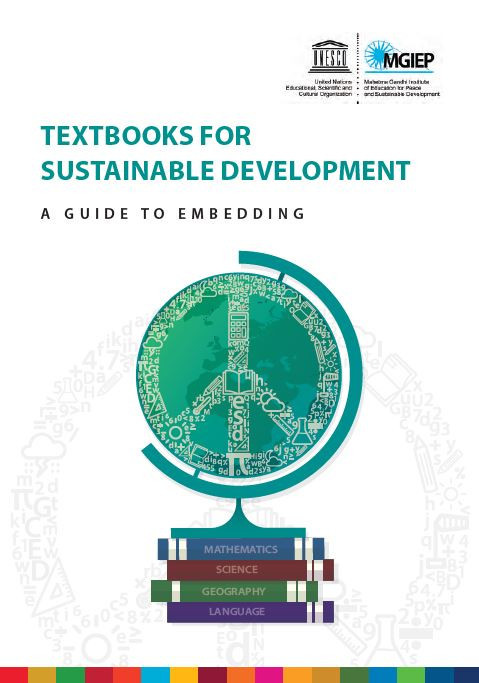 Textbooks for Sustainable Development: A Guide to Embedding Année de publication: 2017 Auteur institutionnel: UNESCO | Mahatma Gandhi Institute of Education for Peace and Sustainable Development (MGIEP) This guidebook introduces the approach of embedding education for sustainable development into core subjects, building on the German initiative as well as consolidating other existing efforts. This ambitious work began when the UNESCO Mahatma Gandhi Institute of Education for Peace and Sustainable Development (MGIEP), with support from Engagement Global gGmbH, brought together 30 international experts in mathematics, sciences, languages, geography and education for sustainable development in Bangalore, India, in June 2016. These experts co-drafted this guidebook. This publication is designed as a guide for stakeholders in textbook development – education ministries, national curriculum authorities, textbook writers and publishers – to help them produce a new generation of textbooks. Such textbooks will make a clear departure from the mechanistic transmission of information and procedural knowledge devoid of meaning and contextual relevance. They will also advocate a new vision of learning and contribute to fostering young people’s competencies and capabilities to shape more peaceful and sustainable societies. Competencies such as critical and systemic thinking, appreciation of diversity, empathy and commitment to change are the key goals of this ambitious publication.